


General
SLA Economics: The Real Cost of Your Delivery Promises

In last-mile delivery, Service Level Agreements shape customer expectations, influence conversion, and directly impact the bottom line.
Same-day delivery. Two-hour windows. Real-time tracking. They look compelling in sales decks. But every promise carries a real operational cost that most organizations still struggle to quantify.
The result is familiar: premium services that are under-priced, uniform promises applied across wildly different geographies, and penalties that don’t reflect operational reality. Over time, margins quietly erode while performance risk compounds.
The Problem: Delivery Is Now a Product Feature
Last-mile delivery is now a core part of the customer experience. In e-commerce, grocery, and healthcare, speed and reliability have become table stakes.
Yet many SLAs are still designed without a clear understanding of cost or capacity.
The same promise is applied to dense metros and remote regions, despite fundamentally different economics. Faster delivery is introduced without accounting for additional vehicles, overtime, or reduced route efficiency. Contracts penalize missed SLAs even when failures are driven by factors outside operational control. And commitments remain static while demand patterns, carrier mix, and network design continue to evolve.
When you apply a uniform promise across diverse geographies, your high-density routes end up subsidizing the massive inefficiencies of your outlier deliveries.
SLA Economics: A Different Question
SLA economics reframes delivery promises as products – each with its own cost structure, performance behavior, and commercial value.
Instead of only asking “What do customers want?”, the conversation shifts to harder questions:
- What does it actually cost to deliver this SLA?
- How does that cost vary by geography, order profile, and seasonality?
- What incremental revenue, conversion uplift, or retention benefit does it generate?
Answering these questions requires connecting operational performance, delivery cost, and commercial outcomes into a single view, rather than treating them as separate discussions.
Three Metrics That Matter
To make SLA economics actionable, organizations need consistent measurement across three dimensions.
- Performance – on-time delivery by SLA, region, and channel; first-attempt success; root causes of failure.
- Cost – cost per successful delivery, cost of failure, and the incremental cost of premium service levels.
- Revenue – conversion uplift, willingness to pay, and retention impact by customer segment.
When these metrics are viewed together, it becomes clear which SLAs create value, which are marginal, and which quietly subsidize customer experience at the expense of margin.
From One SLA to a Portfolio
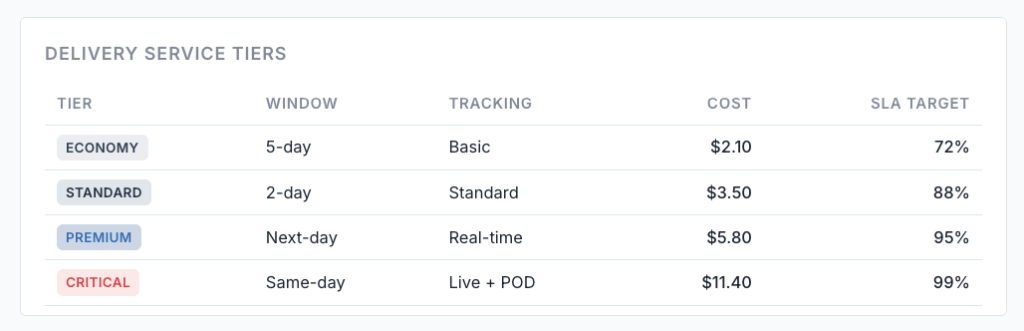
High-performing organizations don’t rely on a single promise but design a portfolio of delivery products.
- Economy options prioritize cost efficiency and flexibility.
- Standard tiers balance speed and reliability, where network density supports it.
- Premium services offer tighter windows or faster delivery and are priced to reflect their true cost.
- Critical SLAs are reserved for regulated, high-value, or time-sensitive use cases with strict eligibility.
Each tier has clear geographic boundaries, operational prerequisites, and commercial logic. This prevents premium services from becoming the default and keeps promises scalable.
Every SLA Is Built on Operational Trade-offs
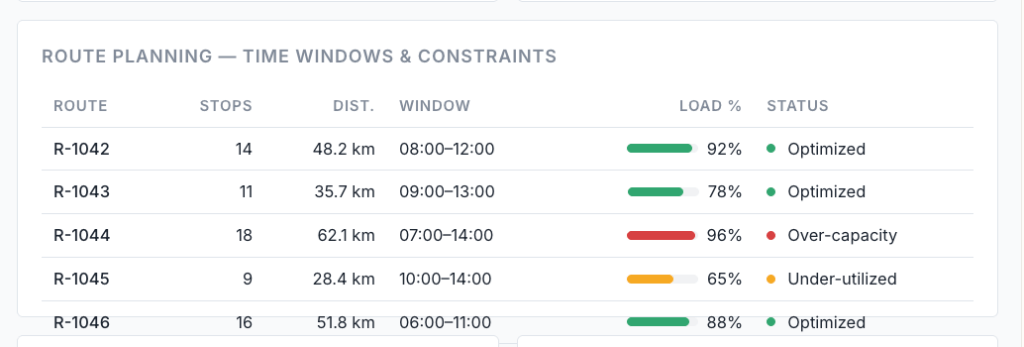
Every delivery promise embeds constraints that directly affect cost and predictability.
- Speed compresses planning cycles and requires standby capacity.
- Narrow time windows reduce drop density and sequencing flexibility.
- High flexibility increases replanning and execution variability.
- Advanced tracking raises the bar on data accuracy and operational responsiveness.
Effective SLA design is about balancing customer value with network stability.
Making It Actionable
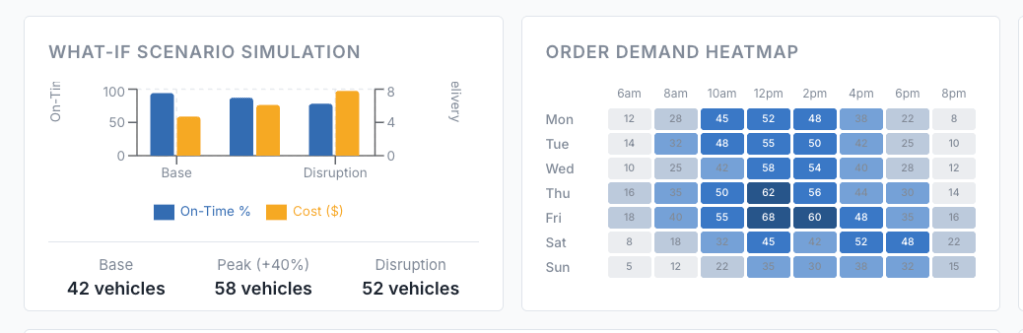
Moving beyond intuition means modeling impact before commitments are made.
Historical analysis helps compare cost, performance, and customer outcomes across existing SLAs. What-if modeling allows teams to test changes to cut-offs, windows, or coverage. Scenario testing reveals how promises hold up under peak demand, disruptions, or carrier constraints.
This is how organizations quantify what it really takes to move from 95% to 98% on-time delivery – and decide whether the investment makes sense.
Embedding SLA Economics in Operations
SLA economics only delivers value when it’s embedded in how decisions are made.
That means unified data across products, regions, and partners. Regular reviews that refresh assumptions as networks evolve. And shared ownership across commercial, operations, finance, and product teams.
Delivery promises stop being static contracts and become actively managed products.
Where to Start
Start small. Run a focused SLA audit in a single market or business unit. Map true delivery costs, performance patterns, and margin contribution. Apply the framework, then scale it across the network.
SLA economics turns delivery promises from intuition-driven commitments into measurable, governable products. In an environment of rising expectations and persistent cost pressure, this is how last-mile delivery scales profitably.
Designing Delivery Promises with Operational Clarity
Organizations that treat delivery promises as measurable operating decisions (not static contract terms) scale without eroding margins. With unified planning, execution, and performance data, teams can model trade-offs, simulate new service tiers, and adapt commitments as networks evolve.
Locus connects route planning, capacity modeling, and real-time execution to quantify the true economics of every SLA. Schedule a demo to see how you can design, price, and manage delivery promises with confidence.


General
Carrier Management: Onboarding, Performance Tracking, Contracts, and Compliance

Mar 5, 2026
Carrier management governs who gets freight, under what terms, and how exceptions get handled. Learn 12 KPIs and what a CMS must do at enterprise scale.
Read more
General
7 Best Carrier Integration Software Platforms for Enterprise Logistics (2026)
Mar 10, 2026
Compare 7 carrier integration software platforms built for enterprise logistics. Covers API vs EDI, multi-carrier governance, SLA monitoring, and onboarding speed.
Read moreInsights Worth Your Time




















SLA Economics: The Real Cost of Your Delivery Promises