


General
How Route Mapping Software Transforms Enterprise Logistics Operations

Key Takeaways
- Enterprise route mapping software handles multi-constraint dispatch planning across vehicle types, capacity limits, regulatory zones, time windows, and driver hours simultaneously, where consumer-grade tools address none of these variables.
- GIS, machine learning, and real-time data integration are the three technology layers powering production-grade routing platforms.
- Dynamic re-routing, multi-constraint handling, scenario modeling, accurate ETA prediction, and deep TMS/WMS/OMS API integration are the five capabilities that separate enterprise platforms from point solutions.
- AI-based dispatch planning reduces fuel costs by 15-25% and total miles driven by 10-20%, compressing daily planning time from four to six hours down to under 15 minutes for a 50-vehicle fleet.
- Optimized routing delivers measurable CO2 reduction and supports Scope 3 emissions reporting, now a mandatory buying criterion for enterprise procurement teams.
If you ask a vendor what happens to their route calculation quality at 80,000 orders across 15 depots with 40% same-day volume, and they pivot to a case study instead of a benchmark, there’s your answer.
Most people evaluating enterprise routing software have been through enough vendor conversations to know when they’re being managed rather than answered. The architectural gap between a planning tool that produces a dispatch plan and hands it off, versus a platform that stays active and replans throughout the day, is a major difference.
In the long run, it also reflects substantial numbers like fuel variance, SLA penalties, redelivery rates, and dispatcher hours spent firefighting. This is a guide for buyers who are close to a decision and want to make sure they’re testing for the right components of the software tools.
What Route Mapping Software Executes
A consumer map calculator answers one question: What is the fastest path from A to B?
On the other hand, an enterprise routing software answers a structurally different question: How do we move 3,000 orders across 200 vehicles, 12 depots, five vehicle classes, four SLA tiers, hours-of-service restrictions, weight limits, and a live traffic feed, and produce an executable dispatch plan in under 10 minutes?
Consumer-grade tools operate on point-to-point logic. They find the shortest path between stops, with no model for vehicle capacity, delivery time windows, or regulatory zone restrictions.
A 26-ton rigid truck prohibited from an urban zone between 7 a.m. and 9 a.m. is a constraint a free route planner cannot process. Mid-dispatch events (failed deliveries, new priority orders, drivers running behind) require replanning capability, which these tools have never been designed to support.
Production-grade routing software solves a constraint-satisfaction problem at scale. Every plan reflects simultaneous constraint logic across vehicle load capacity, stop sequence, time window compliance, driver shift limits, vehicle-to-stop suitability, customer priority tier, and live road conditions.
The output is an executable dispatch across a full fleet without manual intervention. Tools built for small or mid-market fleets often appear in this category, but at enterprise scale, they hit architectural limits that are a function of how they were built.
3 Major Technology Stacks Behind Modern Route Mapping
Feature descriptions across vendor websites converge on the same vocabulary. AI-powered, real-time, dynamic. The architecture behind that vocabulary varies significantly. Evaluating whether a platform can handle complex-constraint environments requires understanding the three layers behind a production-grade routing software tool.
GIS and geospatial intelligence
Geographic Information System technology provides the road-network foundation. GIS ingests road topology, classifies road types and legal restrictions, models vehicle-specific traversal rules, and enables polygon-based zone definitions for compliance. This is because a 40-foot trailer traverses a different road set than a sprinter van, and the dispatch engine must reflect that distinction in every plan it builds.
Machine learning for predictive routing
Static algorithms produce plans based on current conditions. ML-driven platforms build on predicted conditions, specifically what traffic will look like when a vehicle passes through a corridor, based on historical pattern analysis and event data. Locus trains proprietary models on historical traffic patterns, accounting for time-of-day variation and weather, feeding those predictions directly into ETAs.
The result is AI-powered route optimization producing delivery windows that reflect actual road conditions at dispatch time.
Real-time data integration
Live traffic feeds, road closure alerts, weather disruptions, and mid-dispatch event triggers feed into the routing engine continuously. A platform’s ability to ingest those signals and re-calculate in response separates a planning tool from an execution layer, since strong GIS with no real-time integration produces plans that go directionless within an hour.
These three layers produce compounding value when natively integrated into a single decisioning framework. Platforms that bolt together GIS, ML, and real-time feeds from separate vendor tools introduce latency and coordination failure at the layer boundaries, a problem that becomes operationally visible on peak days.
Critical Capabilities Separating Enterprise Platforms
The evaluation problem has never been surface-level feature parity, because every vendor in this category claims dynamic re-routing and real-time re-planning. The question is how deep each capability runs, and whether it is core architecture or a checkbox.
Dynamic re-routing based on live conditions
Automated route planning at scale handles events continuously: a driver falls behind, a delivery attempt fails, a new priority order arrives post-dispatch.
Updated routes push to drivers without dispatcher intervention, whereas platforms lacking this capability require dispatchers to manually rebuild the plan as conditions change, a pattern that consistently produces SLA failures and overtime costs.
Multi-constraint handling at scale
Fleets simultaneously carry binding constraints across vehicle weight ratings, hazmat certifications, cold-chain requirements, time window commitments, customer-tier priority rules, and hours-of-service limits, all of which must be applied in a single pass.
Scenario modeling for demand surges
Promotions, seasonal peaks, supplier disruptions, and carrier capacity drops all require contingency plans built in advance. Scenario modeling lets teams simulate a 40% volume spike or a depot closure and evaluate implications before the event occurs, rather than improvising under live disruption.
Accurate ETA prediction
A committed delivery window is a customer promise. Platforms that compute ETAs without variability modeling generate windows accurate on average but unreliable at the individual shipment level, with consequences showing up in escalation volume, failed first delivery attempts, and SLA penalties.
Deep API integration with TMS, WMS, and OMS
Dispatch decisions are downstream of order management and warehouse staging. A platform without pre-built connectors creates a workflow where route plans are built without a full operational context, requiring manual data transfer.
Locus’s dispatch management platform handles multi-fleet, multi-depot orchestration in a single workflow with native connectors for major TMS, WMS, and ERP systems. The vehicle allocation engine matches the optimal vehicle class to each route, removing the over-assignment pattern that manual dispatch under time pressure consistently produces.
Where Route Mapping Software Delivers Measurable ROI
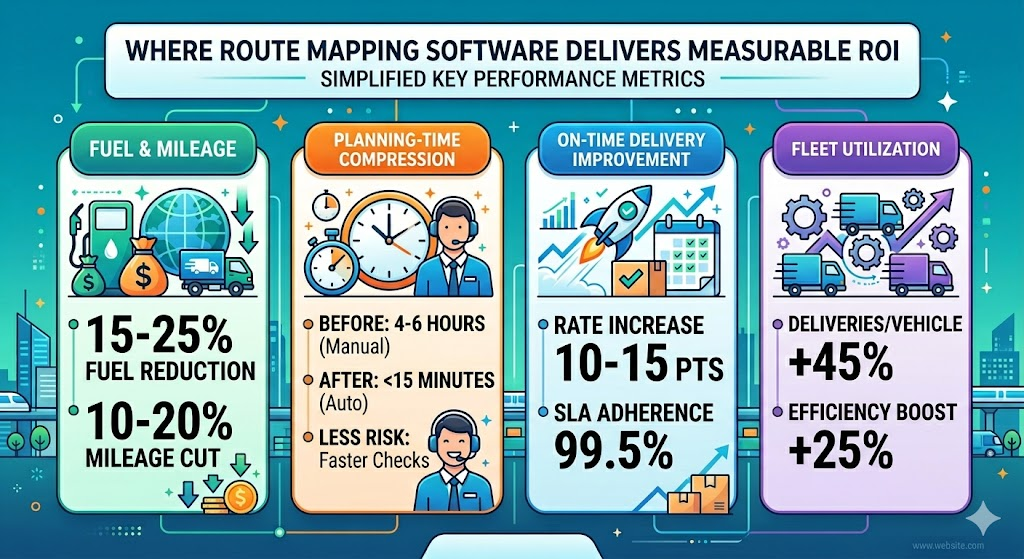
The ROI case for enterprise routing software is well-documented. The question is how quickly it materializes and which cost levers it hits hardest.
Fuel and mileage reduction
AI-based dispatch planning delivers 15-25% fuel cost reduction and 10-20% total mileage reduction in production deployments. For instance, Locus clients have achieved 15-30% cost reduction within the first year, with 800 million+ miles eliminated and $320 million+ in transit costs saved.
Planning-time compression
Manual route planning for a 50-vehicle fleet typically consumes four to six hours of dispatcher time daily, and automated platforms reduce it to under 15 minutes.
The risk reduction is larger than the labor saving: manual planning under time pressure produces only partially constraint-compliant plans, with dispatchers making judgment calls that a routing engine resolves in seconds.
On-time delivery rate improvement
Operations moving from static to dynamic dispatch planning show a 10-15 percentage point improvement in on-time delivery rates post-implementation.
Locus clients have reached 99.5% SLA adherence across diverse geographic environments, with downstream effects compounding across customer escalation volume, failed delivery attempts, and overall routing efficiency, and a 5% improvement in first-attempt delivery rate on a 10,000-order operation eliminates redelivery cost on 500 orders per day.
Fleet utilization
Locus’s vehicle allocation engine has delivered a 45% increase in deliveries per vehicle per day and 25% improvement in fleet efficiency by automating vehicle-to-route matching that dispatchers handle inconsistently under time pressure.
Sustainability and Compliance: The Overlooked Advantage of Route Mapping
Enterprise procurement teams have added a criterion that most routing software evaluations address poorly. Sustainability impact and regulatory compliance support are now primary buying criteria.
Every mile eliminated is a mile of fuel unburned, and Locus’s platform has offset 17 million+ kilograms of CO2 through mileage reduction across its deployment base. That figure translates directly into Scope 3 emissions reporting under GHG Protocol frameworks, making route planning a native input to ESG performance for operations with committed net-zero targets.
The regulatory compliance dimension is operationally urgent for multi-geography fleets. Urban Low Emission Zones bar older diesel vehicles during specified hours. In Ho Chi Minh City, heavy vehicles face restrictions between 6 a.m. and 10 p.m. Hours-of-service rules under FMCSA in the U.S. and EC Regulation 561/2006 in Europe create hard constraints on route design that manual planners frequently miscalculate under pressure.
Platforms with native compliance support encode these restrictions as routing constraints, making compliance a property of the plan by construction.
Implementing Route Mapping Software at Enterprise Scale
Enterprise implementation follows four phases. Organizations that underestimate the effort between a pilot and full multi-market deployment consistently spend 12-18 months in a partial-deployment state that captures limited ROI.
Data readiness assessment
Before dispatch planning can run accurately, the platform needs verified inputs like geocoded delivery addresses (operations databases routinely carry 15-25% address quality issues in emerging markets), historical order data, and fleet specifications.
Data quality gaps discovered mid-implementation are the primary cause of deployment delays.
Phased rollout from pilot
A single-market pilot validates constraint configuration, integration behavior, and dispatcher workflow before the platform is exposed to full fleet volume, typically over 6-10 weeks. Expansion to additional markets uses the pilot as a template, with regional adjustments for local constraints and regulatory environments.
Locus supports this with dedicated solution architects who manage configuration work rather than delegating it to the client.
Integration architecture
Routing software sits at the operational center of a logistics technology stack, and pre-built connectors for major TMS, WMS, ERP, and driver app environments reduce integration timelines by 40-60% compared to API-only approaches.
For operations with supply chain network design complexity spanning multiple geographies, that difference is substantial.
Change management for dispatchers
Dispatchers who have built route plans manually for years have judgment-based approaches. It conflicts with algorithm-driven outputs in ways difficult to articulate but deeply felt. Plus, driver adoption of new routing apps generates pushback that, if unaddressed, produces deviation rates that erode efficiency gains.
Structured feedback loops between field teams and platform configuration determine deployment outcomes.
Assessing Route Mapping Software: What Buyers Should Prioritize
Standard feature checklists are the wrong evaluation frame for route mapping software, where every vendor claims dynamic re-routing and scalability. The evaluation must go one level deeper to distinguish core architecture from a checkbox.
Scalability under real operational load
Request documented benchmark performance, going beyond vendor claims. For instance, Locus has processed 650 million+ orders across 400+ cities globally, maintaining stable performance during peak events where order density spikes above the daily average.
Algorithmic sophistication
Strategic route planning tools generate plans at dispatch time. Dynamic platforms re-plan based on event triggers during execution.
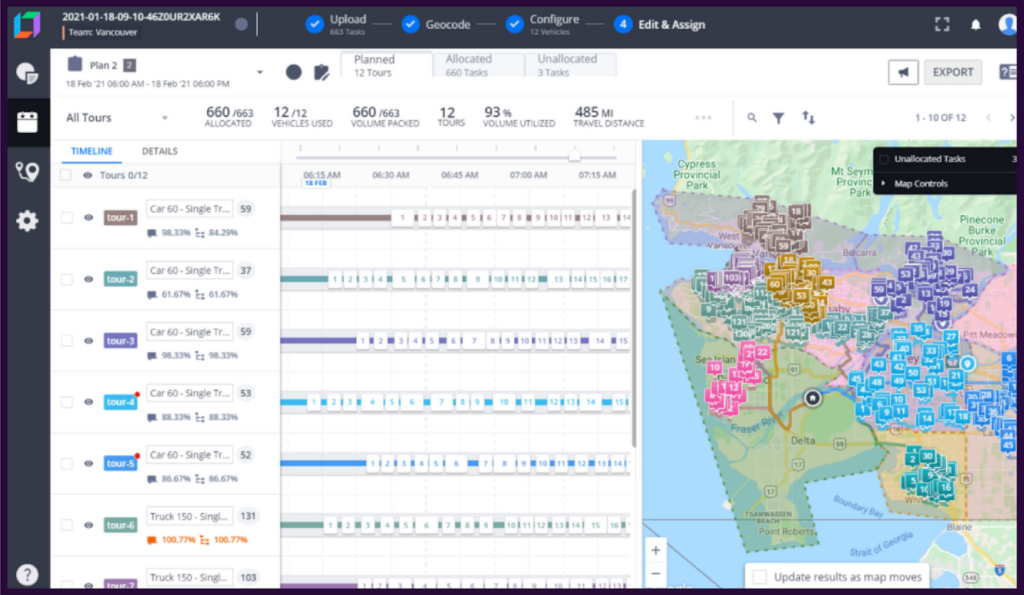
Continuous re-routing platforms run a rolling evaluation loop throughout the dispatch day, adjusting proactively as conditions evolve, a distinction that matters most in high-density urban operations where conditions change on sub-hour cycles.
Real-time visibility integration
Route planning without execution visibility functions as a scheduling tool. Buyers require a platform where the routing engine and visibility layer are natively integrated, with deviations and exception events feeding back into dispatch logic in real time.
API ecosystem depth
A platform with a full REST API but no pre-built connectors for the SAP, Oracle, or Manhattan Associates environments that a buyer already runs requires 4-8 months of custom integration work before going live. Evaluate the connector library as well as the API specification.
Total cost of ownership
Licensing typically represents 15-25% of total ownership cost when integration, implementation, change management, and ongoing configuration are included. At 2,000 daily routes, $0.45 in per-route savings generates $328,500 annually, but a platform with lower unit savings and lower TCO may represent better economics at the same volume.
Start Mapping Routes Better with Locus
As noted above, across 650 million+ orders in 30+ countries, Locus has produced a 25% improvement in fleet efficiency, a 45% increase in deliveries per vehicle per day, and 99.5% SLA adherence.
It has also delivered a 20% reduction in ground resource costs for clients across retail, FMCG, e-commerce, 3PL, or CPG. These are production deployment outcomes, which are not mere benchmark test conditions.
Planning-led tools produce route plans and hand execution over to dispatchers. Locus operates as an execution-led orchestration platform, remaining active throughout the delivery day, re-planning routes as conditions change. It can adjust assignments in real time and maintain a single view across owned fleets, contracted carriers, and gig providers, with route calculation as one output of a broader AI decisioning engine.
For operations evaluating where current infrastructure is leaving performance on the table, last-mile excellence starts at the planning layer and is sustained at the execution layer.
Schedule a Locus demo and bring your constraint profile, current stack, and peak-day volume.
Frequently Asked Questions (FAQs)
1. How does route mapping software differ from a standard distance calculator or navigation app like Google Maps?
A distance calculator finds the fastest path from A to B. Enterprise routing software solves a multi-constraint dispatch problem across hundreds of stops simultaneously, accounting for vehicle capacity, time windows, driver hours limits, and regulatory zone restrictions. Consumer tools have no mechanism for these constraints, and the output difference is categorical.
2. What volume of daily deliveries justifies investing in enterprise-grade route mapping software?
The threshold is typically 200-500 daily routes across two or more depots, or any operation with multi-constraint complexity across cold chain, hazmat, or time-sensitive SLA tiers. Above this level, enterprise-grade platforms deliver positive ROI within 6-18 months at conservative savings assumptions.
3. Can route mapping software optimize routes in real time when conditions change mid-dispatch?
Enterprise-grade platforms can, though the capability varies. Static platforms produce a plan at dispatch time and leave it unchanged. Dynamic platforms re-plan on event triggers. Continuous re-routing platforms run a rolling evaluation loop throughout the dispatch day. The correct evaluation question is how re-planning is triggered, how long it takes, and how updated routes reach drivers in the field.
4. How long does a typical enterprise implementation of route mapping software take from pilot to full deployment?
A single-market pilot typically runs 6-10 weeks, covering data readiness, constraint configuration, integration testing, and dispatcher training. Full multi-market deployment averages 4-9 months, depending on geographies and integration complexity. Organizations that complete a data readiness assessment before the pilot consistently deploy faster.
5. What ROI metrics should logistics leaders track after deploying route mapping software?
Cost per delivery, on-time delivery rate, first-attempt delivery rate (FADR), and daily planning time per dispatcher are the four primary KPIs. Fuel consumption per route and total mileage confirm the fuel savings component. Most deployments show measurable movement on all four within 60-90 days of going live.


General
Why Enterprise Logistics Teams Are Rethinking Dispatch Routing Software

Mar 27, 2026
Most dispatch routing software was built for simple fleets. This article covers what enterprise logistics operations need from a dispatch platform in 2026.
Read more
General
Top 10 Last Mile Routing Software for Enterprise Logistics Teams in 2026
Mar 27, 2026
Compare the top 10 last mile routing software tools built for enterprise fleets, from AI-powered dispatch automation to real-time re-routing and deep ERP integration.
Read moreInsights Worth Your Time




















How Route Mapping Software Transforms Enterprise Logistics Operations