


General
Top 10 Last Mile Routing Software for Enterprise Logistics Teams in 2026
Key Takeaways
- Enterprise last mile routing software spans a wide capability range, from SMB route planners capped at 100 stops to AI-native platforms processing thousands of daily orders across mixed fleets.
- The defining differentiator is whether dispatch automation is native to the routing engine or requires manual intervention after route generation.
- AI-native tools maintain routing accuracy at 5,000+ daily stops, while SMB-oriented tools like Routific and Onfleet plateau well below enterprise scale.
- Tools built around carrier management, such as Bringg, FarEye, and Shipsy, serve fundamentally different operational models than owned-fleet dispatch platforms.
- Event-triggered re-routing is the operational standard for high-variability enterprise environments, where batch-based systems leave route gaps of one to two hours.

The market for last mile routing software has consolidated around a recognizable set of vendors. Some tools are built around a route optimization engine as the core product. Others treat routing as one module inside a broader logistics or carrier management suite. A few have built dispatch automation as the primary value proposition, with routing as an output of that system rather than a standalone engine.
For enterprise teams comparing tools, the architectural distinction matters more than any individual feature. The key question is whether the routing engine was designed for high-volume, multi-constraint environments from day one, or extended to handle enterprise workloads after proving itself in simpler deployments.
The 10 tools handpicked in this guide are evaluated through that lens. Last mile management at enterprise scale demands more than a route generator. The evaluation criteria here prioritize constraint depth, stop-scale ceiling, real-time adaptability, and integration architecture across retail, FMCG, e-commerce, 3PL, and CPG operations.
Best Last Mile Routing Software for Enterprises: Quick Answer
For enterprise logistics teams, the best last mile routing software in this guide is Locus when the operation needs high-volume routing, automated dispatch, event-triggered re-routing, and deep integration across OMS, WMS, ERP, CRM, and TMS systems. FarEye, Bringg, and Shipsy are stronger fits when the main requirement is carrier management, customer communication, or freight-plus-last-mile visibility rather than owned-fleet dispatch automation.
Use this shortlist to match the software category to the operating problem before comparing demos.
| Enterprise need | Best-fit software from this guide | Why this fit is supported in the article |
| High-volume owned or mixed-fleet dispatch | Locus | Locus is described as processing thousands of orders per planning cycle, handling simultaneous constraints, and pushing event-triggered route changes directly into driver assignments. |
| Carrier-dependent retail or D2C delivery | FarEye or Bringg | FarEye is described as customer-experience-led with multi-carrier visibility, while Bringg is described as carrier-first with multi-network delivery orchestration. |
| Freight, carrier, and last mile in one workflow | Shipsy or LogiNext | Shipsy spans freight management, carrier allocation, and last mile delivery; LogiNext spans first mile, middle mile, and last mile operations. |
| Configurable mid-market route planning | Route4Me | Route4Me is described as a configurable route planning engine with add-ons and 2,000+ stop batch import support. |
| Scheduled field service or predictable routes | OptimoRoute | OptimoRoute is described as strongest for long-horizon planning across a five-week scheduling window. |
| Smaller fleets moving from manual routing | Onfleet, Routific, or GSMtasks | These tools are described as faster to set up and better suited to growth-stage, SMB, or straightforward delivery operations. |
The key enterprise distinction is whether the product is a route planner, a carrier management platform, or a dispatch orchestration system. Enterprise teams should choose based on stop volume, exception frequency, integration depth, fleet model, and whether dispatch automation is required.
How We Evaluated the Top Last Mile Routing Software
This shortlist was assessed using a practical enterprise evaluation methodology rather than a feature-count approach. Last mile routing software performs differently when it is tested against dense urban delivery, mixed owned-and-outsourced fleets, real-time exceptions, multi-depot dispatch, and thousands of daily stops. The evaluation therefore prioritised operational fit over marketing breadth.
The assessment considered six weighted areas:
| Evaluation Area | What Was Assessed | Why It Matters for Enterprise Teams |
| Routing and optimisation depth | Constraint handling, stop sequencing, capacity rules, time windows, SLA prioritisation, traffic inputs, service times, and mixed fleet rules | Enterprise routing accuracy depends on how well the engine handles constraints simultaneously, not sequentially |
| Dispatch automation | Whether order-to-driver assignment is automated, semi-automated, or dependent on manual dispatcher intervention | Manual dispatch becomes a cost and SLA risk as delivery density rises |
| Real-time adaptability | Ability to re-route on live events such as failed deliveries, delays, urgent orders, vehicle changes, and route deviations | Static routes degrade quickly in volatile last mile environments |
| Integration architecture | API depth, OMS/WMS/ERP/TMS connectivity, driver app workflows, and synchronisation frequency | Routing outcomes are only reliable when order, fleet, customer, and execution data stay aligned |
| Enterprise scalability | Demonstrated suitability for multi-region operations, high stop volumes, multi-depot planning, and complex user roles | Tools that work for small fleets do not always hold performance at enterprise scale |
| Commercial and operational fit | Pricing model clarity, implementation requirements, support depth, deployment complexity, and ideal use case | The best software decision depends on total operational impact, not licence price alone |
Vendors were then grouped by the type of routing problem they are best suited to solve: AI-native dispatch orchestration, multi-carrier delivery management, configurable route planning, scheduled field service routing, or SMB delivery management. This matters because two platforms can both claim “route optimisation” while serving very different operating models.
This guide does not use unverified third-party ratings, customer counts, or review scores as ranking factors. Where pricing, trial availability, or contract models are not publicly stated, the article flags them as items buyers should verify directly during procurement.
What to Look For in Enterprise-Grade Last Mile Routing Software
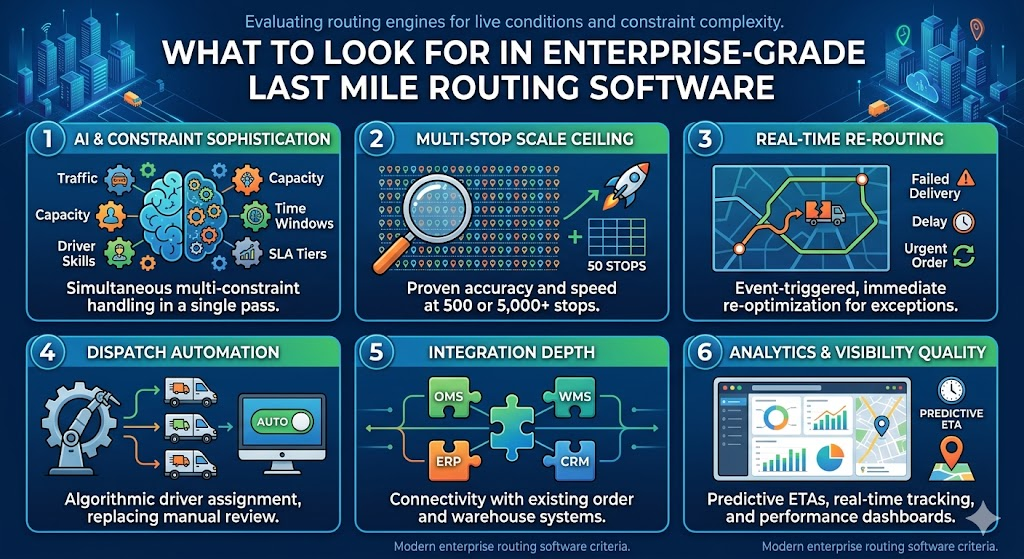
Evaluating routing software across vendor demos is a poor substitute for understanding how each tool handles constraint complexity under live conditions. A demo with 40 stops and two vehicle types will not reveal whether the routing engine degrades at 2,000 stops, or whether re-routing fires in real time or on a batch schedule.
Six criteria separate enterprise-grade tools from those performing well only at a smaller scale.
- AI and constraint sophistication
Measures whether the routing engine handles traffic, vehicle capacity, driver skills, time windows, and SLA tiers simultaneously, or whether each constraint requires manual configuration and reduces accuracy when combined. The benchmark for AI-powered route optimization at enterprise scale is simultaneous multi-constraint handling in a single pass.
- Multi-stop scale ceiling
Determines a tool’s operational floor for enterprise use. Tools performing well at 50 stops per run may not maintain accuracy or speed at 500 or 5,000. Enterprise operations need software tested and proven at volume, not extended to it as an afterthought.
- Real-time re-routing
Capability varies significantly across tools. Batch-based systems re-optimize on a fixed schedule, typically every one to two hours. Event-triggered systems fire re-routing on individual events, including a failed delivery attempt, a driver running 20 minutes behind, or a new urgent order injected after dispatch. The latter is what enterprise exception management requires.
- Dispatch automation
Determines whether orders are assigned to drivers algorithmically or whether dispatchers manually review and approve each allocation. High-volume operations cannot sustain manual dispatch at scale. The importance of last mile tracking and visibility only deliver operational value when dispatch itself is automated first, giving teams something accurate to track.
- Integration depth
Spans connectivity with OMS, WMS, ERP, and CRM systems. Routing software operating in isolation from order management creates data reconciliation overhead and delays at every handoff point.
Enterprise buyers should also test how the routing platform exchanges data with fleet management software, especially where vehicle availability, driver eligibility, utilisation, maintenance status, and cost-per-kilometre data influence dispatch decisions. Routing should not sit apart from fleet execution; it should consume fleet constraints and push route outcomes back into operational systems.
Mapping and routing APIs may also be part of the integration landscape. For example, teams using external services such as Google Maps Platform Routes API for distance, ETA, or map data should confirm how those inputs connect with the broader routing workflow. These APIs can support routing intelligence, but they are not a substitute for enterprise dispatch orchestration, exception handling, driver workflows, and SLA governance.
- Analytics and visibility quality
Predictive ETAs, real-time driver tracking, and post-delivery performance dashboards give enterprise operations teams the signal needed to reduce exceptions and improve planning accuracy over time.
Visibility should include the operational capabilities enterprises expect from a driver tracking app: live driver location, task-level status updates, ETA refreshes, route deviation alerts, idle time signals, failed-attempt flags, and exception notifications. These signals should be available to dispatchers, customer support teams, and analytics users without manual reconciliation.
Proof of delivery software capabilities should be evaluated alongside routing, not after vendor selection. Photo capture, digital signatures, barcode scans, OTP validation, geotagged delivery confirmation, timestamped exception notes, and damaged-item evidence all affect dispute resolution, first-attempt delivery performance, and customer communication quality.
Enterprise Selection Criteria for Last Mile Routing Software
Enterprise last mile routing software should be selected by testing how it performs under real operating constraints, not by counting features. The strongest enterprise fit is the tool that can maintain routing accuracy, automate dispatch, and adapt in real time when order, driver, vehicle, or customer conditions change.
Use these criteria as a minimum evaluation standard before issuing an RFP.
| Criterion | What enterprise buyers should verify | Why it matters |
| Stop-volume performance | Whether the platform is proven at hundreds or thousands of daily stops, not only small demo runs. | The article notes that tools performing well at 50 stops may not maintain speed or accuracy at 500 or 5,000. |
| Multi-constraint optimization | Whether traffic, capacity, driver skills, time windows, service times, SLA tiers, and fleet rules are handled together. | Enterprise routing accuracy depends on simultaneous constraint handling rather than sequential rule processing. |
| Dispatch automation | Whether orders move from allocation to driver assignment algorithmically or require manual dispatcher approval. | Manual dispatch becomes a cost and SLA risk as delivery density rises. |
| Real-time re-routing | Whether re-optimization is event-triggered or batch-based. | The article identifies event-triggered re-routing as the standard for high-variability enterprise environments. |
| Integration depth | Whether OMS, WMS, ERP, TMS, CRM, fleet systems, telematics, driver apps, and reporting tools stay synchronized. | Routing outcomes are reliable only when order, fleet, customer, and execution data remain aligned. |
| Proof of delivery and visibility | Whether driver tracking, ETA updates, exception alerts, photo capture, signatures, scans, OTPs, and geotagged confirmations are supported. | Execution data affects dispute resolution, first-attempt delivery performance, and customer communication quality. |
| Security and privacy | Whether encryption, access controls, audit logs, SSO, MFA, data retention, and hosting requirements can be validated. | Last mile routing platforms process customer addresses, driver location, proof-of-delivery evidence, and order details. |
A vendor that performs well on one criterion but weakly on another may still be the wrong enterprise fit. For example, a carrier-first platform can be strong for marketplace delivery orchestration, while an AI-native dispatch platform can be stronger for owned-fleet routing at high stop volumes.
Top 10 Last Mile Routing Software for 2026
The tools below range from AI-native orchestration systems to focused route planners and SMB-oriented delivery software. Each entry notes where a tool performs strongest, where it shows limits, and which operational profile it fits best.
1. Locus
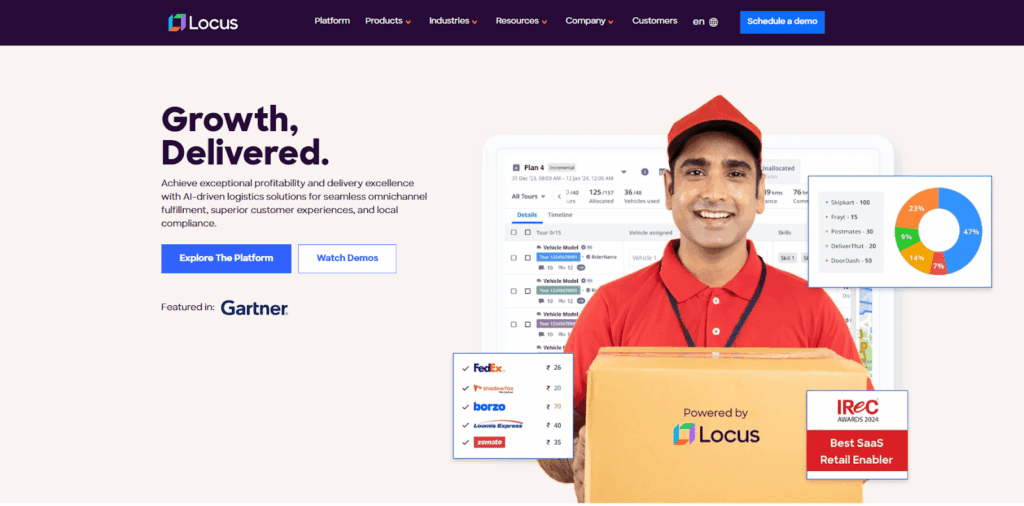
Locus was built around a single architectural premise. A route is only as valuable as the dispatch system executing it. While most routing tools generate a route and hand it off to manual dispatch workflows, Locus closes that loop algorithmically.
The routing engine and the dispatch engine share the same operational state in real time, which means route changes from traffic, failed deliveries, or new urgent orders flow directly into driver assignments without dispatcher intervention.
Locus processes thousands of orders per planning cycle, handling simultaneous constraints across vehicle type, payload, time windows, customer SLAs, driver availability, and geographic complexity.
Its geocoding accuracy in emerging markets, specifically India, Southeast Asia, and MEA, is a meaningful differentiator for enterprises running cross-geography operations where address quality is inconsistent.
Locus’s Key Features
- Multi-constraint route planning at enterprise stop volumes: Locus processes 250+ business variables simultaneously, including vehicle capacity, service time per stop, driver skill requirements, time window tiers, and live traffic, with the engine holding accuracy as stop counts scale from 500 to 5,000 daily drops
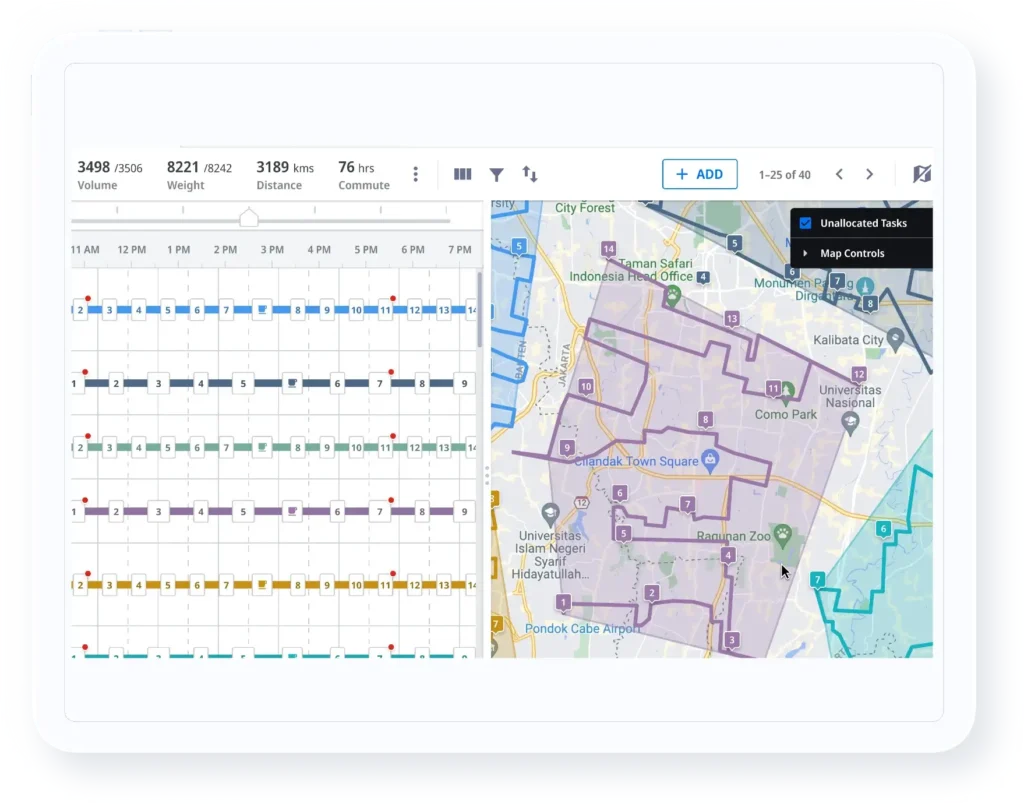
- Event-triggered dispatch re-optimization: Re-optimization fires on individual operational events rather than hourly batch intervals, with a failed delivery, a driver falling 20 minutes behind, or an urgent order, each triggering a route recalculation pushing directly to drivers through the LOTR mobile app
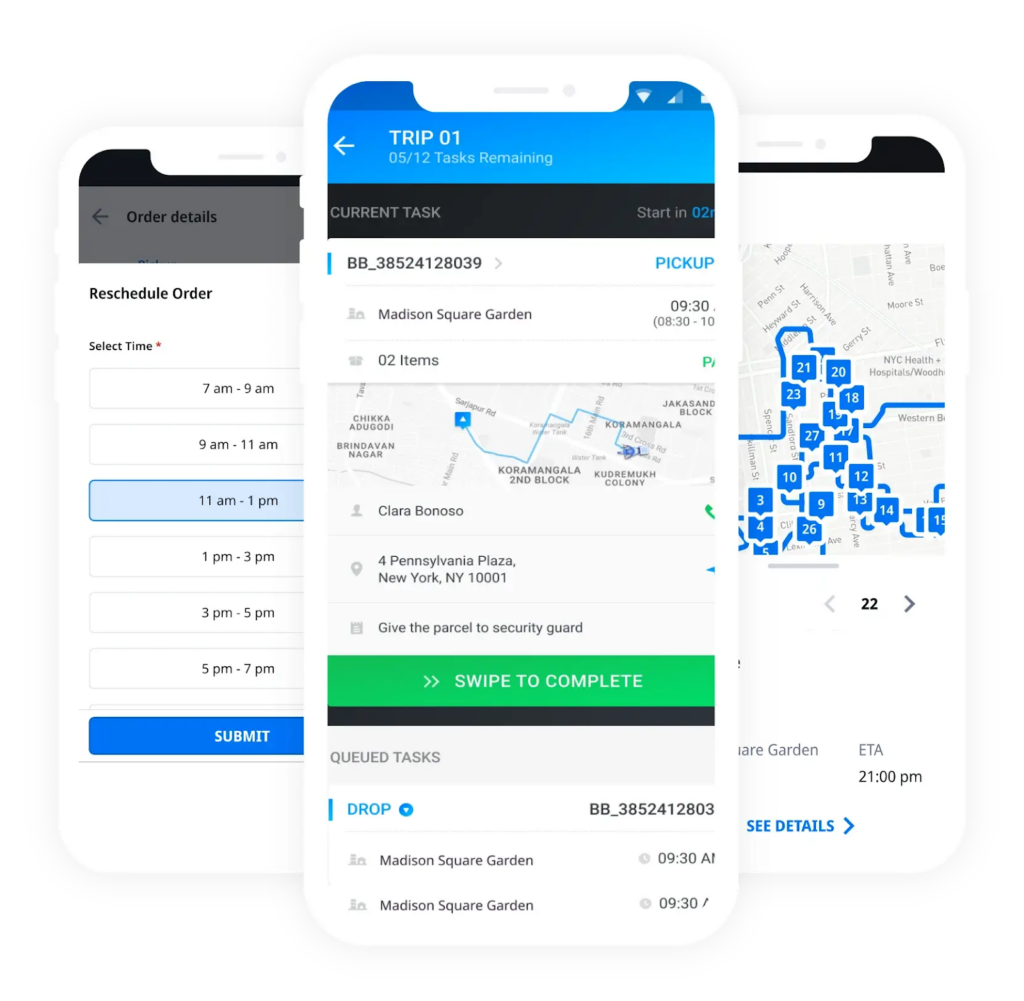
- Automated order-to-driver allocation: Locus’s dispatch planning module assigns orders to available fleet resources automatically, applying business rules across fleet mix, geographic zones, vehicle type restrictions, and SLA priority tiers, cutting route planning time from hours to minutes
- Geocoding precision for complex geographies: In markets where structured address data is unreliable, Locus applies a proprietary geocoding layer, improving pin accuracy for dense urban grids, informal settlements, and markets transitioning from zone-based to coordinate-based addressing
Locus’s Pros
- AI dispatch automation eliminating manual order-to-driver allocation at high stop volumes, reducing per-order planning time and dispatcher headcount requirements
- Multi-constraint routing handling vehicle type, time windows, capacity, driver skill, and SLA tier simultaneously in a single pass, with accuracy maintained at enterprise scale
- Superior geocoding in India, Southeast Asia, and the Middle East geographies improving first-attempt delivery rates in markets where address infrastructure is inconsistent
- End-to-end orchestration connecting routing, dispatch, execution, and visibility in one system, removing the data reconciliation gap when separate planning and tracking tools are stitched together
- Proven enterprise scale across retail, FMCG, e-commerce, and 3PL operations, with 650M+ orders processed
Locus’s Cons
- Configuration depth and breadth exceeding the operational requirements of teams running small, low-complexity fleets, where a lighter tool would suffice
- Initial implementation requiring workflow mapping and data integration work, particularly for organizations moving from manual or spreadsheet-based dispatch for the first time
Locus Is Best For
Locus fits enterprise teams running high-volume, multi-constraint last mile operations where manual dispatch and static routing have become the binding constraint. It delivers the most value for retail, FMCG, e-commerce, 3PL, or CPG operations processing hundreds to thousands of daily orders across mixed owned and contracted fleets.
Locus’s Pricing
Locus uses custom, volume-based pricing factoring in daily delivery volume, operating regions, fleet composition, and the modules deployed. Contact Locus directly for a scoped estimate. See Locus’s AI dispatch in action. Schedule a demo.
2. FarEye
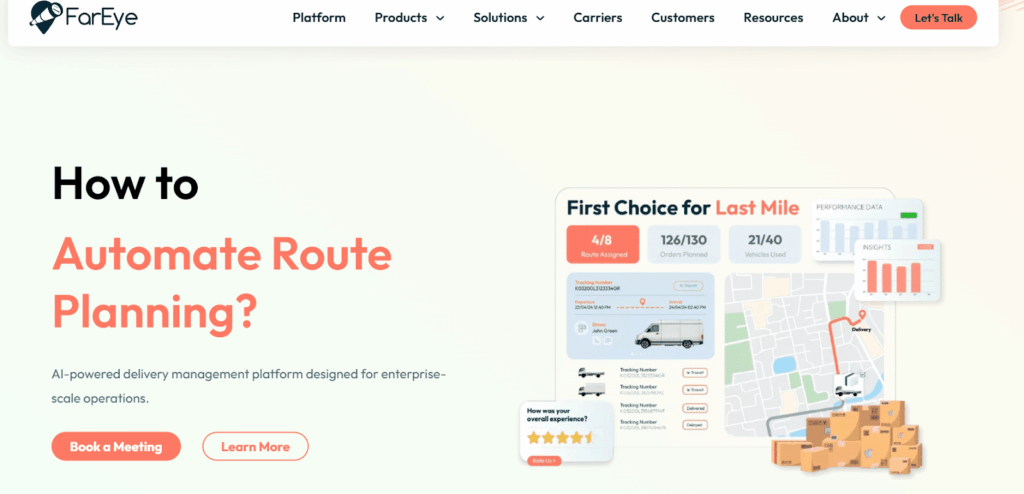
FarEye’s primary orientation is customer experience rather than route optimization. It was designed around the premise that delivery success depends on communication and exception recovery as much as algorithmic routing, and its product architecture reflects that ordering of priorities.
Workflow customization, branded tracking pages, and customer notification tooling sit at the core of the product rather than as add-ons to a routing engine.
FarEye’s Key Features
- Configurable no-code workflows for delivery exceptions, rescheduling, and SLA escalations
- Branded real-time tracking portals with customer notification triggers across SMS, email, and app channels
- Multi-carrier visibility consolidated into a single control layer for carrier performance monitoring
- Predictive delay detection with automated customer outreach on exception events
FarEye’s Pros
- Strong customer communication and branded delivery experience tooling for B2C retail and e-commerce operations where post-dispatch CX is a primary performance metric
- Flexible no-code workflow configuration for adjusting exception handling processes without engineering support
- Multi-carrier performance tracking in a single interface, reducing SLA management overhead across a diverse carrier mix
FarEye’s Cons
- Route optimization as a secondary capability within a broader delivery management suite, with less constraint depth than AI-native routing engines built around fleet execution
- FarEye’s tooling weighted toward carrier management rather than fleet dispatch automation for teams with owned-fleet operations as the primary dispatch model
- Dynamic re-optimization under live operational constraints less developed than in tools where routing is the core architectural investment
FarEye Is Best For
Large retailers and D2C brands running carrier-dependent fulfillment where branded customer experience and exception communication matter as much as routing accuracy.
FarEye belongs in evaluations where post-dispatch customer experience and multi-carrier visibility are the primary purchase criteria. For operations aiming to achieve last mile excellence through tighter dispatch control and dynamic re-routing on an owned fleet, a more execution-focused tool is the stronger fit.
FarEye’s Pricing
Custom enterprise pricing. Contact FarEye directly for current pricing.
3. LogiNext

LogiNext Mile is a broad enterprise logistics suite spanning first mile, middle mile, and last mile operations within one tool. The strength and the limitation come from the same source.
A team evaluating specifically for last mile route optimization is buying a wider system than it may need, which affects configuration complexity and the depth of any individual capability.
LogiNext’s Key Features
- Multi-modal logistics coverage spanning first, middle, and last mile in a single deployment
- Analytics dashboard having plan-vs-actual delivery performance tracking
- Route planning offering time-window and vehicle capacity constraint handling
- API integration layer for OMS and ERP connectivity
LogiNext’s Pros
- Multi-modal coverage in a single deployment, reducing the number of vendor systems required for operations spanning the full logistics network
- Strong analytics visibility giving operations teams cross-stage performance data without building a separate reporting layer
- Established market presence in South Asia and MEA with relevant regional integrations for those geographies
LogiNext’s Cons
- UI and configuration complexity creating a steeper onboarding curve, particularly for teams transitioning from simpler dispatch tools
- Dynamic real-time re-routing under live constraint changes less developed than in tools where route optimization is the core product investment
- Enterprise integration timelines running longer than single-purpose routing tools given the system’s breadth and configuration surface area
LogiNext Is Best For
Mid-to-large enterprises in South Asia and MEA seeking a unified logistics suite spanning fulfillment stages. Strongest fit for organizations wanting to consolidate first, middle, and last mile visibility into one system and able to absorb the configuration investment upfront.
LogiNext’s Pricing
It offers custom enterprise pricing.
4. Onfleet
Onfleet built its product around dispatcher and driver usability. Setup is measured in hours rather than weeks.
The driver app is consistently cited as one of the most intuitive in the category, and for growth-stage operations scaling from spreadsheet dispatch, Onfleet offers a fast path to structured routing and delivery management without the implementation overhead of enterprise systems.
Onfleet’s Key Features
- Automated dispatch with driver availability and proximity matching for route assignment
- Driver app with turn-by-turn navigation, proof of delivery via photo and signature capture, and two-way dispatcher messaging
- Shopify, WooCommerce, and common e-commerce integrations for order ingestion
- Customer SMS and email notifications with real-time ETA updates
Onfleet’s Pros
- Fast implementation and an intuitive interface reducing ramp time for dispatch teams moving from manual operations, with most teams operational within a day
- Strong proof-of-delivery tooling with photo, signature, and barcode capture built into the driver app at every tier
- Clean e-commerce integrations reducing order ingestion overhead for D2C fulfillment teams managing Shopify-based operations
Onfleet’s Cons
- Routing depth plateauing for enterprise fleets processing thousands of daily deliveries, where constraint complexity exceeds the tool’s algorithmic ceiling
- Pricing scaling with delivery volume in ways making high-volume enterprise operations significantly more expensive relative to the value delivered at scale
- AI dispatch automation and broader orchestration capabilities absent, requiring more manual dispatcher involvement as stop volumes grow
Onfleet Is Best For
Growth-stage e-commerce and D2C brands scaling from manual routing to structured dispatch, typically handling up to a few hundred daily stops. Teams having outgrown spreadsheets and needing fast onboarding, but not yet facing the constraint complexity enterprise-grade tools address.
Onfleet’s Pricing
Onfleet uses a per-task or subscription model scaling with delivery volume. Pricing for base tiers is publicly documented on Onfleet’s website.
5. Route4Me
Route4Me’s design premise is configurability. It is structured around a core route planning engine plus a marketplace of add-ons covering advanced stop sequencing, territory management, real-time tracking, and specialized industry modules.
Teams can assemble a routing configuration by selecting the add-ons matching their specific operation, which gives flexibility but also introduces coordination complexity.
Route4Me’s Key Features
- Multi-stop route planner with bulk CSV and Excel stop imports supporting 2,000+ stops per run
- Mobile driver app with turn-by-turn navigation and delivery confirmation
- Marketplace of add-ons covering advanced route planning, territory management, and fleet tracking
- Time window and vehicle capacity constraint support across route planning
Route4Me’s Pros
- High stop-count import capability making it viable for mid-market operations handling large daily volumes in batch planning workflows
- Flexible add-on model allowing teams to configure the tool incrementally based on actual operational requirements
- Broad vehicle type support across delivery, field service, and mixed fleet operations
Route4Me’s Cons
- Add-on model fragmenting the workflow when multiple advanced modules are required simultaneously, creating coordination overhead a unified system avoids
- Algorithmic accuracy under complex mixed-fleet and live-constraint scenarios lagging behind AI-native tools designed for dynamic re-routing at scale
- User interface complexity as a recurring friction point in review data, with onboarding taking longer than the product’s positioning suggests
Route4Me Is Best For
Mid-market delivery and field service fleets running predictable, schedulable routes and needing configurable multi-stop planning without the overhead of an enterprise orchestration system.
Route4Me’s Pricing
Route4Me offers tiered subscription pricing with additional costs for advanced add-on modules. Pricing is publicly available on Route4Me’s website.
6. Shipsy
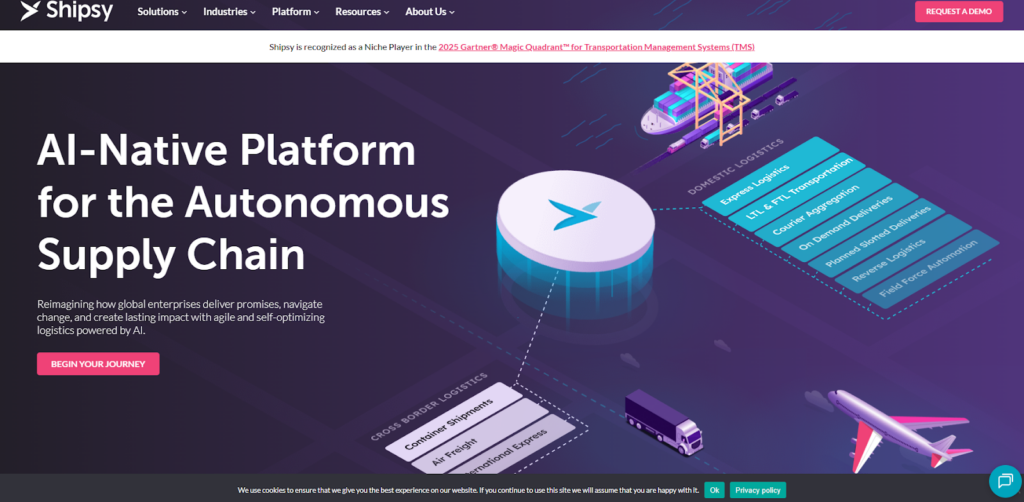
Shipsy’s architecture spans freight management, carrier allocation, and last mile delivery within a single logistics tool.
It has developed particular traction in the Middle East and South Asian markets, where combining cross-border freight coordination with domestic last mile delivery in one system is a meaningful operational simplification for enterprises managing both stages.
Shipsy’s Key Features
- Carrier allocation and rate comparison for domestic and cross-border freight operations
- Last mile route planning with driver app and real-time delivery tracking
- Supply chain visibility across freight and last mile stages from a single interface
- Carrier performance analytics and delivery SLA tracking
Shipsy’s Pros
- Unified mid-mile and last mile coverage reducing vendor fragmentation for operations spanning both fulfillment stages
- Strong carrier management tooling with rate comparison and performance tracking for carrier-dependent logistics models
- Established regional footprint in MEA and South Asian markets with relevant carrier integrations for those geographies
Shipsy’s Cons
- Last mile routing depth reflecting the product’s multi-stage positioning, with less algorithmic sophistication than tools where routing is the sole architectural focus
- Product value weighted toward carrier management capabilities for teams where owned-fleet last mile is the primary use case
- Advanced constraint handling and event-triggered re-routing for high-volume owned-fleet operations a weaker area compared to purpose-built dispatch tools
Shipsy Is Best For
Enterprises in MEA and South Asia managing logistics across multiple fulfillment stages, where unified freight and last mile visibility in a single system reduces operational overhead. The strongest fit is carrier-dependent models rather than high-volume owned-fleet dispatch.
Shipsy’s Pricing
Custom enterprise pricing. Contact Shipsy directly for current rates.
7. OptimoRoute
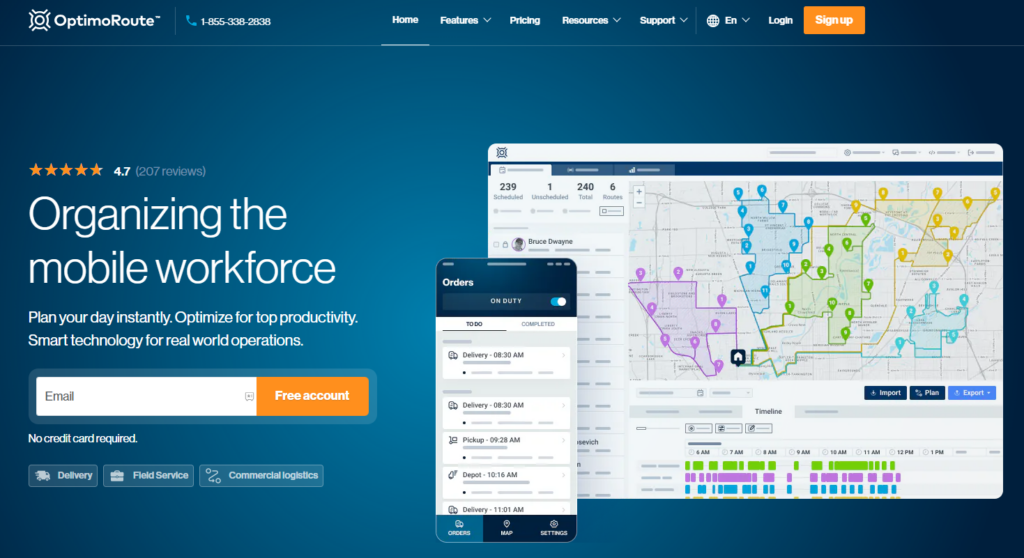
OptimoRoute’s standout capability is long-horizon planning. It supports route planning across a five-week window, making it well-suited for operations planning routes days or weeks in advance.
Field service teams with appointment-based scheduling and delivery operations on fixed weekly beats are the primary use cases the product was built around.
OptimoRoute’s Key Features
- Long-horizon planning across a five-week scheduling window
- Workload balancing across drivers based on stop volume and geographic territory assignment
- Mixed pickup and delivery route support in a single planning run
- Clean interface with fast route generation for advance planning workflows
OptimoRoute’s Pros
- Multi-week planning capability as a genuine differentiator for scheduled delivery and field service operations requiring advance route commitment and driver schedule predictability
- Workload balancing across drivers reducing overtime exposure and improving fleet utilization for operations with consistent daily route structures
- Fast setup and a straightforward interface reducing administrative overhead for smaller dispatch teams managing predictable route patterns
OptimoRoute’s Cons
- Real-time dynamic re-routing for live constraint changes limited, with less event-triggered sophistication than tools designed for high-variability enterprise environments
- Enterprise-grade API integrations and the connectivity depth required by large 3PLs and national retailers limited relative to purpose-built orchestration tools
- Product orientation toward scheduling rather than execution-layer dispatch automation, limiting value for operations with high daily route variability
OptimoRoute Is Best For
Mid-market delivery and field service operations with predictable, schedulable routes where advance planning is the primary scheduling challenge. The fit narrows for operations requiring real-time dispatch automation, event-triggered re-routing, or deep ERP and OMS integration.
OptimoRoute’s Pricing
OptimoRoute uses per-driver subscription pricing, publicly documented on its website.
8. Routific
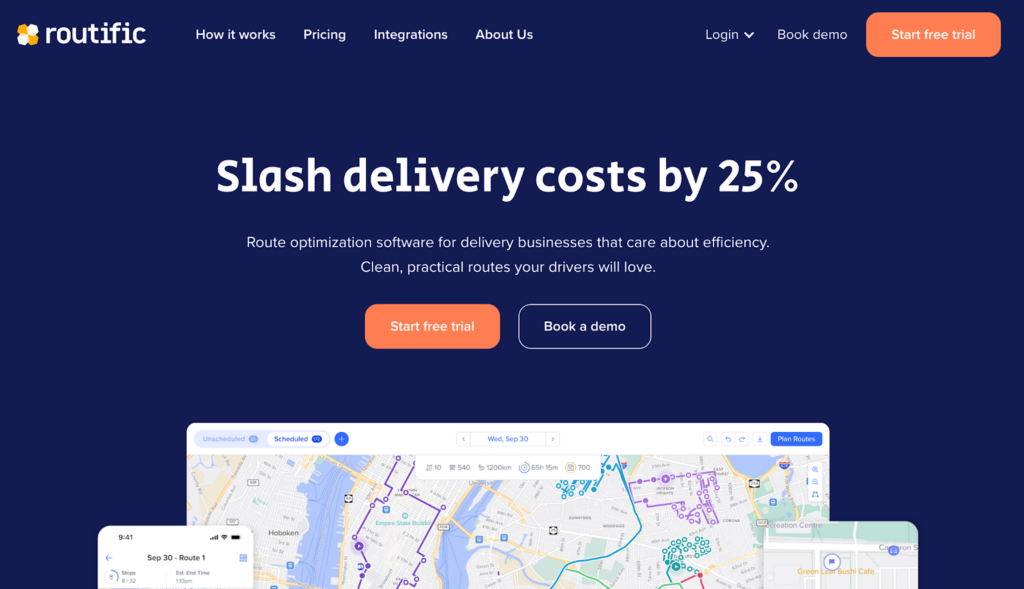
Routific’s market positioning is explicitly SMB-oriented. It competes on simplicity, speed of setup, and transparent pricing rather than routing depth or enterprise integration breadth.
A delivery team with 5 to 50 routes per day can be operational within an afternoon, which is the value proposition it delivers.
Routific’s Key Features
- Route planning with time window and vehicle capacity constraints for daily delivery planning
- Driver app with customer notification and proof of delivery tools
- Simple bulk stop import and quick route generation for standard daily planning workflows
- Shopify integration for e-commerce order ingestion
Routific’s Pros
- Fast implementation and minimal configuration overhead making it the most accessible entry point in this list for teams new to routing software
- Transparent per-vehicle pricing removing volume-scaling cost uncertainty affecting some competing tools as operations grow
- Clean driver app with customer notification tools reducing dispatcher-to-driver communication friction for small fleet operations
Routific’s Cons
- Feature depth and algorithmic scalability plateauing well before enterprise-scale fleets handling thousands of daily stops across complex constraint environments
- AI dispatch automation, real-time re-optimization, and enterprise integration capabilities falling outside the tool’s current scope
- Operations outgrowing 50 to 100 daily routes hitting the tool’s ceiling before the organizational scaling curve levels off
Routific Is Best For
SMBs and local delivery operations running up to 50 vehicles with relatively simple routing requirements. Routific suits teams needing fast, affordable multi-stop route planning and not yet facing the constraint complexity enterprise-grade tools address.
Routific’s Pricing
Routific uses per-vehicle monthly pricing with a free tier capped at three vehicles. Current pricing is publicly available on Routific’s website.
9. Bringg
Bringg’s architecture is carrier-first. It was built to help large enterprise retailers orchestrate delivery across a mix of owned fleets, third-party carriers, and gig delivery networks from a single interface.
Carrier connectivity, network flexibility, and post-dispatch customer experience tools are its primary investments.
Bringg’s Key Features
- Multi-carrier delivery orchestration with a broad third-party and gig carrier network
- Customer experience tooling including branded tracking pages and real-time delivery communication
- Automated carrier selection based on cost, speed, and coverage rules across a carrier marketplace
- Last mile visibility across owned fleet and carrier deliveries in a unified control view
Bringg’s Pros
- Carrier network breadth giving large retailers access to a wide range of last mile delivery options from a single interface without managing direct carrier contracts independently
- Customer experience and delivery communication tools well-developed for B2C retail and marketplace fulfillment models where post-dispatch experience drives brand perception
- Multi-carrier performance tracking and SLA monitoring in a unified view, reducing carrier management overhead for retailers running diverse delivery networks
Bringg’s Cons
- Route optimization sitting within a broader orchestration suite rather than as the core architectural investment, with less constraint depth than tools where routing is the primary product
- Bringg’s value weighted toward carrier selection rather than fleet execution for teams where owned-fleet dispatch automation is the primary use case
- Configuration depth for high-frequency delivery exception handling in owned-fleet environments less developed than in purpose-built dispatch tools
Bringg Is Best For
Bringg is most valuable when carrier diversity and multi-network visibility are the primary operational requirements, rather than deep routing for a fixed owned fleet. Teams prioritizing how to manage delivery exceptions across owned fleets at high daily stop volumes will find Bringg’s tooling less suited to that need than dedicated routing and dispatch tools.
Bringg’s Pricing
Custom enterprise pricing. Contact Bringg directly for current rates.
10. GSMtasks
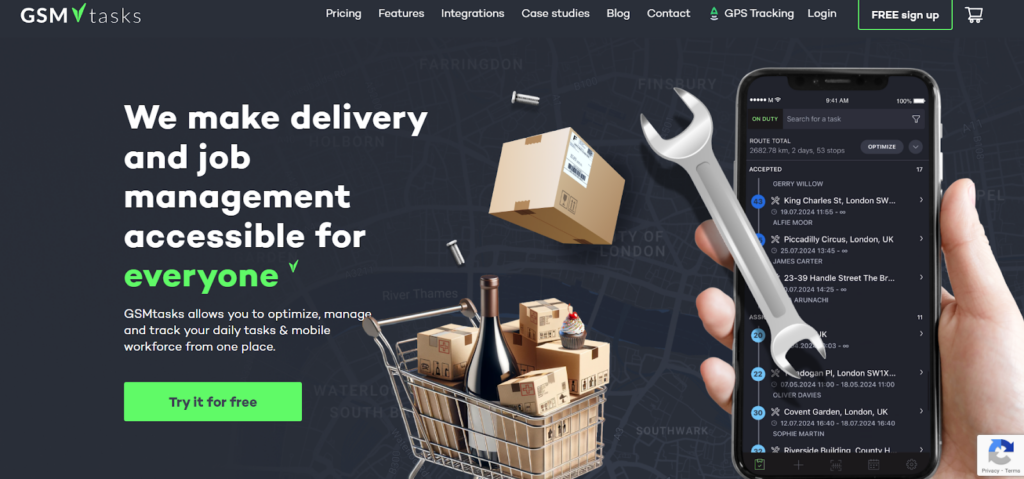
GSMtasks sits at the budget end of the delivery management market. Task management, basic route planning, and driver tracking address the core use cases.
For operations with straightforward routing requirements and no enterprise integration needs, it provides a functional baseline at a low entry cost.
GSMtasks’s Key Features
- Task management and delivery scheduling with basic route optimization
- Driver app with GPS tracking and proof of delivery capture
- Customer notification tools with delivery status updates
- Basic reporting on task completion and driver activity
GSMtasks’s Pros
- Low entry cost making it accessible for small fleets or teams evaluating delivery management software for the first time
- Simple setup and minimal onboarding overhead for operations with straightforward, low-variability routing requirements
- Core delivery tracking and proof of delivery tools meeting the essential requirements for basic fleet operations
GSMtasks’s Cons
- AI route automation, event-triggered re-routing, and advanced dispatch allocation absent from the tool’s current feature set
- Integration depth limited, with fewer enterprise system connections than tools designed for OMS, WMS, or ERP workflows
- Analytics and reporting basic, providing insufficient operational insight for teams managing at enterprise scale or seeking to improve planning accuracy over time
GSMtasks Is Best For
Small fleets and startups with basic route planning and driver tracking needs and tight budgets. GSMtasks is included here to represent the lower tier of the market. The gap between its capabilities and enterprise-grade tools reinforces why operations managing at scale need materially more algorithmic depth.
GSMtasks’s Pricing
GSMtasks offers tiered subscription pricing starting at low monthly rates per user. Current pricing is publicly available on the GSMtasks website.
Last Mile Routing Software Comparison
The table below gives a point-in-time comparison across eight dimensions most relevant to enterprise evaluation. Use it to narrow the field before moving to a structured demo process with two or three tools.
| Software | Best For | AI-Powered Optimization | Max Stop Scale | Real-Time Re-Routing | Dispatch Automation | Key Integrations | Enterprise Pricing |
|---|---|---|---|---|---|---|---|
| Locus | Enterprise retail, FMCG, e-commerce, 3PL | Yes | 5,000+ stops/day | Yes, event-triggered | Yes, automated | OMS, WMS, ERP, CRM, TMS | Yes |
| FarEye | Large retailers, carrier-dependent B2C | Partial | Mid-to-high | Partial | Partial | Multi-carrier, OMS | Yes |
| LogiNext | Multi-modal enterprise, South Asia and MEA | Partial | Mid-to-high | Partial | Partial | OMS, ERP, WMS | Yes |
| Onfleet | Growth-stage D2C, e-commerce | Partial | ~500 stops/day | No | Partial | Shopify, WooCommerce | Mid-market |
| Route4Me | Mid-market field service, delivery fleets | Partial | 2,000+ (batch import) | No | No | CSV/Excel, basic APIs | Mid-market |
| Shipsy | MEA/South Asia freight plus last mile | Partial | Mid-range | Partial | Partial | Carrier APIs, WMS | Yes |
| OptimoRoute | Scheduled routes, field service | Partial | ~500 stops/day | No | No | Basic API | Mid-market |
| Routific | SMB local delivery | Partial | ~100 stops/day | No | No | Shopify | SMB tiers |
| Bringg | Enterprise retailers, hybrid carrier model | Partial | Mid-to-high | Partial | Partial | Multi-carrier, OMS | Yes |
| GSMtasks | Small fleets, startups | No | Low | No | No | Basic | SMB tiers |
Total Cost of Ownership: What to Budget Beyond License Pricing
Licence pricing is only one component of last mile routing software cost. Enterprise buyers should calculate total cost of ownership across implementation, integrations, support, operational change, and long-term optimisation.
| Cost Area | What to Include in the Business Case | Procurement Question to Ask |
| Software subscription or platform fee | Base licence, modules, users, vehicles, tasks, delivery volume, regions, and support tiers | Is pricing based on vehicles, drivers, tasks, orders, delivery volume, or a custom enterprise scope? |
| Implementation and configuration | Workflow mapping, depot set-up, constraint modelling, user roles, business rules, SLA logic, and pilot design | What implementation services are included, and what requires a separate professional services scope? |
| Integrations | OMS, WMS, ERP, TMS, CRM, telematics, fleet management software, mapping APIs, customer notification systems, and BI tools | Are integrations pre-built, API-led, custom, or dependent on internal engineering resources? |
| Data readiness | Address quality improvement, geocoding, master data clean-up, driver/vehicle records, customer time windows, and territory data | What data format and quality thresholds are needed before go-live? |
| Mobile and device costs | Driver app deployment, device compatibility, MDM requirements, connectivity, and training | Does the driver app work with the devices and operating systems currently used in the field? |
| Change management | Dispatcher training, driver adoption, SOP changes, exception handling rules, and performance governance | What roles need training, and how long does it take before teams operate independently? |
| Ongoing optimisation | Quarterly rule tuning, new depot onboarding, reporting changes, seasonal capacity planning, and SLA recalibration | Is post-go-live optimisation included, or is it charged separately? |
A lower upfront subscription can become more expensive if the platform requires additional tools for proof of delivery software, driver tracking app functionality, customer notifications, carrier management, or reporting. Conversely, a broader orchestration platform may carry a higher entry cost but reduce integration and reconciliation costs across planning, dispatch, execution, and analytics.
Free Trial, Demo, and Contract Model Comparison
Trial and contract terms change frequently, so procurement teams should validate current availability directly with each vendor before shortlisting. Based on the pricing information discussed in this guide, the market generally separates into transparent self-serve tiers for SMB tools and custom enterprise contracts for larger orchestration platforms.
| Software | Public Trial or Free Tier Signal | Demo Model | Contract Model to Verify |
| Locus | Not positioned as a self-serve free tier in this guide | Scoped enterprise demo | Custom, volume-based enterprise contract |
| FarEye | Not specified in this guide | Enterprise demo | Custom enterprise contract |
| LogiNext | Not specified in this guide | Enterprise demo | Custom enterprise contract |
| Onfleet | Public base-tier pricing referenced in this guide; current trial availability should be verified | Product demo or sales-led evaluation | Subscription or per-task model scaling with delivery volume |
| Route4Me | Public pricing referenced in this guide; current trial availability should be verified | Product demo or self-serve evaluation depending on plan | Tiered subscription plus add-on modules |
| Shipsy | Not specified in this guide | Enterprise demo | Custom enterprise contract |
| OptimoRoute | Public per-driver pricing referenced in this guide; current trial availability should be verified | Product demo or self-serve evaluation depending on plan | Per-driver subscription |
| Routific | Free tier capped at three vehicles referenced in this guide | Self-serve evaluation or product demo | Per-vehicle monthly pricing |
| Bringg | Not specified in this guide | Enterprise demo | Custom enterprise contract |
| GSMtasks | Public tiered pricing referenced in this guide; current trial availability should be verified | Product demo or self-serve evaluation depending on plan | Tiered subscription pricing |
For enterprise evaluations, a live pilot using actual order data is more valuable than a generic trial. Ask vendors to model real depot locations, historical delivery density, service times, driver shifts, vehicle constraints, and exception patterns before comparing route quality or cost outcomes.
Customer Review Signals to Check Before Shortlisting
Independent customer reviews can help validate usability, support responsiveness, implementation experience, and day-to-day dispatcher adoption. However, review scores change over time and may vary by geography, company size, and use case. Buyers should verify current ratings and review themes directly on platforms such as G2, Capterra, Gartner Peer Insights, TrustRadius, or regional procurement marketplaces before issuing an RFP.
When reviewing third-party feedback, look beyond the headline score. Segment reviews by:
- Company size and industry, especially enterprise retail, FMCG, e-commerce, 3PL, CPG, pharmacy, or field service use cases
- Region, since geocoding, carrier integrations, and support coverage can differ materially by market
- Implementation comments, including timelines, data migration, API complexity, and training effort
- Dispatcher and driver usability, not just executive reporting or sales-cycle impressions
- Support quality during live operational issues, peak periods, and exception-heavy delivery days
- Mentions of scalability limits, add-on costs, reporting gaps, or manual workarounds
Use review data as a validation layer, not the primary selection method. The strongest procurement process combines third-party review checks with a structured pilot, commercial modelling, security assessment, and integration review.
The comparison table simplifies what is fundamentally an architectural decision. The right tool depends less on feature checklists and more on identifying where your operation’s binding constraint actually sits.
Implementation Timeline and Onboarding Requirements
Implementation effort depends on operational complexity, data readiness, integration depth, and the number of regions or depots included in the first rollout. A single-market pilot with clean data and limited integrations can move faster than a multi-country deployment involving ERP, OMS, WMS, telematics, fleet management software, and customer communication systems.
A practical enterprise onboarding plan typically includes the following stages:
| Phase | Typical Activities | Internal Owners Required |
| Discovery and workflow mapping | Document delivery models, depot structures, fleet types, service windows, dispatch rules, exception workflows, and SLA definitions | Logistics operations, transport managers, dispatch leads, IT, customer experience |
| Data readiness | Prepare order data, address data, customer time windows, vehicle capacity, driver availability, service times, territories, and historical delivery performance | Operations analytics, master data, IT, depot teams |
| Integration design | Define API flows for OMS, WMS, ERP, TMS, fleet systems, proof of delivery workflows, driver app data, notifications, and reporting systems | IT architecture, integration teams, security, vendor implementation team |
| Configuration and rule set-up | Configure constraints, business rules, prioritisation logic, fleet assignment, route parameters, exception triggers, and user permissions | Dispatch leads, process owners, vendor solution team |
| Pilot testing | Run parallel planning, compare route outputs, validate ETAs, test driver workflows, confirm proof of delivery capture, and track exception handling | Depot managers, dispatchers, drivers, operations excellence |
| Training and change management | Train dispatchers, supervisors, drivers, customer support teams, and analytics users on new workflows and escalation paths | Operations leadership, HR/training, vendor success team |
| Go-live and stabilisation | Move selected regions or depots into production, monitor route quality, adoption, data sync, and SLA impact | Operations, IT support, vendor support |
| Scale-up and optimisation | Add depots, regions, vehicle types, additional integrations, seasonal planning rules, and advanced analytics | Programme management, regional operations, IT, finance |
Before onboarding begins, enterprises should prepare a current-state operating pack containing delivery volumes, historical stop density, depot locations, vehicle profiles, driver shifts, order cut-off times, customer time windows, delivery failure reasons, and reporting requirements. This reduces discovery time and improves the quality of pilot design.
Buyers should also define acceptance criteria before go-live. Examples include planning-time reduction, route adherence, on-time delivery improvement, exception response time, dispatcher productivity, first-attempt delivery rate, driver app adoption, and integration uptime.
Security, Compliance, and Data Privacy Questions to Ask
Last mile routing platforms process operationally sensitive and personally identifiable data, including customer addresses, phone numbers, delivery instructions, driver location, proof-of-delivery evidence, and order details. Security assessment should therefore be part of the initial shortlist, not a final-stage procurement formality.
Enterprise buyers should ask:
- What data is collected, processed, stored, and retained across planning, driver tracking, proof of delivery, analytics, and customer notifications?
- Where is data hosted, and can hosting or data residency requirements be aligned to regional compliance needs?
- What encryption is used for data in transit and at rest?
- How are role-based access controls, user permissions, and audit logs managed?
- Does the platform support single sign-on, multi-factor authentication, and enterprise identity management?
- How is driver location data handled, and what retention rules apply?
- Can customer data be masked, minimised, or deleted according to internal privacy policies?
- What controls exist for mobile app security, device loss, session expiry, and unauthorised access?
- How are third-party integrations, APIs, webhooks, and external mapping services secured?
- What incident response, breach notification, business continuity, and disaster recovery processes are documented?
- Which security certifications, compliance attestations, or audit reports are available for procurement review?
- How does the vendor support privacy requirements across markets such as North America, the EU, India, Southeast Asia, and MEA?
For regulated or high-sensitivity categories such as pharmacy, healthcare, financial services delivery, or age-restricted goods, security evaluation should also include chain-of-custody controls, proof-of-delivery evidence governance, access logs, retention limits, and exception auditability.
How to Choose the Right Last Mile Routing Software for Your Enterprise
To put it simply:
- Operations with stop volume as the primary constraint need a tool proven at scale under real-world conditions.
- Operations where dispatch time is the bottleneck need automated allocation ahead of a better route generator.
- Operations with high delivery exception rates need event-triggered re-routing firing on individual failures rather than a tool recalculating on an hourly batch schedule.
The cost of assembling a point-solution stack also warrants direct accounting. A separate routing tool, a separate tracking system, and a separate carrier management system each add integration overhead, data reconciliation work, and gaps in operational context between planning and execution.
A system connecting planning, dispatch, execution, and routing efficiency analysis in a shared operational view removes those gaps at the source.
AI depth is the final deciding factor. Tools extended to enterprise scale handle dynamic constraints differently than tools trained on enterprise-scale operations data from the start. The former often shows performance degradation under high daily variability. The latter holds accuracy as conditions change in real time.
For enterprises managing complex, high-volume daily operations, automated route planning combined with dispatch orchestration is what separates tools scaling with operational growth from those plateauing at mid-market complexity.
Best-Fit Use Cases by Industry
The right last mile routing software depends heavily on delivery promise, product characteristics, fleet model, customer density, and exception profile. Use-case mapping helps prevent enterprises from buying software built for a different operating model.
| Industry or Use Case | Routing Requirements | Capabilities to Prioritise |
| Grocery and quick commerce | Dense delivery zones, short time windows, perishability, high order volatility, and frequent same-day fulfilment | Real-time re-routing, capacity-aware batching, temperature-sensitive fleet rules, accurate ETAs, driver tracking app visibility |
| Pharmacy and healthcare delivery | High trust, strict proof requirements, sensitive customer data, controlled delivery workflows, and potential chain-of-custody needs | Secure proof of delivery software, audit logs, role-based access, exception documentation, customer identity validation |
| Furniture and bulky goods | Large item capacity planning, vehicle compatibility, crew requirements, appointment windows, and longer service times | Vehicle capacity modelling, skill-based routing, two-person delivery support, service-time configuration, customer notifications |
| Parcel and CEP | High stop density, multi-depot operations, route adherence, first-attempt success, and SLA tiering | High-volume optimisation, territory balancing, event-triggered re-routing, scan-based proof of delivery, performance analytics |
| Field service | Appointment scheduling, technician skills, parts availability, repeat visits, and route stability | Skill-based scheduling, long-horizon planning, workload balancing, mobile task updates, customer ETA communication |
| Food delivery | Short delivery windows, live order injection, variable preparation times, and customer experience sensitivity | Dynamic dispatch, live ETA updates, proximity-based allocation, real-time tracking, exception alerts |
| FMCG and CPG distribution | Beat planning, outlet service levels, vehicle utilisation, recurring routes, and merchandising or sales constraints | Territory planning, recurring route optimisation, capacity management, visit compliance, route performance analytics |
| Retail and e-commerce | Omnichannel order flows, mixed fulfilment nodes, customer notifications, returns, and peak season volatility | OMS/WMS integration, SLA-based prioritisation, carrier and owned-fleet orchestration, automated dispatch, analytics |
Enterprise buyers should shortlist platforms that match the dominant operating model first, then evaluate adjacent capabilities. A carrier-first platform, a field service scheduler, and an AI-native dispatch orchestration platform can all claim last mile routing capability, but they solve different operational problems.
Route Optimization ROI Calculation Framework
A credible ROI model for last mile routing software should connect operational levers to financial outcomes. The most useful model starts with current baseline performance and estimates improvement across planning time, fleet productivity, distance travelled, fuel or energy use, delivery failures, SLA penalties, customer support load, and dispatcher workload.
Use this framework to structure the business case:
1. Establish the baseline
Capture current monthly values for:
- Total deliveries attempted
- Total kilometres or miles driven
- Fuel, energy, toll, and vehicle operating costs
- Number of dispatchers and average planning hours
- Average deliveries per driver per shift
- Failed delivery attempts and reattempt costs
- On-time delivery rate
- Customer support tickets linked to delivery status
- SLA penalties or chargebacks
- Cost per delivery
2. Model improvement levers
Estimate conservative, moderate, and high-impact scenarios for:
- Planning time reduction from automated route planning and dispatch allocation
- Distance reduction from better stop sequencing and route density
- Improved vehicle utilisation from capacity-aware routing
- Fewer failed attempts through better ETAs, customer communication, and proof of delivery
- Lower exception handling time through event-triggered re-routing
- Reduced manual reconciliation from deeper OMS, WMS, ERP, and fleet management software integrations
3. Calculate monthly benefit
A simplified model:
Monthly ROI benefit = delivery cost savings + labour productivity gain + failed-attempt reduction + SLA penalty reduction + support cost reduction – monthly software and operating cost
4. Compare against total cost of ownership
Include licence fees, implementation, integrations, training, devices, internal IT effort, ongoing support, and optimisation costs. The ROI case is strongest when the baseline includes manual dispatch, poor route adherence, high reattempt rates, underutilised fleet capacity, or limited real-time visibility.
5. Validate in a pilot
Before committing to full rollout, run a pilot using real delivery data and compare planned versus actual outcomes. The pilot should measure route quality, planning time, dispatcher adoption, driver app usage, ETA accuracy, exception response time, and cost-per-delivery movement.
Common Mistakes When Choosing Last Mile Routing Software
Enterprise routing software decisions often fail when buyers focus on surface-level functionality instead of operating architecture. Avoid these common mistakes:
- Choosing a route planner when the real constraint is dispatch automation: Faster route generation will not fix manual order allocation, exception handling, or driver reassignment.
- Testing with unrealistic demo data: A clean 40-stop demo does not reveal how the engine performs with thousands of stops, poor address quality, strict time windows, and mixed vehicle constraints.
- Underestimating integration complexity: Routing decisions depend on live data from OMS, WMS, ERP, TMS, fleet management software, telematics, driver apps, and customer systems.
- Treating proof of delivery as a minor add-on: Photo capture, signatures, scans, OTPs, geotags, and exception notes are central to dispute management and customer trust.
- Ignoring driver adoption: A powerful planning engine loses value if the driver tracking app is slow, confusing, unreliable, or poorly aligned to field workflows.
- Comparing licence price instead of total cost of ownership: Add-on modules, integration effort, implementation services, support tiers, and reporting gaps can change the economics materially.
- Overlooking real-time exception architecture: Batch re-optimisation may be acceptable for predictable routes, but high-variability enterprise operations need event-triggered re-routing.
- Failing to segment by use case: Grocery, pharmacy, furniture, parcel, field service, FMCG, and food delivery each require different routing priorities.
- Skipping security review until late procurement: Driver location, customer addresses, proof-of-delivery evidence, and order data require early privacy and compliance assessment.
- Not defining success metrics before pilot: Without baseline KPIs, buyers cannot prove whether routing software improved cost, SLA adherence, planning time, or delivery reliability.
RFP Checklist for Last Mile Routing Software
Use this checklist to structure a procurement scorecard or RFP template for last mile routing software.
Business and operating fit
- Daily order volume, peak volume, and projected growth
- Number of depots, regions, countries, and fulfilment nodes
- Owned fleet, contracted fleet, 3PL, gig, or hybrid operating model
- Same-day, next-day, scheduled, recurring, or on-demand delivery promise
- Industry-specific requirements such as grocery perishability, pharmacy compliance, bulky goods capacity, or field service skills
Routing and dispatch capability
- Multi-constraint optimisation
- Automated order-to-driver allocation
- Real-time, event-triggered re-routing
- Capacity, time-window, service-time, skill, territory, and SLA rules
- Multi-depot and mixed-fleet support
- Returns, pickups, exchanges, and reverse logistics support
Execution and visibility
- Driver tracking app capabilities
- ETA accuracy and customer notifications
- Proof of delivery software features
- Exception management workflows
- Dispatcher control tower functionality
- Route adherence and driver performance dashboards
Integrations and data
- OMS, WMS, ERP, TMS, CRM, telematics, and fleet management software connectivity
- API documentation and webhook support
- Batch versus real-time data synchronisation
- Mapping, geocoding, and external routing API compatibility
- BI and reporting exports
- Data migration and master data requirements
Security and compliance
- Data hosting and residency
- Encryption, access control, SSO, MFA, and audit logs
- Driver location data retention
- Customer data minimisation and deletion processes
- Incident response and disaster recovery documentation
- Security certifications or audit reports available for review
Commercial and implementation
- Pricing metric and contract term
- Implementation scope and timeline
- Training and change management support
- Customer success model and support SLAs
- Professional services costs
- Pilot success criteria and scale-up plan
- References from comparable enterprise deployments
For a structured evaluation, convert this checklist into a weighted scorecard and score each vendor across operational fit, integration readiness, security posture, commercial model, and pilot performance.
Schedule a Locus demo to see AI-powered dispatch and route planning running at your operation’s actual scale.
Frequently Asked Questions (FAQs)
1. What is the difference between route planning software and a full logistics orchestration platform?
Route planning software generates optimized routes from a list of stops and outputs a sequence for drivers to follow. A logistics orchestration platform spans the full delivery workflow across order allocation, driver assignment, route optimization, real-time dispatch, exception handling, and post-delivery analytics. For enterprise evaluators, the distinction matters because route planning alone leaves dispatch automation and operational visibility unaddressed, and those are where high-volume operations most often lose efficiency and planning accuracy.
2. How does AI-powered route optimization differ from rule-based multi-stop route planners?
Rule-based planners apply fixed constraint hierarchies to generate routes, processing constraints in a predetermined order. AI-powered routing evaluates all constraints simultaneously, learns from historical delivery data to improve accuracy over time, and recalculates routes in response to live events. At enterprise stop volumes, the quality gap between AI and rule-based approaches widens because the number of possible constraint interactions exceeds what fixed rule hierarchies can handle without sacrificing accuracy.
3. Can last mile routing software integrate with existing ERP and OMS systems?
Enterprise-grade tools provide pre-built API connectors and integration frameworks for major ERP, OMS, and WMS systems. Integration depth varies significantly across tools. A tool with native OMS integration reduces order ingestion latency and data reconciliation overhead. Teams evaluating integration capability should ask specifically about bidirectional data flow and synchronization frequency during live operations, going beyond inbound order import to confirm the full integration scope.
4. What ROI should enterprises expect after deploying route optimization software at scale?
Outcomes vary by starting point and operational complexity. Enterprises moving from manual or spreadsheet-based dispatch typically see reductions in per-order planning time, fuel consumption per stop, and failed delivery rates. One retailer reduced delivery cost per order by 22 percent after replacing manual planning with Locus. A regional 3PL improved on-time delivery by 30 percent through automated dispatching and route re-optimization. The ROI case strengthens most when the baseline includes significant manual dispatch effort or high delivery exception rates automation directly reduces.
5. How do last mile routing platforms handle real-time delivery exceptions and dynamic re-routing?
Architecture determines the answer. Batch-based tools re-optimize routes on a fixed schedule, typically hourly, which means exceptions occurring between cycles remain outside the updated route until the next scheduled pass. Event-triggered tools fire re-optimization on individual events. A failed delivery, a driver running behind schedule, or an urgent order added after dispatch each trigger an immediate recalculation. Managing delivery exceptions in real time requires event-triggered architecture. Enterprise operations with high daily variability need that capability to maintain on-time delivery performance when live conditions change during the shift.


General
10 Best Dispatch Software Platforms for 2026: Features, Pricing & Fit

Aug 24, 2026
Evaluate the best dispatch software for enterprise logistics in 2026. Compare AI dispatch, real-time rerouting, fleet management, carrier allocation, and pricing across 10 platforms.
Read more
General
What Makes the Best TMS for Freight Cost Control and How to Evaluate One
Aug 24, 2026
Learn what makes a TMS effective for freight cost control: from AI route optimization to cost-to-serve analytics, and how to evaluate solutions for enterprise logistics.
Read moreInsights Worth Your Time




















Top 10 Last Mile Routing Software for Enterprise Logistics Teams in 2026