


General
Retail Logistics Visibility Gaps Are Costing the Industry Billions. Here Is How to Close Them.

TL;DR: Retailers hemorrhage $95 billion annually from logistics visibility gaps—broken handoffs between warehouses, carriers, and last-mile fleets. With 57% of supply chain professionals citing a lack of visibility as their top challenge and last-mile delivery consuming up to 50% of total logistics cost, closing these gaps is the single highest-value move a retail operations team can make. This article maps the full anatomy of the information void and the structural shifts required to close it.
The Illusion of End-to-End Control
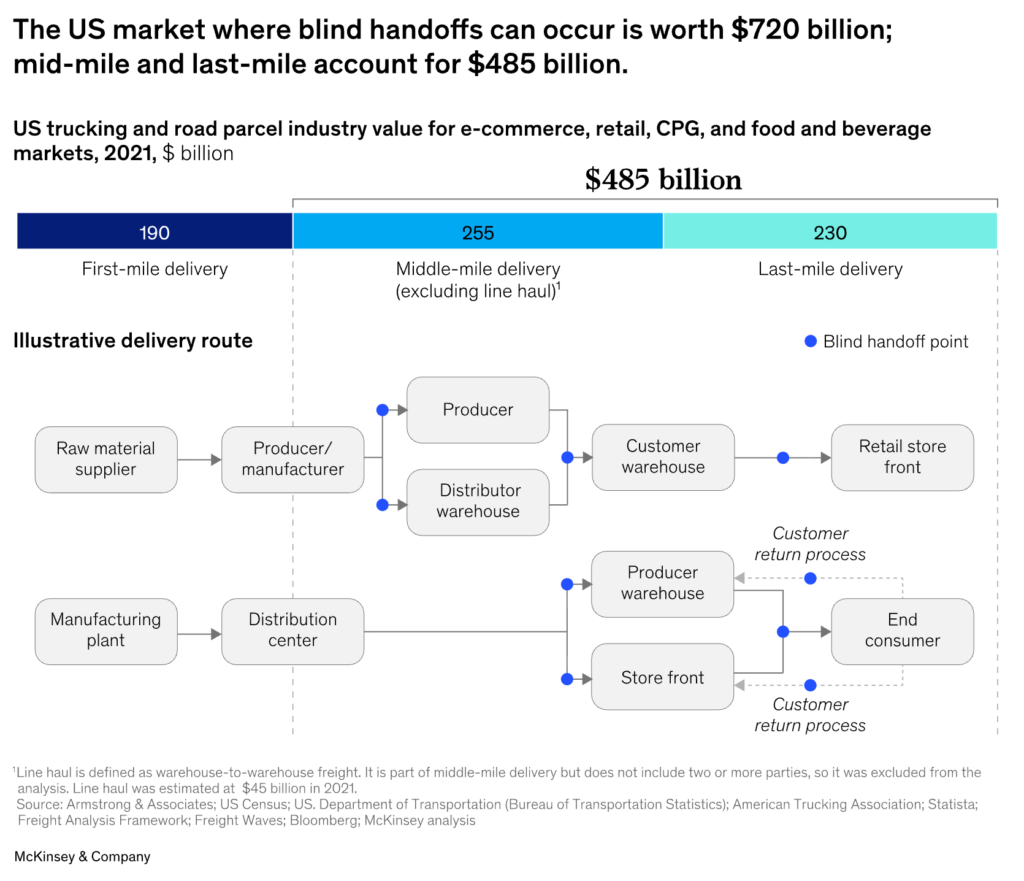
Retail logistics visibility is the single biggest operational blind spot in modern commerce. Based on a McKinsey analysis, the industry loses an estimated $95 billion every year because shipment data breaks at every handoff between warehouse, carrier, and last-mile fleet. The scale of the problem is reflected in the market itself: the United States Retail Logistics Market is valued at USD 244.76 billion in 2026, growing at a CAGR of 3.87% to reach USD 295.99 billion by 2031—yet just 6% of businesses report having full supply chain visibility.
Retailers have spent the last decade perfecting the digital storefront. One-click checkouts, personalized recommendations, buy-now-pay-later integrations, AI-powered product search. Shoppers expect friction-free buying, and for the most part, brands have delivered.
Then the order is placed, and that polished experience ends. Warehouses run on one system. The 3PL runs on another. Line-haul carriers push updates on their own schedule. The last-mile partner sends a tracking link that often shows the same status for three days. By the time a customer calls to ask where their order is, nobody on the operations team has a clean answer.
This is the information void. It is the gap between what retailers think they can see and what they actually control. Every handoff between nodes is an opportunity for data to break. When data breaks, shipments get delayed, claims pile up, and customer retention slides.
The financial weight of this fragmentation is not abstract. Roughly 19% of all logistics costs trace directly to disconnected handoffs across warehouse, transit, and last-mile systems. That translates to $95 billion in annual revenue loss across the industry. For large enterprises tracking more than 160,000 assets daily, even a minor data gap at a single handoff cascades into systemic cost leakage.Retailers keep investing in front-end experience while bleeding margin on the back end. Closing the information void is not a tracking problem. It is an orchestration problem—and it is one that delivery logistics software built for enterprise-scale networks is purpose-designed to solve.

Transform Your Supply Chain
Discover how Locus can optimize your logistics operations with AI-driven solutions.
Key Takeaways
| # | Insight | Why It Matters |
| 1 | $95B lost annually to logistics visibility gaps across the retail industry | Disconnected handoffs between warehouse, transit, and last-mile systems account for 19% of all logistics costs |
| 2 | 57% of supply chain professionals cite lack of visibility as their top challenge | Only 6% of businesses have full supply chain visibility—leaving 94% exposed to margin erosion |
| 3 | Last-mile delivery consumes 41–50% of total supply chain costs | Without end-to-end visibility, the costliest leg of fulfillment is also the least controlled |
| 4 | 40% of retailers cancel at least 10% of orders due to inventory data inaccuracies | Ghost inventory corrupts promise dates, slot allocation, and carrier tenders downstream |
| 5 | 30% of retailers now leverage AI for supply chain visibility, projected to reach 41% within the next year | 59% of executives expect positive ROI from AI-driven supply chain initiatives within 12 months |
| 6 | Proactive orchestration replaces reactive tracking as the competitive standard | Retailers who shift from observation to automated exception management recover margin, retention, and capacity |
What Is Retail Logistics Visibility?
Retail logistics visibility is the capability to track, monitor, and act on shipment, inventory, and order data in real time—from the moment a product leaves a warehouse to the moment it reaches a customer’s door. It spans every node: fulfillment centers, cross-docks, mid-mile carriers, last-mile fleets, and reverse logistics networks.
True visibility is not a single tracking link. It is a unified data layer connecting ERP, OMS, WMS, and TMS systems so that every stakeholder—from warehouse operators to customer service teams—operates from the same real-time picture. When visibility is fragmented, the average large enterprise is managing more than 160,000 assets daily across systems that were never designed to communicate.
The distinction matters because tracking tells you where something was. Visibility tells you where it is, where it will be, and what to do when something breaks.
How Fulfillment Failures Begin Before the First Mile
Supply chain visibility problems are often framed as a trucks-and-drivers conversation. The bigger issue sits upstream, where inventory data, demand signals, and shipping rules decide whether a sale even makes it to the warehouse floor. For enterprise retailers managing thousands of SKUs across distributed fulfillment networks, these upstream failures compound at scale.
Cart Abandonment and Shipping Friction
Shoppers abandon carts for many reasons. Shipping friction is the one retailers control, and the one they most often get wrong. Long delivery windows, limited slot choices, and opaque costs at checkout push buyers to competitors before they click pay.
The scale of the leak is severe. Retailers lose $18 billion a year to cart abandonment tied specifically to shipping and delivery friction. That number is shelf stock walking out of the digital store because the fulfillment layer could not keep up with buyer expectations.
How Does Inventory Accuracy Impact Cart Abandonment?
For large retailers and global supply chains, inventory accuracy and checkout conversion are directly linked. If a SKU is available online but not physically in the right forward location, the enterprise has two options: ship slowly from a farther node, or cancel. Both kill conversion on the next visit and erode trust at scale.
Buyers who receive a cancel email or a nine-day delivery promise do not return with the same trust. Inventory data that reflects true network-wide availability, down to the hour, is the foundation for checkout promises that hold. This is where real-time inventory visibility—powered by integrated ERP, WMS, and OMS systems—becomes non-negotiable for high-volume operations.
The Ghost Inventory Problem
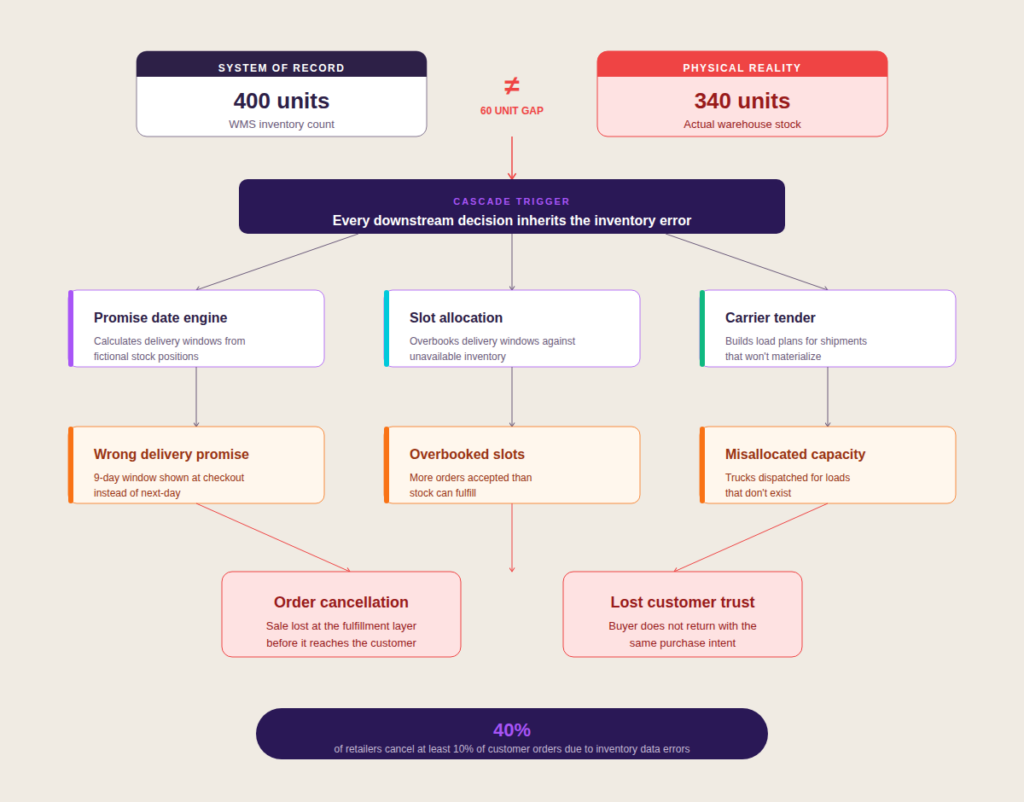
Selling what you cannot ship is a self-inflicted wound. Yet 40% of retailers still cancel at least 10% of customer orders because their inventory data was wrong at the moment of sale.
Brands that built their growth on online channels are now the ones most exposed to the inventory-to-fulfillment gap. Their volume is too high and too fast for legacy WMS data to stay accurate in real time. With 66% of retailers planning nearshoring, onshoring, or supplier diversification to address rising input costs, the complexity of inventory networks is increasing—not decreasing.
Ghost inventory also corrupts planning. If the system shows 400 units when there are 340, the promise date engine works from fiction. Every downstream decision, from slot allocation to carrier tender, inherits that error. The ability to automate logistics operations across this expanding network is what separates enterprises that scale from those that stall.
Mid-Mile Visibility: Where Fragmented Handoffs Bleed Revenue
Once an order clears fulfillment and moves into transit, a new set of visibility gaps opens. Parcels physically change hands between carriers, hubs, cross-docks, and last-mile fleets. Data rarely moves at the same pace.
The Revenue Leak from Poor Order Visibility
Poor order visibility causes miscommunication across manufacturers, warehouses, retail stores, and consumers. A shipment that is physically at the distribution hub but still shows as in transit in the retailer’s system triggers duplicate work, phantom claims, and misrouted customer service responses. Each of these costs real money per order.
Why Do Retail Supply Chains Fail in the Mid-Mile?
Industry leaders know that mid-mile failures are rooted in digital trail gaps. Carriers update at their own cadence. Hub scanners miss events. Multi-leg shipments pass through systems that were never designed to communicate. In high-volume operations, these asynchronous updates create costly visibility challenges—requiring advanced orchestration to sustain enterprise performance.
By the time a retailer notices a problem, the shipment has already missed its SLA. The mid-mile is where shipment visibility should be strongest because it is where exception cost is highest. Instead, it is where most retailers have the weakest data. With last-mile delivery alone accounting for 41% of supply-chain costs, any breakdown in the mid-mile compounds exponentially as the package moves closer to the customer.
Explore real-time visibility to the all-mile for all fulfillment channels: Locus Control Tower
The Operational Reality of Broken Handoffs
Suboptimal delivery coordination causes direct revenue leaks, not just customer experience damage. Detentions at distribution centers add hours to turnaround. Lost shipments trigger replacement orders. Re-deliveries eat the profit margin on every order that needed a second attempt.
Delivery visibility gaps across mid and last-mile touchpoints compound. A single missed handoff event can cascade into an SLA breach, a chargeback, and a CX hit that shows up in the next quarter’s NPS.
How Much Revenue Do Retailers Lose to Poor Logistics Visibility?
Retailers lose roughly $95 billion annually to logistics visibility gaps. That figure captures cost leakage across failed deliveries, duplicate work, claims processing, and customer churn tied to broken fulfillment experiences. It is not a soft CX number but a hard margin hit. With last-mile activities representing up to 50% of total logistics cost, the downstream impact of every upstream visibility failure is amplified.
Optimize Your Routes
Enhance delivery efficiency with our advanced route optimization solutions.
Proactive Visibility vs. Reactive Tracking: Closing the Gap
The industry has begun to recognize the scale of the gap. 30% of retailers now leverage AI for supply chain visibility, a figure expected to climb to 41% within the next year. Meanwhile, 59% of executives anticipate a positive return on investment from AI-driven supply chain initiatives within the next 12 months. The question is how to invest in a way that actually closes the void instead of adding another screen to an already fragmented stack.
What Is Proactive Visibility in Logistics?
Proactive visibility is the ability to see, predict, and act on shipment exceptions before they become SLA breaches. Reactive tracking tells a customer service rep that a package is late after the customer has already complained. Proactive logistics orchestration flags the risk while the shipment is still in transit, triggers automated re-routing or re-assignment, and notifies the right stakeholder in time to save the promise.
The shift is from observation to orchestration.
Read use case: Dynamic Route Resequencing for Last-Mile
What Is the Difference Between Reactive Tracking and Proactive Visibility?
The distinction between the two approaches determines whether visibility creates value or simply documents loss:
| Dimension | Reactive Tracking | Proactive Visibility |
| Trigger | Customer complaint or manual inquiry | Automated anomaly detection in real time |
| Data Model | Event logs after the fact | Predictive analytics on live data streams |
| Action | Manual investigation and escalation | Automated re-routing, re-assignment, and customer notification |
| Scope | Single carrier portal or tracking link | Unified decision layer across the entire fulfillment network |
| Outcome | Post-mortem reporting | SLA preservation and margin recovery |
| Enterprise Impact | Rising WISMO calls and CX degradation | Scalable exception management without headcount growth |
A tracking dashboard shows that a driver missed a delivery window. A proactive visibility layer detects the missed window, checks capacity across nearby routes, reassigns the stop, and updates the customer with a new ETA—all without manual intervention. Understanding what is route optimization and how it integrates with real-time visibility is fundamental to this shift.
Three Structural Shifts to Close the Information Void
Closing the void requires three structural shifts.
1. Unified Order Management
A single source of truth connecting all business systems, carriers, warehouses, and store nodes. Order data, inventory position, and capacity should live in one decision layer.
Promise dates should be generated from real network feasibility, not static cutoff rules. When the ERP, OMS, WMS, and carrier systems all write to the same operational brain, the retailer stops choosing between speed and accuracy at checkout.
2. Touch-to-Touch Shipment Continuity
Visibility across the full shipment lifecycle. Every touchpoint, from the initial API call at order intake to the electronic proof of delivery at the customer’s door, generates structured event data into the same platform.
No gaps between the 3PL scan and the last-mile dispatch. No manual reconciliation between the carrier’s tracking feed and the retailer’s control tower. Continuity is what turns a tracking link into an accountable journey.
3. Intelligent Exception Management
Automated workflows for rescheduling, cancellations, failed attempts, and re-deliveries. When an exception occurs, the system should evaluate the network, select the best recovery path, and execute without waiting for a human to open a ticket.
Human governance stays in the loop through override, approval, and audit, but routine exceptions resolve themselves. This is the operational layer that lets enterprises scale last mile delivery volume without scaling headcount—a critical capability given that last-mile activities represent up to 50% of logistics cost.
The Technology Stack for Retail Logistics Visibility
Closing the information void requires more than a single software purchase. Enterprise retailers need an integrated technology stack that connects physical asset movement with digital data flows.
IoT, RFID, and GPS: The Physical Data Layer
Real-time tracking technologies—IoT sensors, RFID tags, and GPS—provide the foundational data layer. They capture location, condition, and movement events at every node. For the average large enterprise tracking more than 160,000 assets daily, these technologies replace manual scans and periodic updates with continuous data streams.
Integration Platforms: ERP, TMS, WMS, OMS
The data is only as useful as the connections between systems. Integration Platform as a Service (IPaaS) solutions and API-first architectures bridge ERP, TMS, WMS, and OMS systems so that a scan at a cross-dock in Dallas appears in the same decision layer as an inventory count in a forward stocking location in Atlanta.
Retailers like Boxed have demonstrated that cloud-based integration of suppliers, logistics, and warehouses can deliver 10–15% operational efficiency gains by eliminating manual reconciliation and creating a single source of truth.
AI and Advanced Analytics: The Decision Layer
The raw data and system connections create the foundation. AI transforms that foundation into decisions. Route optimization software that processes 250+ real-world constraints in real time, predictive exception management that flags SLA risks before they materialize, and automated carrier selection that evaluates cost, speed, and reliability simultaneously—this is the decision layer that separates proactive visibility from passive tracking.
With 59% of executives expecting positive ROI from AI-driven supply chain initiatives within the next 12 months, the question for most enterprises is no longer whether to invest but how fast to deploy.
Benefits of End-to-End Retail Logistics Visibility
Enterprise retailers that close their visibility gaps unlock compounding returns across cost, customer experience, and operational capacity:
1. Direct Margin Recovery
The 19% of logistics costs tied to disconnected handoffs becomes recoverable margin. Fewer failed deliveries, eliminated duplicate work, and reduced claims processing translate directly to bottom-line improvement.
2. Reduced Cart Abandonment
When inventory data is accurate and delivery promises are generated from real network feasibility, the $18 billion annual cart abandonment leak from shipping friction shrinks. Shoppers see delivery slots they can trust—and convert.
3. Scalable Operations Without Proportional Headcount
Intelligent exception management automates the resolution of routine delivery failures. Enterprises that understand why your business needs route optimization at this layer can scale from 500 to 4,000 trucks without proportionally scaling planning teams.
4. SLA Adherence and Carrier Accountability
Touch-to-touch shipment continuity creates an auditable record of every handoff. SLA breaches are attributable to specific nodes, enabling data-driven carrier negotiations and performance management.
5. Customer Retention and Loyalty
Delivery reliability has replaced delivery speed as the primary loyalty driver. Customers rank accurate, predictable delivery promises higher than raw speed claims. Visibility turns fulfillment from a cost center into a retention engine.
6. Sustainability and Efficiency Gains
End-to-end visibility enables green logistics strategies by identifying redundant routes, consolidation opportunities, and carbon-heavy legs in the supply chain. Fewer re-deliveries and optimized routes reduce both cost and emissions.
Why Choose Locus for Retail Logistics Visibility
Locus empowers enterprise retailers and logistics providers to transform fragmented supply chains into orchestrated, AI-driven networks—delivering cost savings, SLA adherence, and strategic agility at global scale.
Locus delivers the three structural shifts—unified order management, touch-to-touch shipment continuity, and intelligent exception management—as a single decision-intelligent TMS. The platform runs a continuous Sense ? Decide ? Execute ? Learn cycle across 250+ real-world constraints, with every decision logged, auditable, and configurable through a BPMN workflow engine.
Enterprise results on Locus:
| Metric | Outcome |
| On-time delivery | Moved from 70% to 99% |
| Planning efficiency | 66% reduction in planning time while scaling from 500 to 4,000 trucks |
| Order optimization | More than $4B in annual orders optimized across nine countries |
| Global reach | Enterprise logistics operations powered across 30+ countries |
Locus is trusted by Fortune 500 retailers and global brands to solve complex logistics challenges with AI—not by adding another dashboard, but by replacing observation with orchestration.
Go Green with Locus
Implement sustainable logistics practices with our green supply chain solutions.
Visibility as a Revenue Engine
Delivery reliability has replaced delivery speed as the primary loyalty driver in retail. Customers globally now rank accurate, predictable delivery promises higher than raw speed claims. The retailers that pull ahead are not the ones with the fastest trucks. They are the ones whose fulfillment journeys do not break.
The $95 billion information void represents the single highest-value opportunity in retail operations today. Every void that closes turns into margin recovered, retention preserved, and capacity reclaimed. With 30% of retailers already leveraging AI for supply chain visibility and adoption projected to reach 41% within the next year, the competitive window for early movers is narrowing.
Logistics stops being a cost line and becomes the operational backbone that protects every dollar the front end earns. Enterprise retailers who stop tracking packages and start orchestrating unbroken fulfillment journeys will compound customer trust into revenue growth over the next decade.
The three actions to take now:
- Close the $95B gap — Audit every handoff between warehouse, carrier, and last-mile fleet for data continuity
- Shift from reactive to proactive — Deploy AI-orchestrated visibility that predicts and resolves exceptions before SLA breaches
- Integrate the stack — Connect OMS, WMS, TMS, and carrier systems into a single decision layer with IoT-powered data streams
Frequently Asked Questions (FAQs)
What is retail logistics visibility?
Retail logistics visibility is the capability to track, monitor, and act on shipment, inventory, and order data in real time—from warehouse to last-mile delivery. It closes the data gaps that cost the industry $95 billion annually by connecting ERP, OMS, WMS, and TMS systems into a unified decision layer. For enterprise retailers, it enables proactive exception handling rather than after-the-fact tracking, delivering 10–15% operational efficiency gains through elimination of blind spots.
What are the main retail logistics visibility gaps?
Key gaps occur at handoffs between warehouses, carriers, and last-mile fleets—disconnected handoffs account for 19% of all logistics costs. Mid-mile failures stem from asynchronous carrier updates, missed hub scans, and multi-leg shipments passing through legacy systems never designed to communicate. For large retailers managing 160,000+ daily assets, these gaps cascade into duplicate work, phantom claims, and $95 billion in aggregate industry losses.
How does inventory accuracy impact cart abandonment?
For large retailers and global supply chains, inventory accuracy and checkout conversion are directly linked. When a SKU appears available online but is not physically in the right forward location, enterprises must either ship slowly from a farther node or cancel the order—both outcomes damage buyer trust and kill conversion at scale. Retailers lose $18 billion annually to cart abandonment tied specifically to shipping friction. Inventory data that reflects true network-wide availability, down to the hour, is the foundation for checkout promises that hold.
Why do retail supply chains fail in the mid-mile?
Mid-mile failures are rooted in digital trail gaps: the digital record lags the physical movement of goods. In high-volume enterprise operations, carriers update at their own cadence, hub scanners miss events, and multi-leg shipments pass through systems never designed to communicate. By the time a retailer notices a problem, the shipment has already missed its SLA. This is compounded by the fact that last-mile delivery accounts for 41% of total supply chain costs, making every mid-mile breakdown exponentially more expensive downstream.
What is the difference between reactive tracking and proactive visibility?
Reactive tracking logs events after the fact—it tells a customer service representative that a package is late after the customer has already complained. Proactive visibility drives real-time decisions: it detects a missed delivery window, checks capacity across nearby routes, reassigns the stop, and updates the customer with a new ETA—all without manual intervention. Reactive tracking is a line item on a carrier portal. Proactive visibility is a unified decision layer across the entire fulfillment network, enabling enterprises to scale exception management without scaling headcount.
How much revenue do retailers lose to poor logistics visibility?
Retailers lose roughly $95 billion annually to logistics visibility gaps. That figure captures cost leakage across failed deliveries, duplicate work, claims processing, and customer churn tied to broken fulfillment experiences. Approximately 19% of all logistics costs trace directly to disconnected handoffs across warehouse, transit, and last-mile systems. With last-mile activities representing up to 50% of total logistics cost, the financial impact of visibility failures is concentrated in the most expensive segment of the supply chain.
What is the information void in retail logistics?
The information void is the gap between what retailers think they can see and what they actually control in their supply chain. Every handoff between warehouses, carriers, hubs, and last-mile fleets is an opportunity for data to break. When data breaks, shipments get delayed, claims pile up, and customer retention slides. With just 6% of businesses reporting full supply chain visibility, the information void affects virtually the entire industry. Closing it requires moving from reactive tracking to proactive orchestration across the full shipment lifecycle.
What tools enable retail logistics visibility?
Enterprise visibility requires an integrated technology stack: IoT sensors, RFID tags, and GPS provide the physical data layer for real-time asset tracking. Integration platforms (IPaaS) and API-first architectures bridge ERP, TMS, WMS, and OMS systems into a unified data model. AI and advanced analytics form the decision layer—processing constraints in real time, predicting exceptions, and automating carrier selection. 30% of retailers already leverage AI for this purpose, with adoption expected to reach 41% within the next year.
What are best practices for retail logistics visibility?
Five best practices define enterprise-grade visibility: (1) Implement unified order management with a single source of truth across all business systems. (2) Ensure touch-to-touch shipment continuity from API intake to electronic proof of delivery. (3) Deploy intelligent exception management that automates rescheduling, re-routing, and customer notification. (4) Integrate data access so all stakeholders can view BOLs, invoices, and SLA performance from one platform. (5) Use AI-driven analytics to shift from observation to prediction, flagging SLA risks before they materialize rather than reporting breaches after the fact.


General
The End of Flat-Rate Shipping: Why AI Dynamic Pricing is the New Last-Mile Standard

Apr 13, 2026
Discover how AI-powered dynamic pricing reduces last-mile delivery costs by 35%. Learn how real-time data, surge management, and "green nudges" transform logistics profitability and customer choice.
Read more
General
How Control Towers Are Reshaping Supply Chain Decision-Making: From Dashboards to Orchestration

Apr 14, 2026
Learn how AI-powered control towers transform supply chain decision-making from passive visibility to real-time logistics orchestration.
Read moreInsights Worth Your Time



















Retail Logistics Visibility Gaps Are Costing the Industry Billions. Here Is How to Close Them.