


Retail & CPG
What Is Retail Logistics? Strategy, Challenges, and Best Practices
Key Takeaways
- Retail logistics manages how products move across suppliers, warehouses, stores, and customers. Strong coordination across these functions determines service performance and cost efficiency.
- Routing precision, inventory positioning, and dispatch coordination influence delivery speed and cost. Small inefficiencies at scale reduce profitability.
- Retailers must maintain real-time insight into inventory levels, order flow, and delivery performance to respond quickly to demand shifts.
- Reverse logistics plays a central role in retail performance. Faster inspection and reintegration improve inventory accuracy and revenue recovery.
- AI-driven routing, automated dispatch, and integrated systems enable retailers to shift from reactive coordination to proactive execution.
- As networks expand and delivery timelines shorten, retailers need systems that unify inventory visibility, automated dispatch, and route optimization. Platforms like Locus enable this level of coordinated execution across the network.
Retailers are fulfilling orders across multiple locations. A single order might ship from a distribution center, a store, or a micro-fulfillment hub. Whether customers buy online or in-store, it doesn’t matter; all they expect is fast delivery and easy returns.
That shift changes how products move through your network. That’s because inventory should be visible across locations, orders have to be routed intelligently, and deliveries have to meet tight timelines without increasing cost.
When these pieces are not coordinated, retailers face stock imbalances, delayed shipments, and rising last-mile expenses.
This is where retail logistics plays a key role. It manages how inventory flows, dispatches orders, and executes deliveries across channels.
In this guide, we explain what retail logistics means, the components behind it, the challenges retailers face, and the best practices that improve performance at scale.
What Exactly Is Retail Logistics?
Take a simple retail order. A customer places it online. The product might be available in multiple locations, so someone or something has to decide where it should ship from.
Once that’s decided, the item is picked, packed, assigned to a carrier, and routed for delivery. If it comes back as a return, it has to be received, checked, and placed back into inventory.
What you read above is retail logistics in action.
Retail logistics oversees the movement of products across suppliers, warehouses, stores, fulfillment centers, and customers. It includes:
? Inventory management
? Order fulfillment
? Transportation
? Returns
What makes it different from general logistics is the pace and variability of retail: demand changes quickly, promotions create sudden spikes, and orders originate from multiple channels. Customers expect fast delivery and simple returns as a standard experience.
Retail logistics management provides coordination across inventory, fulfillment, and transportation to maintain service performance while controlling cost.
Execution quality in retail logistics directly influences service levels, cost efficiency, and customer experience. To deliver that level of execution consistently, several core components have to work together.
Key Components of Retail Logistics
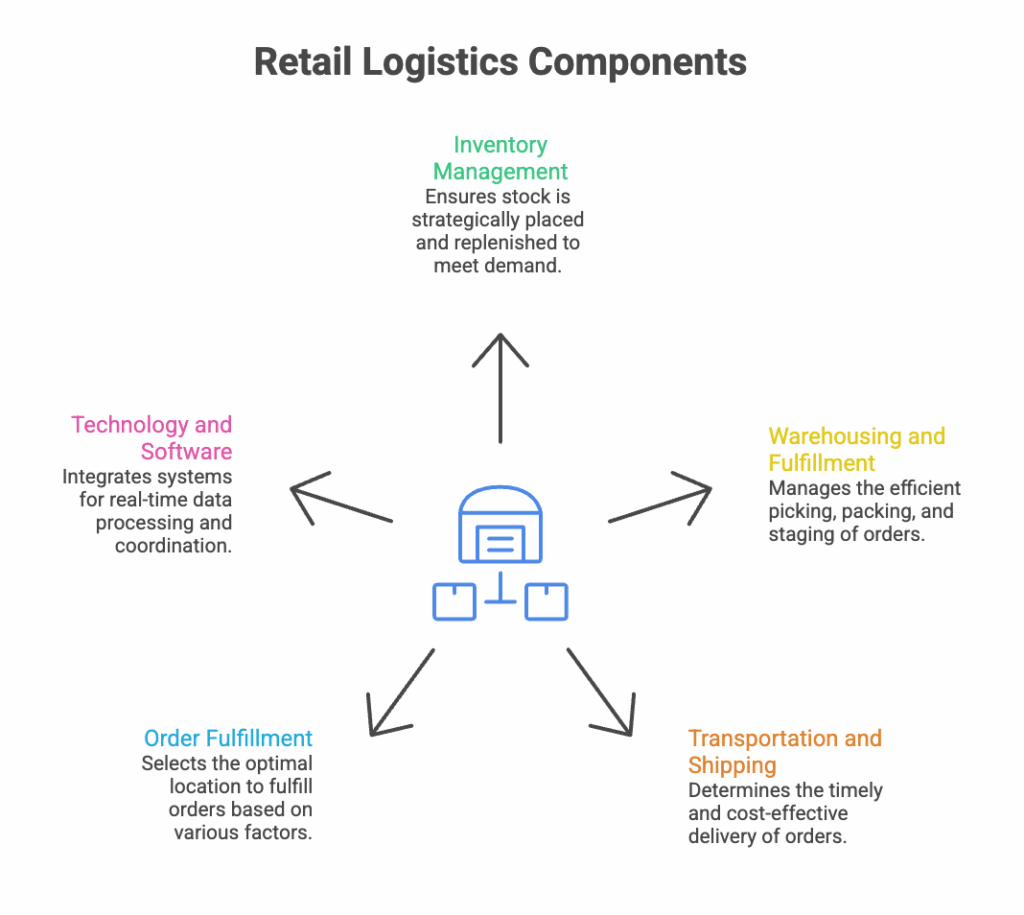
Retail logistics works when multiple operational layers stay coordinated. You see this in how inventory is positioned, how warehouses execute orders, and how deliveries are routed under real demand pressure.
1. Inventory Management
Say a promotion goes live on Friday. By Saturday afternoon, one warehouse is running low because a surge in orders is concentrated in that region, while another location still holds excess stock. If inventory visibility is limited, transfers are delayed and stockouts follow.
Inventory management prevents this by controlling:
- Where stock is placed
- How much is replenished
- When inventory is redistributed
In retail environments, this involves forecasting demand at the SKU level, planning replenishment cycles, and maintaining real-time visibility across distribution centers and stores.
When inventory management works well, fulfillment decisions become faster and more accurate. When it does not, routing and dispatch teams react to shortages instead of executing efficiently.
2. Warehousing and Fulfillment
Once an order is confirmed, it must be picked, packed, and staged for dispatch within a defined service window. During peak periods, thousands of orders move through the facility at the same time. Even small inefficiencies in picking or staging can create delays.
Warehousing and fulfillment operations manage:
- Receiving incoming inventory
- Storing and slotting products efficiently
- Picking and packing orders accurately
- Staging shipments for dispatch
In retail environments, fulfillment may happen from centralized distribution centers, regional hubs, or micro-fulfillment locations closer to customers. Warehouse layout, slotting strategy, and picking workflows directly influence processing speed and order accuracy.
3. Transportation and Shipping
Once orders leave the warehouse, transportation determines whether service commitments are met. Delivery windows must be adhered to, routes must account for geography and traffic, and carrier capacity must match volume.
Transportation and shipping operations manage:
- Line-haul movements between facilities
- Carrier allocation and capacity planning
- Route planning and dispatch decisions
- Last-mile delivery execution
Even small inefficiencies in routing or load planning can significantly increase cost at scale. Extra miles driven, underutilized vehicles, or missed delivery slots directly affect margins and customer satisfaction.
When transportation is planned effectively, deliveries remain predictable and cost-efficient. When coordination breaks down, delays and cost overruns increase.
4. Order Fulfillment
When a customer places an order, the system must decide where it should be fulfilled from. That decision affects delivery speed, shipping cost, and inventory balance across the network.
Order fulfillment coordinates:
- Inventory availability checks
- Fulfillment node selection
- Pick and pack initiation
- Shipment tracking and status updates
In omnichannel retail, fulfillment may happen from a warehouse, a store, or a micro-fulfillment hub. Choosing the wrong facility can increase delivery distance, create stock imbalances, or reduce margin on the order.
Effective order fulfillment aligns inventory location with delivery capacity and service expectations.
5. Technology and Software
Behind every inventory decision, fulfillment choice, and routing plan, a layer of systems processes data in real time. Without that coordination, teams rely on manual checks, spreadsheets, and reactive decisions.
Technology and software in retail logistics typically include:
- Warehouse management systems (WMS)
- Transportation management systems (TMS)
- Dispatch management platforms
- Supply chain management and control tools
These systems connect inventory data, order information, routing logic, and delivery tracking into a unified flow. They enable faster decisions, better visibility across locations, and more predictable execution when integrated.
At the same time, when systems operate in isolation, data gaps appear. Teams spend time reconciling information instead of improving performance.
In theory, each function can perform well. The real difficulty appears when they must respond together to sudden demand shifts, delivery commitments, and cost pressure.
Challenges in Retail Logistics
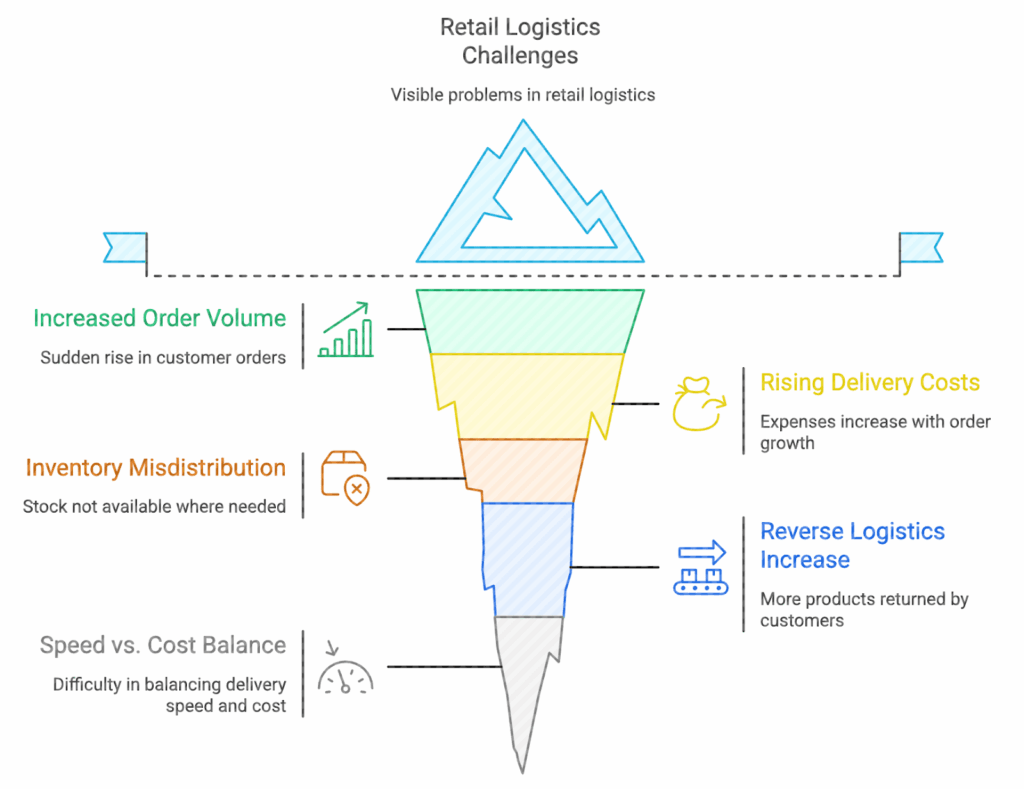
A retailer expands into a new region to support faster delivery. Inventory spreads across more locations, delivery zones widen, and coordination becomes difficult across forecasting, fulfillment, and transportation.
As the network becomes more distributed, maintaining alignment gets harder. Many retail logistics challenges begin when scale increases faster than coordination.
Here are some of the most common challenges retailers face.
1. Sudden Increases in Order Volume
Order volumes can rise quickly during promotions, regional campaigns, or seasonal peaks. When that happens, inventory levels, warehouse capacity, and delivery schedules must adjust immediately. Real-time visibility becomes important because it allows teams to respond before service levels are affected.
Solution
Retailers address this by improving demand visibility and coordination across locations.
With Locus’s Control Tower, you get a unified view of inventory levels, order flow, and dispatch status across the network. With this visibility, teams can rebalance stock, adjust fulfillment decisions, and optimize dispatch before delays and stockouts occur.
2. Delivery Costs Increasing with Scale
As order volumes grow and delivery windows narrow, routing and capacity planning must be optimized carefully. Expanding zones, lower drop density, and stricter timelines directly influence cost per order.
Every routing decision affects distance traveled, fleet utilization, and on-time performance. At scale, even small inefficiencies reduce margin.
Pro Tip
Retail teams reduce delivery cost by improving route density and dispatch precision. They group nearby orders, sequence stops efficiently, and align vehicle capacity with delivery volume.
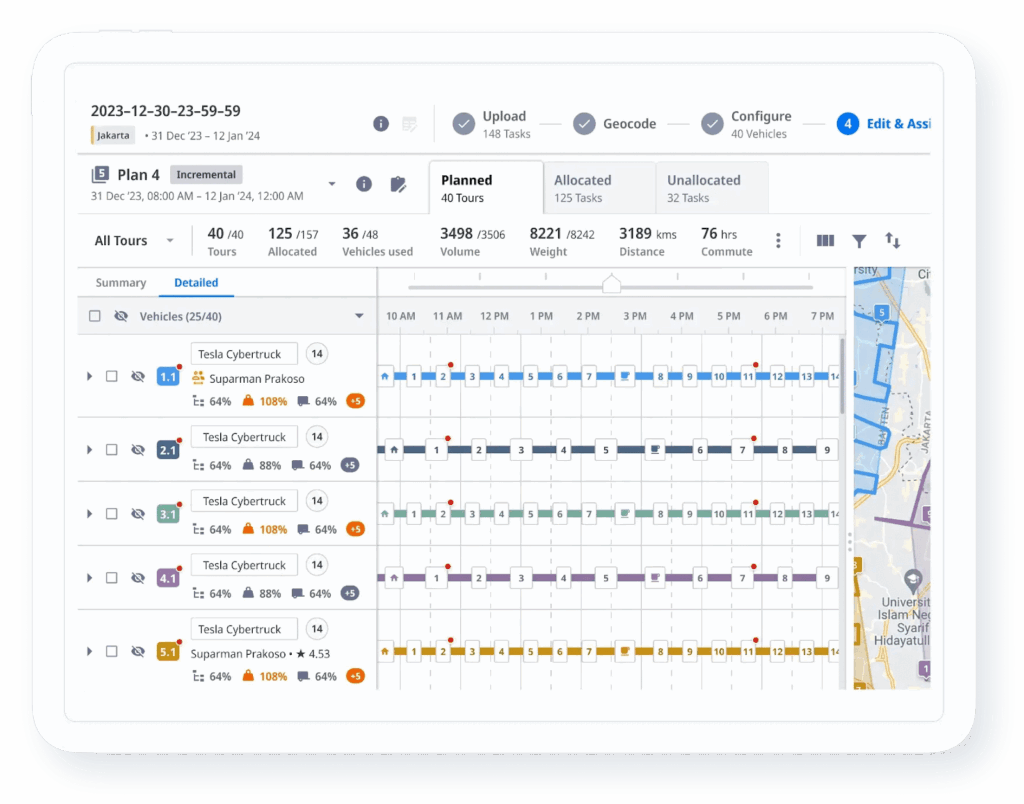
Locus generates optimized delivery routes and automates dispatch decisions based on geography, capacity, and service timelines. This reduces unnecessary miles while maintaining delivery performance.
3. Inventory Not Available Where It’s Needed
A retailer may have enough stock overall, but not in the location where demand shows up (While one warehouse runs out, another still holds excess units.) Orders are then shipped from farther facilities, increasing delivery distance and cost.
The issue is not tied to low inventory, but uneven distribution.
When stock is not positioned correctly, fulfillment decisions become reactive. Shipping distances increase, delivery timelines stretch, and margins start to tighten.
Solution
Retailers improve inventory coordination by maintaining unified visibility across locations and aligning order allocation with current stock levels.
Platforms like Locus use real-time data to optimize fulfillment location selection and dispatch planning, helping teams route orders from the most suitable facility while maintaining delivery performance.
4. Increase in Reverse Logistics
Customers now receive products at home with just a few clicks. Many try items in their own space before deciding whether to keep them. If the product does not meet expectations, they initiate a return almost immediately.
Returns have become a routine part of retail operations, especially after the growth of e-commerce in recent years. The challenge begins after the return request is placed. Products move back through the network for inspection, restocking, or disposal.
Each step requires coordination between warehouses, inventory systems, and refund processing. As return volumes grow, delays in handling and reintegration can affect inventory accuracy, resale speed, and overall margins.
Execution Focus
Retail teams improve return handling by standardizing inspection workflows and updating inventory as soon as items are received. Faster assessment and system updates return products to sellable stock more quickly.
Maintaining visibility across return movement and current inventory levels also helps prevent stock discrepancies and unnecessary replenishment.
5. Balancing Speed, Cost, and Service
Customers expect shorter delivery windows. Same-day and next-day shipping are becoming common across regions. At the same time, retailers must protect margins and maintain operational stability.
Faster delivery often requires:
- Inventory closer to customers
- More dispatch runs
- Tighter route planning
- Higher service commitments
Each improvement in speed increases pressure on cost control. Expanding fulfillment locations raises holding costs. More frequent dispatch increases transportation spend.
The challenge is maintaining delivery performance while preserving margin discipline.
Solution
Retail teams approach speed and cost together rather than treating them separately. They align fulfillment location decisions with routing efficiency and continuously monitor service commitments against delivery cost per order.
When delivery planning is data-driven and coordinated across inventory and transportation, retailers maintain speed without sacrificing profitability.
How Technology Is Reshaping Retail Logistics
Retail logistics has shifted from manual coordination to data-driven execution. As fulfillment networks grow and delivery timelines shorten, decision speed becomes just as important as operational capacity.
Technology now supports real-time visibility, automated planning, and continuous performance monitoring across inventory, fulfillment, and transportation.
AI and Automation in Planning and Dispatch
Retail operations generate large volumes of data that include order flow, inventory levels, route performance, carrier timelines, and service metrics. AI-driven systems process this data continuously to improve decision-making.
Automation supports:
- Dynamic route planning
- Automated dispatch assignment
- Capacity balancing
- Real-time adjustments based on volume changes
Instead of reacting after delays occur, teams can adjust fulfillment and routing decisions proactively.
Platforms like Locus apply AI-based optimization to routing and dispatch planning, enabling retailers to improve service performance while maintaining cost efficiency.
IoT and Real-Time Tracking
Once orders are dispatched, visibility becomes critical. Retailers need to know where shipments are, whether deliveries are on schedule, and how fleet performance aligns with service commitments.
IoT devices, GPS tracking, and integrated tracking systems provide continuous updates on shipment location and delivery status. This improves ETA accuracy and reduces uncertainty across teams and customers.
Real-time tracking also supports operational adjustments. When delays occur, teams can reroute vehicles, update customers proactively, and protect service levels before issues escalate.
Digital Logistics Platforms
As retail networks grow, separate systems for inventory, fulfillment, and transportation create data silos. Teams spend time reconciling information instead of improving execution.
Digital logistics platforms bring inventory data, order flow, routing decisions, and delivery tracking into a unified environment. Instead of reacting to isolated data points, teams gain a connected view of operations across locations.
When systems operate together, decision-making becomes faster and more consistent. Fulfillment allocation, dispatch planning, and delivery performance are managed through shared visibility rather than manual coordination.
Platforms like Locus provide this level of orchestration, enabling retailers to manage planning and execution across the network from a single interface.

Best Practices to Improve Retail Logistics
Retail logistics performance improves when teams focus on five core areas: operational clarity, shared visibility, routing precision, coordinated fulfillment, and disciplined returns management.
Below are the key practices that support this improvement.
- Map and Review Your Current Workflows: Retail teams improve performance by understanding how decisions move across systems. Mapping inventory allocation, warehouse processing, dispatch planning, and delivery execution reveals delays and manual intervention points.
Clear process visibility enables teams to standardize workflows and remove inefficiencies. - Strengthen Inventory and Order Transparency: Performance improves when teams operate with unified data across warehouses, stores, and fulfillment centers. Real-time visibility supports better allocation decisions and reduces reactive corrections.
- Improve Dispatch and Route Planning: Delivery cost and service performance depend on routing accuracy. Retailers benefit from continuously evaluating delivery density, vehicle utilization, and stop sequencing.
Automated routing and dispatch tools improve consistency as volume increases. - Align Order Allocation with Delivery Capacity: Selecting a fulfillment location influences both cost and service. Retailers should align allocation decisions with routing capacity and service commitments, not inventory availability alone.
- Treat Returns as a Core Process: Returns require structured inspection workflows and rapid inventory updates. Clear visibility across returned stock ensures faster reintegration into sellable inventory.
The Future of Retail Logistics, Powered by Locus
Retail logistics shapes how products move from suppliers to warehouses, from fulfillment centers to customers, and back again through returns. It brings together inventory management, warehousing, transportation, fulfillment, and technology into one coordinated system.
We’ve covered how retail logistics operates, the key components that drive it, the challenges retailers face as networks scale, and the practices that strengthen performance. From managing sudden shifts in order volume to controlling delivery cost and improving return processing, consistent execution determines service levels and margin stability.
Looking ahead, retail logistics will rely more on predictive analytics and smarter automation. Deeper integration with e-commerce and omnichannel models will require systems that connect inventory, dispatch, and delivery decisions in real time. Agility and resilience will become core operational capabilities rather than competitive advantages.
Platforms like Locus support retailers in moving from manual coordination to intelligent execution. Locus combines AI-driven route optimization, automated dispatch planning, and centralized visibility across inventory and delivery operations. This enables teams to make faster allocation decisions, design efficient delivery routes, and monitor performance across regions from a unified system.
Instead of reacting to disruptions after they affect service levels, retailers can adjust fulfillment and dispatch decisions proactively based on real-time data.
Explore how Locus strengthens retail logistics for better coordination, visibility, and delivery performance across your network.
Frequently Asked Questions (FAQs)
1. What is meant by retail logistics?
Retail logistics refers to the process of managing how products move from suppliers to warehouses, stores, and customers. It includes inventory management, order fulfillment, transportation planning, and returns handling. Retail logistics ensures products are available where demand exists and delivered within expected service timelines.
2. What are the four major types of logistics?
The four major types of logistics are inbound logistics, outbound logistics, reverse logistics, and third-party logistics (3PL). In retail environments, these functions work together to manage product flow from suppliers to customers and back through returns or exchanges.
3. What is store logistics in retail?
Store logistics focuses on how products move between distribution centers and retail stores. It includes replenishment planning, direct-to-store delivery, inventory updates, and coordination with in-store operations to maintain stock availability and support omnichannel fulfillment models.
4. Why are logistics important in retail?
Logistics directly influence delivery speed, inventory accuracy, and customer satisfaction. Strong retail logistics management helps control transportation costs, maintain service levels, and support scalable operations across regions and channels.
5. How can retailers improve retail logistics performance?
Retailers improve retail logistics by increasing visibility across inventory and delivery operations, refining routing and dispatch planning, and aligning fulfillment decisions with service commitments. Data-driven decision-making and coordinated execution across systems support consistent performance as networks scale.


AI in Action at Locus
The Proof of Delivery Verification: AI-Powered Assurance for Modern Enterprises

Mar 2, 2026
Blurry PODs cost money. Learn how AI-driven Proof of Delivery verification cuts fraud, enforces compliance, and speeds cash cycles for modern logistics networks.
Read more
AI in Action at Locus
Understanding AI for Retail Logistics: Use Cases, Benefits, and Challenges

Mar 3, 2026
AI for retail logistics improves routing, inventory, and dispatch. Learn benefits, use cases, ROI, and how to get started.
Read moreInsights Worth Your Time




















What Is Retail Logistics? Strategy, Challenges, and Best Practices