


E-Commerce
A Comprehensive Guide to Retail Ecommerce Fulfillment

Key Takeaways
- Retail ecommerce fulfillment succeeds when inventory allocation, transportation planning, and delivery commitments are coordinated across the entire network.
- In-sourcing offers direct operational control, outsourcing enables faster geographic reach, and hybrid models combine both strengths. With structured allocation logic, retailers can apply consistent decision-making across owned and partner-operated nodes.
- As omnichannel volumes grow, fulfillment evolves into a network orchestration capability. Orders are dynamically assigned based on proximity, inventory depth, service commitments, and cost alignment, ensuring stable performance across regions.
- Retailers that invest in centralized visibility and automated decision frameworks strengthen margin control, support regional expansion, and deliver consistent customer experiences at scale.

There is a difference between managing a single online store with limited SKUs and fulfilling orders across multiple channels, regions, and delivery partners. Smaller setups can rely on manual coordination, but enterprise retail e-commerce fulfillment demands unified visibility (for example, real-time stock across marketplaces), structured dispatch logic (automatic routing to the nearest warehouse), and consistent SLA execution (meeting same-day dispatch cutoffs) across complex operating environments.
- Inventory sits across stores, warehouses, fulfillment centers, and third-party locations.
- Orders arrive from marketplaces, brand websites, and retail outlets at the same time.
- Delivery promises change depending on location, sales channel, and customer expectations.
- Carrier capacity and shipping rates shift with demand and peak seasons.
Without integrated planning and execution systems, retailers encounter inefficient routing, delayed dispatch decisions, and inconsistent customer experiences.
Retail e-commerce fulfillment requires alignment across inventory allocation, transportation planning, and delivery performance management.
This guide breaks down retail e-commerce fulfillment models, compares strategic approaches, and outlines the technology foundations retailers need to operate reliably at scale.
What Retail Ecommerce Fulfillment Actually Involves
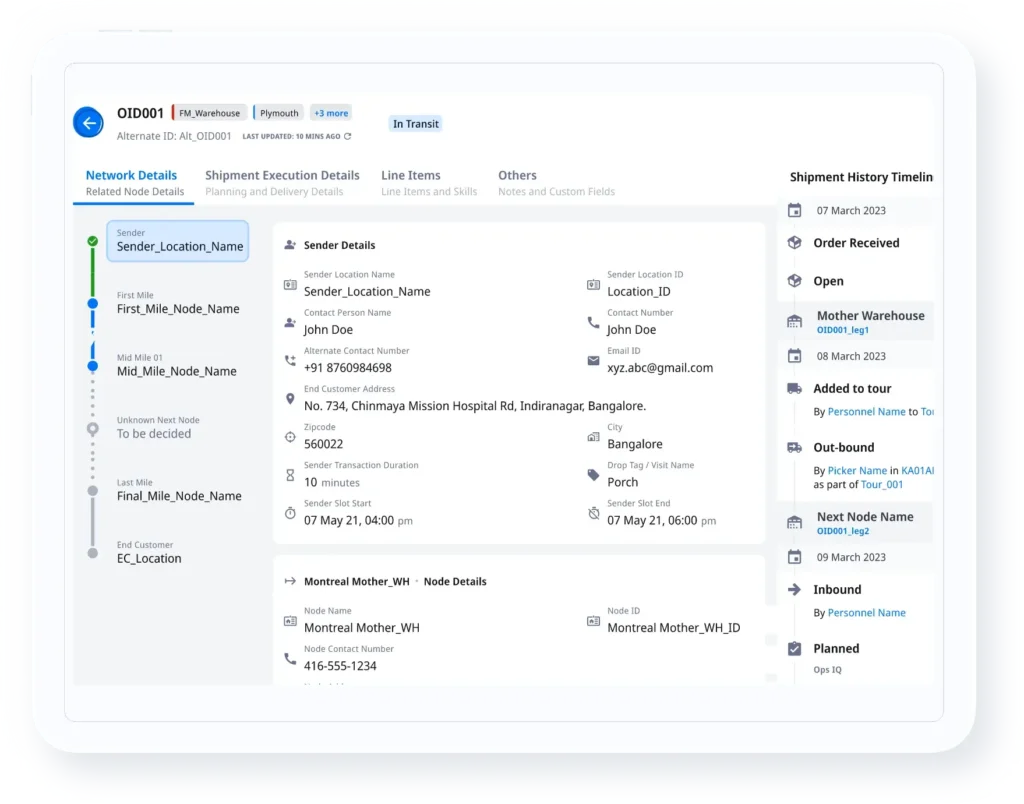
Retail ecommerce fulfillment operates at the level of an individual order. Each transaction is assigned a unique shipment ID, linked to a fulfillment node, scheduled within a defined delivery window, and tracked across the first, mid, and last-mile stages.
Execution begins with dynamic inventory allocation. The system determines which warehouse, store, or partner facility should fulfill the order based on inventory availability, delivery commitment, transportation cost, and regional capacity.
Once assigned, the order moves through structured execution steps:
- Node confirmation and shipment creation
- Dispatch scheduling within defined time slots
- Carrier or fleet allocation
- Real-time status updates across each transit stage
- SLA tracking against promised delivery windows
Traditional retail distribution was designed to move goods in bulk to stores. Ecommerce retail fulfillment treats each order as a distinct delivery commitment, where every routing decision directly impacts cost per order, transit time, and service reliability.
This shift from pallet-based movement to order-level execution requires centralized visibility across all nodes and coordinated decision logic to maintain consistent performance across regions.
Understanding Retail Ecommerce Fulfillment Models
Retail ecommerce fulfillment models determine where inventory sits and how orders move from click to doorstep. The three major models include in-house fulfillment, 3PL fulfillment, and hybrid fulfillment.
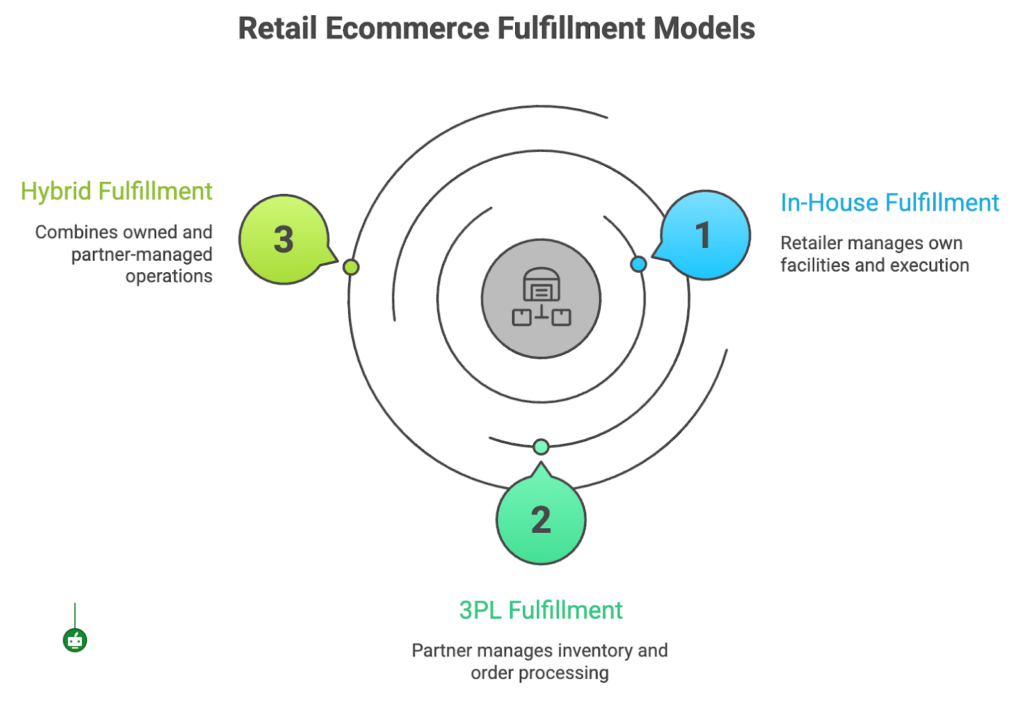
1. In-House Fulfillment
A retailer running in-house fulfillment handles its own facilities and day-to-day execution. Inventory sits inside company-owned distribution centers, orders move through internal routing systems, and picking teams work through planned waves while dispatch choices stay with internal planners.
When peak season hits, the team expands hiring to keep up. When a new region launches, the business looks at leasing or building another warehouse, while carrier agreements are managed directly.
The advantage is clear control, though it also means most of the operational weight lives inside the retailer’s own infrastructure.
2. Third-Party Logistics (3PL) Fulfillment
In a 3PL fulfillment model, inventory is housed within partner-managed facilities rather than the retailer’s own warehouses. Orders flow from the retailer’s ecommerce platform into the 3PL’s warehouse management system, where the partner’s teams handle picking, packing, and carrier handoffs.
If the retailer expands into a new region, the 3PL may already operate facilities there, allowing distribution to scale quickly without building new infrastructure. Carrier coordination, workforce management, and day-to-day warehouse execution remain with the partner.
This setup enables faster geographic expansion and reduces capital investment. At the same time, operational visibility depends on how well systems are integrated, since inventory status and performance metrics are now shared across organizations.
Many omnichannel fulfillment providers operate distributed warehouse networks built to support multichannel order volumes across regions.
3. Hybrid Fulfillment Models
Many enterprise retailers now operate a mix of owned and partner-managed fulfillment. High-volume SKUs may ship from company-run distribution centers, while long-tail inventory sits inside 3PL facilities. At the same time, store locations often act as micro-fulfillment points for same-day or next-day delivery.
An online order might route to the nearest store in one scenario and to a regional warehouse in another, depending on stock levels, service commitment, and delivery feasibility.
At this stage, fulfillment becomes a network-level allocation decision rather than a fixed operational path.
Retail ecommerce fulfillment services that support hybrid models depend on centralized orchestration to ensure routing logic remains aligned across nodes and service levels stay consistent as volume shifts.
Comparing Retail Ecommerce Fulfillment Strategies
Retail ecommerce fulfillment strategies are typically structured around two sourcing approaches: in-sourcing and outsourcing. The choice determines who owns the infrastructure, who manages execution, and how control is distributed across the network.
The comparison below outlines how both models operate across key operational dimensions.
| Evaluation Factor | In-Sourcing Fulfillment | Outsourcing to 3PL / Fulfillment Partner |
|---|---|---|
| Infrastructure Ownership | Retailer owns warehouses, systems, and workforce | Partner owns facilities and operational systems |
| Capital Investment | High upfront investment in facilities, automation, and labor | Lower capital expenditure; primarily contractual costs |
| Operational Control | Full control over routing rules, inventory placement, and SLA management | Control depends on integration depth and service agreement |
| Scalability | Scaling requires new facilities, hiring, and carrier contracts | Faster regional expansion using partner’s existing network |
| Geographic Expansion | Requires physical presence or facility setup in new regions | Can leverage partner footprint, e.g., regional hubs such as retail distribution solutions for ecommerce fulfillment in Dallas |
| Technology Dependence | Retailer must invest in internal systems for allocation and dispatch logic | Execution relies on partner’s warehouse and transportation systems |
| Cost Structure | Fixed costs with potential long-term margin control | Variable cost model aligned to volume |
| Performance Visibility | Direct access to operational metrics and real-time execution data | Visibility depends on reporting transparency and system integration |
| Risk Exposure | Operational risks retained internally | Shared operational risk, but higher dependency on partner performance |
Key Decision Considerations
When selecting a retail ecommerce fulfillment model, retailers typically evaluate:
- Demand Predictability: Stable order volumes support owned infrastructure. Seasonal spikes may require flexible partner capacity.
- Network Complexity: Multi-region operations require centralized allocation logic and performance visibility.
- Capital Allocation Strategy: Long-term margin control versus lower upfront investment.
- Delivery Commitments: Same-day and next-day SLAs demand proximity-based routing and dynamic carrier selection.
- Technology Readiness: Ability to integrate inventory, order, and transportation systems across nodes.
How to Choose the Right Fulfillment Strategy for Ecommerce
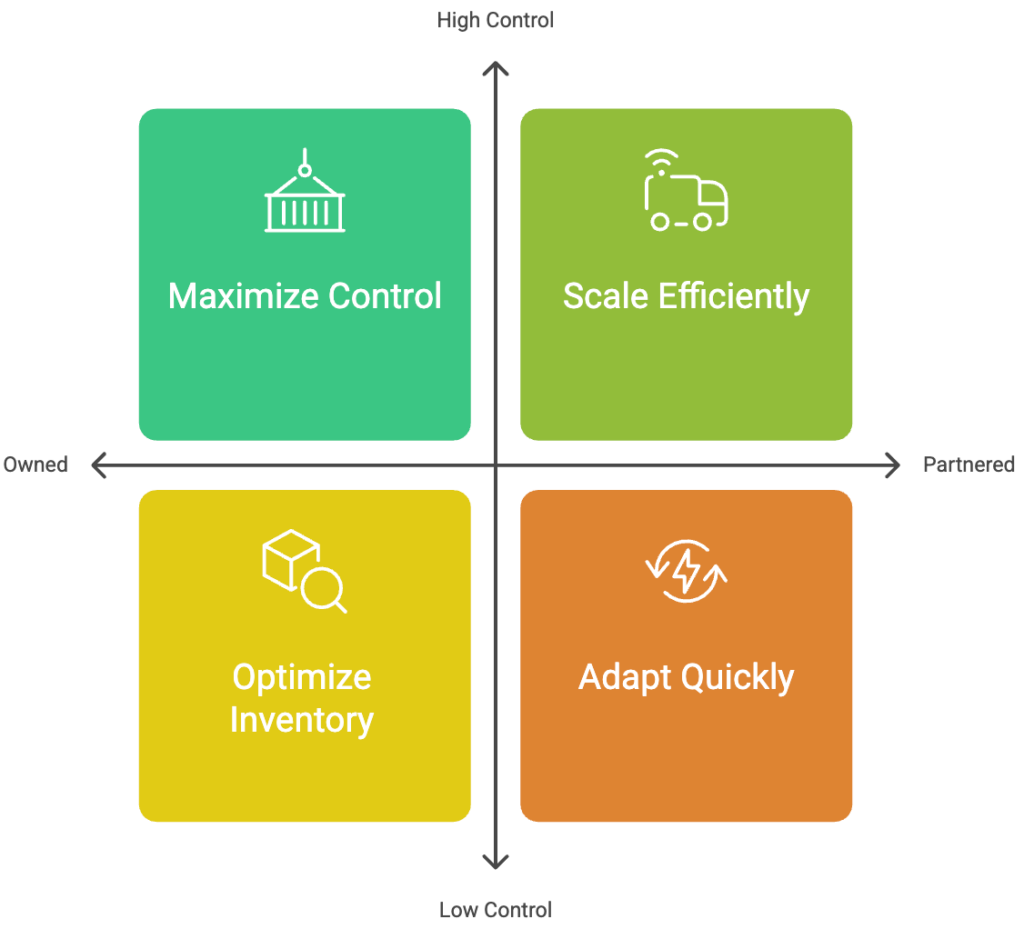
Retailers evaluating ecommerce fulfillment must decide how much execution to retain in-house and where partner capacity adds flexibility. Infrastructure costs, order density, expansion plans, and SLA commitments shape that structure.
The sections below outline how in-house, 3PL, and hybrid models operate in practice so you can assess which approach aligns with your network priorities.
Balancing In-Sourcing and Outsourcing
High-volume, fast-moving SKUs may ship from owned distribution centers where control and margin optimization are prioritized.
Orders are allocated based on proximity, inventory depth, cost impact, and SLA requirements. The allocation logic must remain consistent across all nodes to prevent conflicting routing decisions.
Without centralized coordination, hybrid networks create duplicated effort and uneven service performance.
Adapting to Market Changes
Retail ecommerce fulfillment strategies must adjust to:
- Seasonal demand spikes, such as holiday sales that increase order volumes and compress delivery timelines
- Entry into new geographic markets, where existing warehouse coverage may not support promised service levels
- Channel expansion across marketplaces and stores, which adds new order streams that must align with the same inventory and routing logic
- Changes in carrier capacity and rate structures, including peak surcharges or limited fleet availability, that affect cost and performance
Retailers require configurable rule engines and real-time performance visibility to adjust routing and dispatch decisions without disrupting service levels.
Use Technology for Network Coordination
Hybrid fulfillment environments rely on structured orchestration layers.
Instead of managing each warehouse or partner independently, centralized platforms apply decision logic across inventory allocation, carrier selection, and dispatch scheduling.
Retail supply chain software that integrates order management, transportation planning, and execution tracking enables retailers to:
- Maintain consistent SLA performance
- Reduce shipping cost per order
- Improve inventory utilization across nodes
- Monitor fulfillment performance across regions
Retail e-commerce fulfillment becomes scalable when execution decisions are system-driven.
Key Considerations in Retail Ecommerce Fulfillment
The table below outlines the operational areas that determine how consistently retail ecommerce fulfillment meets delivery commitments while controlling cost.
| Operational Area | What Must Be Managed and Why It Matters |
|---|---|
| Order Processing | Orders must be automatically allocated to the optimal fulfillment node based on inventory availability, delivery promise, and cost impact. Structured routing prevents manual overrides, reduces processing delays, and ensures SLA adherence. |
| Inventory Distribution | Stock must be strategically positioned across stores, warehouses, and partner facilities based on demand forecasts and regional buying patterns. Proper allocation minimizes split shipments, lowers last-mile costs, and prevents stock imbalances. |
| Transportation Planning | Carrier selection should factor in service reliability, transit time, rate fluctuations, and capacity availability. Dynamic carrier allocation reduces shipping costs while protecting delivery commitments. |
| Regional Fulfillment Strategy | Inventory placement decisions must align with customer density and delivery expectations. Locating stock closer to demand clusters shortens transit times and improves same-day or next-day performance. |
| Delivery Performance Monitoring | Real-time tracking of dispatch status, carrier delays, and SLA compliance enables proactive exception handling. Early visibility prevents missed commitments |
Exploring Fulfillment Solutions with Locus
Retailers scaling across owned and partner networks need a system that evaluates allocation, routing, and dispatch decisions in one place.
Locus provides AI-driven orchestration, automated dispatch management, and real-time visibility across the fulfillment network. Decision logic remains consistent across nodes, even as volume and geography expand.
Schedule a demo with Locus today to explore our fulfillment solutions. Build a strategy that fits and scales your team.
Frequently Asked Questions (FAQs)
1. What are the most common challenges in retail e-commerce fulfillment?
Retailers often face inventory fragmentation across multiple nodes, rising shipping costs, inconsistent SLA performance, and limited real-time visibility. As order volumes grow, manual coordination increases routing inefficiencies and delays, making centralized allocation and transportation planning essential for maintaining reliable delivery standards.
2. How can retailers ensure a seamless customer experience in e-commerce fulfillment?
A seamless experience requires accurate delivery promises, real-time order tracking, and proactive exception management. Retailers must align inventory allocation, dispatch scheduling, and carrier performance monitoring to prevent delays and maintain consistent service levels across regions and sales channels.
3. What technologies are essential for optimizing e-commerce retail fulfillment?
Retailers need integrated order management, inventory visibility systems, and transportation planning tools that apply structured allocation logic across nodes. AI-driven dispatch management and centralized performance dashboards help reduce cost per order while maintaining delivery reliability.
4. How do retailers balance cost and efficiency in fulfillment strategies?
Balancing cost and efficiency requires dynamic node selection based on proximity, inventory depth, and carrier rates. Structured decision engines prevent shipping from suboptimal locations and help maintain SLA commitments without inflating transportation spend.
5. What are the benefits of a hybrid fulfillment model?
Hybrid models combine owned infrastructure with partner networks to improve geographic reach and flexibility. When coordinated through centralized orchestration, retailers can optimize allocation decisions across all nodes while maintaining consistent service performance and cost control.


General
ERP vs TMS: What Freight Teams Should Use in 2026

Feb 19, 2026
ERP vs TMS in 2026: see what belongs in each system for freight execution, billing, and visibility. Use the table, then sign up for a free consultation.
Read more
General
5 Operational Pillars of Executable Omnichannel Retail
Feb 20, 2026
Omnichannel retail strategy designed for execution at scale. Learn how to unify inventory, routing, and last-mile delivery. Sign up for a free trial.
Read moreInsights Worth Your Time




















A Comprehensive Guide to Retail Ecommerce Fulfillment