


General
ERP vs TMS: What Freight Teams Should Use in 2026
Key Takeaways
- ERP vs TMS comes down to their respective roles in supply chain: ERP runs orders, finance, and governance, while TMS runs transportation execution and daily freight decisions.
- If dispatchers rely on calls, spreadsheets, and manual rework to handle exceptions, you likely need a stronger TMS execution layer alongside ERP.
- Use the table to decide what stays in ERP (system of record) and what belongs in TMS (routing, tendering, rescheduling, carrier performance).
- In 2026 freight operations, adaptive planning matters because plans shift mid-day, and teams still need stable ETAs and controlled cost-to-serve.
- Locus supports real-time rescheduling, automated allocation, and ERP sync so execution stays controlled when the original plan changes.
Freight teams hit the same wall once volumes grow and delivery windows tighten. Enterprise Resource Planning (ERP) keeps orders, inventory, and financial controls clean. It tells you what shipped, what it cost, and what should happen next.
Then the day changes. Docks run late, carriers reject tenders, urgent orders arrive, and the morning plan stops matching reality. That is where a Transportation Management System (TMS) matters. It runs the transportation layer, handling tendering, routing, dispatch changes, and in-transit exceptions so execution stays controlled as constraints shift.
This guide breaks down what belongs in ERP vs TMS, where WMS fits, and how to choose the right split for freight teams in 2026.
What Is an ERP System?
An ERP system runs the business as a single system of record. For logistics and supply chain teams, that typically means it owns orders, inventory, procurement, finance, and the rules that keep data consistent across departments.
In freight terms, ERP is where demand becomes an order, an order becomes a shipment request, and a shipment request becomes something finance can track. It manages master data (items, locations, carriers as vendors, contracts), ties activity to budgets and cost centers, and supports approvals, audit trails, and reporting.
Typical Use Cases in Logistics and Supply Chain
Most logistics leaders rely on ERP for upstream and downstream coordination, even when transportation execution happens elsewhere.
- Order-to-ship workflows: Order capture, allocation rules, promised dates, and fulfillment milestones.
- Procurement and vendor management: Carrier onboarding as vendors, contract references, and payment terms.
- Freight accruals and invoice processing: Cost booking, approvals, GL coding, and payment workflows.
- Enterprise reporting: Cost-to-serve rollups, lane-level spend, and period-close support.
- Cross-team visibility: Aligning customer service, finance, and supply chain around the same order and cost data.
Pros and Cons for Freight-Focused Operations
We’re narrowing in on freight-focused operations because that is where the “Having an ERP is enough” assumption breaks first, especially once tendering, routing, and exceptions become daily work.
Where ERP works well for freight:
- Keeps order, inventory, and financial data clean and auditable across the business
- Supports standardized processes for approvals, payments, vendor records, and reporting
- Helps finance and supply chain align on what was shipped and what it cost
Where ERP struggles in freight execution:
ERP is built around planned flows. Freight execution rarely behaves that way at scale.
When dispatch needs to rebalance routes, reassign loads, insert urgent orders, or switch carriers mid-cycle, teams often do it outside ERP because it is not built for rapid, constraint-based re-planning.
Then you get the familiar split: dispatch runs reality in one place, ERP records it later, and the business spends time reconciling what happened and what it should cost.
What Is a Transportation Management System (TMS)?

A Transportation Management System (TMS) runs transportation as an operating function. It sits closer to dispatch and carrier networks, where decisions need to be made quickly and repeated frequently.
In practical freight terms, a TMS typically handles:
- Load and shipment planning: Consolidating orders into loads, selecting modes, setting service rules and cutoffs
- Carrier selection and tendering: Assigning carriers based on cost, capacity, SLA, and lane history, then managing accept/reject cycles
- Dispatch execution: Assigning vehicles or linehaul legs, sequencing stops, and pushing plans to teams on the ground
- Tracking and exception handling: Monitoring delays, missed pickups, failed deliveries, and updating ETAs as things change
- Freight rating and billing workflows: Rate tables, accessorial logic, invoice matching, and dispute support
- Carrier performance: On-time rates, tender acceptance, detention exposure, damage claims, and scorecards
ERP can store many of these data points. A TMS is built to run them.
How a TMS Creates Day-to-Day Control
The value of a TMS shows up when the day stops going to plan, which is most days at scale. A TMS supports continuous execution decisions: rebalance loads when volumes change, re-tender when capacity drops, adjust for dock delays, and keep ETAs usable without forcing dispatch to rebuild plans manually.
The Difference Between TMS vs WMS vs ERP
WMS comes up in ERP vs TMS discussions because warehouse cutoffs, picking delays, and dock readiness are what usually break transportation plans, so you need a clean boundary across all three. It helps to separate these systems by what they execute:
- ERP: Enterprise planning and system of record. Owns orders, procurement, inventory value, finance, and reporting.
- WMS: Warehouse execution. Owns receiving, putaway, picking, packing, staging, and dock activity.
- TMS: Transportation execution. Owns shipment planning, dispatch, carrier workflows, in-transit changes, and transportation cost events.
A simple way to see it: ERP knows what needs to move and what it should cost. WMS manages how it gets prepared. TMS controls how it moves, who moves it, and what happens when the plan changes after the truck leaves the yard.
ERP vs TMS: Key Differences
The quickest way to choose between ERP and TMS is to compare how each system behaves when freight gets messy: last-minute order changes, carrier rejections, dock delays, and shifting capacity.
| Decision Area | ERP (Enterprise Resource Planning) | TMS (Transportation Management System) |
|---|---|---|
| Primary role | System of record for orders, inventory value, finance, and reporting | System of execution for transportation planning, dispatch, and in-transit control |
| Time horizon | Best with planned flows and scheduled updates (daily/weekly) | Built for frequent changes (hourly and real-time) |
| What it optimizes | Financial accuracy, governance, cross-team consistency | Cost-to-serve, on-time performance, capacity use, routing decisions |
| Planning style | Plan, then record outcomes | Plan, execute, re-plan as constraints change |
| Exception handling | Often handled outside, reconciled later | Handled inside execution workflows (retender, resequence, reassign) |
| Data granularity | Orders, SKUs, invoices, cost centers, vendor records | Shipments, stops, loads, lanes, capacity, service constraints |
| Carrier management | Vendor records, contracts, and payments | Tendering, acceptance, scorecards, and accessorial tracking |
| Freight billing | Strong approvals, invoice processing, and GL coding | Strong rate logic, event-based charges, audit and disputes |
| Visibility | Enterprise rollups and reporting | Operational views for dispatch, in-transit status, and service risk |
| Best-fit outcome | Audit-ready reporting and standardized controls | Reliable execution under change with fewer manual interventions |
| Integration dependency | Often needs a transportation layer for live decisions | Feeds clean outcomes and costs back into ERP |
For day-to-day execution, this table makes the boundary clear. Keep ERP as the backbone. Use a TMS for transportation, where re-tendering, resequencing, and exceptions happen in real time.
ERP vs TMS: Some Key Freight and Logistics Use Cases
If your team spends the day reconciling dispatch issues back into ERP, these use cases will look familiar. They explain why execution belongs in a TMS, while ERP remains the system-of-record.
1. Transportation Execution and Route Optimization
This is where the gap in ERP vs TMS shows up. When routes are stable and volumes are predictable, an ERP-led process can look “good enough.” But once you’re running tight delivery windows, mixed service levels, and frequent exceptions, execution becomes a live control problem.
What changes mid-day is familiar. An urgent order lands after a cutoff, a carrier rejects a tender, a dock runs late, a vehicle goes offline, or a customer asks for a new time window.
ERP can capture outcomes later, but it is not built to continuously re-plan routes and assignments while protecting cost-to-serve and SLA commitments. Dispatch compensates with manual coordination, and you see the symptoms quickly, including overtime, more calls, “best guess” ETAs, and inconsistent performance.
Suggested Read: The Rise of the Modern TMS: Revolutionizing Logistics
2. Freight Billing and Carrier Management
Freight billing is one of the reliable ways for ERP and transportation teams to get stuck in reconciliation mode. ERP is strong once the cost is known: approvals, coding, payment workflows, and clean audit trails.
Freight costs rarely arrive as one clean, final number. They show up in pieces, across different events, and often after the shipment is already closed. Accessorials, detention, redelivery, fuel surcharges, and lane exceptions create gaps between what was expected and what was billed.
A TMS helps because it ties charges back to transportation events and carrier behavior. It records tender acceptance and rejection, tracks what happened in transit, and links those events to rate logic. That reduces after-the-fact cleanup and makes carrier performance usable in future decisions.
3. Inventory and Order Coordination Across Systems
Freight integration does not start with the truck. It starts with order release logic, inventory availability, warehouse cutoffs, and customer promises. That’s why ERP, WMS, and TMS boundaries matter.
Common coordination points where systems must stay aligned:
- When orders are released for picking and staged for dispatch
- When partial inventory creates split shipments or backorders
- When cutoffs shift due to warehouse congestion or labor constraints
- When transportation capacity forces reallocation across regions or modes
- When customer service needs accurate ETAs tied to what is physically possible
When ERP contains the “official” order status but dispatch runs reality elsewhere, customer service shares outdated ETAs, finance accrues the wrong costs, and ops spends hours doing manual updates that do not scale.
A TMS narrows that gap by keeping execution data consistent and syncing outcomes back into ERP.
How Locus Enhances TMS and ERP Capabilities
As an end-to-end logistics solution for all miles, Locus fits best when you already have ERP in place (and often a TMS too), but execution still depends on dispatchers manually fixing plans as constraints change.
Instead of treating transportation like a static schedule, the platform supports continuous execution decisions while keeping ERP and downstream teams aligned on what changed and why.
Route Planning
Route plans break for predictable reasons at scale: demand spikes after cutoff, capacity shifts, tighter service windows, and on-ground delays.
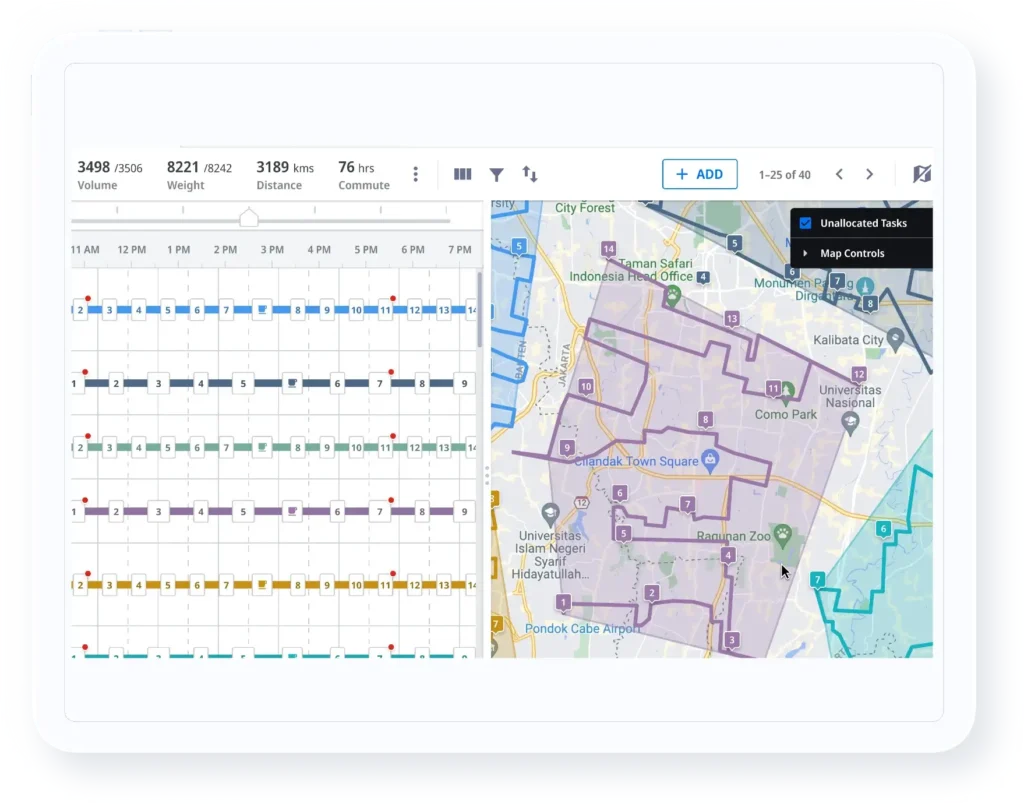
Locus supports live route rebalancing and rescheduling logic, so the plan reflects what is actually possible, not what looked possible earlier in the day.
Track and Trace
Carrier choice is rarely “lowest rate wins” once you factor in what actually happens after tendering: whether the carrier accepts on time, how often they run late on that lane, and what service failures cost you.
- Acceptance probability: A low rate does not help if the carrier rejects, responds late, or forces you into a higher-priced backup.
- Reliability by lane: On-time performance varies by lane, day-of-week, and facility behavior, so historical lane outcomes matter.
- Service-failure costs: Late-delivery chargebacks, detention, missed delivery windows, stockouts, and rescheduling labor often erase the “cheapest” rate.
So the best carrier is the one with the highest expected performance at the lowest total cost, not the lowest quoted rate.
Locus supports allocation logic that can prioritize cost, SLA, capacity, or customer tier, and then tracks performance against those choices so carrier decisions improve over time.
Seamless Sync With ERP
ERP remains the system of record for orders, financial controls, and reporting. Locus complements it by syncing execution outcomes back to ERP, so teams avoid the split where dispatch runs reality in one place, and ERP catches up later.
The goal is simple: cleaner order status, tighter cost traceability, and fewer manual reconciliations.
Suggested Read: Integrate Legacy TMS with Locus for Seamless Logistics
- For a quick refresher on the basics, you can also reference: What is Logistics Management? Definition and Overview
ERP vs TMS: Example Workflows
These two workflows show where ERP ends, and transportation execution begins. Use them to spot the handoff points that usually create rework, like mid-shift order changes, tender rejections, and ETA drift. If your dispatch reality lives outside the system that finance and customer teams rely on, these are the failure loops you will recognize first.
Workflow 1: Retail Multi-Drop Replenishment With Mid-Day Order Adds
- ERP knows: Store orders, priorities, promised dates, and financial coding.
- TMS executes: Initial load plan and dispatch.
- Where it breaks: Urgent store additions come in after routing is finalized, or a few stops run late and the rest of the route slips.
- What Locus improves: Rebalances stops across vehicles, updates ETAs based on current constraints, and pushes one updated operational version to teams.
Workflow 2: 3PL Linehaul + Last-Mile Handoff With Carrier Variability
- ERP knows: Customer SLAs, billing rules, shipment references.
- TMS executes: Tendering and milestone tracking.
- Where it breaks: Tender rejections, capacity swaps, late arrivals at the cross-dock that cascade into missed last-mile slots.
- What Locus improves: Supports rapid allocation changes and rescheduling, then syncs outcomes so finance and customer teams see the same final picture
ERP vs TMS: Making the Final Call Conclusion
ERP vs TMS is rarely a choice between competing platforms. The real decision is ownership.
Keep ERP as the system-of-record for orders, master data, financial controls, and enterprise reporting. Use a TMS to run transportation execution, including tendering, dispatch changes, and exception handling as conditions shift.
If dispatch work routinely happens in calls and spreadsheets, you are already paying for the gap through unreliable ETAs, higher dispatcher load, and after-the-fact cost cleanup.
As an end-to-end logistics solution for all miles, Locus helps by strengthening execution with real-time rescheduling, automated allocation logic, and tighter ERP sync so operations and reporting stay aligned when conditions change.
To learn more, get a demo.
Frequently Asked Questions (FAQs)
1) Can an ERP replace a TMS for freight execution?
In most cases, no. ERP systems track orders, costs, and approvals well, but freight execution needs live decisions like tender retries, route changes, and ETA updates. A TMS is built for transportation workflows that change throughout the day.
2) When do you need a TMS if you already use ERP transportation modules?
You typically need a TMS when manual coordination becomes the default. Signs include frequent tender rejections, route rework, unreliable ETAs, higher dispatcher workload, and too much time spent reconciling freight costs and service issues after shipments move.
3) What is the difference between TMS vs WMS vs ERP in one fulfillment flow?
ERP owns the order and financial records. WMS runs warehouse execution like picking, packing, staging, and dock activity. TMS runs transportation execution like carrier selection, dispatch, routing, and in-transit exception handling. Each system supports a different execution layer.
4) What integrations matter most for ERP + TMS freight workflows?
The most important integrations are order release to shipment planning, shipment status and proof-of-delivery updates back to ERP, and freight cost data tied to shipment events. These keep customer service, finance, and logistics working from the same outcomes.
5) How does real-time rescheduling improve freight performance?
Real-time rescheduling helps teams respond when the plan changes mid-day due to capacity shifts, delays, or urgent orders. It reduces dispatcher firefighting, keeps ETAs usable, and helps control cost-to-serve by making adjustments inside the workflow, not in spreadsheets.


General
Best Transportation Scheduling Software in 2026

Feb 19, 2026
Best scheduling software for dense delivery networks. Review constraint handling, mid-shift adjustments, and scale performance.
Read more
E-Commerce
A Comprehensive Guide to Retail Ecommerce Fulfillment
Feb 20, 2026
Retail e-commerce fulfillment guide covering models, hybrid strategies, regional distribution, and technology to improve cost control and delivery performance.
Read moreInsights Worth Your Time




















ERP vs TMS: What Freight Teams Should Use in 2026