


General
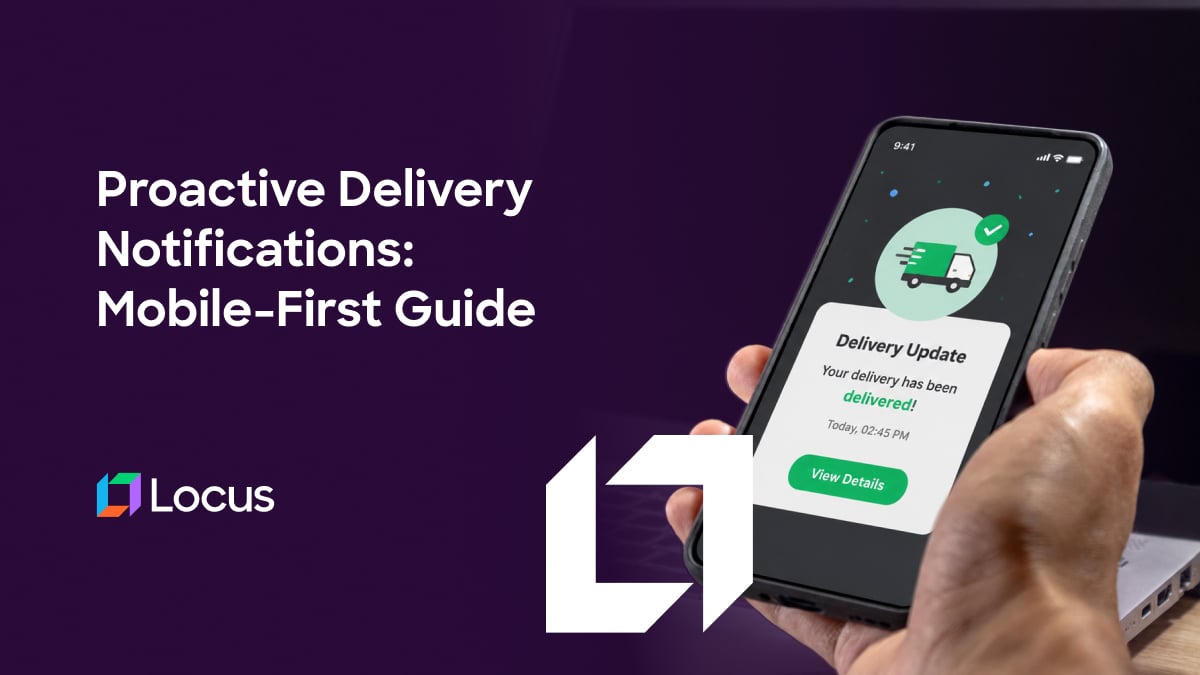
Proactive Delivery Notifications in 2026: The Complete Guide to Mobile-First Delivery Experience
Key Takeaways
- Proactive delivery notifications tell the customer what is happening before they think to ask. Reactive tracking makes them come looking, which is why a tracking page alone does not reduce contact volume or failed deliveries.
- Proactive customer notifications operate at five moments: order confirmation, pre-dispatch window, out-for-delivery with a live ETA, exception or delay, and post-delivery confirmation. Most operations run two of the five and describe it as a notification programme.
- Mobile-first is not a design preference. The notification arrives on a phone, is read in seconds, and either produces an action or does not, which changes what the message must contain and how the tracking view must behave.
- Notification performance is measurable on four numbers: WISMO contact deflection, first-attempt delivery rate, notification-to-tracking-view rate, and ETA accuracy at the moment of promise.
Why Reactive Tracking Is Not Enough
Most delivery experience programmes begin and end with a tracking page. The customer is given a link, and if they want to know where their order is, they can go and look.
That design has a structural flaw: it only helps customers who are already worried. By the time someone opens a tracking page, they have decided something might be wrong. The contact you were trying to prevent is often already in flight, and the delivery you were trying to complete may already have failed because the customer stepped out having no idea when to expect anyone.
The economics make this expensive rather than merely suboptimal. Each failed first attempt costs roughly $17.78 (OrangeMantra) before any account of the customer relationship, and last-mile carries 41 to 53% of total logistics cost (Capgemini Research Institute). Failed attempts and inbound “where is my order” contacts are the two highest-volume symptoms of the same underlying condition: the customer knows less than the operation does.
Proactive delivery notifications invert that model. Rather than waiting to be asked, the operation tells the customer what is happening at the moments that matter, on the device they are holding, with enough specificity to act on.
What Proactive Delivery Notifications Actually Are
Proactive delivery notifications are automated, event-triggered communications sent to a recipient at defined points in the delivery lifecycle, containing current status and a revised expectation, without the recipient requesting them.
The distinction from tracking is direction. Tracking is pull: the customer initiates. Proactive notification is push: the operation initiates, on the operation’s knowledge, before the customer’s concern.
A complete proactive delivery notifications programme covers five moments:
- Order confirmation with an initial commitment. What was bought, and the delivery window being promised. This is the first place a promise can be made unachievable, and the first place accuracy pays.
- Pre-dispatch window narrowing. The evening before or the morning of, when the route is planned and a four-hour window can become two. This is the single highest-value notification for keeping the customer available.
- Out for delivery with a live ETA. Not “your order is on its way,” which tells the customer nothing actionable, but a time estimate they can plan around, updated as the route runs.
- Exception or delay notification. The one most operations skip and the one that determines whether a bad delivery becomes a lost customer. Sent when the operation detects the problem, not when the window expires.
- Post-delivery confirmation. Proof of completion, placement detail where relevant, and a route into returns or support that does not require starting from scratch.
Most operations run moments one and three, and describe it as a notification programme. Moments two and four are where the measurable outcomes sit.
Also Read: The WISMO Tax: Quantifying What Poor Delivery Communication Costs European Retailers Per Order
Where This Fits: Delivery Experience Optimization Defined
Delivery experience optimization is the practice of improving every customer-facing interaction across the delivery lifecycle, from the promise made at checkout through live tracking, arrival, and confirmation, by connecting customer communication to real operational data. Proactive delivery notifications are its most visible component, and they depend on the rest of it: a notification is only as good as the operational truth behind it.
Why Mobile-First Design Matters
The notification arrives on a phone. That single fact determines the design constraints, and getting them wrong wastes the notification entirely.
The message is read in seconds, in a notification shade, often without being opened. The critical information has to survive truncation. “Your delivery is arriving between 2 and 4pm” works. “Update regarding your recent order” does not, because it requires a tap to convey anything, and most people will not tap.
The tracking view is opened one-handed, on cellular, possibly outdoors. That argues for a lightweight page, a legible ETA above the fold, and a map that is supporting evidence rather than the primary content. Desktop-designed tracking pages fail here in a predictable way: the ETA ends up below a large map that takes three seconds to load.
The channel changes the contract. SMS is intrusive and reliably read, so it should carry the moments that require action: window narrowing and exceptions. Email is tolerant of length and poorly read in the moment, so it suits confirmations and receipts. Messaging channels such as WhatsApp sit between the two and allow a reply, which means someone has to be able to receive it.
The action must be one tap. Reschedule, redirect, add a delivery instruction, or contact support. A notification that surfaces a problem the customer cannot act on generates the contact it was meant to deflect.
Worth noting on customer priorities: Locus’s Q2 2026 consumer research found reliability outranking raw speed as a delivery preference, with 56% prioritizing reliability against 34% prioritizing speed. That finding is the commercial argument for notification investment. An accurate window communicated well beats a faster window communicated badly, and notifications are how reliability becomes visible to the customer.
The Five Components of a Proactive Delivery Notification System
1. Event Triggers Tied to Operational Reality
Proactive customer notifications must fire on operational events, not on a schedule. A message sent at 08:00 saying “out for delivery” when the vehicle left at 09:40 is worse than no message, because it trains the customer to distrust the channel. Triggers should read from live dispatch and execution state: route dispatched, vehicle en route, stop approaching, exception raised, delivery completed.
2. Multi-Channel Delivery With Channel Logic
Supporting SMS, email, and messaging channels is table stakes. The capability is choosing correctly per moment and per recipient, respecting consent and locale, and failing over when a channel bounces. Channel choice should be a rule, not a global default.
3. Dynamic ETA Recalculation
The component that separates real systems from templated ones. An ETA fixed at dispatch is a guess that ages badly across a sixty-stop route. Dynamic recalculation reads route progress, traffic, and actual service times, and pushes a revised expectation when the change is material. The design decision that matters: define a materiality threshold, because notifying on every minor recalculation is its own form of noise.
4. Exception Escalation
When the system detects that a promise will break, two things must happen: the customer is told early with a revised expectation, and the operation is given the chance to recover before telling them. Sequencing matters. A notification programme that announces failures it could have prevented is well-instrumented and badly wired.
5. Post-Delivery Feedback Loop
Completion is a data point, not an ending. Proof of delivery, a lightweight satisfaction signal, and a clean path into returns or support close the loop, and the response data feeds back into which notifications actually reduced contacts. Without this component the programme cannot be improved, only maintained.
How to Measure Proactive Delivery Notification Performance
Proactive delivery notifications are measurable on four numbers, and the second is the one finance cares about:
| Metric | Definition | What it reveals |
|---|---|---|
| WISMO contact deflection | Inbound “where is my order” contacts per thousand shipments, trended before and after | Whether notifications are reaching people in time to answer the question they were going to ask |
| First-attempt delivery rate | Deliveries completed on first attempt over deliveries attempted | Whether notifications are keeping customers available, at roughly $17.78 saved per failure avoided |
| Notification-to-tracking-view rate | Share of notifications that produce a tracking view | Whether the message is being read and is worth opening |
| ETA accuracy at promise | Share of communicated ETAs landing inside their stated tolerance | Whether the notification programme is trustworthy, which governs all three metrics above |
ETA accuracy is the foundational one. A notification programme built on inaccurate ETAs will show declining engagement over time regardless of design quality, because customers learn.
Customer sentiment measures such as NPS or CSAT lift are worth tracking as directional confirmation, and they move too slowly and with too much noise to steer a notification programme week to week.
Also Read: WISMO Costs You Twice: The Support-Ticket Math Behind Poor Delivery Communication in 2026
Three Approaches to Proactive Delivery Notifications Compared
| Dimension | Manual and template-based | Automated rules-based | AI-driven and orchestrated |
|---|---|---|---|
| Trigger source | Status changes in a carrier feed, often batched | Defined operational events | Live execution state plus predicted risk |
| ETA basis | Static transit assumption | Planned route times | Recalculated from live progress and learned service times |
| Exception handling | Notified after the window is missed | Notified when the exception is raised | Predicted before the miss, with recovery attempted first |
| Channel selection | One default channel | Rule-based per event | Rule-based with per-recipient and locale logic |
| Improvement over time | Manual template edits | Manual rule edits | Recalibrates from outcome data |
| Typical failure mode | Messages that contradict reality | Accurate messages sent too late to act on | Requires operational data quality to deliver value |
The middle column is where most enterprise proactive delivery notifications programmes sit, and the gap that matters is timing rather than accuracy. Rules-based systems send true messages after the point at which the customer or the operation could have done something with them.
How Locus Handles Proactive Delivery Notifications
Locus generates customer notifications from the same operational state that plans and dispatches the delivery, which is the architectural reason its ETAs and its notifications agree with each other. The platform is the world’s first Decision-Intelligent, Agentic Transportation Management System, and customer communication runs as one of its agent domains rather than as a messaging layer reading a status feed.
Practically, that means notifications fire on live execution events rather than batch status updates; ETAs recalculate as routes progress and push revised windows when the change is material; exceptions are detected against promise risk, so recovery is attempted before the customer is told a delivery will be late; branded tracking pages carry live status and ETA on mobile; and supported channels include SMS, email, and WhatsApp where configured. Because the platform models 250+ real-world constraints when planning, the window being communicated is one the operation can actually hold.
Also Read: Predicting Delivery-Promise Risk in European Retail
At scale: 1.5B+ deliveries orchestrated for 360+ enterprise customers across 30+ countries, at 99.99% platform uptime. Locus is included in the 2026 Gartner Hype Cycle across AI-powered logistics categories.
For the full customer-facing capability set, see the delivery experience optimization page, the deeper guide on delivery experience optimization in 2026, and the companion piece on delivery notification software.
Learn more, visit locus.sh
Frequently Asked Questions (FAQs)
What are proactive delivery notifications?
Automated, event-triggered messages sent to a recipient at defined points in the delivery lifecycle, containing current status and a revised expectation, without the recipient asking. They differ from tracking, which requires the customer to come looking.
What is the difference between reactive tracking and proactive notifications?
Tracking is pull: the customer initiates, usually once already concerned. Proactive notification is push: the operation initiates on its own knowledge, before the concern forms. Only the second reduces contact volume and failed deliveries, because it reaches customers who were not going to check.
How do proactive delivery notifications reduce failed deliveries?
Mainly through the pre-dispatch window notification, which tells the customer a narrowed window while they can still plan around it, and through exception notifications that reset expectations early enough to reschedule rather than fail. Each failure avoided saves roughly $17.78 (OrangeMantra) plus the relationship cost.
What makes a delivery notification mobile-first?
Critical information surviving truncation in a notification shade, a lightweight tracking view with the ETA above the fold, channel choice matched to urgency (SMS for action, email for records), and any offered action reachable in one tap.
Which notification moments matter most?
Pre-dispatch window narrowing and exception notification. Most operations already send order confirmation and out-for-delivery messages; the two that are usually missing are the ones that change delivery outcomes rather than just informing.
How do you measure proactive notification performance?
WISMO contact deflection per thousand shipments, first-attempt delivery rate, notification-to-tracking-view rate, and ETA accuracy at the moment of promise. ETA accuracy is foundational, because inaccurate promises degrade engagement with every other metric over time.
What is delivery experience optimization?
The practice of improving every customer-facing interaction across the delivery lifecycle, from the checkout promise through tracking, arrival, and confirmation, by connecting customer communication to real operational data. Proactive delivery notifications are its most visible component.


General
Top 10 Delivery Experience Optimization Platforms for E-Commerce and 3PLs (2026)

Aug 6, 2026
A buyer's guide to delivery experience optimization software for e-commerce brands and 3PLs: six evaluation criteria, ten platforms grouped by fit with limitations named, a comparison table, and separate e-commerce and 3PL considerations.
Read more
General
Real-Time Tracking and Visibility in 2026: How Control Tower Software Gives Logistics Managers One View Across Every Delivery

Aug 6, 2026
How real-time tracking and visibility works through control tower software: the capabilities that matter, what separates a dashboard from a control tower, and an FMCG deployment that cut distance per order 34%.
Read moreInsights Worth Your Time



















Proactive Delivery Notifications in 2026: The Complete Guide to Mobile-First Delivery Experience