


General
OMS and TMS in Omnichannel Retail: Where the Node Decision Should Live in 2026
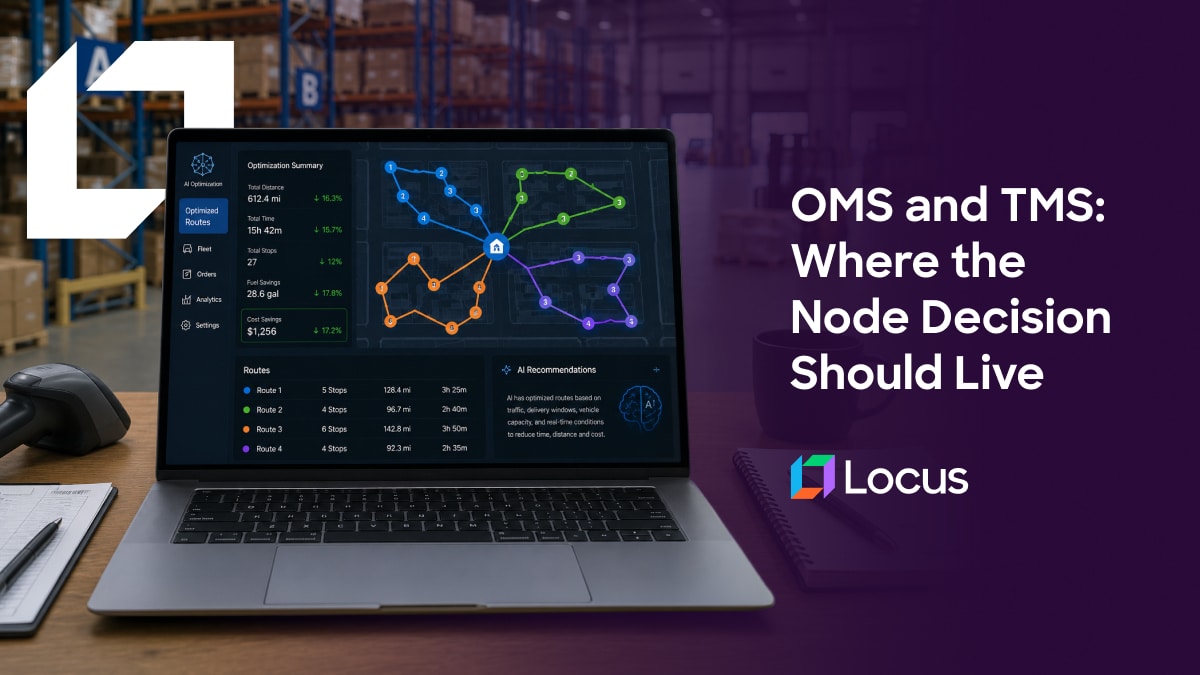
The node decision in omnichannel retail is the choice of which store, dark store, micro-fulfillment site or distribution center fulfills an order, and in most architectures it is owned by a distributed order management system and handed to a transportation management system as a fixed input. That boundary was correct when origins were fixed and is wrong now, because node selection and route construction are two halves of one optimization problem sitting in two systems with no shared objective, no iteration and no compensating path when the node turns out to be wrong. For a logistics technology owner the question is not which system is better. It is where the decision should live, and what has to be true for it to live there.
Key Takeaways
- Node selection and routing are one optimization problem split across two systems by a one-way handoff that bakes the origin into the payload.
- Three architectures are available: DOM decides and TMS routes, DOM proposes and TMS scores before commit, or a single layer decides both. Each has a different latency and integration cost.
- The two-phase option is the common instinct and the hardest to build, because a route-cost call has to fit inside the order-capture latency budget.
- The standard OMS-to-TMS payload lacks the fields optimization needs: remaining store labor capacity, consolidation candidates, per-zone carrier performance and inventory confidence.
- Node decisions run on unreliable data. A Management Science study of nearly 370,000 records across 37 stores found 65% inaccurate.
- Re-sourcing after a pick failure is a compensating transaction across a stale route, a possibly tendered carrier and a live customer promise. Most integrations have no path for it.
Why the boundary matters: the business case
The commercial pressure is well documented. Deloitte finds omnichannel shoppers spend 1.5 times more per month than single-channel shoppers while many retailers have not made those services profitable, and McKinsey notes shipment costs can exceed $10 per order early in a program. The last mile carries 60% to 70% of total parcel delivery cost, so the architecture that governs the final leg governs most of the spend.
For a technology owner the more useful finding is about data quality, because it determines what any architecture can achieve. The foundational empirical work on retail inventory records, published in Management Science, examined nearly 370,000 inventory records across 37 stores of one retailer and found 65% to be inaccurate. Later research on causes and labor effects confirms the pattern persists and is driven by store-level process rather than by system choice.
That reframes the integration question. Your DOM is selecting fulfillment nodes from a record set where a large share of entries may not match physical reality, which is why peer-reviewed work treats pick failure in ship-from-store as a design problem rather than an exception. An architecture that cannot express inventory confidence, or cannot re-source cleanly when a pick fails, is not a data problem waiting to be fixed. It is a permanent operating condition.
The build risk is real too. Gartner predicts more than 40% of agentic AI projects will be canceled by the end of 2027 (June 2025), and a Gartner survey found 56% of chief supply chain officers citing legacy integration as a major challenge (April 2026). Any answer that requires replacing both the OMS and the TMS is the least likely to survive.
Also Read: TMS, ERP and WMS API Integration for Logistics: What to Look For in a Platform
How the handoff works, and where it fails
Step 1: The DOM selects a node on inventory and distance
Distributed order management receives the order, evaluates candidate locations on availability and proximity with margin or aging-inventory rules layered on, and writes an origin onto the order. That decision is now a fact rather than a hypothesis.
Step 2: The payload crosses the boundary with the origin baked in
The message the TMS receives typically carries order lines, origin, destination, service level, weight and dimensions. The origin arrives as an input to be routed from, not as one option among several, so the transport layer has no standing to question it.
Step 3: Routing solves a smaller problem than the one that existed
The TMS optimizes sequence from a fixed origin, which it does well. What it cannot do is evaluate whether a different origin would have allowed consolidation with other orders in the same drop zone, because those orders were assigned to other nodes by the same upstream logic moments earlier.
Step 4: Neither system can see the cost it created
The DOM reports a good sourcing decision on its own objective and the TMS reports a good route on its own objective. The cost of the interaction between them appears in neither report, which is why this leak survives quarterly review cycles.
Step 5: The node fails the pick and the transaction has no reverse gear
Given record inaccuracy at store level, some assigned nodes cannot fulfill. Re-sourcing now requires a compensating transaction: invalidate the route, un-tender the carrier if a tender was sent, preserve or renegotiate the customer promise, and re-plan the remaining stops. Most OMS-to-TMS integrations are built as a forward-only flow and have no defined path for this.
Step 6: Batch cycles freeze the mismatch in place
If routing runs on a batch cycle while node decisions are made continuously at order capture, the plan reflects sourcing decisions as they stood at the last run. Every decision made since then is either excluded or handled manually.
Three architectures for the node decision
| A. DOM decides, TMS routes | B. DOM proposes, TMS scores, DOM commits | C. One layer decides both | |
|---|---|---|---|
| Where authority sits | Order management | Split, with a handshake | Orchestration layer above both |
| Consolidation visibility | None at sourcing time | Partial, limited to what the score returns | Full, node and route evaluated together |
| Latency added at capture | None | A synchronous route-cost call inside the checkout budget | None at capture if scoring is precomputed by zone |
| Integration cost | Lowest, forward-only message | Highest, two-phase with timeouts and fallbacks | Moderate, one integration to each system |
| Pick-failure recovery | Manual exception | Requires an explicit compensating transaction | Re-source and re-plan in one loop |
| Main risk | Silent cost leakage | Timeout behavior degrades to option A under load | Requires trusting one layer with the decision |
Option B is the common instinct and the hardest to deliver. A synchronous route-cost lookup has to return inside the order-capture latency budget, and when it times out the fallback is almost always to commit the DOM’s original choice, which means the system degrades to option A precisely when volume is highest and the decision matters most.
Also Read: Last-Mile Delivery API Integration With ERP or TMS
Also Read: BOPIS: Omnichannel Retail Fulfillment Is the Way Ahead
The data contract is missing the fields optimization needs
Architecture choice is moot if the message cannot carry the inputs. This is the gap most integration designs discover late.
| Field | In a typical OMS to TMS payload | Needed to optimize node and route together |
|---|---|---|
| Order lines, weight, dimensions | Yes | Yes |
| Origin | Yes, as a decision | As a set of candidates with costs |
| Service level and promise | Usually | Yes, with the promise timestamp |
| Remaining store labor capacity today | No | Yes, per site and per shift |
| Consolidation candidates in the drop zone | No | Yes, or a zone-level density signal |
| Per-zone carrier first-attempt performance | No | Yes, to allocate after the node is chosen |
| Inventory confidence for the assigned line | No | Yes, to route around unreliable nodes |
| Access and dock attributes for the node | Rarely | Yes, and they belong to master data |
Two of these are the ones nobody owns. Store labor capacity lives in workforce management, and inventory confidence usually does not exist as a field anywhere, even though the record accuracy research says it should.
What to look for in an omnichannel routing architecture
Candidate origins expressed as options, not a decision. The decisive integration question. Confirm whether the platform can accept or generate a candidate node set with associated costs, rather than requiring a committed origin in the inbound payload.
A defined compensating path for re-source. Ask specifically what happens when a node fails a pick after routing: which calls are reversed, what happens to a sent tender, and how the customer promise is preserved. If the answer is a support queue, that is your answer.
Event-driven ingestion rather than scheduled pulls. Node decisions happen continuously at order capture, so the transport layer has to accept them as events. Batch ingestion guarantees a permanent mismatch between sourcing and routing.
Master data ownership that is actually assigned. Store geocodes, dock and access attributes, and per-site capacity calendars have to have a named owner and a maintenance process. These are the fields that silently decay and take plan quality with them.
Incremental deployment above the existing estate. Given how often replacement programs are canceled, prefer an architecture that can take the node and route decision above your current OMS and TMS and prove itself on one channel before extending.
Also Read: Direct Carrier APIs vs Aggregators vs Pre-Integrated Platforms
The architecture in action: real-world results
North American retail enterprise, several hundred stores. Ocean, rail and road ran across six legacy systems, which is the boundary problem multiplied: sourcing, transport and exception handling each decided somewhere different with no shared definition of success. Consolidating execution onto Locus produced more than $1M in savings with 99%+ on-time store delivery, exceptions resolved in under two hours, 95%+ route compliance and 80%+ less manual dispatch, breaking even in year one.
Fortune 50 parcel and freight, 4,500 drivers, 51 sites. Dispatch logic diverged site by site because no layer held the decision consistently. Centralizing execution on Locus lifted weekly execution rate from 75% to 92% and surfaced more than $14M in unused contracted capacity, at 99.99% uptime.
Common architecture mistakes
Building the two-phase handshake without a load plan. Option B is defensible until the route-cost call times out under peak volume and the fallback commits the DOM’s choice anyway. Test the degraded path before you design for the happy one.
Treating inventory accuracy as a project rather than a parameter. The record inaccuracy research is decades old and the number has not collapsed. Design for confidence as an input and a re-source path as a feature, rather than waiting for clean data.
Leaving master data unowned. Store geocodes, dock attributes and capacity calendars sit between merchandising, store ops and logistics. Unowned fields decay, and plan quality decays with them silently.
Scoping a dual replacement. Replacing the OMS and the TMS together to fix a boundary between them is the highest-risk path available and the one most likely to be canceled midway.
How Locus resolves the boundary without replacing either system
Locus, the world’s first Decision-Intelligent, Agentic TMS, sits above the existing estate and takes node selection and route construction as one decision, which is option C without a dual replacement. The Digital Supply Chain Officer (DiSCO) framework runs a continuous Sense-Decide-Execute-Learn cycle across eight specialized agents, reasoning over 250+ real-world constraints against a single objective.
The Dispatch Agent evaluates candidate origins against route cost and consolidation potential rather than accepting a committed origin. The Capacity Agent models store, hub and fleet capacity per site and per shift, which is how remaining store labor becomes a constraint rather than an unmodeled cost. The Carrier Agent allocates across contracted fleet, courier and 1,000+ pre-integrated carriers through ShipFlex after the node is fixed, using recent per-zone performance. When a node cannot fulfill, the Orchestrator Agent re-sources and recomputes the affected routes inside the same loop rather than raising an exception, and normalizes cost and event data so cost per delivered order can be reported per fulfillment mission and per node.
Integration is API-first and event-driven, working alongside existing OMS, WMS and ERP systems rather than replacing them, and modules deploy independently so one channel can prove the architecture before the next is committed.
Across more than 1.5 billion deliveries for 360+ enterprise customers in 30+ countries at 99.99% uptime, Locus has produced over $320M in documented logistics cost savings. Locus has been recognized by Gartner for seven consecutive years, including the 2026 Gartner Hype Cycle for Supply Chain Execution and Logistics Technologies, is a Leader in Transportation Management Systems in the QKS Group SPARK Matrix, and ranked #1 in Route Planning on G2’s 2026 Best Software Awards.
Also Read: Scaling Retail and Grocery Transportation: Why Enterprise Networks Require Orchestration
In October 2025, Ingka Investments, the investment arm of Ingka Group, the world’s largest IKEA retailer, acquired Locus. Locus continues to operate independently.
Request a Locus architecture review to map where your node decision sits today and what moving it would cost.
Frequently Asked Questions (FAQs)
Should the OMS or the TMS decide which node fulfills an order?
Neither, in the sense that the decision should not be made in isolation by either. Node selection determines consolidation potential, store labor consumption and pick reliability, all of which are transport and capacity variables, so a sourcing decision made only on inventory and distance forfeits information the transport layer holds. The three viable architectures are DOM decides and TMS routes, a two-phase handshake where the TMS scores candidates before the DOM commits, or a single orchestration layer that decides both.
Why does the OMS to TMS handoff lose money?
Because it splits one optimization problem in two and passes the origin as a fixed input. Once the origin is committed, consolidation with orders assigned to other nodes is impossible, and the routing engine cannot see the saving it lost. Both systems then report success on their own objectives, so the cost of the interaction appears in neither system’s reporting and survives review.
How accurate are store inventory records for fulfillment decisions?
Less accurate than most sourcing logic assumes. The foundational study in Management Science examined nearly 370,000 records across 37 stores and found 65% inaccurate, with variation driven by SKU characteristics within stores and by inventory density and variety across stores. Later research confirms the causes are store-level process rather than system choice, which means an architecture should treat inventory confidence as an input and design a re-source path rather than assume records will improve.
What is the latency problem with checking route cost before committing a node?
A two-phase design needs the transport layer to score candidate origins while the order is still being captured, which means a synchronous call inside a tight checkout latency budget. Under peak volume that call is the first thing to time out, and the standard fallback is to commit the order management system’s original choice. The result is that the architecture degrades to a one-way handoff exactly when volume makes the decision most valuable, so the degraded path has to be designed deliberately.
What fields are missing from a standard OMS to TMS integration?
Typically four: remaining store labor capacity for that site and shift, consolidation candidates or a zone-level density signal, per-zone carrier first-attempt performance, and an inventory confidence value for the assigned lines. Access and dock attributes for the node are often missing too. The first and last belong to master data with no natural owner, which is why they are the fields most likely to be absent or stale.
Do you need to replace the OMS and TMS to fix this?
No, and attempting both together is the highest-risk option. Gartner predicts more than 40% of agentic AI projects will be canceled by the end of 2027, with legacy integration the most cited challenge. The lower-risk path is an orchestration layer above the existing systems that holds the node and route decision together, deployed on one channel first and extended once it has proven itself against your own cost per delivered order.


General
AI Route Optimization for Omnichannel Retail: Why the Origin Decision Costs More Than the Route in 2026

Sep 3, 2026
In omnichannel retail the origin is a variable, and an unreliable one. Optimizing node selection and routing separately is where cost-to-serve leaks.
Read more
General
Fleet Utilization is a Balance-Sheet Problem: A CFO Framework for Cost Per Mile Across Owned, 3PL and Gig in 2026

Sep 3, 2026
Owned fleet consumes capital that cost-per-mile ignores. Adding a capital charge moves the own-versus-buy breakeven by 25%, and utilization decides which side you land on.
Read moreInsights Worth Your Time


















OMS and TMS in Omnichannel Retail: Where the Node Decision Should Live in 2026