


General
Why Manual Route Planning Is Holding Your Logistics Operation Back

Key Takeaways
- Manual route planning for a 50-vehicle fleet can consume four to six hours daily. Algorithm-based planning can reduce the same cycle to under 15 minutes.
- The real cost of manual route planning in logistics goes well beyond fuel and mileage. It compounds across planner labor, delayed dispatch, underutilized fleet capacity, overtime, compliance exposure, SLA risk, and dependency on one experienced dispatcher.
- Semi-automated workarounds such as Google Maps, spreadsheet plugins, and basic routing add-ons reduce friction, but they do not optimize across vehicle capacity, driver hours, delivery windows, live traffic, customer priority, and cost-to-serve.
- AI-powered route orchestration preserves senior dispatcher knowledge by encoding it into rules, constraints, and execution feedback loops that scale across depots, fleets, and regions.
- Automated routing typically reduces logistics costs by 10–20%, while AI-powered dispatch and routing tools have been reported to reduce route planning time by 90–95%.
Definition: Manual route planning in logistics
Manual route planning is the process of building delivery routes by hand using dispatcher judgment, spreadsheets, static maps, printed manifests, basic TMS screens, or consumer navigation tools instead of an automated optimization engine. In last-mile logistics, this typically means a human planner manually assigns orders to vehicles, sequences stops, checks delivery windows, accounts for driver hours, and manages dispatch changes by hand. For broader context, see what route planning means in logistics.
Many enterprise logistics operations, especially those still running legacy transport processes, deliver on time because of one person.
Let’s call him Charlie.
Charlie has 15 years on the job. He knows every shortcut, back road, difficult delivery point, and reliable carrier by memory. He knows which retail stores refuse late arrivals, which drivers can handle dense city routes, and which routes need additional buffer on Fridays. The routes he builds work.
The problem is that they work because Charlie builds them.
What happens when Charlie calls in sick during peak season? What happens when a second warehouse comes online and none of his assumptions apply? What happens when he retires and the institutional knowledge behind daily dispatch leaves with him?
Manual route planning persists across many mid-to-large logistics operations because it has worked well enough. But “well enough” becomes expensive at scale. This article examines what manual route planning in logistics really costs, where it fails, what still makes it useful in limited scenarios, and what AI-powered orchestration replaces it with.
As an end-to-end platform for all-mile logistics, Locus orchestrates deliveries across enterprise retail, FMCG, e-commerce, and 3PL operations globally. That gives us direct visibility into where manual planning breaks down: route optimization, dispatch automation, SLA adherence, delivery productivity, fleet utilization, and cost-to-serve.
Still planning routes manually?
See how AI route optimization cuts planning time from hours to minutes while improving fleet utilization and on-time delivery.
What Is Manual Route Planning in Logistics?
Manual route planning is a dispatcher-led process. A planner reviews transport orders, decides which deliveries belong together, assigns those orders to vehicles, sequences stops, and adjusts routes when drivers, customers, or field conditions change.
In many logistics operations, the TMS is not performing route optimization. It is used as a system of record for order data, documentation, or dispatch status. The actual routing logic still happens in spreadsheets, maps, printed manifests, and the dispatcher’s head.
Manual route planning usually includes:
- Importing or receiving order data
- Grouping orders by geography or delivery zone
- Checking delivery time windows and service commitments
- Matching shipments to vehicle capacity
- Assigning routes to drivers
- Sequencing stops manually
- Estimating departure and arrival times
- Calling or messaging drivers with updates
- Replanning manually when exceptions occur
This can work in small, stable networks. It breaks down when volume, delivery density, depot count, customer requirements, compliance rules, and same-day changes increase.
Short Answer: What does manual route planning mean?
Manual route planning means a human dispatcher decides which orders go on which vehicle and in what order, without algorithmic optimization. The planner may use Excel, Google Maps, a TMS, printed manifests, or local knowledge, but the route logic is still manual.
How Manual Route Planning Works in Enterprise Logistics
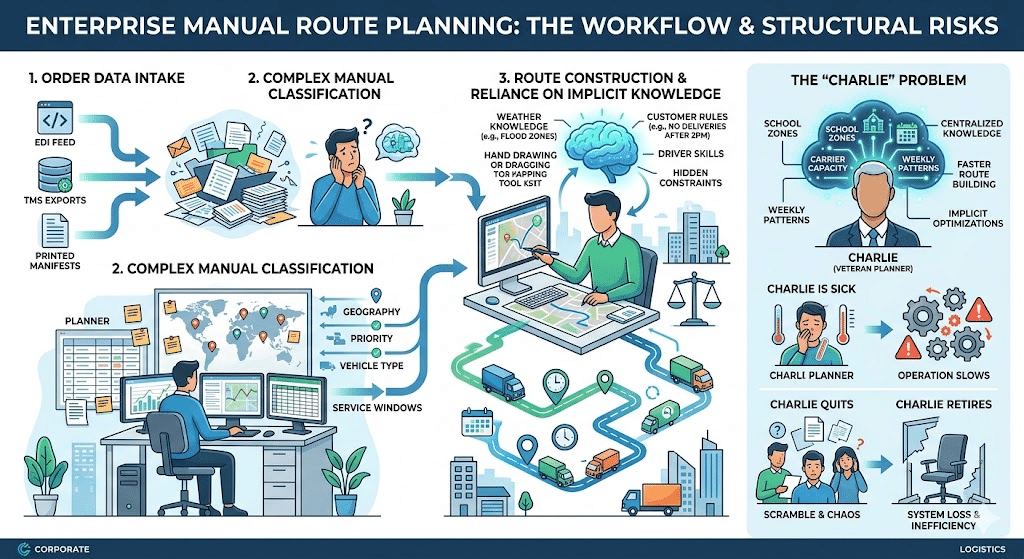
Most logistics leaders think manual planning means one person working in a spreadsheet. At lower volumes, that is broadly accurate. At enterprise scale, it is more complicated: a layered, time-intensive operating model held together by institutional knowledge, informal exceptions, and workarounds that are rarely documented.
Manual route planning process steps in last-mile logistics
In a manually planned logistics operation, the day typically starts with order intake. For enterprise accounts, this may arrive through EDI feeds, TMS exports, WMS or OMS downloads, printed manifests, emails, or a combination of all of them.
A planner, or a small dispatch planning team, then sorts orders by:
- Delivery geography
- Customer time window
- Service tier or SLA
- Vehicle type and capacity
- Product handling requirement
- Driver availability and working hours
- Priority orders and failed-delivery reattempts
- Depot, hub, or fulfillment location
This segregation happens in spreadsheets, on wall maps, in static routing tools, and often in the planner’s head.
From there, routes are built manually or dragged across a mapping tool. The planner balances estimated delivery times against vehicle load limits, driver schedules, customer commitments, and local operating knowledge. Each decision depends on memory: which roads flood in winter, which customer refuses deliveries after 2 pm, which urban route needs a smaller vehicle, and which driver can handle a high-density drop pattern.
None of this lives in a structured system. It lives in a person.
The Charlie problem
The planner holding a decade of route knowledge is both an asset and a liability.
The expertise is real. Routes get built faster than any new hire could manage. The implicit optimization is valuable: avoiding a school zone at 3 pm, knowing which carrier has capacity on Thursdays, or building in extra time for a customer with strict unloading rules.
The risk is concentration.
When Charlie is sick, planning slows. When he quits, dispatch performance drops. When he retires, the business loses an undocumented operating system.
For enterprises processing hundreds of routes across multiple depots, this is not a people problem. It is a structural planning risk.
A resilient logistics operation should not depend on one person’s memory to protect on-time delivery, SLA adherence, route cost, and customer experience.
Manual Route Planning vs Automated Route Optimization
Manual planning and automated route optimization are not different versions of the same workflow. They are different operating models.
Manual planning relies on human experience and static tools. Automated route optimization uses algorithms to evaluate constraints, sequence stops, allocate vehicle capacity, and update plans as conditions change.
| Capability | Manual route planning | Semi-automated tools | AI-powered route orchestration |
| Planning speed | Hours for larger fleets | Faster than manual, but still planner-led | Minutes for complex multi-vehicle plans |
| Multi-vehicle optimization | Limited by planner capacity | Basic sequencing only | Optimizes across fleets, depots, zones, and constraints |
| Delivery windows | Manually checked | Partially supported | Built into route logic and SLA risk scoring |
| Vehicle capacity | Manually estimated | Limited modeling | Optimized by load, volume, weight, skill, and vehicle type |
| Driver hours and compliance | Manual validation | Limited | Enforced through configured rules and alerts |
| Live traffic and disruption response | Manual replanning | Navigation-level visibility | Dynamic route planning and real-time rebalancing |
| Historical learning | Stored in dispatcher memory | Minimal | Execution feedback improves future plans |
| Cost-to-serve visibility | Manual calculation | Limited | Measured by stop, route, depot, and network |
| Scalability | Weak beyond stable, low-volume networks | Moderate | Designed for high-volume, dynamic logistics operations |
Automated route optimization does not remove human judgment. It changes where that judgment is applied. Planners stop building every route manually and start defining rules, validating exceptions, monitoring network performance, and improving operating parameters.
The Compounding Cost of Manual Route Planning at Scale
The cost case against manual route planning is often framed as a fuel or mileage issue. Those are real costs, but they are only the visible part of the problem.
At enterprise scale, manual planning compounds across five operational dimensions:
- Planning time
- Dispatch delay
- Suboptimal mileage and fuel use
- Fleet and driver underutilization
- Compliance, SLA, and single-point-of-failure risk
Most logistics budgets track one or two of these. Few capture the full manual planning tax.
Time, fuel, and fleet underutilization
A planner managing a 50-vehicle fleet typically spends four to six hours building the day’s routes. An algorithm-based system can complete the same planning cycle in under 15 minutes.
The difference is not just planner productivity. It affects the whole morning operation.
When routes are not confirmed:
- Vehicles sit idle
- Drivers wait for assignments
- Pick-pack-staging teams cannot sequence loads
- Dispatch waves are delayed
- Customer ETAs are not available
- Supervisors lack a reliable view of route risk
Across 250 working days, a 50-vehicle operation loses thousands of hours annually to planning overhead alone.
Suboptimal sequencing adds another layer. Manual planners optimize for routes they know, not for the full combinatorial set of possible routes. They cannot simultaneously evaluate every combination of stop order, vehicle capacity, time window, driver hours, depot allocation, road restriction, service priority, and route optimization objective.
Redrawing inefficient routes can eliminate 30 or more minutes of duplicated driving per vehicle per day. For a 50-vehicle fleet, that represents more than 400 hours of recoverable fuel and driver time per month.
Fleet underutilization compounds the cost further. In manual environments, orders are often assigned to familiar routes and familiar drivers. Some vehicles run close to capacity while others leave half-empty. High-priority deliveries may sit behind routine freight because the planner cannot dynamically rebalance capacity across the entire network.
For teams trying to improve fleet utilization, that creates both a cost-to-serve problem and an SLA problem.
Hidden costs of manual route planning for delivery fleets
Manual route planning creates cost leakage in areas that rarely appear as a single line item:
- Planner labor: US Tech Automations, citing the MHI Annual Industry Report, states that 67% of supply chain and logistics companies still rely on spreadsheets for at least one critical workflow, with route planning and optimization consuming coordinator time and labor cost.
- Vehicle utilization: Fleets implementing AI-driven routing have reported 20–30% improved vehicle utilization, according to Placematic’s 2026 logistics and fleet management trends analysis.
- Fuel and operating cost: Fleet Rabbit reports that AI-powered dispatch and routing can deliver 10–25% total cost reductions, driven by lower fuel consumption and reduced planning time.
- Late shipments: DigitalApplied summarizes research indicating that companies using AI-powered dynamic routing can achieve 10–15% reductions in fuel costs and approximately 30% fewer late shipments once deployed at scale.
- Empty miles: Placematic also reports that AI-driven routing can cut empty miles by 20–35% through better sequencing, route density, and fewer deadhead runs.
Compliance risk and single-point failure
Hours-of-service rules, temperature-sensitive delivery windows, customer SLAs, proof-of-delivery requirements, and route-specific constraints need consistent enforcement across every dispatch plan.
Manual planning has no automated enforcement layer.
A dispatcher using memory and spreadsheets cannot reliably flag every situation where:
- A driver is approaching an hours limit
- A cold-chain route is at risk of breaching a time or temperature window
- A service-critical stop is sequenced too late
- A vehicle is overloaded
- A delivery window is impossible given live traffic
- A contractual SLA is at risk before departure
In manual environments, violations often surface after the event: when a customer escalates, when a delivery fails, or when an auditor asks for evidence.
The single-point-of-failure risk ties the cost picture together. Automated routing typically reduces logistics costs by 10–20% across fuel, driver time, and vehicle utilization. But the gap between manual planning and AI orchestration is not only a route quality gap.
It is an operating model gap.
Manual planning relies on individual judgment. AI orchestration converts that judgment into repeatable, governed, measurable decisions.
Where Manual Planning Breaks Down at Enterprise Scale
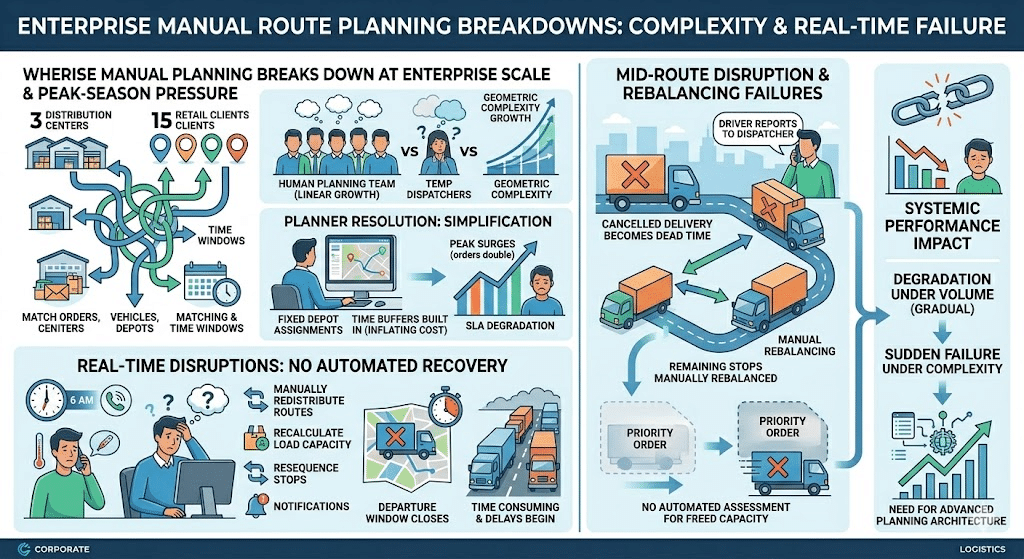
Manual planning usually degrades gradually as volume rises, then fails suddenly when complexity spikes.
The failure scenarios below are not edge cases. They define modern enterprise logistics.
When does manual route planning stop working?
Manual route planning starts to break down when route complexity grows faster than dispatcher capacity.
That usually happens when operations add:
- More vehicles
- More stops per route
- More delivery time windows
- More depots or fulfillment points
- More product handling requirements
- More same-day or next-day orders
- More customer-specific SLAs
- More driver-hour and compliance constraints
- More live exceptions during execution
A 10-vehicle fleet serving stable delivery zones may still be manageable with manual planning. A 50-vehicle fleet with multi-stop routes, strict time windows, and real-time exceptions is a different problem. At that point, the planner is no longer simply sequencing stops. They are trying to solve a dynamic network optimization problem by hand.
Multi-warehouse and peak-season pressure
A 3PL managing 15 retail clients from three distribution centers cannot reliably plan with spreadsheets without creating systemic failure points.
The planner has to match:
- Orders to depots
- Depots to delivery zones
- Vehicles to capacity and service type
- Drivers to working-hour rules and route familiarity
- Clients to contract-specific time windows
- Same-day and next-day orders to available dispatch waves
- Returns, failed deliveries, and priority reattempts into active routes
This complexity multiplies faster than any human team can calculate consistently.
So the planner simplifies. Clients get locked to fixed depots. Delivery zones become rigid. Route flexibility is reduced. Time buffers are inflated. The result is higher mileage, lower vehicle utilization, weaker delivery density, and increased cost-to-serve.
Peak season intensifies the issue. Holiday retail, FMCG promotional cycles, grocery peaks, and e-commerce spikes can double route counts overnight. Planning headcount may grow linearly through temporary dispatch support, but planning complexity grows geometrically.
Temporary dispatchers also lack Charlie’s institutional knowledge. They may build routes that look efficient on a map but fail on the road because they miss unloading constraints, access restrictions, driver familiarity, or local traffic patterns.
Operations relying on manual planning during peak events typically see SLA performance degrade exactly when customer expectations are highest.
Optimize high-volume retail and FMCG deliveries
Discover how direct-to-store delivery orchestration helps enterprise teams manage multi-drop routes, delivery windows, and peak-season complexity at scale.
Real-time disruptions with no recovery
When a driver calls out sick at 6 am, a manually planned operation faces an immediate cascade.
The absent driver’s route must be redistributed across remaining vehicles. That requires the dispatcher to recalculate:
- Vehicle capacity
- Stop sequence
- Delivery windows
- Driver hours
- Product handling constraints
- Customer priority
- Updated ETAs
- Customer notifications
In a 50-vehicle operation, that can consume an hour or more. By then, the dispatch window may have closed and delays are already embedded into the day.
The same problem appears mid-route.
If a delivery is canceled, the driver reports back and the dispatcher manually adjusts the remaining stops. But there is no automated way to assess whether that freed capacity could absorb a nearby priority order, support a failed-delivery reattempt, or reduce another driver’s overtime exposure.
The canceled delivery becomes dead time rather than recovered capacity.
Managing this speed of change requires dynamic route planning. Manual processes cannot provide it reliably across a live fleet.
Why Semi-Automated Workarounds Still Fall Short
Many enterprises are not fully manual. They use Google Maps, basic routing add-ons, GPS tools, or spreadsheet plugins layered onto existing dispatch processes.
These tools reduce some friction. They do not deliver enterprise-grade route optimization.
That distinction matters before committing to a technology investment or trying to choose the right route planning software.
Manual route planning tools: maps, spreadsheets, and basic TMS usage
Common manual and semi-automated routing tools include:
- Excel or Google Sheets
- Google Maps or Apple Maps
- Printed manifests
- Wall maps
- Driver WhatsApp groups or SMS updates
- Basic GPS tracking
- TMS screens used for order lookup or documentation
- Spreadsheet route sequencing plugins
- Low-complexity multi-stop route planners
These tools help planners see information. They do not necessarily optimize decisions.
What basic tools cannot do
Google Maps provides turn-by-turn navigation and point-to-point distance estimates. It is useful for a driver navigating from one stop to the next.
It cannot orchestrate 50 vehicles simultaneously against:
- Customer delivery windows
- Driver hours and compliance rules
- Vehicle capacity and load constraints
- Depot and hub allocation
- Product-specific handling requirements
- Live traffic and road restrictions
- Cost-to-serve targets
- SLA priority
- On-time delivery risk
- Real-time dispatch exceptions
Each of those constraints requires structured input. Optimizing across all of them requires a logistics orchestration engine, not a consumer mapping tool.
Basic routing add-ons extend spreadsheets slightly. They can plot multiple stops on a map and suggest a sequence. But they usually do not provide:
- Compliance audit trails
- Historical route performance learning
- Automated exception management
- Dynamic route rebalancing
- Driver app execution flows
- SLA risk alerts
- Integrated proof of delivery
- Cost-to-serve analysis
- Feedback loops from actual versus planned performance
Each planning cycle starts largely from zero.
The false sense of optimization
The operational risk of semi-automated tools comes from the confidence they create.
A planner using a routing add-on may believe the routes are optimized because the tool has calculated a shorter path between stops. But shortest path is not the same as optimal logistics route.
A logistics route is only optimal if it protects service and cost together. That means answering questions such as:
- Can the vehicle complete every delivery within its committed window?
- Will the driver breach hours-of-service limits?
- Is the highest-priority shipment sequenced correctly?
- Is the route using the right vehicle type?
- Is a cold-chain delivery exposed to avoidable delay?
- Does the plan increase overtime risk?
- Could another depot or vehicle serve the order at lower cost?
- What is the impact on on-time delivery if one stop fails?
A basic route calculation cannot answer those questions.
The structural problems of manual planning remain. The visibility into them decreases.
Advantages of Manual Route Planning — and Where It Still Makes Sense
Manual route planning is not always wrong. It becomes a problem when it is used beyond its natural operating range.
Manual route planning can still make sense when:
- The fleet is small
- Delivery zones are stable
- Stop counts are low
- Customer delivery windows are flexible
- The same drivers serve the same areas every day
- The business handles highly individualized or specialized deliveries
- Route changes are rare
- Compliance requirements are simple
- Software investment would exceed the value of optimization
In these scenarios, driver familiarity and dispatcher judgment may be enough. A small bakery, field technician team, or local distributor with predictable stops may not need enterprise-grade orchestration on day one.
But manual planning should be treated as a maturity stage, not a permanent strategy. Once order density, fleet size, customer expectations, or delivery constraints increase, the same manual process becomes a barrier to growth.
Benefits of Moving From Manual Planning to AI-Powered Route Orchestration
The move from manual planning to AI orchestration is often framed as replacement. That is incomplete.
The better framing is: replace the manual process, preserve and scale the expertise.
What gets replaced is spreadsheet-based route construction, manual resequencing, and dispatch firefighting. What gets preserved is the institutional knowledge Charlie spent 15 years building.
Key business benefits
AI-powered route orchestration improves logistics performance across several dimensions:
- Faster planning cycles
Planning that takes hours manually can be completed in minutes using algorithmic optimization. - Higher delivery productivity
Fleet Rabbit reports that AI-powered route planning benchmarks can reduce planning time from 60–120 minutes to 2–5 minutes, while increasing stops per driver per day in benchmark scenarios. - Better fleet utilization
AI-driven routing has been reported to improve vehicle utilization by 20–30% by matching orders, vehicles, routes, and delivery constraints more effectively. - Lower fuel and operating cost
Better stop sequencing, improved route density, and fewer deadhead miles reduce avoidable driving. - Improved customer experience
More reliable ETAs, fewer missed delivery windows, and proactive exception notifications reduce customer uncertainty. - Stronger SLA adherence
Service commitments are built into the plan rather than checked manually after dispatch. - Reduced planner dependency
Operational knowledge becomes systemized instead of sitting with one senior dispatcher. - More resilient peak operations
The planning system scales with order complexity rather than requiring proportional increases in dispatch headcount.
Key Features to Look For in Route Planning Software
Not every route planning tool replaces manual planning at enterprise scale. Some tools simply digitize the old workflow. Others optimize the logistics network.
When evaluating route planning software, look for capabilities that address the structural limits of manual planning:
| Feature | Why it matters |
| Multi-vehicle route optimization | Plans across the full fleet instead of optimizing one route at a time |
| Time-window management | Protects customer delivery commitments and SLA performance |
| Vehicle capacity modeling | Prevents overloads and improves load utilization |
| Driver-hour and compliance rules | Reduces manual checking and audit exposure |
| Dynamic route rebalancing | Supports live recovery from cancellations, delays, and driver absences |
| Depot and hub allocation | Improves planning across multi-warehouse networks |
| Cost-to-serve visibility | Helps teams understand delivery economics by route, stop, customer, and region |
| Driver app integration | Connects planning to execution in the field |
| Proof of delivery | Creates verifiable execution records |
| Historical learning | Uses actual performance data to improve future plans |
| Exception management | Flags route risk before service failures occur |
| Reporting and analytics | Gives operations leaders measurable control over logistics performance |
The goal is not just to produce a shorter route. The goal is to create a governed planning layer that improves cost, service, compliance, capacity, and resilience at the same time.
How AI-Powered Route Orchestration Preserves Dispatcher Knowledge
Modern AI route optimization engines ingest thousands of constraints simultaneously, including:
- Vehicle type, capacity, and availability
- Driver hours, skills, and schedules
- Customer delivery windows
- Service-tier priority
- Depot and hub allocation
- Product handling requirements
- Road restrictions
- Live traffic and weather signals
- Historical delivery performance
- Driver and route-level execution patterns
- Failed-delivery and reattempt data
- Cost-to-serve objectives
- SLA adherence thresholds
Locus’s AI route optimization engine optimizes across 250+ variables in a single pass, producing multi-route plans for enterprise fleets in minutes.
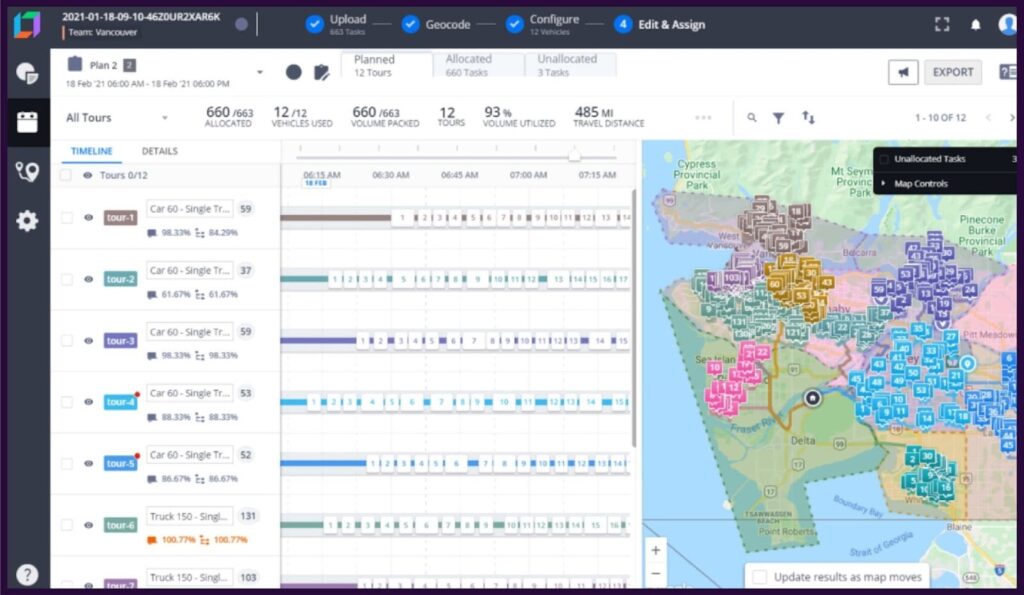
The institutional knowledge Charlie holds becomes system input rather than mental overhead.
For example:
- Zones to avoid at specific times of day
- Routes that run long on Fridays
- Customers that reject unannounced arrivals
- Delivery locations with poor access
- Drivers best suited to dense urban routes
- Time windows that need more buffer than the contract suggests
- Stores where unloading takes longer than average
Over time, Locus learns from execution patterns by incorporating actual versus planned ETAs, driver feedback, failed-delivery data, service outcomes, and route-level performance into future planning cycles.
The knowledge becomes organizational, auditable, and scalable. It can be applied across 50 vehicles, 500 vehicles, multiple depots, and new regions without depending on one planner’s memory.
This is what automated route planning delivers at its core: not a smarter map, but a planning architecture that operates consistently regardless of who is in the dispatch chair.
Real-time adaptability mid-execution
When a driver is absent, an order cancels mid-route, a customer changes availability, or a traffic incident blocks a primary corridor, manual operations return to a human bottleneck.
Someone has to identify the issue, assess its impact across the fleet, resequence routes, update drivers, and notify customers.
Locus’s dispatch management platform is designed to handle these disruptions without forcing every operational change back through manual replanning.
When a delivery is canceled, the system can identify available capacity across nearby routes and reassign eligible orders based on configured rules. When a driver reports a delay, predictive ETAs update across the affected sequence and customers can receive proactive notifications. When a road is closed, alternative sequences are calculated and pushed to the driver app in real time.
The planner’s role shifts from building every route by hand to governing the orchestration layer:
- Setting operating rules
- Reviewing exceptions
- Approving deviations where required
- Monitoring SLA risk
- Adjusting business priorities
- Improving planning parameters over time
The judgment stays human. The execution overhead does not.
Measuring the Shift From Manual to AI Orchestration
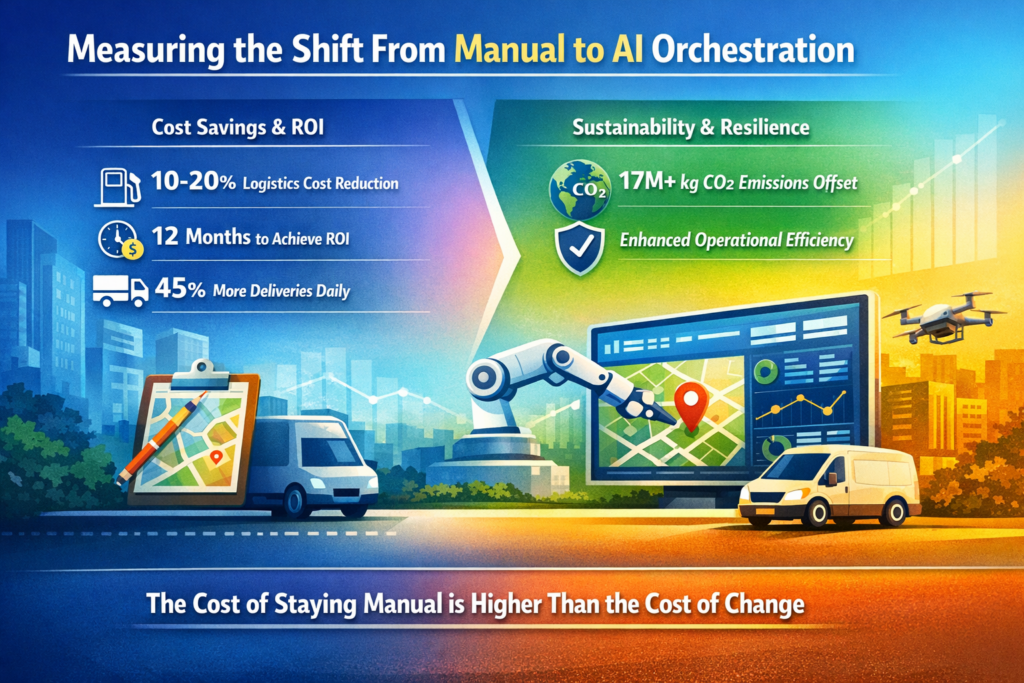
The ROI case for moving from manual to AI-powered route planning is often measured in fuel and overtime. Those are real savings and a logical starting point.
They are also only part of the total recovery.
The full business case includes:
- Reduced planning time
- Higher delivery capacity per vehicle
- Better on-time delivery performance
- Lower driver overtime
- Improved fleet utilization
- Fewer failed deliveries
- Stronger SLA adherence
- Lower compliance exposure
- Reduced cost-to-serve
- Faster peak-season scaling
- Less dependency on individual planners
Direct cost savings and ROI
Automated routing reduces logistics costs by 10–20% across fuel consumption, driver overtime, and vehicle utilization, a range documented across enterprise deployments at varying fleet sizes.
ROI is typically achieved within 12 months for fleets of 10 or more vehicles. Larger enterprise operations often reach payback faster because the recoverable inefficiency is greater: more orders, more vehicles, more depots, more exceptions, and more routing combinations that manual planning cannot evaluate.
Locus has reduced ground resource costs by 20% while enabling fleets to complete 45% more deliveries per day without adding vehicles. Across 360+ enterprise deployments, Locus has recovered $320M+ in transit cost savings and reduced driven distance by 800M+ miles.
The route optimization software market is also expanding as logistics operators move away from manual and static planning. Market Research Future projects the market to grow from US$6.247 billion in 2025 to US$12.59 billion by 2035, reflecting a 7.26% CAGR.
These outcomes come from the same operating conditions most enterprise logistics leaders manage daily: dense last-mile networks, multi-drop routes, hybrid fleets, high service expectations, and limited planning time.
The routing efficiency gains share one source: replacing isolated planner intuition with algorithmic precision across variables no human can optimize simultaneously.
Route planning KPIs: measuring manual vs optimized performance
A practical business case should track at least these KPIs before and after implementation:
| KPI | Why it matters |
| Planning time per route wave | Measures dispatch planning productivity |
| Cost per stop or cost per delivery | Captures cost-to-serve improvements |
| On-time delivery rate | Shows SLA and customer experience impact |
| Vehicle utilization | Measures capacity use across the fleet |
| Driver overtime hours | Quantifies labor efficiency |
| Miles per delivery | Captures route efficiency and emissions impact |
| Failed-delivery rate | Shows execution quality |
| SLA breach rate | Measures contractual and service risk |
| Exception resolution time | Tracks resilience during live operations |
| Stops per driver per day | Shows delivery productivity and route density |
| Empty miles | Measures avoidable mileage and fuel waste |
Sustainability and resilience
Fewer miles driven translates directly into measurable carbon reduction.
For enterprises facing ESG reporting requirements, logistics is one of the largest controllable emissions categories. Locus has offset 17M+ kg of CO2 across its deployments, a figure traceable to route optimization outcomes rather than a blanket carbon credit purchase.
That traceability matters. Board-level ESG reporting increasingly requires clear links between operational decisions and emissions outcomes. Route optimization creates that link by connecting fewer miles, better vehicle utilization, and lower fuel consumption to execution data.
The resilience argument is harder to quantify but often more consequential.
An operation running on algorithmic planning does not degrade when a senior planner leaves. It does not slow down in the same way during peak season because the planning system scales with order volume rather than headcount.
The tracking layer connecting route execution data back into route planning creates a continuous improvement loop. Each delivery cycle improves the inputs to the next one.
The question is no longer whether to move away from manual planning. At enterprise scale, the cost of staying is higher than the cost of change.
How to Transition From Manual Route Planning to Routing Software
Moving from manual routing to AI-powered planning does not require a big-bang rollout. The best transitions usually preserve dispatcher expertise while gradually shifting route logic into software.
A practical transition roadmap
- Map the current planning workflow
Document how orders enter the system, how routes are built, which exceptions occur, and where planners rely on undocumented knowledge. - Clean the core data
Standardize addresses, customer time windows, vehicle types, driver schedules, depot locations, service times, and delivery constraints. - Start with one zone or route wave
Pilot routing software in a controlled geography or dispatch wave before scaling across the full network. - Run manual and automated plans in parallel
Compare route distance, planning time, vehicle utilization, ETA accuracy, and driver feedback. - Keep dispatchers involved
Let planners validate algorithmic routes, flag missing constraints, and encode local knowledge into system rules. - Train drivers and dispatchers together
Adoption improves when field teams understand why route sequences change and how execution data improves future plans. - Measure before scaling
Track planning time, on-time rate, cost per stop, miles per delivery, overtime, and exception resolution time. - Expand by depot, region, or use case
Once the pilot proves value, scale to additional depots, delivery types, and customer segments. - Move planners into governance roles
Shift the dispatcher’s role from manual route builder to orchestration manager.
Hybrid planning is often the best bridge. Dispatchers continue to supervise the operation, but the algorithm handles the complexity that humans cannot evaluate consistently at scale.
Why Choose Locus for Enterprise Route Orchestration?
Locus is built for logistics operations that have outgrown manual routing, spreadsheet sequencing, and basic dispatch workarounds.
Enterprise logistics teams choose Locus when they need to:
- Optimize complex multi-stop routes
- Plan across depots, regions, and hybrid fleets
- Improve fleet utilization without adding vehicles
- Reduce planning time from hours to minutes
- Protect customer delivery windows
- Manage peak-season routing complexity
- Rebalance routes during live disruptions
- Reduce fuel, mileage, and driver overtime
- Improve delivery productivity
- Encode dispatcher knowledge into repeatable planning rules
- Track execution performance and improve future planning cycles
Locus does not simply digitize manual planning. It creates an orchestration layer that connects planning, dispatch, execution visibility, exception management, and continuous improvement.
That matters because manual route planning is not only a routing issue. It is a scalability issue, a customer experience issue, a cost issue, and a resilience issue.
Find the hidden cost of manual planning
Assess route inefficiencies, planner dependency, and SLA risk with experts who understand enterprise logistics transformation.
Stop Paying the Manual Planning Tax
Manual route planning persists in enterprise logistics for the same reason most operational legacies persist. It works well enough to avoid crisis until it does not.
The costs are real, compounding, and often invisible until a peak event, service failure, audit, or resignation exposes them.
Manual planning creates:
- Excess planning overhead
- Delayed dispatch
- Suboptimal route sequencing
- Underutilized vehicles
- Higher fuel and labor costs
- Overtime exposure
- Missed delivery windows
- Weak SLA adherence
- Compliance risk
- Dependency on individual planners
Manual route planning is viable for small, stable operations. It becomes a barrier to growth when order volume, delivery zones, customer promises, and execution complexity increase.
Automated and AI-powered route planning consistently outperform manual methods on speed, scalability, cost control, service reliability, and operational resilience. Hybrid rollouts let organizations preserve dispatcher knowledge while moving repeatable route logic into a system that can scale.
Signs your logistics operation has outgrown manual route planning include:
- Planning takes several hours before dispatch can begin.
- Routes depend heavily on one senior planner.
- Dispatchers regularly resequence routes after vehicles have left.
- SLA performance drops during peak season.
- Vehicles leave underfilled while other routes run overloaded.
- Driver overtime is rising faster than order volume.
- Google Maps or spreadsheet plugins are being treated as optimization tools.
- Compliance checks happen after execution rather than during planning.
- Customer ETAs are unreliable or manually updated.
- New depots, regions, or clients require disproportionate planning effort.
Route planning maturity is now a strategic logistics capability. Moving beyond manual routing is central to building efficient, data-driven last-mile and distribution networks.
Frequently Asked Questions (FAQs)
1. How long does manual route planning typically take compared to AI-optimized planning for a fleet of 50+ vehicles?
Manual planning for a 50-vehicle fleet typically consumes four to six hours per day. Algorithm-based planning completes the same task in under 15 minutes. The gap extends beyond planning time. Vehicles idle, and order staging cannot begin until routes are confirmed. At 250 working days per year, the time delta compounds into thousands of hours of recoverable operational capacity annually.
2. What are the biggest compliance risks associated with manual route planning in regulated logistics environments?
Manual planning has no automated enforcement mechanism for hours-of-service regulations, temperature compliance windows, or SLA commitments. Violations surface after a customer escalation or an audit. By then, the failure has already happened. Operations running on spreadsheets and planner memory have no systemic way to flag approaching compliance thresholds across a dynamic daily route set before a breach occurs.
3. Can manual route planning handle dynamic disruptions like driver absences or weather delays in real time?
Manual planning has no real-time recovery mechanism. When a driver calls out, routes must be manually redistributed, a process consuming an hour or more, during which the departure window closes. When a delivery cancels mid-route, freed capacity typically goes unused. There is no automated system to identify reallocation opportunities and act within the available window.
4. What is the typical ROI timeline when transitioning from manual route planning to an automated dispatch platform?
Automated route optimization typically delivers ROI within 12 months for fleets of 10 or more vehicles. Larger enterprise operations tend to recover their investment faster because the volume of inefficiency being eliminated is proportionally greater. The primary ROI drivers are fuel savings, reduced driver overtime, and improved fleet utilization, each measurable from the first weeks of deployment.
5. How does AI route optimization preserve institutional planner knowledge instead of replacing it?
AI route optimization encodes the planner’s knowledge rather than erasing it. Route preferences, customer quirks, and operational patterns a senior planner has built over the years become system inputs rather than mental overhead. The system learns from execution data over time, incorporating actual versus planned performance into future plans and making institutional knowledge organizational rather than individual.


General
AI Agents in Logistics Are Only as Smart as the Platform Underneath

Apr 1, 2026
Every logistics vendor is launching AI agents. But an agent's output is only as good as the platform underneath it. Here's what to evaluate.
Read more
General
Easter Logistics: How Retail & Grocery Operations Handle the Spring Surge

Apr 2, 2026
Easter grocery surge isn't just a volume problem. It's a time-window precision problem, a cold-chain compliance problem, and a customer-expectation problem, all at once.
Read moreInsights Worth Your Time


















Why Manual Route Planning Is Holding Your Logistics Operation Back