


General
7 Best Large Bulky Item Courier Delivery Software of 2026
Key Takeaways
- Delivering a refrigerator to a third-floor apartment with a two-person crew, a 2-hour appointment window, and a haul-away is a job with several dependencies.
- Standard courier software isn’t built to model it that way.
- This guide compares seven platforms built for large, bulky-item delivery, including furniture, appliances, gym equipment, palletized B2B freight, where a missed appointment window or a damage dispute may occur.
- Locus handles enterprise-scale orchestration across mixed fleets, partners, and regions. On the other hand, OneRail suits retail operations that need dispatch coordination with optional network capacity coverage.
- FarEye is the stronger fit when visibility and cross-carrier workflow control are the priority. Locate2u and Onfleet work well for mid-market teams moving off manual dispatch. Also, Track-POD is worth evaluating when field compliance and condition capture are the primary gaps.
- Routific fits SMB fleets that need route optimization without the overhead of an enterprise platform.
- The right choice depends on your constraint density, fleet structure, and how much each failed stop actually costs you.
If you deliver sofas, refrigerators, gym equipment, or palletized B2B freight, chances are, you already know the risk profile is different. A missed time window is not a minor delay. A damaged unit is not a small refund. One failed appointment can erase the margin for the entire route.
This guide is written for operations and logistics leaders evaluating large, bulky-item courier delivery software, whether you’re replacing a route planner that can’t handle appointment commitments, consolidating disconnected tools across dispatch and field execution, or building the business case to move away from manual coordination.
What Is Large Bulky Item Courier Delivery Software?
Large bulky item courier delivery software is a category of last-mile execution platform built for the delivery of oversized, heavyweight, or high-service-cost goods. It includes furniture, appliances, fitness equipment, and palletized B2B freight. These are the areas where standard parcel tools fail because the cost and complexity of each stop is structurally different.
A refrigerator delivery with a two-person crew, a third-floor carry-in, a packaging haul-away, and a 2-hour appointment window is not a stop on a route. It is a job with dependencies.
So, the software has to model it that way: matching the vehicle to the load, pairing the right crew, protecting the appointment slot, and capturing delivery evidence that holds up in a damage dispute.
Standard courier tools optimize stop sequences. Large bulky item courier delivery software manages the constraints that determine whether those stops can be completed at all.
It is built to handle:
- Vehicle matching based on weight, cubic dimensions, and equipment requirements (lift gate, two-person carry, refrigerated compartment)
- Appointment slot management with customer confirmation flows and reschedule handling that does not break route feasibility
- Crew pairing rules based on job type, skills, and physical requirements
- Proof-of-delivery that captures the condition before, during, and after placement
- Real-time re-optimization when delays, access issues, or customer no-shows disrupt the plan mid-route
If this sits inside a broader stack refresh, it helps to understand how it connects with your last mile delivery logistics and delivery management software approach.
Now that the category is clear, the next question is whether your operation truly needs it.
Who Typically Needs Bulky Delivery Software?
The operations that need this category share a specific pattern. It has a high failure cost per stop, service requirements that vary by job type, and coordination overhead that cannot be managed solely through route planning.
To share an example, a furniture retailer running 40 two-person delivery appointments per day cannot run that on a parcel routing tool. Each stop has a crew requirement, an equipment requirement, a time commitment, and a service sequence.
Miss the appointment, and you’ve lost the driver’s time, the slot revenue, and in many cases the customer.
The category is most relevant for:
- Furniture and home goods retailers running appointment-based, crew-paired delivery routes
- Appliance brands managing delivery, installation, activation, and old-unit removal as a single job
- B2B distributors coordinating dock scheduling, documentation, and pallet-level delivery compliance
- 3PLs operating mixed fleets where service commitments, vehicle types, and crew requirements vary by shipment
- D2C brands with high-value items, such as mattresses, fitness equipment, and outdoor furniture, where a failed delivery or damage claim erases the order margin
If your operation runs straightforward drop-offs with no appointment commitments and no crew dependencies, a general routing tool will cover it. If you manage time windows, two-person crews, long service times, and exceptions that cost real money, the software category below is the right scope.
What Are the 7 Best Large Bulky Item Courier Delivery Software of 2026?
| Tool | Best-fit scenario | Bulky-delivery strengths | Watch-outs | Pricing model |
|---|---|---|---|---|
| Locus | Enterprise bulky delivery orchestration across fleets, partners, and regions | Capacity-aware routing with vehicle matchingAppointment and time-window coordination with disruption handlingMulti-fleet orchestration and operational control layerStructured POD and exception workflows | Enterprise onboarding and integration planning requiredMore depth than very small fleets typically need | Quote-based |
| OneRail | Retail operations that need orchestration plus optional network capacity coverage | Dispatch coordination across delivery optionsTracking visibility and exception oversightHelpful when demand spikes create coverage gaps | Bulky handling depth depends on carrier configurationValidate crew logic and constraint depth for your service model | Public tiers for app, plus quote-based for enterprise and services |
| FarEye | Enterprises prioritizing visibility, workflows, and customer experience across carriers | Strong delivery visibility and workflow controlCustomer communication and exception workflowsCross-region standardization | Validate routing and capacity depth for heavy constraintsImplementation scope can vary by use case | Quote-based |
| Locate2u | SMB to mid-market teams moving from manual dispatch to structured delivery ops | Scheduling, routing, tracking, and POD in one platformFaster adoption for regional operations | May not handle high constraint density and multi-fleet complexity at enterprise scale | Public subscription tiers |
| Onfleet | Mid-market delivery ops that want clean dispatch, tracking, and driver workflows | Strong dispatcher experience and driver appCustomer tracking and notificationsPackaged plans for predictable rollout | Not purpose-built for deep vehicle matching and complex appointment orchestrationValidate bulky constraints and crew needs | Public subscription tiers plus enterprise |
| Track-POD | Teams where POD rigor and field compliance reduce disputes and claims | Strong POD, forms, and checklistsHelpful for condition capture and audit trailsFlexible pricing options | Routing and orchestration depth vary by needsValidate for complex, multi-region coordination | Public pricing by driver or by orders |
| Routific | SMB fleets that need route optimization with order-based pricing | Fast routing improvementsOrder-based pricing for variable volumeUseful for simpler, bulky profiles | Limited heavy constraint modeling and orchestrationNot designed for complex multi-fleet enterprise control | Public plans, including a limited free tier |
Here are seven large bulky item courier delivery software platforms evaluated for bulky delivery environments:
1. Locus
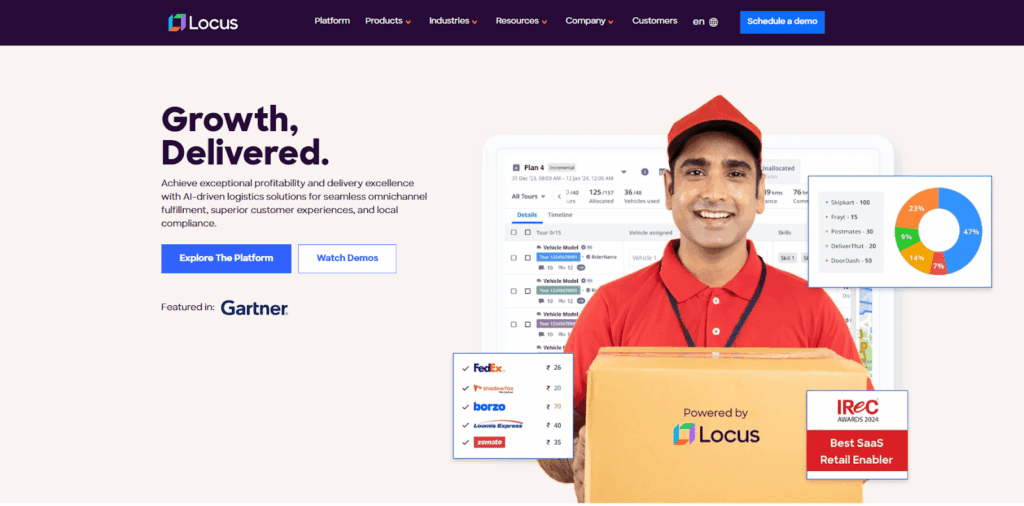
Locus is built for the full execution cycle. Where most routing tools produce a plan and hand it off, it connects planning, dispatch, execution, and exception handling in a single layer, with constraint logic designed for the specific demands of capacity-intensive, appointment-heavy delivery networks.
For bulky delivery, that means the platform is not being adapted to handle weight limits, crew assignments, and appointment windows. It is built around them.
Locus Key Features
- Capacity-aware vehicle matching, not just stop sequencing: Locus matches each order to a vehicle based on declared weight, cubic dimensions, equipment requirements, and compatibility rules.
A refrigerator and a fragile glass table do not go on the same truck. A third-floor carry-in does not get assigned to a solo driver. The assignment logic runs before dispatch, not after the truck is already loaded. - Appointment windows managed as operating commitments: When a delivery window is confirmed, Locus protects it. If a delay upstream threatens the slot, the system re-sequences affected stops and recalculates ETAs automatically.
- Exception handling that filters noise from actual problems: Routine allocation decisions are automated. Dispatch sees only the stops that need judgment: a missed time window, an unreachable customer, a vehicle breakdown. The system handles the rest.
- POD that holds up in damage disputes: Locus captures photos at each stage, like item condition before entry, during carry-in, and post-placement, along with e-signatures, timestamps, and structured condition notes. When a claim comes in, the evidence is already organized and retrievable.
- Single operational view across owned fleets and 3PL carriers: Allocation logic runs across internal vehicles and external partners in one interface. Ops teams can see carrier performance by partner, track exceptions by fleet, and manage the full network without logging into separate systems.
- API-first integration that keeps execution clean: Locus connects with OMS, WMS, ERP, and CRM systems so order data flows in automatically and delivery status flows out in real time. Dispatch is not rekeying order details from one system into another.
For upstream coordination, review order management software and transportation and logistics management.
Locus Is Ideal For
- Enterprise retailers delivering furniture and appliances
- 3PLs managing multi-region service commitments
- B2B distributors operating high-density, bulky routes
Locus Pros
- Designed for high constraint complexity
- Strong fit for appointment-based delivery
- Scales across fleets and regions
Locus Cons
- May exceed the needs of small fleets
- Requires structured enterprise onboarding
Locus Pricing
Quote-based, depending on volume, integration scope, and operational complexity
2. OneRail
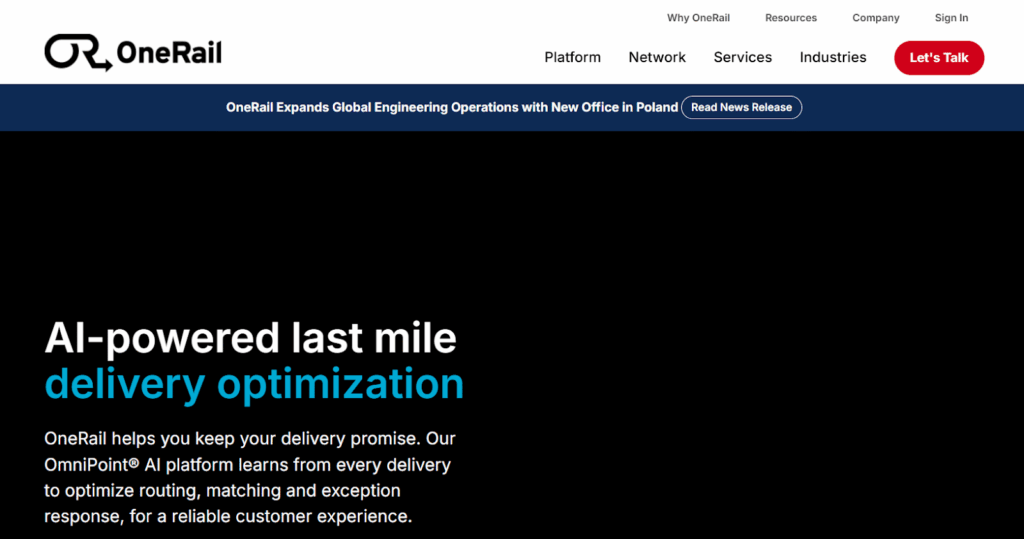
OneRail is built around dispatch coordination and third-party capacity, which is useful when your owned fleet cannot cover every spike in demand. Its OmniPoint platform is positioned as an API-first orchestration layer that can connect order signals from commerce or back-office systems to both internal and external fleets.
It also includes workflows for tracking, proof-of-delivery, and managing delivery exceptions with operational oversight. In practice, teams evaluate OneRail when they want a single system to source couriers, automate dispatch decisions, and keep delivery status consistent across partners.
OneRail Key Features
- Courier capacity management, centralized: OneRail helps you source, onboard, and manage courier capacity across its network so dispatch is not chasing coverage when volume spikes or owned fleet falls short.
- Rule-based dispatch automation: The platform automates dispatch workflows using configurable rules that match deliveries to couriers based on timing, proximity, and shipment attributes.
- Built-in rate shopping across modes: Rate comparison is embedded in the dispatch flow so teams can evaluate carrier options before confirming, without switching between tools or spreadsheets.
- Exception management with early SLA protection: OneRail flags at-risk deliveries and triggers exception workflows designed to surface disruptions before a delay becomes a missed commitment.
OneRail Is Ideal For
- Retail operations needing flexible capacity
- US-based networks with fluctuating delivery demand
OneRail Pros
- Combines software and network coverage
- Strong retail integrations
- Clear tracking visibility
OneRail Cons
- Bulky handling depth depends on carrier configuration
- May require validation for complex crew logic
OneRail Pricing
Driver App tiers are publicly listed. Enterprise and network services are quote-based.
3. FarEye
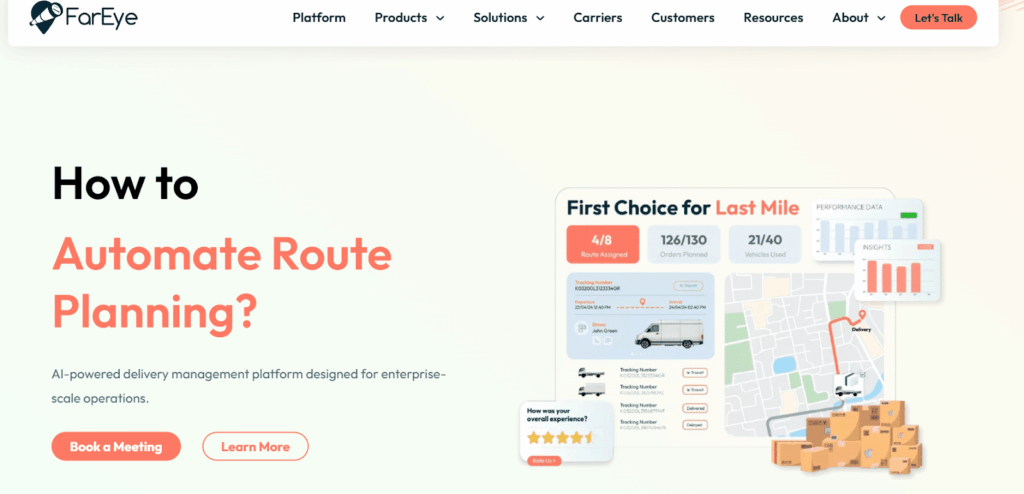
FarEye is typically evaluated by teams that want stronger control over the post-purchase delivery experience, not just route plans. It focuses on tracking, scheduling, and customer communications, including proactive notifications and rescheduling flows that reduce “where is my order” pressure.
The platform also highlights exception workflows and predictive alerts so ops teams can intervene before a delay becomes a failed delivery. For bulky operations, it is often considered when visibility, workflow consistency, and customer coordination are just as important as route efficiency.
FarEye Key Features
- Branded customer tracking, not a generic link: FarEye supports white-labeled tracking pages and proactive delivery notifications so customers can self-serve status updates instead of calling support.
- Scheduling and rescheduling built into the customer flow: Customers can adjust delivery windows through FarEye’s scheduling flows without requiring manual back-and-forth between the carrier and the recipient.
- Predictive exception alerts before delays become failures: The platform surfaces at-risk deliveries using predictive signals so ops teams can intervene early rather than managing fallout after the fact.
FarEye Is Ideal For
- Enterprises prioritizing visibility and CX
- Multi-region delivery networks
FarEye Pros
- Strong reporting and analytics
- Configurable enterprise workflows
- Focus on customer experience
FarEye Cons
- Public pricing not available
- Requires validation for heavy constraint modeling
FarEye Pricing
Quote-based.
4. Locate2u
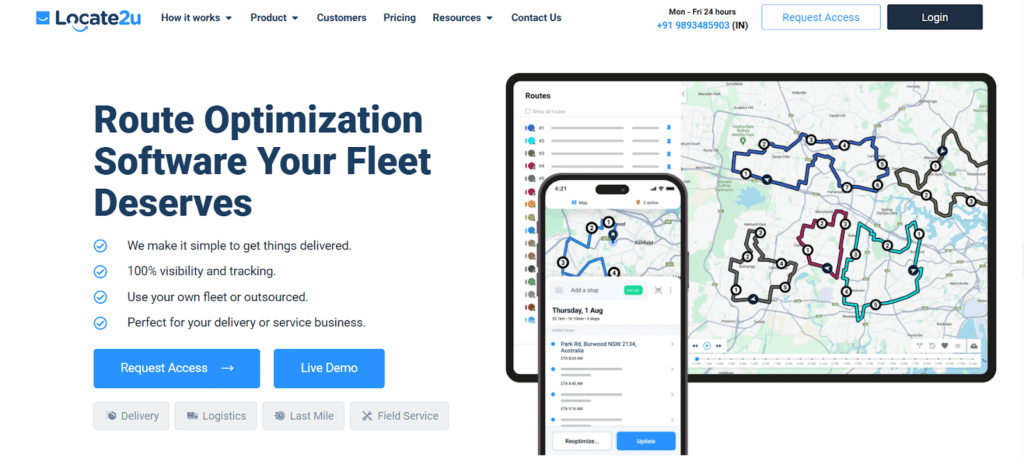
Locate2u sits in the scheduling-plus-execution category, aimed at delivery and field-service teams that need structure without a heavy enterprise rollout. It combines stop and booking management with route optimization, live tracking, and proof-of-delivery in one platform.
It also leans into practical ops controls like route replay, team regions, and skills-based assignment options, which can matter when crews and service types vary. Teams usually look at Locate2u when they want to move off manual dispatch while keeping the system simple enough to adopt quickly.
Locate2u Key Features
- Multi-stop route plans built in minutes: Locate2u generates optimized routes for multiple drivers quickly, so dispatch can plan the day without manually sequencing stops.
- Real-time rerouting when conditions change: The platform adjusts routes dynamically when traffic or delivery issues arise, keeping drivers on schedule without rebuilding the plan from scratch.
- Live location sharing with customers: Drivers’ positions can be shared with recipients in real time, so customers know when to expect arrival without calling dispatch.
- Mobile proof-of-delivery capture: Drivers collect e-signatures and photos through the mobile app at the point of delivery, so completion is documented at the doorstep.
Locate2u Is Ideal For
- Regional bulky-item couriers
- Appliance and service teams
Locate2u Pros
- Straightforward implementation
- Public subscription tiers
- Clean operational interface
Locate2u Cons
- Limited depth for high constraint density
- May not scale to multi-region enterprise orchestration
Locate2u Pricing
Public subscription tiers available
5. Onfleet
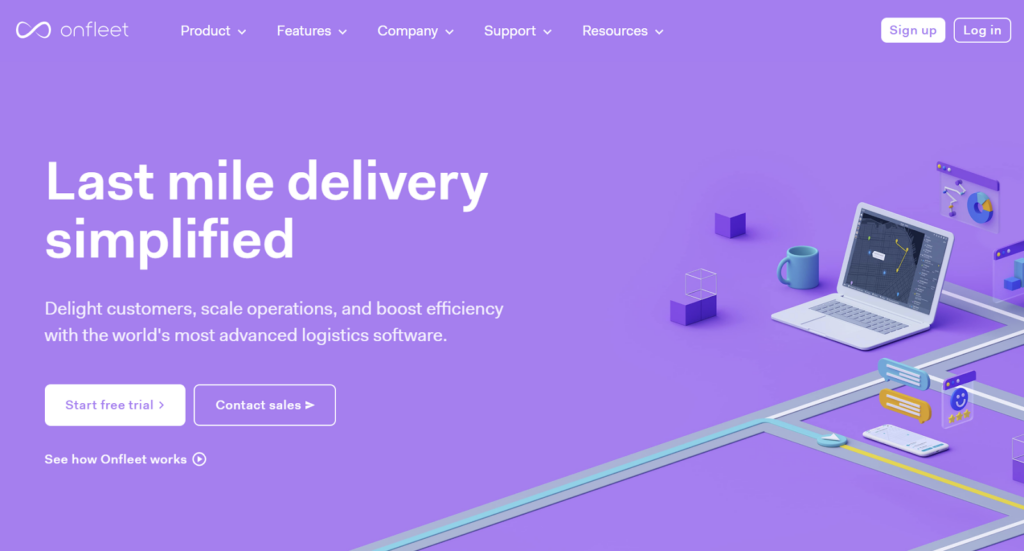
Onfleet is a delivery-management platform that many teams use as the day-of-delivery operating layer for dispatch, driver execution, and customer visibility. It supports route optimization, automated assignment and dispatch options, real-time tracking, and customer notifications with ETAs.
The platform also emphasizes proof-of-delivery and a developer-friendly API so it can connect to ecommerce systems or internal OMS and WMS workflows. It tends to come up in evaluations when the priority is a clean dispatcher experience with reliable tracking and integrations.
Onfleet Key Features
- Route optimization with measurable mileage reduction: Onfleet’s route engine minimizes travel time across multi-stop runs, giving dispatchers more efficient plans without manual sequencing.
- Automated dispatch with AI-based ETAs: The platform assigns deliveries and generates ETAs automatically so teams can scale daily volume without adding manual allocation steps.
- Real-time fleet visibility for in-day management: Live driver tracking and analytics surface delays as they develop, so dispatchers can act before service levels slip.
- Customer SMS notifications with accurate arrival windows: Automated delivery alerts reduce inbound customer inquiries and improve the delivery experience without requiring manual status calls.
Onfleet Is Ideal For
- Mid-market delivery operations
- Teams prioritizing dispatch and tracking visibility
Onfleet Pros
- Clean user interface
- Public plan pricing
- Strong driver app
Onfleet Cons
- Not purpose-built for heavy vehicle matching
- Appointment complexity requires validation
Onfleet Pricing
Public subscription tiers with an enterprise plan available.
6. Track-POD
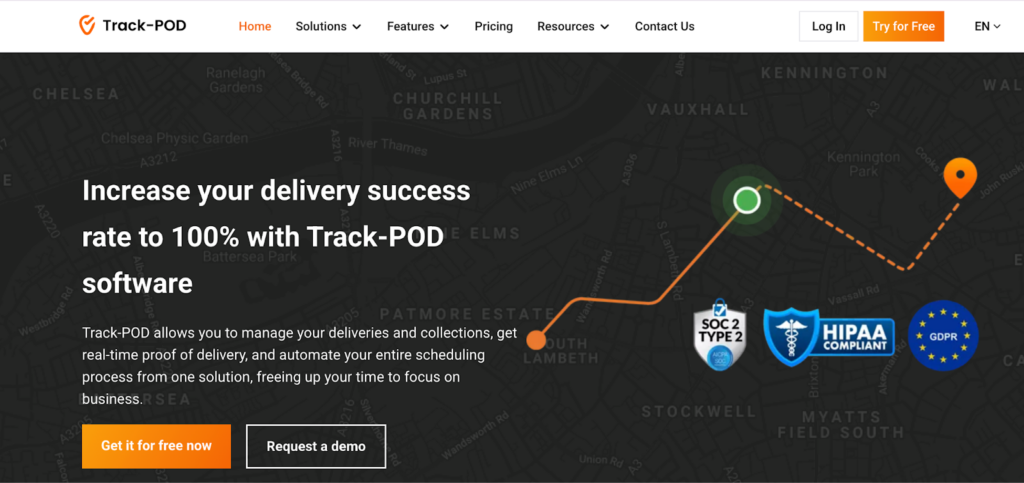
Track-POD leans into last-mile execution, especially proof-of-delivery and delivery documentation that helps teams close out jobs cleanly. It provides a web dashboard for managing deliveries and routes, plus mobile apps that support ePOD capture, including signatures, photos, and real-time status updates.
The tool also lists route optimization features that consider constraints like vehicle capacities and time windows, along with real-time map visibility during the day. It is commonly evaluated by teams that want a practical blend of routing, live tracking, notifications, and defensible POD, with pricing that can scale by orders or by drivers.
Track-POD Key Features
- Structured proof-of-delivery for dispute defense: Track-POD captures completion evidence, so teams have retrievable documentation when customers contest a delivery.
- Photo and signature capture at the point of handoff: POD workflows record condition and recipient acknowledgment at delivery, reducing ambiguity in post-delivery claims.
- Route planning with capacity and time-window inputs: The platform supports route creation with vehicle capacity and time-window constraints, so drivers receive structured plans rather than manually sorted lists.
- Live tracking for dispatcher and customer visibility: Real-time location data keeps dispatchers informed during execution and gives customers a delivery status they can follow.
Track-POD Is Ideal For
- Teams focused on dispute reduction
- Operations requiring defensible delivery records
Track-POD Pros
- Flexible pricing models
- Strong POD structure
- Form customization
Track-POD Cons
- Routing depth may require validation
- Enterprise orchestration capabilities vary
Track-POD Pricing
Public pricing by driver or by order volume.
7. Routific
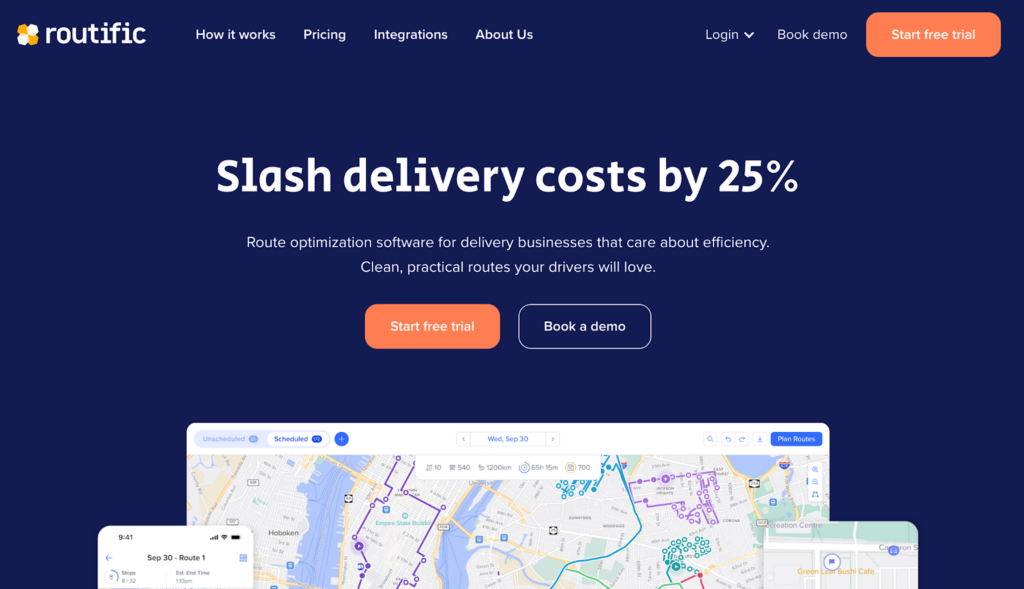
Routific is designed for teams that want route optimization plus a dispatcher-friendly workflow that is easy to run daily. Its pricing is based on scheduled order volume, and the core plan includes route optimization, mobile driver apps, real-time GPS tracking, customer notifications, a delivery tracker, and proof-of-delivery.
Dispatchers also get tools for making day-of changes, like editing routes and adjusting stops without rebuilding everything. Routific is usually evaluated when the goal is to improve routing efficiency and delivery visibility quickly, especially for operations with variable order volume.
Routific Key Features
- Order-based route optimization for variable daily volume: Routific’s pricing and optimization logic is built around scheduled order count, so teams pay for what they use, and routes scale with volume.
- Mobile driver apps for digital dispatch: Routes are pushed to drivers through the mobile app, replacing printed manifests and reducing miscommunication at the start of each run.
- Live GPS tracking with updated ETAs: Real-time location data provides accurate arrival estimates for both dispatchers and customers throughout the delivery day.
- Customer-facing delivery tracker with automated notifications: Recipients can follow delivery progress through a tracker link, reducing inbound calls without requiring manual status updates.
Routific Is Ideal For
- SMB delivery teams
- Operations with fluctuating daily order counts
Routific Pros
- Flexible order-based pricing
- Quick setup
- Predictable routing gains
Routific Cons
- Limited heavy constraint modeling
- Not designed for multi-region enterprise orchestration
Routific Pricing
Free tier available. Paid plans are priced per order volume.
How to Evaluate Large Bulky Item Courier Delivery Software: 8 Criteria That Matter
Every platform on this list does route optimization, live tracking, and proof-of-delivery. If those were the only requirements, picking one would be straightforward.
The harder question is what happens on a day when a crew member calls out at 6 AM, a customer pushes their window by three hours, and a 300-lb treadmill arrives at a building with no freight elevator. That is a normal day in bulky delivery.
These criteria below are what separate platforms that absorb that kind of day from ones that hand it back to dispatch to solve manually.
1. Capacity Modeling and Vehicle Matching
For bulky delivery, “capacity” is not one number. A sofa bed weighs 200 lbs and requires two people. A pallet of commercial refrigeration units needs a lift gate. A set of custom wardrobes needs a tall vehicle and a ground-floor delivery window.
The software must encode all of these as hard constraints, not soft filters.
If a tool lets dispatchers override vehicle capacity rules manually or cannot model multi-dimensional load constraints, you will spend the first week cleaning up mis-assignments. Ask vendors to show you how a multi-item order with weight, dimension, and equipment requirements gets routed to the right vehicle automatically
2. Appointment Windows and Slot Control
If two-person crews are standard, the platform must treat crew pairing as a constraint, not a manual step. That means assignment rules that pair by job type (install-capable vs. carry-only), skill or certification requirements, and route feasibility when one crew member calls out.
The downstream failure is predictable: a driver shows up alone to a third-floor appliance delivery, cannot complete the job, and the appointment fails. The cost is the re-delivery, the customer call, and the crew time.
Validate crew logic specifically. Ask the vendor: What happens when a crew member is unavailable at 7 AM? Does the system reassign the affected stops automatically, or does dispatch rebuild the run?
3. Service-Time Logic and Stop Compatibility
Most platforms in this category cover the baseline: route optimization, live driver tracking, proof-of-delivery capture, customer notifications, and a dispatcher interface.
For standard parcel operations, that feature set is enough to evaluate on. But for bulky delivery, those features are the floor, not the ceiling.
The criteria that actually separate platforms are the ones that govern what happens when the job gets complicated: a 400-lb item and a third-floor delivery, a crew member who doesn’t show, a customer who reschedules two hours before the window, or a damage claim with no documentation. Use the criteria below to pressure-test each platform against your actual operating conditions before committing to a demo.
4. Two-Person Crew and Task Sequencing
If two-person crews are common, treat crew logic as a first-class requirement. You want assignment rules that pair the right people, align skill requirements, and maintain route feasibility when a crew member becomes unavailable. Without this, dispatch will spend the day rearranging labor instead of managing exceptions.
5. Proof-of-Delivery and Damage Defense
In bulky delivery, POD is not a checkbox. You need photo capture, signatures, condition notes, and structured checklists that stand up in disputes. The best systems make it easy for drivers to capture evidence at the right moments, so claims do not turn into long investigations.
6. Real-Time Re-Optimization and Exception Workflows
The plan will break. Late crews, traffic, customer no-shows, and last-minute cancellations are normal. Look for re-optimization that updates routes and ETAs without forcing dispatch to rebuild the day. Also, check how exceptions get routed internally, including escalation rules and audit trails.
7. Multi-Fleet Orchestration and Partner Visibility
If you run owned trucks plus third-party carriers, you need one operational view. Validate allocation rules, partner tracking, and performance visibility. Fragmented tools create blind spots, and blind spots create missed appointments.
8. Integrations and Time-to-Value
Confirm what integrations are available, how data flows in and out, and who owns ongoing maintenance. If you depend on OMS, WMS, or ERP data, integration quality will determine whether execution stays clean.
If you need a broader context, align the shortlist with your order fulfillment process and retail logistics operating model.
Once you’ve scored your top two or three tools against these criteria, the demos become simple. You can walk vendors through your hardest day and see if the platform holds up.
Try Locus as Your Large Bulky Item Courier Delivery Software
Large, bulky item courier delivery software should absorb operational complexity, not expose it.
If your network runs appointment-heavy, capacity-constrained deliveries across fleets and regions, orchestration depth becomes the deciding factor. This is where platforms like Locus, which is built specifically for constraint-heavy execution, separate themselves from general routing tools.
Lighter operations may prioritize usability and pricing alignment. But when missed windows, failed attempts, or damage disputes carry real financial impact, Locus treats capacity, time windows, crew logic, and exception handling as core design elements, not add-ons.
If you want to see what enterprise-grade orchestration looks like in practice, see how Locus is purpose-built for this level of complexity. Book a demo and evaluate it for your bulky delivery network today!
Frequently Asked Questions (FAQs)
1. What counts as a large or bulky item in delivery?
Items that introduce handling constraints due to size, weight, fragility, or service requirements. Common examples include furniture, appliances, fitness equipment, and palletized B2B shipments.
2. What is the difference between bulky delivery software and standard courier software?
Standard courier tools optimize stops and tracking for parcels. Bulky delivery software adds constraint modeling for capacity and vehicle type, appointment windows, crew rules, longer service times, and dispute-ready proof-of-delivery.
3. Do I need appointment scheduling features if I already have time windows?
Yes, if customers can change availability. Time windows define delivery promises. Scheduling features manage slots, confirmations, and reschedules without breaking route feasibility or creating manual replanning work.
4. How do these tools reduce failed delivery attempts?
They reduce failures by matching orders to the right vehicle and crew, sequencing stops realistically based on service time, confirming appointments, and triggering re-optimization when disruptions occur. They also standardize customer communications so fewer deliveries fail due to availability gaps.
5. What should I look for in proof-of-delivery for bulky items?
Photo capture, signature collection, condition notes, and structured checklists for high-risk steps like unpacking, carry-in, installation, and haul-away. You want an audit trail that is easy to retrieve during claims and chargeback disputes.
6. What pricing model is most common for bulky-item courier delivery software?
You will typically see monthly subscription tiers, per-order pricing, per-seat pricing, or enterprise quote-based pricing. The best fit depends on whether your order volume, fleet size, or geographic coverage is more variable.
7. Can smaller fleets use these tools, or are they enterprise-only?
Smaller fleets can use them, but the value depends on constraint complexity. If you run simple routes with few time-window commitments, a lighter tool may be enough. If you manage appointments, long service times, and high exception costs, deeper orchestration usually pays back quickly.


General
FMCG Logistics Trends: Operational Challenges and How Modern Orchestration Is Changing Execution

Mar 5, 2026
Explore the 5 biggest FMCG logistics challenges in 2026 and how AI-powered orchestration platforms improve execution, reduce costs, and boost visibility.
Read more
General
Carrier Management: Onboarding, Performance Tracking, Contracts, and Compliance
Mar 5, 2026
Carrier management governs who gets freight, under what terms, and how exceptions get handled. Learn 12 KPIs and what a CMS must do at enterprise scale.
Read moreInsights Worth Your Time




















7 Best Large Bulky Item Courier Delivery Software of 2026