


General
Integration Ownership in Logistics: A RACI for When the Connection Breaks

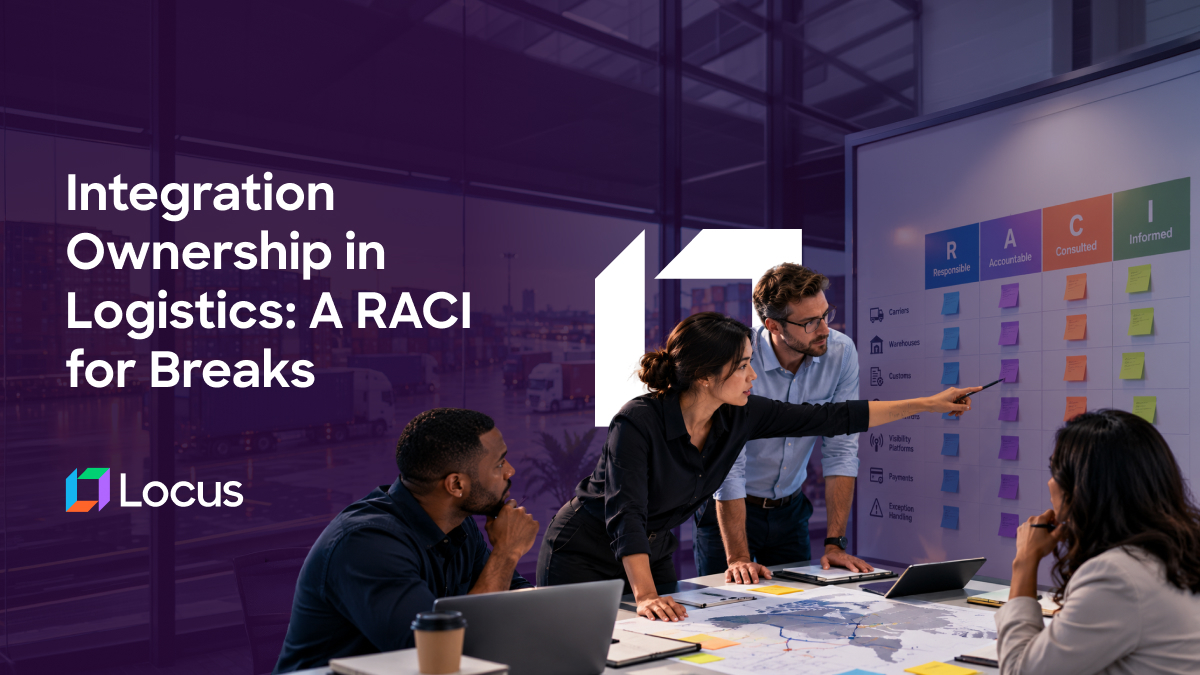
Integration ownership is the named accountability for a connection between two systems, such as the link that releases orders from an ERP to a TMS or the feed that carries carrier status back. It is different from owning either system, because a connection sits between teams and belongs by default to none of them. When it breaks, the ERP team sees clean outbound data, the TMS vendor sees no inbound orders and the logistics team sees trucks waiting, and the first hour goes on deciding whose problem it is. For VPs of IT, logistics systems leaders and procurement teams, this guide gives a RACI for each integration loop, escalation tiers, a first-30-minutes runbook and a support-boundary clause for contracts. Locus, the world’s first Decision-Intelligent, Agentic TMS, runs alongside enterprise systems of record, so its customers meet this question on day one.
Key Takeaways
- Every integration needs exactly one Accountable person. Two names create disputes over the result, and no name means the work is dropped.
- Responsibility can be shared across IT, logistics operations, the vendor and the carrier, but accountability cannot.
- Define ownership per integration loop, such as order release, execution data, settlement and carrier feed, because each fails differently.
- An unmanaged incident fails on narrow focus, poor communication and freelancing, which clear roles prevent.
- Write the support boundary into the contract: where vendor support ends and paid engineering begins.
Why Integration Ownership Matters: The Business Case
Integrations are numerous and mostly unconnected. MuleSoft’s 2023 Connectivity Benchmark found that organizations used an average of 1,061 applications with only 29% integrated, and 80% of IT leaders said integration challenges were slowing their efforts. The figures are from 2023, and the pattern of many systems and few clean connections still describes most logistics stacks.
Accountability is a known failure point. The Project Management Institute’s July 2026 guidance on RACI says that every task has exactly one Accountable person. It lists two names in the Accountable column and no name at all as common mistakes, and says matrixed organizations often leave ownership gaps that need a sponsor to resolve early.
Incidents go badly without roles. Google’s SRE guidance on incident management describes an unmanaged incident failing through narrow technical focus, poor communication and freelancing, where well-intentioned people change production without coordinating. It names incident command, operational work, communication and planning as separate roles, and says only the operations team should modify the system during an incident.
Agentic systems raise the stakes. PMI advises against making an AI agent Accountable: agents can be Responsible for bounded tasks, but accountability and escalation stay with a named human.
What Is Different About Owning a Logistics Integration
It sits between teams. The ERP, the TMS and the carrier each have an owner, and the connection between them has none unless someone is named.
Failures cross organizations. A broken order feed may start in your ERP, the vendor’s platform or a carrier’s interface, so diagnosis needs several parties at once.
Changes come from outside. A carrier can change a field or a vendor can release an update, so ownership includes watching for changes you did not make.
Each loop fails differently. Order release, execution data, financial reconciliation and carrier feeds have different timing and impact, so one owner may not fit all.
The business feels it first. Dispatchers and customer service see the symptom before IT sees the cause, so they need a way to raise it.
How to Assign Integration Ownership in Six Steps
1. Inventory the integrations by loop
List every connection and group it by loop, such as order release, execution data, settlement and carrier feed. For each, record the systems on both ends, the data that moves and who feels it first when it stops.
2. Name one Accountable owner per integration
Choose a single person, with a named deputy, who answers for the outcome. If two functions both claim or avoid it, escalate to the sponsor to settle it before launch.
3. Split the Responsible work
Assign who monitors, who fixes mappings, who rotates credentials, who raises vendor tickets and who talks to the business. Shared work is fine, as long as each task has one name.
4. Define escalation tiers and clocks
Set severity levels based on operational impact, such as dispatch blocked or reports delayed, and a response and update interval for each. Include the vendor and carrier contacts and the point at which a senior sponsor is pulled in.
5. Write a first-30-minutes runbook
Name an incident lead, an operations lead who alone changes the system, a communications lead for the business and a record-keeper. Add the first checks to run, such as last successful message, queue depth and recent changes.
6. Put the support boundary in the contract and review quarterly
Specify what the vendor monitors, what it fixes within standard support and what becomes paid engineering. Review the owners, contacts and boundaries every quarter and after every major change.
An Illustrative RACI for One Integration Loop
The table below shows one possible split for an order-release integration between an ERP and a TMS. Adjust it to your organization.
| Task | Integration owner (IT) | Logistics operations | TMS vendor | ERP team |
|---|---|---|---|---|
| Overall outcome of the loop | A | I | C | C |
| Monitor message flow and queues | R | I | R | I |
| Fix mapping or data errors | A | C | R | R |
| Rotate credentials and access | A | I | R | R |
| Raise and track vendor tickets | R | C | A | I |
| Communicate impact to dispatch | R | A | I | I |
| Post-incident review and fixes | A | R | R | R |
A is Accountable, R is Responsible, C is Consulted and I is Informed. Each row has exactly one A.
Unowned vs Shared vs RACI-Owned Integrations: Key Differences
| Dimension | Unowned | Shared informally | RACI-owned |
|---|---|---|---|
| Who answers | Nobody | “The team”, several names | One Accountable person per integration |
| First hour of a failure | Finding who owns it | Parallel work without coordination | Runbook with named roles |
| Vendor contact | Whoever knows the vendor | Several, uncoordinated | Named, with escalation tiers |
| Changes from outside | Found when something breaks | Noticed by whoever reads the notice | Tracked by the owner |
| Contract | No support boundary | Boundary assumed | Boundary written and reviewed |
| Learning | None | Informal lessons | Post-incident review with owners for fixes |
What to Look for in a Vendor’s Integration Support Model
A named escalation path. Look for severity definitions, response and update targets and named roles on the vendor side.
Clear monitoring responsibility. Check who monitors connectors and callbacks, and how failures are reported to you.
Change notification. Ask how the vendor notifies you of releases and deprecations, and with how much notice.
A written support boundary. Look for what is included in standard support and what is billed as engineering.
Visibility for the business. Check that dispatch and operations teams can see integration health without opening an IT ticket.
Integration Ownership in Action: Real-World Results
Neither deployment below is an ownership study. They show the integration surface a named owner has to cover.
A global FMCG leader running route-to-market across ten countries in Asia. An enterprise integration layer connects distribution management, order management, freight contracts and execution tracking across 1,000+ distributors and 5,000+ riders. After moving to automated planning, plan run time fell from 3 hours to 5 minutes and the company reported a 3X return on investment. Read the FMCG case study.
A Canadian multi-modal retailer. Six legacy systems handled dispatch across ocean, rail and road. After consolidating them on one platform, the retailer reached 99%+ on-time store delivery, held exceptions under two hours and saved $1M+. Read the retailer case study.
Common Integration Ownership Mistakes to Avoid
Naming a team instead of a person. A team cannot be Accountable, so name one person and a deputy.
Making the vendor Accountable for your connection. The vendor can be Responsible for its side, but the outcome in your operation needs your owner.
Skipping the business. If dispatch cannot see integration health or raise an incident, the first signal arrives late.
Setting it once. People move and systems change, so review owners and contacts every quarter.
How Locus Approaches Integration Ownership
Locus, the world’s first Decision-Intelligent, Agentic TMS, was recognized by Gartner for seven consecutive years and appears in the 2026 Hype Cycle for Supply Chain Execution and Logistics Technologies. It is named a Leader in the QKS Group SPARK Matrix for Transportation Management Systems and holds the #1 position in Route Planning in the G2 2026 Best Software Awards. In October 2025, Ingka Investments, the investment arm of Ingka Group, the world’s largest IKEA retailer, acquired Locus. Locus continues to operate independently.
Locus runs as the system of execution alongside the systems of record, with REST APIs for orders, deliveries and master data, configurable callbacks with event-type filtering, pre-built and API-based connections into ERP, WMS and OMS platforms and 160+ pre-integrated carriers through ShipFlex. Deployments are supported by Forward-Deployed Engineers who work alongside customer teams, and six governance mechanisms, including traceability and human-in-the-loop approval, keep accountability for automated decisions with named people. Locus has optimized 1.5B+ deliveries for 360+ enterprise customers across 30+ countries. Public sources do not publish Locus’s integration support matrix, so during evaluation ask for the escalation tiers and response targets by severity, who monitors connectors and callbacks, how release and change notices are given, what sits inside standard support and what is billed as engineering, and which roles Locus names on its side of your RACI. To see how Locus would fit your ownership model, schedule a demo.
For IT and logistics leaders asking who owns an integration when it breaks, Locus works with customers to name owners and boundaries up front and keeps decision records that show what happened and who approved it.
Frequently Asked Questions
What is integration ownership? It is the named accountability for a connection between two systems, such as an ERP-to-TMS order feed. It is distinct from owning either system, because a connection sits between teams.
Who should own a TMS integration? One named person, usually in IT or a logistics systems team, should be Accountable for each integration loop, with a deputy. Operations, the vendor and the ERP team can be Responsible for parts of the work, but the outcome has one owner.
What does RACI mean? Responsible, Accountable, Consulted and Informed. According to PMI, every task has exactly one Accountable person, and responsibility can be shared.
What should a first-30-minutes runbook include? Roles for an incident lead, an operations lead who alone changes the system, a communications lead and a record-keeper, plus first checks such as the last successful message, queue depth and recent changes.
What should a vendor support boundary cover? It should state what the vendor monitors, what it fixes within standard support, what counts as paid engineering and the response targets for each severity. Review it every quarter.
How does Locus handle integration support? Locus pairs its APIs and connectors with Forward-Deployed Engineers and governance records for automated decisions. Ask Locus for its escalation matrix, monitoring responsibilities and support boundary.


General
Reattempt Assignment: Turning a Failed Delivery Into a Recovered One in 2026

Oct 13, 2026
A failed first attempt is a decision, not a default. How to assign the reattempt by reason, customer availability and route capacity, and recover the delivery in 2026.
Read more
General
Peak-Ready Integrations: Designing Logistics Connectivity for Volume Spikes in 2026
Oct 13, 2026
Integrations fail at peak through rate limits, retry storms and stale queues, not outages. Six steps to design logistics connectivity that holds when volume spikes.
Read moreInsights Worth Your Time



















Integration Ownership in Logistics: A RACI for When the Connection Breaks