


General
How AI Dispatch and Allocation Works for Freight Carriers: A 2026 Practical Guide
Key Takeaways
- AI dispatch and allocation is software that decides which load goes to which driver or carrier, in what sequence and route, and adapts as conditions change.
- It works in stages: ingest orders and capacity, assign each load to the best-suited driver or carrier, optimize routes, handle exceptions in real time, and optimize across the carrier network.
- The most capable systems are agentic: they decide autonomously and keep deciding as conditions change, not applying static rules a dispatcher maintains.
- Real-time exception handling, a failed delivery, a late driver, a capacity shift, is where AI dispatch separates from a planning tool: it acts, not just alerts.
- Optimizing across a carrier network means choosing the best carrier per load by cost and service, not only sequencing one fleet’s stops.
- Locus is an agentic TMS that does this for carrier delivery and last-mile operations; pure line-haul freight brokerage is a freight-TMS category.
What AI Dispatch and Allocation is
For a freight carrier, dispatch and allocation is the decision at the center of the operation: which load or order goes to which driver, vehicle, or carrier, in what sequence, on which route, and what to do when something changes. Traditionally that decision is made by a dispatcher’s judgment or by fixed rules in a system. AI dispatch and allocation makes it with software that weighs many variables at once, capacity, service commitments, constraints, cost, and route efficiency, and keeps re-making it as conditions shift through the day.
The difference matters most at scale. A dispatcher can hold a few dozen variables in mind and re-plan a handful of times a day. A freight operation running high volume across many drivers, loads, and carriers generates far more decisions than that, and the quality of each one compounds into on-time performance, cost per load, and asset utilization. AI dispatch exists to make those decisions well and continuously, which is why it has become the core of a modern carrier operation rather than a nice-to-have. This guide explains how it actually works, step by step, and what freight operations leaders should expect from it.
How AI Dispatch and Allocation Works
Under the hood, AI dispatch and allocation runs a repeating loop rather than a one-time calculation. Here is what each stage does.
How AI Assigns Loads and Orders
Assignment is the first decision: matching each load or order to the best-suited driver, vehicle, or carrier. A capable system does this by evaluating capacity, service level, location, vehicle fit, cost, and route efficiency together, rather than by proximity or a simple rule. The goal is not just a feasible assignment but the one that keeps the whole operation efficient, since assigning one load well or badly ripples across every other load that driver or carrier could have taken.
The American Transportation Research Institute puts deadhead (empty running) at about 16.7% of all truck miles — roughly one mile in six with no load.
How AI Optimizes Routes and Sequences
Once loads are assigned, the system sequences and routes them against the operation’s real-world constraints: time windows, vehicle types, service levels, zones, and access rules. Good route optimization is deep, it models many constraints at once, and it produces plans that hold up in execution rather than looking efficient only on paper. This is where a large share of the cost and time savings is generated.
McKinsey finds AI-driven, multi-constraint routing delivers 10–25% cost reductions versus a static plan.
How AI Handles Exceptions in Real Time
The plan meets reality the moment wheels turn, and reality changes: a delivery fails, a driver runs late, traffic shifts, capacity drops. Real-time exception handling is what separates AI dispatch from a planning tool. Instead of surfacing an alert for a dispatcher to work, a capable system detects the exception and acts on it, rerouting, reassigning, or resequencing, so the operation stays optimal through the day rather than degrading after the morning plan.
ATRI found drivers are detained on 39.3% of stops, costing the industry $11.5 billion in lost productivity in 2023.
Also Read: 3PL CFO ROI Framework: Quantifying Dispatch Automation
How AI Optimizes Across a Carrier Network
For a carrier using multiple carriers or a mix of owned and contracted capacity, allocation extends beyond one fleet. The system chooses the best carrier for each load across the network by cost and service, and balances volume across the available capacity. This network-level optimization is what lets a carrier use the best option for every load rather than defaulting to whichever fleet is easiest to assign.
How the System Learns and Improves
The strongest systems close the loop: they sense conditions, decide, execute, and learn from the outcome, feeding actual performance back into future decisions. Over time this makes assignments and routes more accurate for the specific operation, rather than applying the same static logic indefinitely. It is the difference between software that runs the same way on day 500 as on day one and software that gets better at your operation.
Rule-Based vs. Agentic AI Dispatch
Not everything labeled “AI dispatch” makes decisions the same way, and the distinction matters for a freight operation choosing one. Rule-based systems apply logic a person has configured: if this, then that. They automate the routine but break at the edges, and someone has to maintain the rules as the operation changes.
Gartner predicts that by 2030, 50% of SCM solutions will use intelligent agents to autonomously execute decisions.
Agentic systems decide autonomously within guardrails, evaluating the full situation and adapting as it changes, and they keep deciding in real time rather than executing a fixed plan. For a high-volume freight operation, the practical test is simple: when conditions change mid-shift, does the system re-decide on its own, or does it wait for a dispatcher to intervene? The more autonomous the system, the more of the operation it can actually run.
What Freight Operations Leaders Should Take Away
Three things are worth holding onto when evaluating AI dispatch and allocation. First, the value is in the decision, not the dashboard: a tool that shows you the operation but leaves the decisions manual is not AI dispatch in any meaningful sense. Second, real-time exception handling is the capability that pays off daily, because a freight operation lives in the gap between the plan and the day. Third, ask how autonomous the system really is, since “AI” spans everything from static rules to genuinely agentic decisioning, and the difference determines how much dispatcher effort the system removes. Matched to a high-volume operation, autonomous dispatch and allocation is what lets a carrier grow volume without growing the dispatch desk in step.
Also Read: Three-Workforce Fleet Reality: Owned, 3PL, Gig Drivers
How Locus Approaches AI Dispatch and Allocation
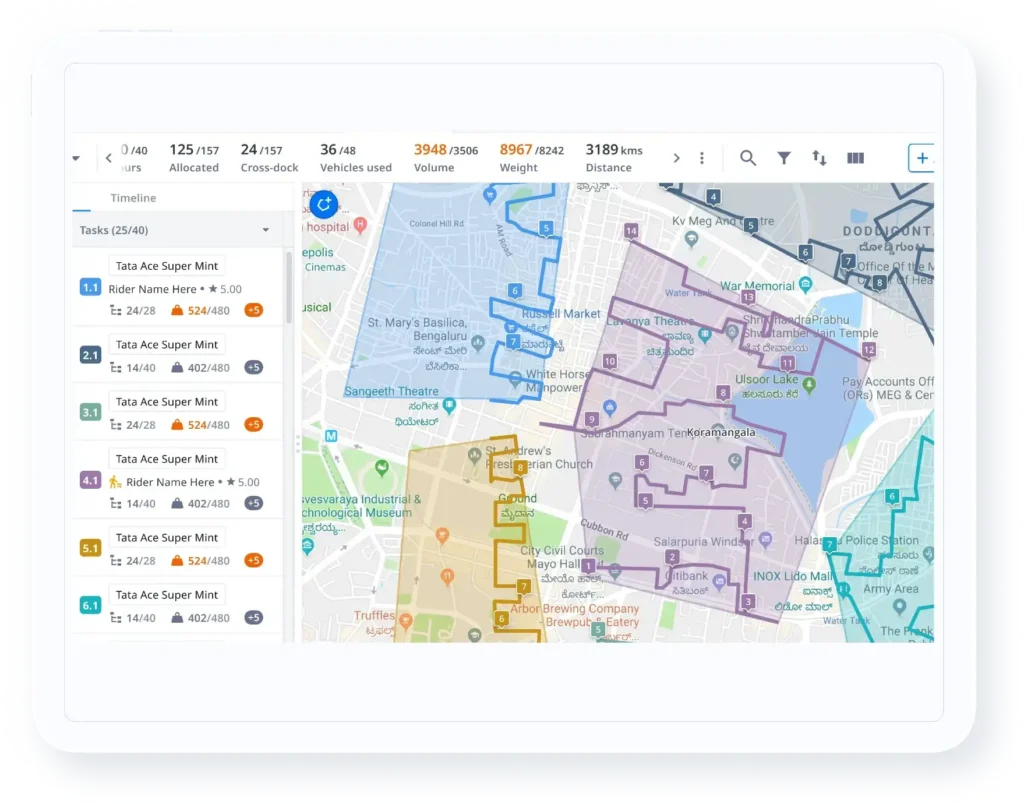
Locus is an agentic TMS, the world’s first, and it implements this loop through coordinating agents. The Dispatch agent assigns and sequences loads and orders; routing optimizes against 250+ real-world constraints; the Orchestrator agent handles exceptions in real time; and the Carrier agent selects and orchestrates carriers across a multi-carrier network. The agents sense, decide, execute, and learn as one system, which is what makes the dispatch decision autonomous rather than dispatcher-driven. Its route intelligence holds G2’s #1 position for Route Planning.
Also Read: Beyond Cost-Per-Delivery: 5 Value Drivers for US CFOs 2026
Locus applies this most directly to carrier delivery, last-mile, and courier-express-parcel operations and to multi-carrier orchestration. It is not a line-haul freight load board or brokerage system, so for pure FTL and LTL brokerage a freight TMS is the right category; where Locus fits the freight-carrier question is in the delivery and allocation side of the operation, where agentic dispatch runs the decision at scale.
Learn more, visit locus.sh.
Frequently Asked Questions (FAQs)
How does AI dispatch and allocation work for freight carriers?
It runs a repeating loop: it ingests orders and available capacity, assigns each load to the best-suited driver, vehicle, or carrier by capacity, service, cost, and route fit, optimizes routes against real-world constraints, dispatches to the field, handles exceptions in real time, and optimizes across the carrier network. The strongest systems also learn from outcomes, improving decisions for the specific operation over time.
How does AI assign loads to drivers or carriers?
By evaluating capacity, service level, location, vehicle fit, cost, and route efficiency together to find the assignment that keeps the whole operation efficient, not just a feasible match. This is different from proximity-based or rule-based assignment, because assigning one load well or badly affects every other load that driver or carrier could have handled.
How does AI dispatch handle exceptions?
A capable system detects exceptions, a failed delivery, a late driver, a capacity shift, and acts on them by rerouting, reassigning, or resequencing, rather than only alerting a dispatcher. Real-time exception handling is what separates AI dispatch from a planning tool, because it keeps the operation optimal through the day instead of letting the morning plan degrade.
What is the difference between rule-based and agentic AI dispatch?
Rule-based systems apply logic a person configures and must maintain, and they break at the edges. Agentic systems decide autonomously within guardrails, evaluate the full situation, and keep re-deciding as conditions change. The practical test: when conditions change mid-shift, does the system re-decide on its own, or wait for a dispatcher? The more autonomous it is, the more of the operation it runs.
Does AI dispatch optimize across multiple carriers?
Yes, in systems built for it. Network-level optimization chooses the best carrier for each load across owned and contracted capacity by cost and service, and balances volume across the network, so a carrier uses the best option for every load rather than defaulting to whichever fleet is easiest to assign.
How does Locus fit for freight carriers?
Locus is an agentic TMS that runs autonomous dispatch, allocation, routing, exception handling, and multi-carrier orchestration, applied most directly to carrier delivery, last-mile, and CEP operations. It is not a line-haul freight load board or brokerage system, so pure FTL and LTL brokerage suits a freight TMS; Locus fits the delivery and allocation side of a freight carrier’s operation.


General
The Best 3PL for Last-Mile Delivery Efficiency: Why Your Tech Stack Is the Real Differentiator in 2026

Jul 24, 2026
The best 3PL for last-mile efficiency is the one with the best tech stack, not the biggest fleet. What to evaluate, and why the stack is the differentiator.
Read more
General
How Order-to-Delivery Automation Reduces Manual Handoffs From Warehouse to Doorstep

Jul 27, 2026
See how order to delivery automation maps warehouse-to-doorstep handoffs and where Locus automates allocation, routing, carrier handoff, and POD to cut costs.
Read moreInsights Worth Your Time



















How AI Dispatch and Allocation Works for Freight Carriers: A 2026 Practical Guide