


General
Beyond the Tracking Link: Redefining Last-Mile Delivery Experience in 2026

Key Takeaways
- Last-mile delivery accounts for up to 53% of total shipping costs per Capgemini Research Institute. WISMO inquiries account for up to 50% of inbound calls to e-commerce customer service, at $5-12 per call. The WISMO drain compounds visible last-mile cost with invisible customer service overhead.
- Failed first-attempt deliveries cost approximately $17.78 each in direct cost per industry research cited by OrangeMantra. Address errors account for approximately 45% of failures. Industry research consistently shows customers materially withdraw repurchase intent following poor delivery experiences.
- Three architectural capabilities convert reactive last-mile into proactive DXO: proactive ETA communication (closes the visibility gap producing WISMO), intelligent address validation (eradicates address-driven failures at source), dynamic route optimization across captive, 3PL, and gig fleets (maintains SLA without margin compression).
- For supply chain leaders, VPs of Last Mile, and Heads of Customer Experience in 2026: cost center to minimize, or primary brand touchpoint to architect?
In the fast-paced landscape of 2026 logistics, dropping a package at a doorstep is no longer enough to win customer loyalty. Supply chain leaders have spent decades perfecting warehouse robotics, freight procurement, and cross-docking operations. To the end consumer, none of that upstream efficiency matters if the final stretch fails.
The last mile is the only physical touchpoint between the brand and the consumer, which makes it a critical driver of future revenue. Modern consumers demand speed, precision, and proactive communication. Meeting these expectations requires a comprehensive strategy known as Delivery Experience Optimization (DXO). Relying on reactive customer service and static GPS tracking dots is a guaranteed way to bleed profit margins. To thrive, logistics teams must leverage AI and predictive intelligence to architect a last-mile experience that prevents exceptions before they occur.
The Financial Toll of WISMO and Failed Deliveries
The last mile is inherently complex, fragmented, and vulnerable to external disruptions like traffic and weather. These challenges compound to make last-mile delivery account for approximately 53% of total shipping costs in B2C supply chains per Capgemini Research Institute analysis. Baseline transportation cost is only part of the operational equation. The structural margin killers are the hidden inefficiencies that compound on top of the visible cost: WISMO calls and failed deliveries.
Last-mile delivery accounts for up to 53% of total shipping costs per Capgemini Research Institute. WISMO inquiries account for up to 50% of inbound calls to e-commerce customer service, at $5-12 per call.
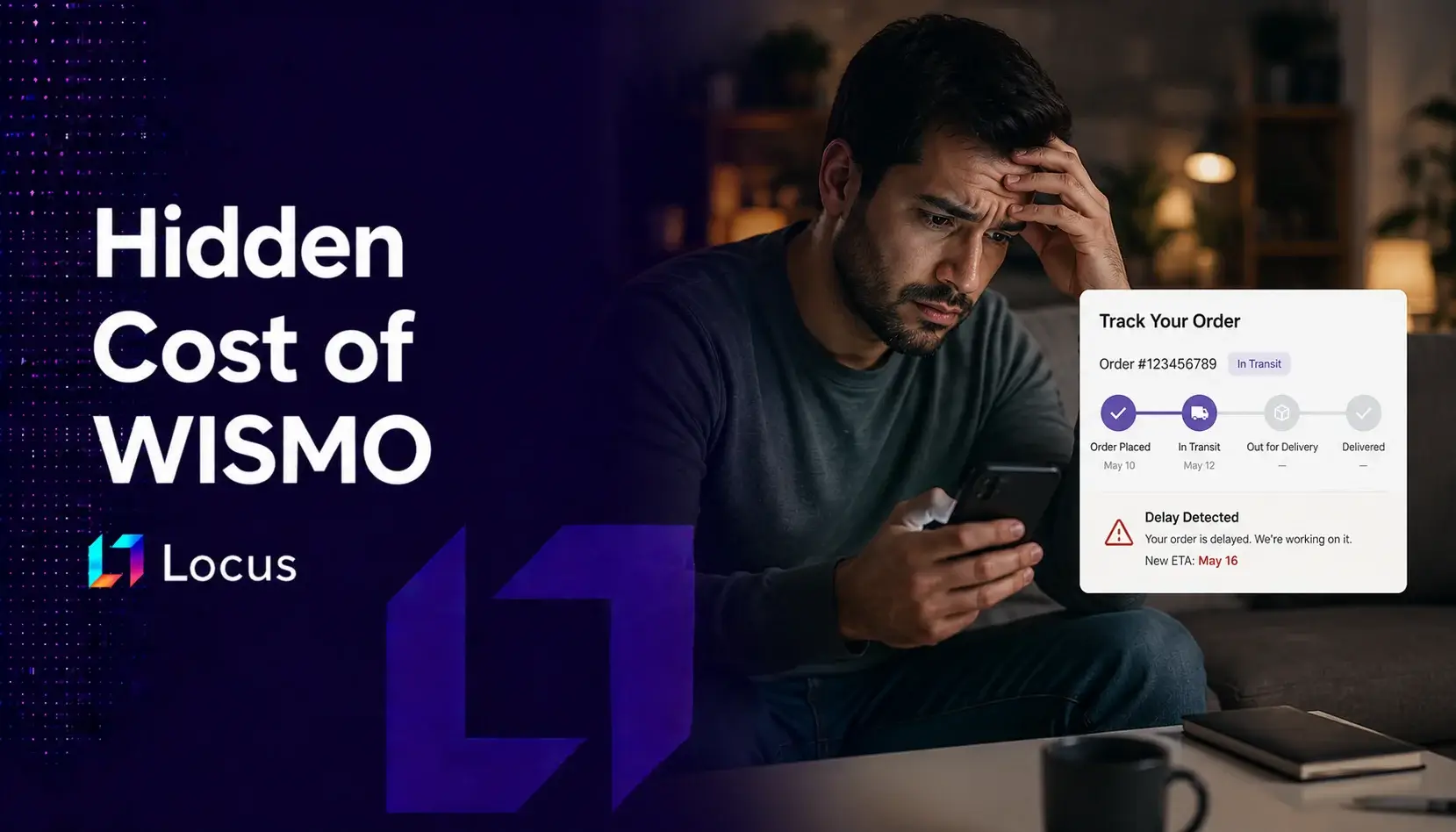
The WISMO drain. WISMO stands for “where is my order.” It is the symptom of a structural problem: the visibility gap between purchase and delivery that customers fill by initiating customer service contact. When customers lack accurate, proactive delivery information, they reach out to customer support to fill the visibility gap. WISMO inquiries account for up to 50% of inbound calls to e-commerce customer service centers, with typical handling costs of $5-12 per call (including agent time, hold time, and follow-up). Operations adding delivery volume without architectural WISMO prevention add customer service capacity proportionally, producing SG&A scaling linearly with revenue growth and eliminating the operating leverage that volume should provide.
The high cost of failure. Failed deliveries occur when a driver arrives at a location but cannot complete drop-off due to an inaccurate address, a closed business, or an unavailable customer. The business pays for fuel, driver labor, vehicle wear, reverse logistics, and customer service overhead for an order that generated zero value. Industry research cited by OrangeMantra puts the direct cost at approximately $17.78 per failed delivery. Beyond the direct cost, future revenue erodes: industry research consistently shows that customers materially withdraw repurchase intent following poor delivery experiences.
Moving from Reactive Tracking to Proactive DXO
Traditional logistics tracking is reactive. The customer checks a tracking link, sees the truck is stuck, calls customer service to complain. The architecture announces failure to the customer rather than preventing it. DXO inverts this. The architecture uses machine learning and historical data to forecast delays, recalculate ETAs continuously, and notify customers of changes before the customer realizes there is a problem.
The architectural shift is what distinguishes profitable last-mile operations from operations that subsidize every delivery through customer service overhead and failed-delivery cost. Three capabilities make the proactive DXO model operational at enterprise scale.
How Locus’s AI-Powered Capabilities Drive Last-Mile Resilience
Architecting a profitable and loyalty-driving delivery experience requires an agentic Transportation Management System capable of intelligent orchestration across the full operational surface. Locus, the world’s first agentic TMS, operates this layer through three integrated AI capabilities: the Mycroft AI Co-Pilot that surfaces emerging exceptions and recommends decisions, the DiSCO (Digital Customer Experience) agentic framework that orchestrates eight specialized AI agents handling routing, dispatch, exception management, and customer communication, and a Sense-Decide-Execute-Learn (SDEL) architecture that processes operational signals continuously through the four-stage decisioning cycle. Across 350+ enterprise deployments in 30+ countries, Locus solves 250+ operational constraints per decision while orchestrating a 1,000+ carrier network. Here is how leading logistics teams use Locus to master the last mile in 2026.
1. Proactive ETA Communication
Customers do not just want fast shipping; they want predictable shipping. Locus generates highly accurate predictive ETAs by analyzing real-time traffic conditions, weather constraints, driver behavior patterns, and customer-promised delivery windows. The Mycroft AI Co-Pilot continuously monitors route execution against committed delivery windows and surfaces emerging exceptions before they affect customer experience. When an exception is detected, the platform automatically triggers branded SMS or WhatsApp notifications with revised ETAs, converting potential frustration moments into trust-building communication. The DiSCO customer-communication agent runs continuous proactive ETA updates as conditions change, closing the visibility gap that produces WISMO inquiries.
The architectural shift is from reactive WISMO handling (customer asks, customer service answers) to proactive ETA communication (the architecture absorbs the communication load before customer service contact is initiated). Research consistently shows material WISMO reduction when operations implement branded tracking pages with proactive ETA notifications versus when customers must initiate contact to learn order status.
WISMO inquiries account for up to 50% of inbound calls to e-commerce customer service centers, with typical handling costs of $5-12 per call (including agent time, hold time, and follow-up).
2. Intelligent Address Validation
Address errors are a primary contributor to failed first-attempt deliveries, accounting for approximately 45% of failures per industry research. Missing apartment numbers, incorrect postal codes, unmapped commercial entrances, and customer-entered formatting errors all produce drivers who reach the right neighborhood but cannot reach the right doorstep. The compound cost is significant: every address-driven failed delivery costs the $17.78 direct cost, generates the WISMO contact that follows the failure, and produces the customer experience damage that erodes future repurchase intent.
Locus combats this through advanced geocoding and address normalization built into the routing layer. The DiSCO (Digital Supply Chain Officer) address intelligence agent cross-references and cleans messy address inputs before the route is generated, converts text strings into precise latitude and longitude coordinates, flags ambiguous addresses for resolution before dispatch, and routes drivers directly to the correct drop-off point through navigation that respects the operational reality at the address. First-attempt delivery success rates improve at structural level because the addresses drivers receive are the addresses drivers can actually reach.
3. Dynamic Route Optimization Across Multi-Fleet
Consumer expectations for precise time-window deliveries and on-demand fulfillment cannot be met with static, manual routing sheets. Modern last-mile operations require routing across captive fleets, third-party logistics (3PL) partners, and gig-economy drivers, with continuous re-optimization as conditions evolve. Locus’s AI-powered routing engine operates this multi-fleet orchestration through the DiSCO framework, optimizing each order against 250+ operational constraints including SLA requirements, vehicle type capability, payload, customer time windows, driver availability, traffic conditions, and cost-to-serve economics across fleet categories.
The SDEL architecture continuously senses operational signals, decisions against the full constraint surface, executes through the fleet category that produces the best cost-to-serve outcome for the order, and learns from execution outcomes to improve future decisioning. Service-level agreements are met without inflating driver hours or fuel consumption beyond operational necessity. Route density maximizes structurally because routing logic adapts continuously rather than executing against frozen plans.
Conclusion: DXO as Competitive Advantage
Treating the last mile as a mere cost center is a strategic vulnerability. In an era defined by fierce e-commerce competition and rising operational expenses, Delivery Experience Optimization is the operational mandate for sustainable growth in 2026. Operations deploying advanced agentic TMS architecture to eradicate failed deliveries, automate proactive communication, and optimize dynamic routing across the full fleet mix transform their last-mile logistics from financial liability into the strongest competitive advantage the brand can build.
The strategic question for supply chain leaders, VPs of Last Mile, and Heads of Customer Experience in 2026 is concrete: does the operation treat the last mile as cost center to minimize, or as primary brand touchpoint to architect? Operations leveraging Locus’s agentic TMS to absorb the WISMO drain, eradicate the $17.78 failed-delivery cost at source, and orchestrate dynamic routing across captive, 3PL, and gig fleets convert the last mile into a loyalty engine while protecting operating margin.
Learn more, visit locus.sh
FAQs
What is a WISMO call and why is it costly?
WISMO stands for “where is my order.” It refers to inbound customer service contacts (calls, chats, emails) from customers who want to know where their orders are and when they will arrive. WISMO inquiries account for up to 50% of inbound calls to e-commerce customer service centers. The costs are real: typical handling costs of $5-12 per call (including agent time, hold time, and follow-up) plus the operational overhead of customer service capacity scaling proportionally with delivery volume. Architectural WISMO prevention runs customer-facing exception communication through the orchestration layer rather than through customer service capacity.
How does Delivery Experience Optimization (DXO) improve customer retention?
DXO converts the last mile from logistics cost center into customer experience layer. Industry research consistently shows customers materially withdraw repurchase intent following poor delivery experiences. DXO architecturally addresses the failure modes (opaque tracking, address-driven failed deliveries, missed SLAs) that erode customer trust. Proactive ETA communication, intelligent address validation, and dynamic route optimization compound into delivery experiences that build trust, reduce frustration, and directly encourage repeat purchases.
What is the primary cause of failed last-mile deliveries?
While traffic conditions, vehicle availability, and customer absence all contribute, bad address data is the largest single contributor. Industry research shows address errors account for approximately 45% of failed deliveries: missing apartment numbers, incorrect postal codes, unmapped commercial entrances, and customer-entered formatting errors. Address validation built into the routing layer (geocoding, normalization, validation before dispatch) eradicates the largest failure category before drivers leave the depot.
How do predictive ETAs differ from real-time tracking?
Real-time tracking is a reactive snapshot of where a vehicle currently is. Predictive ETAs use historical data, machine learning, and live signals (traffic, weather, driver behavior, route execution patterns) to forecast exactly when the vehicle will arrive at each destination. The architectural difference matters for customer experience: real-time tracking tells customers their order is delayed; predictive ETAs tell customers exactly when the order will arrive and proactively update the ETA as conditions change.
How does Locus optimize the last-mile delivery experience?
Locus operates as the world’s first agentic TMS, with three integrated AI capabilities driving last-mile experience optimization: the Mycroft AI Co-Pilot surfaces emerging exceptions and recommends decisions; the DiSCO agentic framework orchestrates eight specialized AI agents handling routing, dispatch, exception management, and customer communication; and the Sense-Decide-Execute-Learn (SDEL) architecture processes 250+ operational constraints per decision while orchestrating a 1,000+ carrier network. The architectural integration eradicates the blind spots that produce WISMO and failed deliveries at source, across 350+ enterprise deployments in 30+ countries.


General
Delivery Experience Optimization: How AI is Reshaping Last-Mile Logistics in 2026

Jun 22, 2026
Last-mile delivery accounts for up to 53% of total shipping costs. Failed deliveries cost approximately $17.78 each. Delivery Experience Optimization (DXO) is the strategic mandate for 2026: predictive ETAs, address intelligence, and dynamic routing that protect both customer retention and operating margin.
Read more
General
The Upstream Shift: Why Leading Enterprises Are Overhauling Their Inbound Logistics Management Software

Jun 23, 2026
Inbound freight typically accounts for 8-12% of an enterprise's material spend and over 21% of EU road freight kilometers operate completely empty. AI-native inbound logistics management software converts static milk runs into dynamic, constraint-aware orchestration. A framework for supply chain and procurement leaders in 2026.
Read moreInsights Worth Your Time



















Beyond the Tracking Link: Redefining Last-Mile Delivery Experience in 2026