


General
Online Grocery Order Tracking: Why Item-Level Visibility Wins Customer Trust in 2026

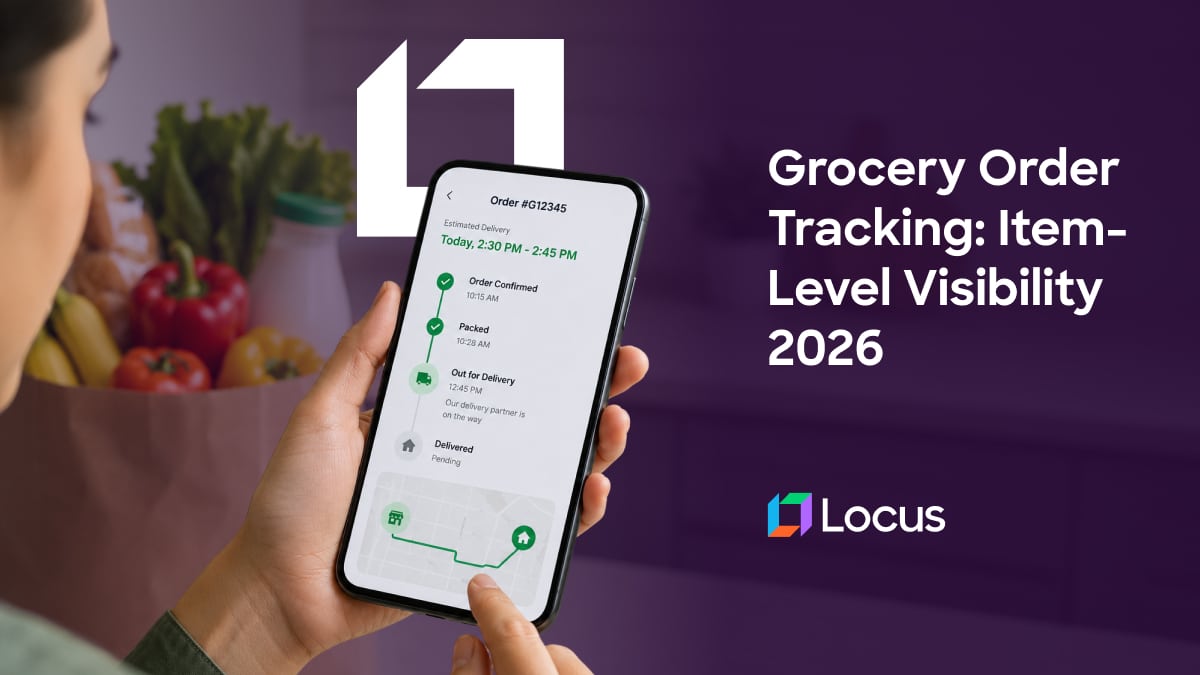
Item-level visibility in online grocery is the practice of exposing the status of individual order lines, not just the shipment, to the customer between checkout and doorstep. It is used by grocery retailers and e-grocery platforms whose orders change composition after payment through substitutions, partial picks and short-dated stock. It matters because grocery is the only major retail category where what the customer bought is not necessarily what arrives, and a location-based tracking page cannot represent that.
Key Takeaways
- Shipment-level tracking answers where the order is. In grocery the more expensive question is what is in it, and a moving map cannot answer it.
- McKinsey finds 10% to 15% of pick-from-store grocery orders experience a stockout requiring substitution, so basket change is a routine event rather than an exception.
- A substitution is a customer decision, not a notification. Exposing it during the fulfillment window converts a complaint into a choice.
- Partial picks create charge disputes rather than delivery failures, which is why they never appear in on-time reporting and always appear in contact volume.
- Grocery WISMO contacts are frequently item-level, which is why location-only tracking pages underperform published self-service deflection benchmarks.
Why Item-Level Visibility Matters in Online Grocery: The Business Case
Online grocery is now a mainstream channel rather than a pilot. Brick Meets Click data reported by Digital Commerce 360 shows online grocery reached more than 19% of category sales in Q1 2026, up from less than 15% in Q3 2024, after six consecutive quarters of growth above 20% year over year. Every point of that shift moves a shopping trip that used to be self-verified in an aisle into a transaction the customer has to trust someone else to execute.
Basket change is routine at that volume. McKinsey’s work on omnichannel grocery fulfillment finds that in a pick-from-store model, 10% to 15% of orders will experience stockouts and potentially require substitution during fulfillment, and notes that poor execution on out-of-stocks and substitution decisions destroys customer trust. That is not a tail case to be handled by exception management. At one in seven to one in ten orders, it is a core flow.
The customer response is measurable and it is policy-sensitive. Research published in the Journal of Retailing on post-purchase out-of-stock in online grocery finds substitution acceptance rises from 66% for random selection to 75% when substitutions follow a recommended policy matched on the category’s dominant attribute, and that stock-outs have a pervasive negative effect on assessment of the transaction and on repurchase intention. The same research finds customers are considerably more likely to accept a product they have bought before. Acceptance is therefore something the retailer influences rather than something it discovers.
Support economics make the visibility gap concrete. Gartner’s survey of 5,728 customers found that while 73% of customers use self-service at some point in their service journey, only 14% of issues are fully resolved there. In grocery, the structural reason is visible: a tracking page built to show location and ETA cannot answer why an item was replaced, where a missing item went, or why a charge does not match the delivery. Those contacts route to a human by design, not by failure.
The experience gap is worth real money at the top line. McKinsey reports that service leaders in grocery pickup reach 63% customer satisfaction against an industry average of 56%, and that grocers executing well on omnichannel have raised share of wallet with existing customers by 20% to 30%. In a category built on weekly repeat purchase, the compounding runs in both directions.
Perishability adds a cost the customer never sees on the tracking page. ReFED’s 2026 U.S. Food Waste Report records 70 million tons of surplus food in 2024, roughly 29% of US food supply, with $325 billion of that treated as waste. A short-dated line delivered without warning frequently becomes a quality claim, a refund and a discarded product, which means the same item is paid for twice and thrown away once. Telling the customer before delivery costs nothing and changes the outcome.
Also Read: Delivery Experience Optimization for E-Grocery 2026
How Item-Level Order Visibility Works
Item-level visibility does not replace the tracking map. It adds a second axis to it, so the customer sees the state of the basket alongside the state of the vehicle, and can act on the basket while acting is still useful.
1. Model the order as lines, not as a shipment
The order has to exist in the system as individual lines with their own status, each one able to be picked, substituted, short-picked, refunded or flagged as short-dated. If the order is a single object with one status field, every downstream customer-facing improvement is blocked at the data layer.
2. Capture pick outcomes as they happen
Pick status flows from the store or dark store as it is generated rather than in a single batch at dispatch. This is what creates a usable decision window, because a substitution surfaced at handover is information and a substitution surfaced during picking is a choice. The length of that window is an operational design decision, and it is usually longer than teams assume, since the gap between pick completion and dispatch is dead time from the customer’s perspective.
3. Surface the decision to the customer inside the window
When a line cannot be filled as ordered, the customer sees the proposed replacement with the attribute that matters for that category, and can approve it, decline it for a refund, or pick an alternative. Matching on the dominant attribute and on prior purchases is what moves acceptance, so the proposal quality is part of the interface, not a back-office concern.
4. Reconcile the charge against what actually ships
The authorized amount is adjusted to the delivered basket before the customer sees a statement line they did not expect. Partial picks and declined substitutions become a settled number rather than a dispute, which removes an entire contact class instead of handling it faster. This is also the step most often deferred, because it touches payments rather than logistics, and deferring it means the customer-facing improvements upstream get undone by the statement.
5. Expose handling state for perishables
Where a line is short-dated or temperature-sensitive, the customer sees the relevant fact at the point it changes their behavior, which is before the delivery rather than after opening the bag. This is also where visibility earns operational credit, because a customer who knows a line is short-dated is far less likely to raise a quality claim.
6. Give the customer control actions, not just status
Reschedule, redirect, alternate drop and leave-safe instructions belong next to the item view, because grocery decisions are contents-dependent. A customer will accept a later slot for an ambient basket and will not accept one for a frozen basket.
7. Close the loop into operations
Substitution acceptance and rejection, short-pick frequency by SKU and by site, and item-level contact reasons feed back into inventory accuracy, picking sequence and substitution rules. Visibility that only flows outward improves the message. Visibility that flows both ways improves the fill rate.
Also Read: Real-Time Delivery Tracking: Customer Expectations Guide
Item-Level Visibility vs Shipment-Level Tracking: Key Differences
| Dimension | Shipment-level tracking | Item-level visibility |
|---|---|---|
| Unit of status | The order as one object | Each order line independently |
| Question answered | Where is my order and when does it arrive | What is in my order, and what changed |
| Substitution handling | Notified at or after handover | Surfaced during picking as an approve or decline decision |
| Partial pick handling | Not represented | Line marked short-picked with charge adjusted before delivery |
| Perishable state | Not represented | Short-dated and temperature-sensitive lines flagged pre-delivery |
| Charge accuracy | Reconciled after the fact through refunds | Reconciled against the delivered basket before billing |
| Customer control actions | Reschedule or redirect the whole delivery | Actions available per line and per basket composition |
| WISMO contacts addressed | Where is my order | Adds why was this replaced, where is my missing item, why this charge |
| Operational feedback | On-time rate, ETA accuracy | Adds acceptance rate by rule, short-pick rate by SKU and site |
| Primary failure mode | Late delivery | Silent basket change discovered by the customer at the door |
The two are complements, not competitors. A grocery operation with excellent shipment tracking and no item-level visibility will run good on-time numbers alongside stubborn contact volume, because it is answering a question its customers had already stopped asking. The reverse also holds: item detail without a reliable slot is transparency about a promise that is still being missed.
What changes with item-level visibility is the timing of the customer’s knowledge. Every substitution and short pick eventually becomes visible. The only variable is whether the customer learns about it while a choice is still available or at the doorstep when the only remaining option is a complaint.
This also explains a reporting artifact worth naming. Item-level failures do not degrade on-time delivery, fill-rate-at-dispatch or ETA accuracy, so an operation can post improving numbers across its entire delivery dashboard while customer satisfaction stalls. The gap is not a measurement error. It is a category of failure that the delivery metrics were never built to capture, and it surfaces instead in contact volume, refund rate and repeat purchase.
What to Look for in Grocery Order Visibility Software
1. Line-level order and status model. Confirm the platform stores and exposes status per order line rather than per shipment, and that line status can be updated independently mid-fulfillment. Ask to see the customer view of an order with one substituted line, one short-picked line and one delivered line, because that single screen tests the whole data model.
2. Live integration with picking, not just dispatch. Item status is only actionable if it arrives while picking is happening. A platform that receives the final basket at dispatch can report substitutions accurately and can never make them a customer decision, which is the difference between transparency and control.
3. Substitution proposal quality. The system should propose replacements matched on the category’s dominant attribute and weighted toward the customer’s own purchase history, since both materially change acceptance. Ask how the rules are configured per category, and how acceptance rate is measured per rule so the logic can be improved. A vendor that cannot report acceptance by rule is offering a substitution feature rather than a substitution capability, since the rules cannot be tuned without that feedback.
4. Charge reconciliation before billing. Look for authorization adjusted against the delivered basket rather than refunds issued afterwards. This is the single highest-leverage item in the list for contact reduction, because a charge the customer did not expect generates a contact even when the delivery itself went well.
5. Two-way operational feedback. The platform should return acceptance and rejection data, short-pick frequency by SKU and site, and item-level contact reasons into inventory and picking. Without that loop, visibility documents a recurring problem at increasing fidelity without reducing it. The test is whether last month’s short-pick data has changed this month’s picking sequence or inventory buffer anywhere in the operation.
Also Read: Delivery Experience Platform: Lift NPS, Cut WISMO
Item-Level Visibility in Action: Real-World Results
E-grocery platform, 25+ cities. A grocery platform carrying more than 18,000 products across 25+ cities reached 99.5% on-time delivery with 95%+ volume utilization after moving to constraint-aware execution. The catalog size is the relevant detail for visibility: at 18,000 SKUs, substitution and short-pick handling is a permanent operating condition rather than a seasonal problem, and slot reliability at that level only converts into customer trust if the basket that arrives matches what the customer was told to expect.
Retail enterprise, six legacy systems. A retail enterprise consolidated six legacy systems into a single execution layer, cut manual dispatch effort by more than 80%, held 99%+ on-time delivery, and broke even inside year one on $1M+ in savings. The consolidation matters more for visibility than for routing. Item-level status is only coherent when order, inventory and delivery state live in one place, since a customer-facing view assembled from six systems inherits the staleness of the slowest one.
Fortune 50 enterprise, 4,500+ drivers. A Fortune 50 operation running more than 4,500 drivers moved execution rate from 75% to 92% and surfaced more than $14M in annualized operational opportunity. Execution rate is the upstream constraint on any visibility program, because a plan that fails at execution generates exactly the surprises that item-level transparency then has to explain to the customer. Sequencing matters here: transparency layered over unreliable execution increases contact volume in the short term, because it gives customers earlier and more specific grounds to get in touch.
Also Read: Delivery Notification Software: Enterprise Guide 2026
Common Grocery Order Visibility Mistakes to Avoid
Treating substitution as a notification. Telling the customer what was replaced after the fact converts a decision into an announcement, and the acceptance data shows the customer would often have chosen differently given the option.
Measuring visibility by tracking page views. Page views rise when customers are anxious. The metrics that indicate visibility is working are item-level contact volume, substitution acceptance rate and refund rate, all of which should fall.
Reconciling charges after delivery. A statement line the customer did not expect produces a contact even on an otherwise perfect delivery, and each of those contacts costs more to resolve than the adjustment itself.
Exposing item detail without control actions. Showing a customer a substituted line they cannot decline is more damaging than showing nothing, because it demonstrates that the retailer knew and did not ask.
Treating the tracking page as the whole of visibility. The tracking page is one surface. Item-level state also has to reach the order history, the receipt, the support agent’s screen and the returns flow, or the customer gets a different answer depending on where they look.
Also Read: Grocery Delivery Management System: What Enterprises Need
How Locus Approaches Order Visibility for Online Grocery
Locus, the world’s first Decision-Intelligent, Agentic TMS, treats customer-facing visibility as an output of execution state rather than a separate communications layer. The Customer Agent within the DiSCO framework tracks every order against its promised slot with live ETAs, raises alerts when a slot is at risk, captures proof of delivery, and carries control actions covering reschedule, redirect and alternate drop, so the customer view and the operational view are reading the same data rather than two reconciled copies.
Because the Customer Agent operates on the Sense-Decide-Execute-Learn cycle alongside the Dispatch and Capacity Agents, a change in execution state reaches the customer as part of the decision rather than as a downstream message triggered after the fact. Ops teams work the same state through control tower software with white-labeled tracking pages and alerts across SMS, email and push on the customer side, which is what allows a proposed substitution or a slot risk to become an actionable choice inside the fulfillment window instead of an explanation afterwards. Six governance mechanisms (explainability, traceability, evaluation, autonomy levels, execution sandbox and human-in-the-loop) mean a customer-facing commitment can be traced to the decision that produced it, which matters when a service leader has to explain why a promise changed.
Locus runs at 1.5B+ deliveries across 360+ enterprise customers in 30+ countries at 99.99% uptime, modeling 250+ real-world constraints including vehicle compartments and temperature zones. Locus has been recognized by Gartner for seven consecutive years across multiple research categories, appears in the 2026 Gartner Hype Cycle for AI-powered logistics, features ShipFlex as a Representative Vendor in the 2026 Gartner MCPMS Market Guide, holds Leader designation in the QKS SPARK Matrix for Transportation Management Systems, and ranks #1 on G2 for Route Planning software.
In the e-grocery deployment referenced above, an operator running 18,000+ products across 25+ cities sustained 99.5% on-time delivery at 95%+ volume utilization, which is the reliability floor that item-level transparency needs in order to be worth exposing. In the retail enterprise case, consolidating six legacy systems produced $1M+ in savings and cut manual dispatch effort by more than 80%, and it is that consolidation that makes a single coherent customer-facing order view possible in the first place.
The same state also drives analytics rather than a parallel reporting stack, so acceptance patterns, short-pick concentration and item-level contact reasons are read from execution history rather than reconstructed from support tickets. That distinction decides whether a visibility program improves the message or improves the fill rate.
In October 2025, Ingka Investments, the investment arm of Ingka Group, the world’s largest IKEA retailer, acquired Locus. Locus continues to operate independently.
Frequently Asked Questions (FAQs)
What is item-level visibility in online grocery delivery?
Item-level visibility is the exposure of status for each individual order line, rather than for the order as a single shipment, between checkout and delivery. It covers substitutions, partial picks, short-dated stock and per-line charge reconciliation, alongside the location and ETA information a standard tracking page provides.
Why is real-time tracking alone insufficient for grocery customer experience?
Because a tracking page reports where the order is and grocery customers also need to know what is in it. Substitutions and partial picks change the basket after payment, and a map with a moving pin has no way to represent a replaced or missing item, so those questions route to support.
How often do online grocery orders require substitutions?
McKinsey finds that in a pick-from-store model, 10% to 15% of orders will experience stockouts and potentially require substitution during fulfillment. At that rate, substitution is a routine flow rather than an exception, which is why it needs a designed customer experience rather than exception handling.
Does showing substitutions to customers increase complaints?
The research points the other way. Journal of Retailing work on post-purchase out-of-stock finds acceptance rises from 66% for random substitution to 75% when replacements follow a policy matched on the category’s dominant attribute, and that customers are more likely to accept products they have purchased before.
Which metrics show item-level visibility is working?
Item-level contact volume, substitution acceptance rate by rule, short-pick rate by SKU and site, and refund rate. Tracking page views are not a success measure, since page views tend to rise when customers are uncertain about their order.
How does item-level visibility reduce WISMO contacts in grocery?
Grocery contacts are frequently about contents rather than location, covering why an item was replaced, where a missing item went, and why a charge does not match the delivery. Answering those in self-service requires line-level status and charge reconciliation, which is what a location-only tracking page cannot provide.


General
Rider Management for Online Grocery: Why Eligibility Beats Proximity in 2026

Sep 3, 2026
In online grocery, the nearest rider is often the wrong rider. Learn how eligibility-based rider management handles cold chain custody, age-restricted goods, and crate recovery at scale.
Read more
General
Peak Season Dispatch Automation in New York: Why Manual Dispatch Loses Margin in the First 40 Minutes of a Surge

Sep 4, 2026
New York surge math, congestion zone toll asymmetry and the reaction-lag arithmetic that decides peak margin before a planner opens the spreadsheet.
Read moreInsights Worth Your Time


















Online Grocery Order Tracking: Why Item-Level Visibility Wins Customer Trust in 2026