


Dispatch Software
GPS Dispatch Software: Features and Capabilities Enterprise Logistics Teams Need
Key Takeaways
- GPS dispatch software is not a tracking tool. The GPS coordinate is an input. The product is the decision that follows: which driver should take this order, by which route, and how should the plan change when conditions shift
- The capability gap between basic GPS fleet tracking and enterprise-grade dispatch orchestration is architectural: whether the platform reacts to location data or uses it to make autonomous dispatch decisions
- Enterprises deploying AI-powered dispatch orchestration typically see 20-30% reductions in logistics costs and 15-20% improvement in on-time delivery rates within the first two quarters
- Locus’s dispatch management platform and route optimization engine power logistics orchestration for global enterprises across retail, FMCG, e-commerce, 3PL, and CPG
Most enterprises still treat GPS dispatch as a tracking exercise: knowing where vehicles are, updating dots on a screen, and letting dispatchers make allocation decisions manually. The cost of that approach scales with fleet size.
Inefficient dispatching at enterprise volume means millions in wasted fuel, missed delivery windows, and a customer experience that erodes brand equity with every SLA breach.
This article breaks down what GPS dispatch software must deliver for enterprises managing complex, high-volume distribution. It draws on Locus’s experience across retail, FMCG, 3PL, and e-commerce deployments where GPS data is the raw input and intelligent dispatch decisions are the operational output.
What GPS Dispatch Software Does Beyond Pin-on-a-Map Tracking
Modern GPS dispatch software is the convergence of real-time vehicle location data with intelligent dispatch decision-making.
The GPS coordinate tells the system where a vehicle is. The dispatch layer decides what the vehicle should do next, what order it should take, which route it should follow, and how the plan should change when conditions deviate from what was expected at 6 AM.
The gap between passive GPS fleet tracking and active dispatch orchestration is where most enterprise operations are currently constrained. An automated tracking system that monitors vehicle position without connecting that data to allocation and routing decisions captures location without generating the operational intelligence that location data makes possible.
The GPS dispatch maturity stack
Four tiers define where an operation sits today and what the next capability threshold requires. Each tier includes a diagnostic signal.
| Capability tier | What it delivers | Enterprise operational outcome | Diagnostic signal |
|---|---|---|---|
| Passive GPS tracking | Vehicle position updated on a map. Driver status visible to dispatcher. Basic geofence event logging. | Dispatchers know where vehicles are. They still manually decide what each vehicle does next, which does not scale at 500+ daily dispatches. | Dispatchers spend 2+ hours per shift on manual allocation. Exceptions surface when customers call |
| GPS with basic routing | Static routes generated at dispatch. Traffic-adjusted ETAs at generation time. No recalculation after departure. | Routes degrade throughout the shift as morning assumptions become stale. Dispatchers handle mid-day exceptions manually. | Routes are fixed by 8 AM. Any mid-shift disruption requires a direct dispatcher call |
| GPS dispatch with automated scheduling | Automated job assignment based on proximity and basic capacity rules. Route recalculation at defined intervals. | Allocation is faster than manual but still rule-bound. Complex constraint interactions (vehicle type, SLA tier, driver certification) require dispatcher override. | Allocation is faster but dispatchers regularly override the system on complex constraint interactions |
| AI-powered GPS dispatch orchestration | Continuous multi-constraint optimization: 250+ variables processed simultaneously at each cycle. Autonomous exception resolution. Learning from delivery outcomes. | 20-30% logistics cost reduction. 15-20% on-time delivery improvement. Fleet utilization above 85% through intelligent load consolidation and dynamic rebalancing. | Dispatcher role shifts to exception governance. Planning cycles complete in under 5 minutes and improve each month |
The Core Capabilities That Separate Enterprise-Grade Dispatch Software from Basic Tools
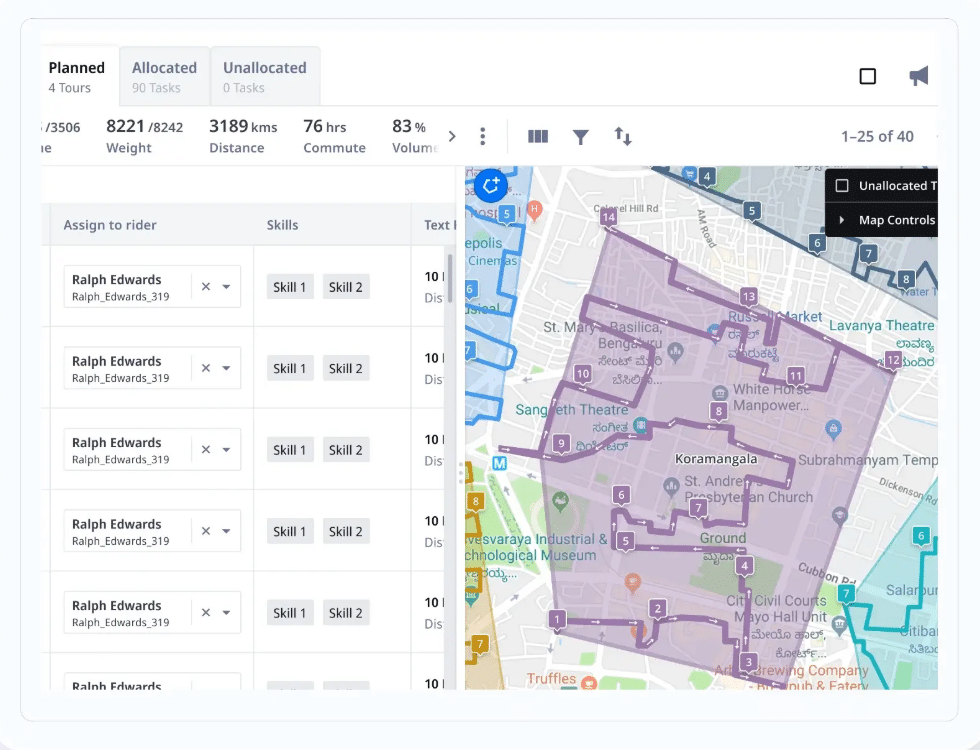
Five capabilities define whether a GPS dispatch platform can handle enterprise logistics complexity.
Real-time GPS tracking with sub-minute refresh
Tracking data that refreshes every 5-10 minutes creates decision blind spots when delivery windows are 30 minutes wide. Enterprise-grade GPS dispatch platforms ingest vehicle telematics, driver app data, and carrier API feeds at sub-minute intervals, normalizing data from heterogeneous sources into a single operational view.
Automated route planning that recalculates against current rather than cached position data produces allocation decisions that reflect what is actually happening in the field.
Dynamic route optimization that recalculates mid-shift
Static routes generated at dispatch are wrong by mid-morning. Dynamic route optimization recalculates stop sequences across the active fleet when traffic shifts, orders cancel, new pickups arrive, or vehicle conditions change. The recalculation happens automatically within a defined cycle window.
At enterprise volume, the difference between these two models is measurable in fuel spend per delivery and first-attempt success rates.
Automated job assignment against multi-constraint logic
Automated job assignment that considers only proximity and capacity produces technically valid allocations that miss critical constraints: a driver without the required certification for a refrigerated delivery, a vehicle whose remaining shift hours cannot complete the assigned route, a time-sensitive order assigned to a driver whose current position creates a 40-minute detour.
Locus’s dispatch management platform processes 250+ constraints simultaneously, producing allocations that account for all interaction effects.
Geofencing with automated compliance alerts
Geofencing at enterprise scale is not just a customer notification trigger. It is a compliance mechanism: drivers entering restricted zones at the wrong time, vehicles deviating from permitted corridors in regulated markets, depot departure times that need to be logged for SLA audit trails.
Automated geofence event logging that feeds directly into compliance reporting replaces manual check-ins and removes the documentation burden from dispatchers who should be managing delivery exceptions.
Integrated driver communication via mobile app
Driver communication that runs through separate channels from the dispatch system creates information gaps that compound into operational delays. When a route recalculation in the dispatch engine does not update the driver’s navigation immediately, the driver follows the old sequence while the system tracks against the new one.
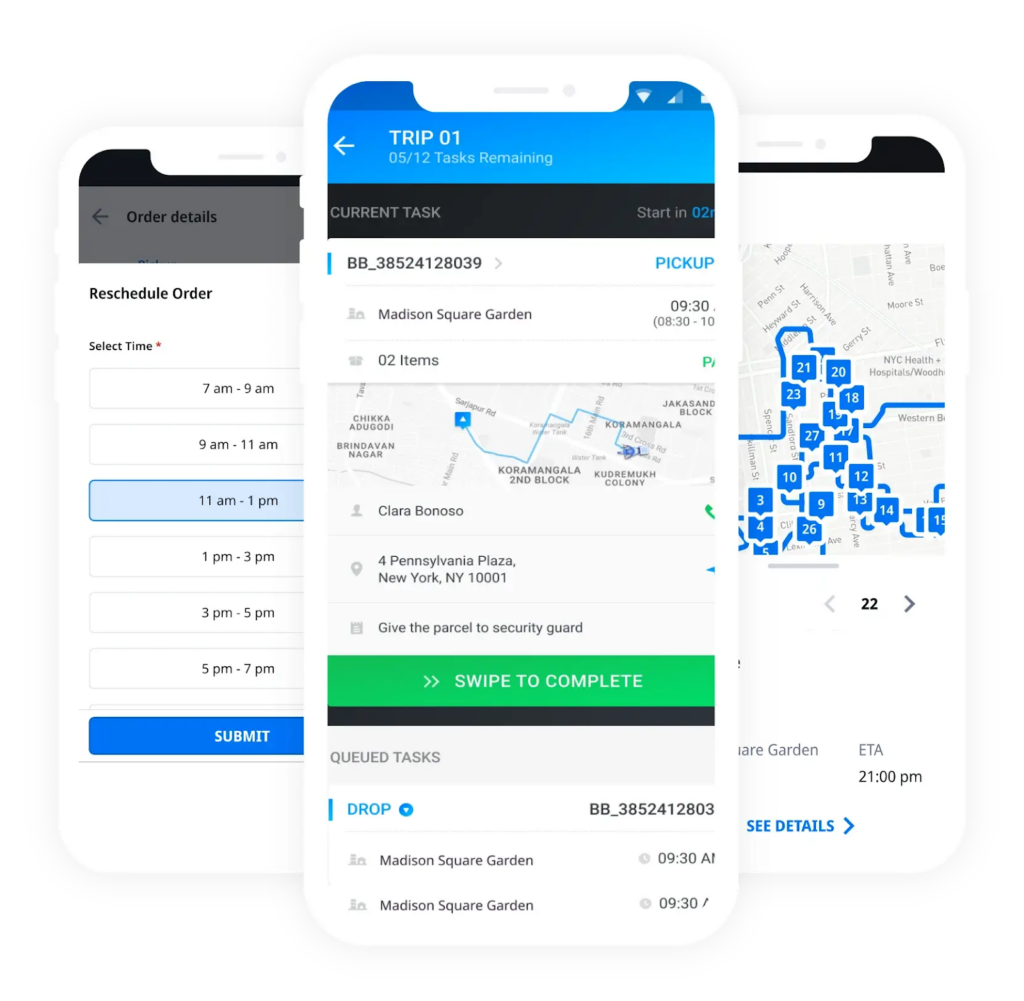
Real-time communication between dispatch platform and driver app ensures that every recalculation, priority change, and new order injection is reflected on the driver’s device within seconds of the system decision.
With Locus’s Driver Companion App, dispatch decisions, navigation updates, task sequencing, proof-of-delivery workflows, and exception handling stay synchronized in real time. It ensures drivers and dispatch operate from a single source of truth throughout the delivery lifecycle.
Why Traditional GPS Fleet Tracking Falls Short for Complex Distribution Networks
GPS tracking is a commodity. The location data that fleet tracking systems provide is widely available, increasingly accurate, and inexpensive to collect.
The value of GPS dispatch software in the intelligence layer that converts location data into operational decisions. Traditional GPS fleet tracking systems that do not include this intelligence layer expose five specific limitations at enterprise distribution complexity:
- No multi-constraint routing capability: Platforms that optimize for distance or time as a single variable ignore vehicle type compatibility, load capacity, temperature zone requirements, driver certification, and time-window constraints that interact with each other
- No predictive response to mid-route disruptions: When a vehicle breaks down or a high-priority order arrives at 11 AM, basic fleet tracking surfaces the event. It does not calculate the downstream impact across all active commitments or suggest a resolution
- Data silos across TMS, ERP, and OMS: Fleet tracking data that does not flow into order management and warehouse systems means dispatch decisions are built on incomplete information. A cancellation logged in the OMS but not propagated to the dispatch platform stays in the route until a driver arrives at an empty location
- Poor scalability above 200 to 300 vehicles: Systems designed for mid-market fleet size do not maintain optimization quality as vehicle count and order volume scale. Planning cycles that run in acceptable time at 200 vehicles degrade at 500 and fail at 2,000
- No compliance-grade emissions reporting: Enterprises under CSRD or Scope 3 audit obligations need per-route, per-carrier, and per-delivery carbon data that basic GPS tracking systems cannot produce natively. Without this data from the dispatch platform itself, emissions reporting requires a separate third-party integration that will not match the granularity of route-level optimization output
How AI Transforms GPS Dispatch From Reactive Monitoring to Predictive Orchestration
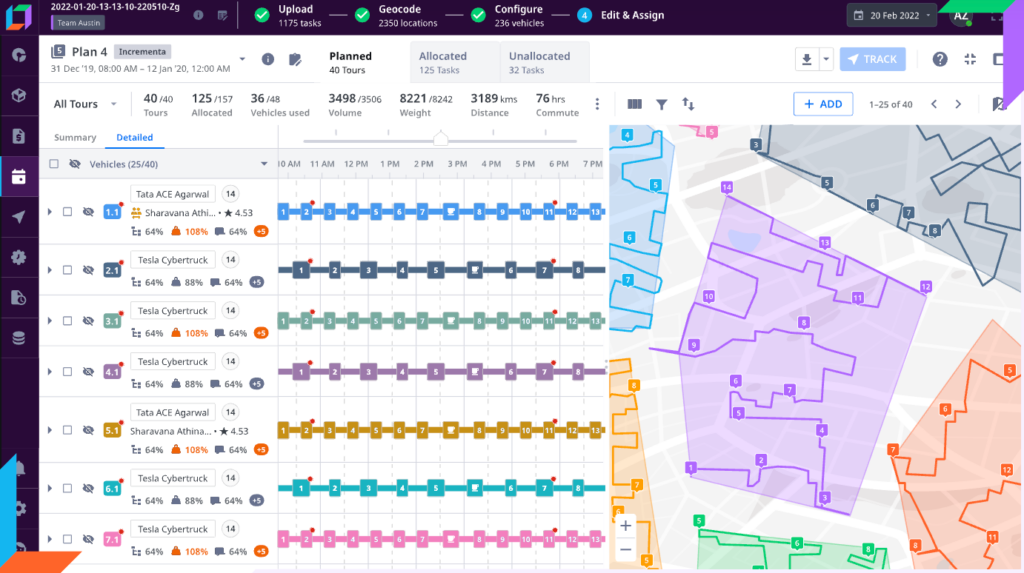
AI and machine learning elevate GPS dispatch from a monitoring tool into a predictive decision engine.
Predictive ETAs that account for real conditions
Distance-based ETA calculations are accurate on average and wrong in specific cases. Machine learning models trained on historical delivery patterns at the route, driver, and time-of-day level produce arrival predictions that account for how long a specific stop type actually takes at 10 AM on a Tuesday in a dense urban environment.
The accuracy improvement compounds over time as the model ingests more delivery outcomes from the fleet it manages.
Auto-dispatch that improves with each cycle
Rule-based auto-dispatch applies the same logic regardless of outcome. If a zone-based assignment rule consistently produces late deliveries on a specific lane, the rule does not update.
Machine-learning-based auto-dispatch learns from those outcomes and adjusts the assignment weighting for that lane. The dispatch quality in month 12 is materially better than month 1 because the model has been trained on the specific delivery patterns of the specific fleet it manages.
Dynamic rerouting triggered by exceptions
When a delivery failure or a new priority order triggers a plan change, AI-powered dispatch recalculates the optimal allocation across all active vehicles simultaneously rather than patching the affected route in isolation.
The ability to manage delivery exceptions at enterprise scale requires the exception resolution to consider all downstream SLA commitments. A reallocation that fixes one delivery while creating a cascade of late arrivals on the reassigned driver’s remaining route is a redistribution of the problem.
Scenario modeling for demand surges
Peak season, promotional events, and same-day demand spikes create volume surges that manual dispatchers cannot absorb without proportional headcount scaling.
AI dispatch scenario modeling allows operations teams to pre-configure surge capacity rules: which carrier relationships activate at specific volume thresholds, how delivery zone boundaries expand to distribute load across available drivers, and which SLA tiers are deprioritized when capacity is constrained.
These decisions are made in advance and execute automatically, rather than being improvised by dispatchers under peak pressure.
Enterprise Use Cases Across Retail, FMCG, E-Commerce, and 3PL
GPS dispatch software delivers different operational value across logistics verticals.
Enterprise buyers should evaluate whether a platform was designed with their vertical’s specific requirements or is a horizontal tool requiring heavy configuration to approximate the right behavior.
Retail and store replenishment
Multi-depot, multi-SKU distribution with tight receiving window commitments across hundreds of store locations defines the retail dispatch challenge. Dispatch assignments have to hold unloading sequence logic at each store type.
Returns logistics and store-to-store transfer orders need to integrate into the forward dispatch model. Missed delivery windows in retail produce stock-out conditions at the store level that translate directly into revenue loss.
FMCG and CPG distribution
High-frequency territory routes covering 30 to 50 stops per vehicle per day, with distributor network coordination and beat optimization across dense and rural geographies simultaneously, require a dispatch model that understands territory structure as a hard planning constraint.
Supply chain network design decisions for FMCG brands flow from the route-level performance data that a well-configured GPS dispatch platform surfaces, making depot placement and distributor territory allocation data-driven.
E-commerce and last-mile delivery
Same-day and next-day SLA pressure, demand surges during promotional events, and customer-facing ETA accuracy expectations define the e-commerce dispatch requirement.
GPS dispatch software that provides customers with static delivery windows that are not updated when route conditions change generates WISMO (Where Is My Order) inquiries that consume customer service capacity proportionally with delivery volume.
Last-mile management at e-commerce scale requires the dispatch platform to push ML-driven ETA updates to customers automatically when route conditions change.
3PL and multi-client fleet operations
Multi-client SLA management, client-level visibility separation, and dynamic workload rebalancing across accounts with different delivery profiles require dispatch capabilities that most single-operator platforms cannot provide without significant customization.
Each client needs to see only their orders, their fleet, and their SLA performance. White-label tracking portals, per-client analytics, and automated billing reconciliation across client contracts are requirements that need to be native dispatch platform capabilities.
Measuring ROI: The Metrics That Matter for Dispatch Software Investments
GPS dispatch software investments justify themselves across specific, measurable KPIs. The framework below connects each metric to the dispatch platform capability that moves it.
| KPI | Baseline in unoptimized operations | What enterprise-grade GPS dispatch delivers |
|---|---|---|
| Cost per delivery | Often 15 to 20% higher than optimized operations due to suboptimal routing, underutilized vehicle capacity, and manual dispatch overhead | Enterprises deploying AI-powered dispatch orchestration report 20-30% logistics cost reductions within the first two quarters of deployment. |
| On-time delivery rate | Often below 90% when static routing and manual dispatch cannot adapt to mid-day disruptions | Locus enterprise customers achieve 99.5% on-time SLA adherence through continuous route re-optimization and predictive exception management. |
| Fleet utilization rate | Commonly below 60% in unoptimized fleets due to poor load consolidation and geographic clustering | Locus customers achieve 45% improvement in fleet utilization through better stop clustering, order grouping, and dynamic zone rebalancing. |
| Fuel spend per route | Manual or static routing does not minimize driven miles per delivery. | 12-18% reduction in driven miles through AI route optimization. Fuel savings compound at fleet scale. |
| Failed first delivery attempts | Each re-attempt costs approximately $17.20 on average, according to Loqate | ML-driven ETAs and proactive customer notifications reduce first-attempt failure rates. Locus deployments maintain 95-plus percent first-attempt success across high-volume networks. |
| Carbon emissions per delivery | Not tracked. No mechanism to report without third-party audit. | Route optimization reduces emissions proportionally to mileage reduction. Locus deployments have offset 17 million+ kilograms of CO2 with auditable per-route carbon data. |
See how Locus’s dispatch management platform moves these KPIs across your specific fleet size and delivery volumes. Schedule a demo to run a live scenario against your operational data.
What to Evaluate When Selecting GPS Dispatch Software for Large-Scale Operations
Six evaluation criteria separate enterprise-grade GPS dispatch platforms from tools that serve smaller or simpler operations:
- Scalability architecture: The platform should maintain sub-five-minute optimization cycle times at 1,000+ vehicles and 50,000+ daily orders. Ask for documented performance at peak load from reference customers at comparable scale
- API-first integration with existing TMS, ERP, and WMS: Prebuilt connectors for SAP, Oracle, and your specific OMS platform should be named explicitly, not implied by “open API” language. Every integration that requires custom middleware development creates a deployment dependency that slows every future network change
- Configurability for region-specific constraints: Regulatory requirements, address infrastructure quality, and carrier network characteristics vary significantly across markets. Geocoding accuracy in low-infrastructure geographies like India, Southeast Asia, and the Middle East must be validated specifically for those markets, not assumed from North American or Western European performance
- AI route optimization depth versus batch planning: Ask specifically whether AI route optimization recalculates during the shift or only at dispatch time. Batch re-planning that runs on a fixed schedule is not real-time optimization, regardless of the marketing language
- Vendor logistics domain expertise: GPS dispatch software that was built by a logistics specialist understands the constraint interactions and operational edge cases that general-purpose software vendors do not. Ask for reference customers in your specific vertical at your order volume
- Proven enterprise-scale deployments in your geography: 30+ country deployment coverage with documented geocoding accuracy in your target markets is a meaningful differentiator, especially for operations in markets with non-standardized address infrastructure
The Shift From GPS Tracking to Logistics Intelligence: Where the Industry Is Heading
The convergence of dispatch, fulfillment, and supply chain visibility into unified orchestration platforms is already underway.
The enterprises that treat GPS dispatch software as a standalone tracking tool are building infrastructure that will require replacement as this convergence accelerates. The ones investing in orchestration platforms now are building infrastructure that extends as capabilities advance.
The near-term trajectory includes sustainability metrics as native dispatch constraints: carbon optimization treated as a planning variable alongside time and cost. It includes autonomous dispatch decisions that operate without dispatcher approval on routine allocations, with human governance reserved for exception cases and policy configuration.
And it includes deeper integration of customer experience signals into dispatch logic, where customer delivery preferences are held as planning constraints rather than post-booking exceptions.
Locus’s dispatch management platform and route optimization engine are operating at this frontier now, processing 1.5B+ deliveries across 30+ countries for enterprises that require logistics intelligence.
The platform delivers $320 million+ in logistics cost savings for customers across retail, FMCG, e-commerce, 3PL, and CPG, with deployment timelines of 8 to 12 weeks into existing enterprise technology stacks.
Schedule a demo to see how AI-powered dispatch orchestration performs against your requirements.
Frequently Asked Questions (FAQs)
1. How does GPS dispatch software differ from standalone GPS fleet tracking systems?
Standalone GPS fleet tracking shows where vehicles are. GPS dispatch software uses that location data to make decisions: which driver takes the next order, by which route, and how the plan changes when conditions shift. The difference is whether the platform monitors or manages the fleet. At enterprise volume, this gap measures in cost per delivery, on-time rate, and fleet utilization.
2. What fleet size or order volume justifies investing in enterprise-grade dispatch software?
Operations running above 200 vehicles or 5,000 daily orders typically hit the performance ceiling of rules-based and manual dispatch systems within 12 to 18 months of growth. The specific trigger points are when dispatch planning cycles exceed two hours per shift, when on-time delivery rates fall below 90% despite adding dispatcher headcount, or when peak-season volume spikes cannot be absorbed without proportional staff increases.
3. Can GPS dispatch software integrate with existing TMS, ERP, or warehouse management systems?
Enterprise-grade GPS dispatch platforms use API-first architecture with prebuilt connectors for ERP systems (SAP, Oracle, NetSuite), WMS, OMS, carrier networks via EDI and REST API, and telematics providers. They deploy into existing stacks without replacing incumbent systems. Locus integrates with 1,000+ carrier and 3PL partners, sharing order and settlement data within a live data model rather than through batch sync.
4. How does AI-powered dispatch reduce delivery costs compared to rules-based routing?
Rules-based routing applies fixed constraints sequentially: capacity, time window, vehicle type. AI-powered dispatch processes all simultaneously, finding allocations that minimize combined cost across all interaction effects. The result is 12 to 18% fewer driven miles through better stop clustering, higher trailer utilization through load consolidation, and faster planning cycles that enable earlier departures and higher daily delivery throughput.
5. How does GPS dispatch software improve coordination between dispatch teams and drivers?
Locus’s GPS dispatch software keeps dispatch operations and driver execution synchronized in real time through a unified dispatch and mobility workflow. When routes are recalculated because of traffic disruptions, order changes, delivery exceptions, or priority updates, the revised instructions are reflected immediately on the driver’s app without manual intervention.


Logistics Management
How AI Logistics Software is Reshaping Enterprise Supply Chains in 2026

May 19, 2026
Learn how AI logistics software transforms dispatch, routing, and supply chain visibility for enterprises. Explore capabilities, ROI data, and real-world use cases.
Read more
General
The Data Integration Architecture Beneath Supply Chain Control Towers: Why Implementation Lives or Dies at the Data Layer

May 19, 2026
European supply chain control tower implementations fail at the data layer more often than at visualization. A data integration architecture framework for CTOs.
Read moreInsights Worth Your Time



















GPS Dispatch Software: Features and Capabilities Enterprise Logistics Teams Need