


General
Furniture Distribution: Why Optimization Must Plan for Items, Not Stops
Most commercial route optimization platforms were built for parcel and consumer goods distribution. In those models, a stop is a stop: a driver arrives, scans a small box or two, spends three minutes at the doorstep, and moves to the next location. The stop count is the primary variable that dictates route feasibility.
In furniture and big-and-bulky distribution, that logic fails completely.
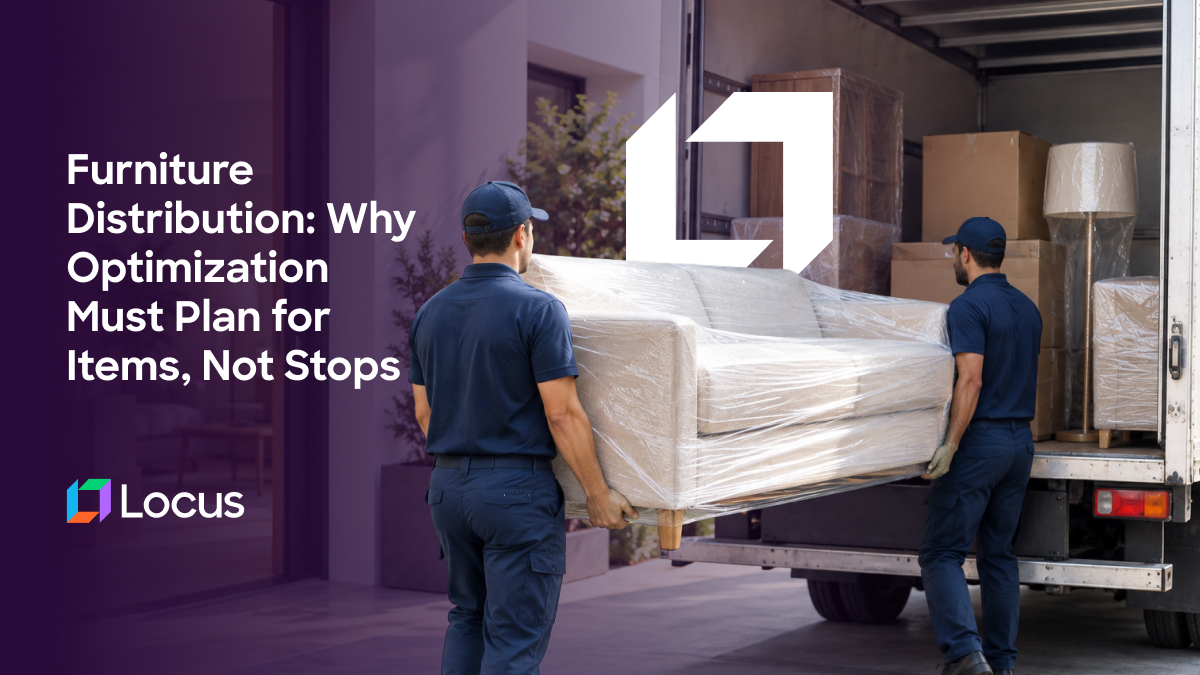
Delivering a three-piece sectional sofa, a marble dining table with six chairs, or a king-sized bedroom set cannot be modeled as a single stop count. A multi-item furniture delivery involves complex volumetric constraints, two-person crew requirements, room-of-choice placement, assembly labor, and strict customer delivery windows.
When big-and-bulky retailers use parcel-native routing software, their dispatch plans crumble on the road—resulting in overloaded vehicles, missed delivery windows, overtime payouts, and damaged goods.
For supply chain and logistics leaders, fixing big-and-bulky execution requires an architectural shift: moving from stop-based routing to item-level volumetric decisioning.
To read our complete technical framework on big-and-bulky logistics execution, download the full whitepaper: Furniture Distribution: Item, Not Stop.
Key Takeaways
- The Volumetric Fallacy: Routing by parcel count or weight ignores 3D cubic meter utilization. Furniture fleets run out of space (cube out) long before they hit vehicle weight limits (weigh out).
- Variable Dwell Time Mechanics: Service times at the doorstep must be calculated at the SKU level based on item complexity, floor placement, and white-glove assembly, not assigned a blanket 10-minute average.
- Skill and Crew Matching: Route plans must link SKU handling requirements directly to driver and helper skills, vehicle tailgate equipment, and two-person crew availability.
The Stop-Based Fallacy in Big-and-Bulky Logistics
Traditional Routing and Scheduling Systems (RSS) calculate capacity using two basic variables: total weight capacity and maximum stops per route. In furniture distribution, this creates three operational breakdowns:
1. Cubing Out vs. Weighing Out
A delivery truck loaded with five modern sectional sofas may reach 100% of its volumetric capacity ($m^3$ / $ft^3$) while utilizing less than 30% of its legal weight payload limit. Traditional routing engines that optimize primarily for payload weight will continue assigning orders to that vehicle, creating severe warehouse loading bottlenecks and requiring manual dispatcher intervention.
2. The Dwell Time Compounding Effect
A parcel delivery driver takes approximately 2 to 3 minutes per stop. Delivering a multi-piece dining set up a flight of stairs takes 45 to 60 minutes. If a routing engine applies a static 15-minute dwell time across all stops, a 10-stop route plan accumulates over two hours of unaccounted delay by midday—causing downstream SLA failures and missed customer delivery windows.
3. Skill, Tool, and Crew Misalignment
Not all furniture deliveries require the same labor profile. A flat-pack delivery can be executed by a single driver, whereas an assembled mahogany wardrobe requires a two-person white-glove crew and a vehicle equipped with a hydraulic liftgate. Stop-based dispatch engines assign orders without evaluating SKU-level handling constraints, leading to doorstep delivery refusals.
3 Pillars of Item-Level Volumetric Optimization
Transitioning to an item-first routing architecture requires embedding three specialized parameters directly into the optimization engine:
Pillar 1: 3D Volumetric & Dimension Loading
Calculates cubic orientation, nestability, and box-level dimensions to prevent vehicle “cube out” failures before trucks leave the depot.
Pillar 2: SKU-Based Dynamic Dwell Time
Calculates doorstep labor time dynamically based on total item weight, assembly complexity, and delivery floor level.
Pillar 3: Crew Skill & Equipment Attribution
Links item handling requirements directly to two-person crews, assembly skill ratings, and liftgate availability.
Deep Dive: Dynamic, SKU-Additive Dwell Time Calculation
Doorstep service time should be calculated dynamically for every unique order using an additive formula:
- Base Arrival Time: Parking and customer interaction (e.g., 5 minutes)
- Item Handling Time: Added minutes calculated per SKU based on weight and volume
- Service Tier Multiplier: Additional time added for room-of-choice placement, unboxing, or full white-glove assembly
- Location Complexity: Multipliers applied for apartment floors, elevator access, or narrow stairwells
Also Read: The Two-Person Crew Decision: Why US Big-and-Bulky Operations Need Helper-Aware Routing
Comparative Matrix: Stop-Based Routing vs. Item-Aware Optimization
Use this operational comparison when evaluating logistics platforms for furniture and big-and-bulky distribution:
| Execution Dimension | Standard Stop-Based Routing Engine | Item-Aware Volumetric Engine (Locus) |
| Capacity Calculation | Total order count & total weight capacity | 3D cubic volume ($m^3$), dimensional orientation, & weight |
| Dwell Time Calculation | Static average time per stop (e.g., 15 mins) | Dynamic SKU-additive time + assembly & stair access factors |
| Crew Assignment | Single driver assumption across all routes | Dynamic two-person crew & assembly skill-level matching |
| Vehicle Assignment | Basic vehicle size classes | Attribute-level matching (liftgate, ramp, padded restraints) |
| Exception Rates | High on-road plan failure due to “cube out” | <1% plan-versus-actual execution drift |
| White-Glove Support | None (Requires manual dispatcher adjustments) | Native support for doorstep assembly and room-of-choice |
How Locus Solves the Big-and-Bulky Execution Challenge
Locus’s Decision-Intelligent platform is engineered specifically to handle the high constraint density of enterprise furniture, appliance, and home goods distribution.
- 250+ Real-World Operating Constraints: Evaluates 3D volumetric capacity, crew skills, time-window tightness, assembly tiers, and vehicle attributes simultaneously in a single optimization run.
- Item-First Dispatching: Automatically ingests line-item SKU details from your OMS/WMS to calculate precise cubic footprint, labor requirements, and doorstep service windows.
- Dynamic On-Road Re-Routing: If an assembly job at a prior stop takes longer than anticipated, Locus recalculates downstream routes in real time, updating customer ETAs and alerting contact centers proactively.
- Unified Driver & Helper Companion App: Provides two-person crews with itemized assembly instructions, electronic proof of delivery (ePOD), damage photo capture, and customer sign-off in a single mobile interface.
Protect Your Big-and-Bulky Delivery Margins
In furniture distribution, executing efficient delivery operations requires software built for the reality of your inventory. Planning routes by the item rather than the stop is the single most effective way to eliminate plan-versus-actual drift, lower cost-per-drop, and deliver an exceptional white-glove customer experience.
Download the complete whitepaper: Furniture Distribution: Item, Not Stop or Schedule a Demo with Locus to see item-level volumetric optimization in action.
Frequently Asked Questions (FAQs)
1. Why does traditional route optimization software fail for furniture delivery?
Traditional software assumes all stops require similar handling time and calculates capacity using simple item counts or weight. Furniture delivery involves complex 3D volume constraints (“cubing out”), variable assembly dwell times, two-person crew requirements, and specialized vehicle equipment that traditional engines cannot model.
2. What is “cubing out” in logistics?
“Cubing out” occurs when a delivery vehicle reaches 100% of its available volumetric space ($m^3$ or $ft^3$) before hitting its legal weight payload limit. In furniture and big-and-bulky distribution, vehicles almost always cube out long before they weigh out.
3. How does item-level routing improve doorstep ETA accuracy?
By calculating doorstep dwell time based on the specific SKUs being delivered—factoring in item weight, quantity, room-of-choice placement, and white-glove assembly requirements—item-level routing eliminates the cumulative delays that cause missed 2-hour delivery windows.
4. Can an item-aware routing platform handle two-person crew scheduling?
Yes. Platforms like Locus evaluate driver and helper skills, vehicle liftgate equipment, and SKU handling rules concurrently during route generation, ensuring two-person crews are assigned only to the routes that strictly require them.


General
5 Questions to Ask Before Buying an “AI-Powered” TMS in 2026 and Beyond

Sep 23, 2026
Cut through AI-washing in logistics software. A CFO and CTO evaluation framework for interrogating vendor AI pitches across decision autonomy, constraint depth, and integration TCO.
Read more
General
Direct Store Delivery (DSD) Optimization: From Static Beat Plans to Dynamic Dispatch

Sep 23, 2026
Discover how FMCG and CPG distributors modernize Direct Store Delivery (DSD). Learn how dynamic beat planning, real-time re-routing, and constraint-aware dispatch protect retail margins.
Read moreInsights Worth Your Time



















Furniture Distribution: Why Optimization Must Plan for Items, Not Stops