


General
5 Questions to Ask Before Buying an “AI-Powered” TMS in 2026 and Beyond
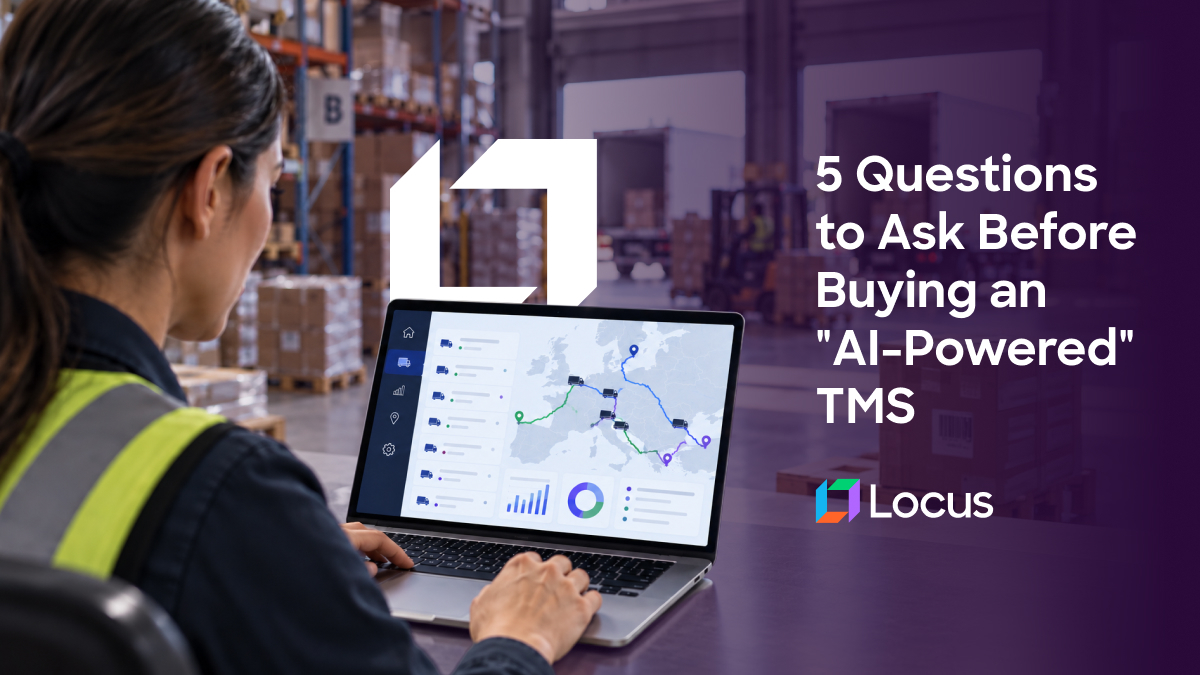
Every Transportation Management System (TMS) vendor deck on the market today claims to be “AI-powered,” “autonomous,” or “driven by machine learning.” Yet, when enterprise supply chain leaders deploy these platforms, many discover they have simply purchased a legacy IF/THEN rules engine wrapped in a modern user interface.
In logistics tech, “AI-washing” is an expensive trap. Bolting machine learning algorithms onto 20-year-old database architectures produces passive prediction dashboards—systems that highlight an impending delivery delay or carrier failure, but still force human dispatchers to manually re-assign orders and fix the route.
When evaluating software designed to manage millions in freight spend, logistics leaders must look past sales pitches and interrogate the underlying architecture.
This buyer’s guide provides five precise, technical questions every CFO, CTO, and VP of Supply Chain should ask when evaluating an AI TMS pitch.
To read our complete technical breakdown on distinguishing real decision-intelligent software from rules engines, download the full whitepaper: 5 Questions to Ask Your AI Pitching TMS Vendor.
Key Takeaways
- Prediction vs. Decisioning: True AI in logistics moves beyond passive prediction (forecasting a delay) to autonomous execution (re-routing and re-assigning carriers within pre-approved guardrails).
- The Constraint Ceiling: Legacy systems process constraints sequentially or cap evaluation at <20 parameters. Agentic platforms calculate 250+ real-world constraints concurrently.
- Integration Reality: A vendor’s integration claims should be measured in days, not months. Bolted-on AI requires expensive custom data pipelines; embedded AI operates natively on raw operational inputs.
Question 1: “Is Your AI Predicting Problems, or Is It Resolving Them Autonomously?”
Most “AI” in legacy TMS platforms is purely predictive. It uses historical data to forecast that a shipment will miss its delivery window or that a driver will hit working-hour limits. While predictive analytics are useful, prediction without execution creates operational friction by flooding dispatchers with alerts.
In a passive predictive AI setup, sensor data predicts a delay and triggers an alert, leaving a human dispatcher to perform manual re-dispatching. In an autonomous decision-intelligent setup (Agentic), sensor data evaluates 250+ constraints, executes re-routing and carrier re-allocation autonomously, updates both the customer and ERP, and logs a decision audit trail.
The Interrogation Test:
Ask the vendor: “When a live delivery exception occurs mid-route, does your platform raise a ticket for my dispatcher, or does it autonomously re-assign the order to the next best carrier based on live SLA performance and execute the update?”
Also Read: Embedded vs. Bolted-On AI: The Architecture Question European Logistics Buyers Are Asking
Question 2: “How Many Concurrent Operating Constraints Can Your Routing Engine Evaluate?”
A simple point-to-point route planner can easily solve for distance and vehicle capacity. Real-world enterprise logistics, however, involves hundreds of conflicting parameters: vehicle weight limits, driver working-hour regulations, dock appointment slots, customer-specific delivery windows, temperature zoning, traffic congestion, and Low-Emission Zone (LEZ) access times.
Legacy optimization engines evaluate constraints sequentially. When constraint density increases, the software either drops secondary constraints (causing on-road plan failure) or takes hours to run a single route plan.
The Interrogation Test:
Ask the vendor: “Can your engine model 200+ real-world operating constraints simultaneously—including helper requirements, SLA penalties, and vehicle volume limits—without slowing route generation time past a few minutes?”
Also Read: What Should a CXO Consider When Evaluating a Modern TMS?
Question 3: “Are Your AI Capabilities Embedded in the Core Engine, or Bolted On via Third-Party APIs?”
When legacy TMS platforms feel pressure to feature “AI,” they frequently acquire or white-label third-party machine learning APIs. This creates a fragmented architecture: order and dispatch data lives in a legacy relational database, gets exported via batch processing to an external AI model, and returns as static recommendations.
This “bolted-on” approach introduces severe data latency, high API maintenance costs, and frequent system failure points during network disruptions.
- Bolted-On AI (Legacy): Relies on batch data exports, suffers from third-party API latency, and incurs high integration maintenance.
- Embedded Agentic AI (Locus): Operates on a real-time Sense-Decide-Execute-Learn (SDEL) loop built on a single unified data layer with an autonomous execution engine.
The Interrogation Test:
Ask the vendor: “Is your AI model operating directly on the live transactional data layer in real time, or does it export data to a secondary system to process recommendations?”
Also Read: How Enterprises Migrate from Legacy Transportation Management Systems to AI-Native Architecture
Question 4: “What Is the True Timeline and TCO for Onboarding New Multi-Carrier Networks?”
Enterprise shippers need multi-carrier flexibility. When volume spikes or a primary carrier fails, adding regional parcel networks or 3PL capacity should be a business decision, not a multi-month engineering project.
Legacy vendors often hide integration costs. Onboarding a new carrier into a legacy TMS typically requires custom EDI/API mapping, custom status code translation, and weeks of testing, costing tens of thousands of dollars per carrier endpoint.
The Interrogation Test:
Ask the vendor: “What is your average timeline to activate a new regional parcel carrier or 3PL into our dispatch workflow, and do you maintain a pre-built orchestration layer with normalized status tracking?”
Also Read: How IT Teams Evaluate API Integrations for Logistics Platforms
Question 5: “How Does Your System Provide an Audit Trail for AI-Initiated Decisions?”
As logistics software gains autonomy, enterprise governance becomes critical. Executives cannot deploy “black box” AI that alters routes, re-allocates carriers, or adjusts delivery windows without clear traceability. If a system tenders a high-value shipment to a more expensive carrier, operations leads need to know why.
True enterprise AI operates within governed, policy-backed sandboxes. Every autonomous decision must log its underlying trade-off logic (e.g., “Re-allocated Order #8492 to Carrier B at +$12 cost to prevent a $150 SLA late-penalty and ensure compliance with driver working hours”).
The Interrogation Test:
Ask the vendor: “Can your system show a clear decision log explaining the financial and operational trade-offs made by the AI for every automated re-dispatch or carrier selection?”
Also Read: Why Governance Matters More Than Autonomy in Enterprise Logistics AI
Comparative Matrix: Legacy Rules Engine vs. Agentic Decision-Intelligent TMS
Use this evaluation framework during vendor RFP reviews:
| Evaluation Dimension | Bolted-On / Legacy AI TMS | Agentic TMS (e.g., Locus) |
| Decision Capability | Passive alerts & predictive dashboards | Autonomous, goal-oriented decision execution |
| Constraint Processing | Sequential evaluation (<20 constraints) | Concurrent evaluation of 250+ real-world constraints |
| Data Architecture | Batch exports to third-party ML models | Native Sense-Decide-Execute-Learn (SDEL) loop |
| Carrier Activation | 8–12 weeks custom engineering per carrier | <3 days via pre-integrated multi-carrier layer |
| Governance & Auditability | “Black box” output without explanation | Full decision lineage and financial trade-off logging |
| Time to Full Value | 12 to 18 months deployment cycles | 60 to 90 days rapid time-to-value |
Take the Next Step in Your TMS Evaluation
In an era of rising transportation costs, volatile fuel prices, and strict service-level agreements, enterprise shippers cannot afford software that relies on manual dispatcher intervention. Interrogating vendor architecture before signing a contract is the single best way to ensure long-term ROI.
Download the complete whitepaper: 5 Questions to Ask Your AI Pitching TMS Vendor or Schedule a Demo with Locus to see our Decision-Intelligent platform in action.
FAQs
1. What is AI-washing in transportation management software?
AI-washing occurs when software vendors market traditional IF/THEN rules engines or basic statistical tools as “advanced artificial intelligence.” While these platforms may feature modern dashboards, they lack the underlying architecture to make autonomous, constraint-aware logistics decisions.
2. Why is predictive AI not enough for modern supply chain orchestration?
Predictive AI can forecast delays or demand surges, but it cannot fix them. Without autonomous execution capabilities, predictive tools simply generate alerts, overwhelming human dispatchers who must still manually re-route vehicles and re-assign orders.
3. What is an Agentic TMS?
An Agentic TMS utilizes autonomous AI agents (such as Dispatch Agents, Carrier Agents, and Capacity Agents) that evaluate operational goals against complex real-world constraints. Operating within governed guardrails, an Agentic TMS autonomously re-routes, re-allocates carriers, and resolves exceptions in real time.
4. How does an Agentic TMS integrate with existing ERPs like SAP or Oracle?
An Agentic TMS acts as a decision-intelligence and execution layer above core enterprise platforms (ERP, WMS, OMS). It ingests order and inventory data via modern APIs, calculates optimal route and dispatch plans, and syncs execution statuses back to the core system in real time.


General
SITL Europe 2026 Field Guide: Evaluating Agentic vs. Legacy TMS Under One Roof

Sep 23, 2026
A decision-stage evaluation framework for European supply chain leaders at SITL Europe 2026. Compare Agentic TMS and legacy platforms across autonomy, integration TCO, and CSRD compliance.
Read more
General
Furniture Distribution: Why Optimization Must Plan for Items, Not Stops
Sep 23, 2026
Discover why traditional stop-based route optimization fails in furniture and big-and-bulky logistics. Learn how item-level volumetric modeling, crew pairing, and dynamic dwell times protect unit economics.
Read moreInsights Worth Your Time



















5 Questions to Ask Before Buying an “AI-Powered” TMS in 2026 and Beyond