


General
How Fashion and Clothing Brands Can Manage Returns and Reverse Logistics Efficiently in 2026

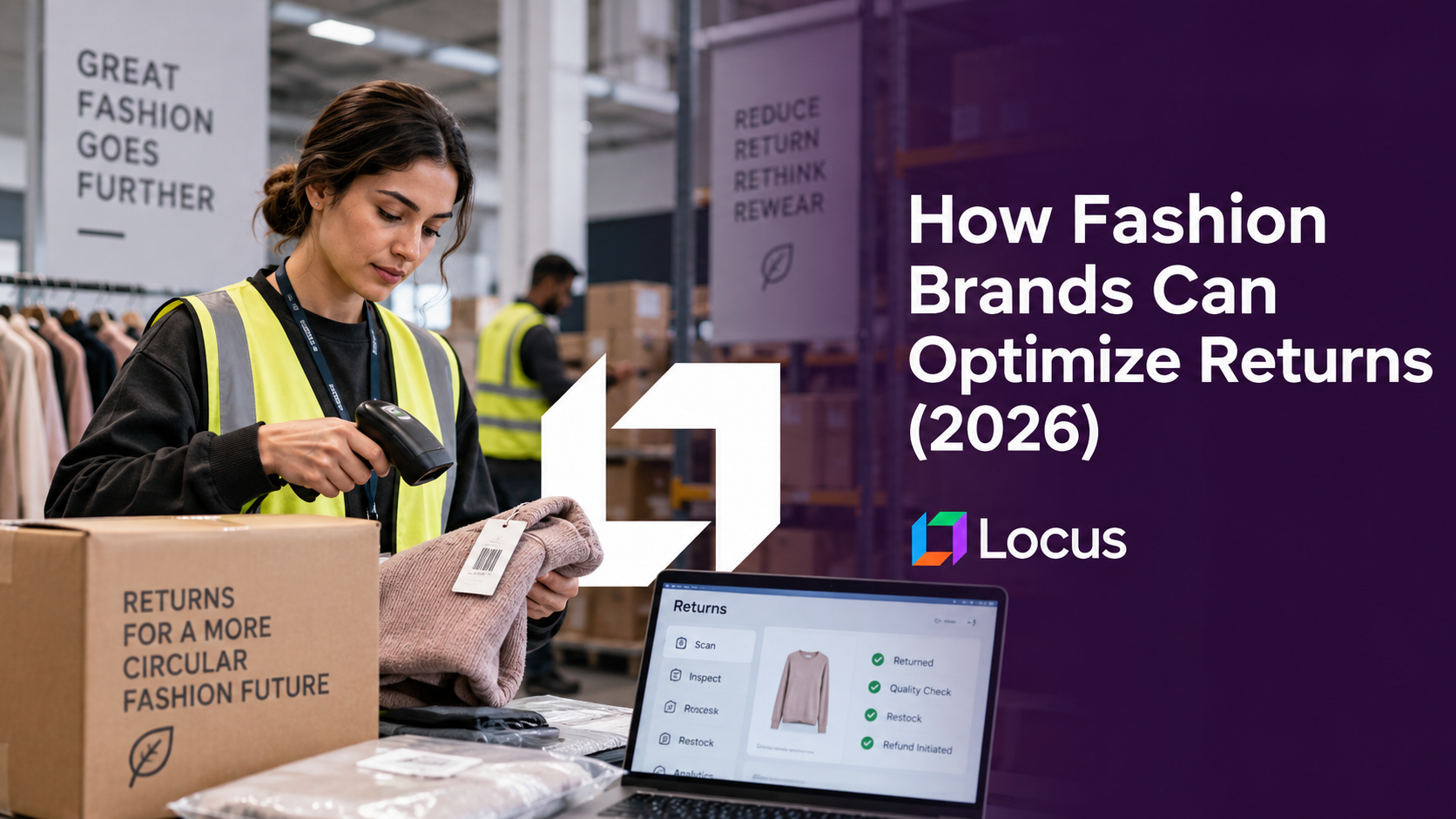
Returns are the quiet tax on every fashion e-commerce business. A customer orders three sizes of the same dress, keeps one, and sends two back. A pair of shoes looks different in person than it did on screen. A sweater arrives and the color is a shade off from what the photos suggested. None of this is a defect. It is simply how consumers shop for clothing online, resulting in return rates that dwarf almost every other e-commerce category.
For supply chain and operations leaders, this reality turns reverse logistics from a back-office afterthought into a primary margin driver. Managing returns effectively is not merely about processing refunds faster—it is about protecting unit economics, maintaining inventory velocity, and delivering a post-purchase experience that retains customer lifetime value.
To see how enterprise apparel brands orchestrate multi-carrier networks and streamline complex fulfillment leveraging Locus, explore our Apparel Multi-Carrier Parcel Management Case Study.
Key Takeaways
- Returns Are an Inventory Velocity Problem: Every day a returned item spends in transit or un-triaged in a facility is a day of lost full-price sell-through potential.
- Integrated Pickup Scheduling Lowers Unit Costs: Slotting return pickups directly into outbound delivery routes eliminates dedicated reverse fleet overhead.
- Real-Time Visibility Reduces WISMO Tickets: Extending end-to-end tracking to the reverse leg eliminates support ticket volume while giving operations precise inventory arrival timelines.
Why Fashion Has the Highest Return Rates in E-Commerce
Apparel e-commerce faces structural friction points that make high return rates inevitable:
- Fit & Size Inconsistency: Sizing varies significantly across brands and individual product lines. A customer’s “medium” in one cut can easily translate to a “small” in another.
- Color and Texture Perception Gap: Digital screens rarely capture fabric sheen, weight, or subtle color tones with total accuracy, leading to expectation mismatches upon delivery.
- Bracketing Behavior: Shoppers routinely purchase multiple sizes or colors of the same item with the explicit intent of returning what does not fit. Bracketing is no longer an edge case—it is a standard consumer shopping workflow.
- Low Friction Policies: Free returns and frictionless policies, while necessary for conversion, remove all consumer friction from sending items back.
The result is an industry-wide return rate ranging between 20% and 35%. This volume demands treating reverse logistics as a core operational discipline rather than an ad-hoc cleanup task.
| Also Read: US Returns Hit $850 Billion in 2025: Why US Retailers Are Restructuring Reverse Logistics in 2026 |
How Locus makes a Difference
A leading ASEAN apparel retailer, with a large store network and a global e-commerce business, was operating last-mile delivery almost entirely through third-party carriers. As the retailer expanded into new markets and migrated to its own WMS, managing multiple carriers became increasingly complex. Each carrier had different systems, rates, service areas, status codes and integration requirements. Adding a new carrier took more than three months, while the lack of a unified shipment view meant operations had to track orders across individual carrier portals. Customers also received vague delivery windows, contributing to hundreds of thousands of delivery and returns-related queries in a six-month period.
Locus deployed its agentic TMS as a multi-carrier parcel management layer, sitting between the retailer’s OMS/WMS and its carrier network. Locus automated carrier allocation, shipment creation, label generation and tracking, while harmonising carrier statuses into a single source of truth. Its Carrier Agent could select carriers based on cost, speed, performance and business rules, while network-aware delivery promises gave customers more accurate ETAs at checkout. The results included a 97% reduction in carrier onboarding time—from three months to just three days, 40%+ fewer WISMO and returns queries, and carrier label generation in under 500 milliseconds. The retailer also gained greater flexibility to test, switch and optimise its carrier mix, helping reduce delivery costs while maintaining service levels. Read the full case study here.
The Real Cost of a Return: The Hidden Margin Drain
The financial impact of a return extends far beyond the refunded purchase price. Every returned item accrues a hidden cost structure:
- Reverse Transportation Costs: Linehaul and parcel shipping costs incurred to transport the item back, whether absorbed by the brand or subsidized.
- Inspection & Triage Labor: Manual checking of item condition, hangtag verification, and sorting into disposition paths.
- Restocking & Refurbishment Overhead: Re-steaming, re-bagging, and re-tagging labor required before an item can return to sellable inventory.
- Value Erosion on Seasonal Stock: Depreciated resale value caused by slow processing cycles, pushing seasonal items past their full-price selling window into markdown territory.
- Customer Support Overhead: Contact center queries regarding return status, refund timing, and exchange processing.
For fast-moving fashion categories, slow reverse logistics turns returnable inventory into forced markdowns or write-offs.
What an Efficient Reverse Logistics Workflow Looks Like
Optimizing reverse logistics requires a sequence of automated, high-velocity decisions:
- Self-Service Return Initiation: Customers initiate returns digitally with instant label generation, clear pickup or drop-off time slots, and transparent refund conditions.
- Dynamic Return Pickup Scheduling: Rather than relying exclusively on customer drop-offs, integrating return pickups into daily outbound dispatch runs maximizes fleet utilization and establishes predictable warehouse arrival windows.
- Real-Time Reverse Leg Tracking: Providing milestone visibility on the reverse journey reduces support inquiries while enabling fulfillment centers to pre-allocate incoming stock for immediate re-sale.
- Standardized Warehouse Triage: Upon arrival, items follow automated decision paths: immediate restock, light refurbishment (steaming/re-tagging), liquidation, or return-to-vendor.
- Intelligent Restocking & Rerouting: Cleared inventory is restored to available stock instantly. Advanced systems route returned items directly to the regional fulfillment center experiencing the highest active demand for that SKU.
- Closed-Loop Data Feedback: Categorized return reasons (e.g., “runs small,” “fabric sheer”) feed directly into product listing pages, size recommendations, and future buying plans to prevent recurring returns.
A Technology Checklist for Automating Reverse Logistics
Manual, spreadsheet-driven return management breaks down at enterprise volume. An optimized reverse logistics technology stack requires:
- Capacity-Aware Pickup Scheduling: Algorithms that dynamically assign return pickups into existing last-mile delivery routes without overloading driver schedules.
- End-to-End Reverse Visibility: Real-time location and event tracking from customer handoff to warehouse dock scanning.
- Dynamic Dispatch & Fleet Flexing: Routing engines capable of absorbing post-peak return surges (e.g., post-holiday sales drops) across captive, 3PL, and gig fleets.
- Seamless WMS/OMS Integration: Automatic inventory status updates across Order Management Systems (OMS) and Warehouse Management Systems (WMS) as returned items pass triage milestones.
- Cycle-Time Analytics: Operational dashboards tracking dock-to-stock duration, return rates per SKU, and cost-per-return benchmarks.
A Simple Framework: Five Steps to Cut Return-Handling Costs
- Quantify Total Cost-Per-Return: Calculate fully burdened costs—including freight, inspection labor, re-packaging, and markdown loss—rather than measuring shipping costs alone.
- Consolidate Forward & Reverse Dispatch: Merge return pickup assignment into outbound delivery route planning to minimize empty miles and driver backtracking.
- Compress Reverse Transit Time: Utilize real-time tracking signals to prepare warehouse intake lanes before shipments arrive, shrinking dock-to-stock turnaround.
- Automate Triage Rules: Establish strict, standardized criteria for grading item condition to eliminate manual decision queues on the warehouse floor.
- Feed Data Back to Front-End Operations: Update online size charts, fit notes, and imagery based on return reason analytics to suppress avoidable returns at the point of purchase.
| Also Read: The Hidden Cost of Failed Deliveries: How AI Route Optimization Cuts WISMO Tickets by 40% |
Transforming Reverse Logistics into a Competitive Advantage
Returns are an unavoidable reality of online apparel retail. Attempting to eliminate them entirely through restrictive policies risks degrading conversion rates and customer trust. The strategic goal is to build a fast, visible, and automated reverse logistics network that minimizes cost-per-return while maximizing inventory value recovery.
Brands that treat reverse logistics as an integrated extension of their delivery network recover inventory faster, protect gross margins, and turn post-purchase touchpoints into long-term customer loyalty.
Schedule a Demo with Locus to discover how our Decision-Intelligent platform automates reverse logistics, optimizes last-mile dispatching, and drives end-to-end delivery efficiency at scale.
FAQs
1. What is reverse logistics in fashion e-commerce?
Reverse logistics encompasses the entire operational workflow of retrieving a product from a customer and returning it to the retailer’s supply chain network. In fashion e-commerce, this includes return authorization, pickup or drop-off orchestration, reverse transit, warehouse inspection/triage, and restocking or liquidation execution.
2. Why do clothing brands experience higher return rates than other retail sectors?
Fashion returns are primarily driven by fit uncertainty, size variance across brands, and consumer bracketing behavior (buying multiple sizes/colors with the intention of returning most). Fabric texture and color discrepancies between digital displays and physical products further elevate return volumes.
3. How can fashion brands reduce return rates without hurting sales conversion?
Brands can suppress return rates by publishing accurate sizing guides, incorporating customer fit feedback into product listings, providing high-definition imagery, and utilizing AI-driven size recommendation engines at checkout.
4. What key technology is required to automate reverse logistics?
An enterprise reverse logistics stack requires a Returns Management System (RMS) integrated with an Agentic Transportation Management System (TMS) for route optimization, an Order Management System (OMS), and a Warehouse Management System (WMS) for real-time inventory updates and automated triage workflows.
5. What is the target timeline from customer pickup to inventory restocking?
For high-velocity fashion brands, the target dock-to-stock window should be 3 to 5 business days. Extended transit and processing times increase the risk of seasonal stock depreciation and forced markdowns.


General
Best Delivery & Logistics Software for Fashion and Apparel E-Commerce Brands (2026)

Sep 18, 2026
Discover top delivery and logistics software for fashion and apparel e-commerce in 2026. Compare Locus, ShipBob, Narvar, Onfleet, and Delivery Solutions for peak-season scalability, reverse logistics, and multi-carrier orchestration.
Read more
General
Last-Mile Delivery Strategies for Peak Fashion Seasons

Sep 18, 2026
Learn how fashion and apparel brands absorb peak demand spikes, optimize multi-carrier dispatching, reduce WISMO support tickets, and scale last-mile delivery without permanent overhead.
Read moreInsights Worth Your Time


















How Fashion and Clothing Brands Can Manage Returns and Reverse Logistics Efficiently in 2026