


General
E2open Pricing, Plans, and Features: Is E2open Worth It in 2026?

Key Takeaways
- E2open publishes pricing only for its carrier marketplace. The broader enterprise TMS suite is custom-quoted through sales.
- Programmatic API access, covering real-time rating, spot market, billing, and carrier communications, requires the eConnect+ tier at a minimum of $18,000/year.
- At the top eConnect band (10,000+ loads, $11,000/year), buyers still have no API access. That capability sits in the tier above, at a higher price floor.
- Enterprise reviewers on G2 and Gartner most consistently flag implementation timelines, configuration complexity for transportation workflows, and post-go-live support response.
- Locus is a transportation management platform covering order intake through delivery settlement, with $320M+ in documented logistics savings across 30+ countries.
If you’re searching for “E2open pricing,” it’s easy to end up looking at the wrong product. E2open actually offers two separate solutions, and only one of them has public pricing.
The carrier connectivity subscription comes with four published tiers you can review and compare. The enterprise TMS suite, which covers demand planning, supply chain coordination, and transportation management at a broader platform level, sends you straight to sales.
This disconnect can create challenges during shortlisting. Buyers who only find the marketplace pricing often assume they’re seeing the full picture, which can lead to budget surprises and demos that miss the mark later on.
These are more than just different packages of the same tool. They solve different problems and come with different architectures and pricing models.
In this article, we use E2open’s September 2025 carrier subscription data and the marketplace.e2open.com ordering portal to break down every published tier clearly. We also look at where the total cost of ownership tends to soar, what enterprise reviewers are actually saying, and how Locus compares for teams focused mainly on transportation execution.
E2open pricing at a glance
| Dimension | E2open Carrier Marketplace | E2open Enterprise TMS | Locus |
|---|---|---|---|
| Starting price | $549/year | Custom, contact sales | Custom, contact sales |
| API access | eConnect+ tier only | Included in contract | API-first, included |
| EDI connectivity | eConnect tier+, add-on per SCAC | Included in contract | 1,000+ pre-integrated carriers |
| Route optimization | Carrier selection and rating focus | Module-dependent | 250+ constraint optimization, proprietary ML |
| Settlement / ePOD | Billing API at API tier | Separate module | Native, single platform |
| Deployment | SaaS marketplace | Enterprise implementation | Cloud-native SaaS |
How We Researched E2open Pricing
As noted above, all pricing data in this article comes from two primary sources: the September 2025 carrier subscription PDF published at marketplace.e2open.com, and the ordering portal itself.
The 2025 document is the current revision, updating several figures from the September 2024 version, including the eConnect mid-tier band. For the broader enterprise platform, the source is the e2open.com transportation management page, which confirms custom pricing with no published tiers.
Review data is sourced from G2 and Gartner Peer Insights, with themes attributed by reviewer role. Locus data is sourced from the website and verified against platform documentation.
How much does E2open cost?
E2open has two different pricing tracks, and mixing them up is one of the most common mistakes buyers make when comparing vendors.
The carrier connectivity product has four public pricing tiers, and the cost is based on annual load volume. The entry-level plan starts at $549 per year. If you need API access, pricing starts at $18,000 per year and goes up from there depending on volume.
The enterprise suite covers demand planning, supply chain coordination, global trade management, and transportation management, but there’s no public pricing available. To get a quote, you have to go through E2open’s sales team.
What this means in practice is fairly simple. A mid-sized enterprise managing several carrier EDI connections is unlikely to get what it needs from the lower tiers. Important capabilities like real-time rating, spot market access, billing automation, and carrier communication APIs only open up at the $18,000 per year level. From there, pricing increases based on load volume.
E2open Pricing Plans in 2026: Explained
All figures are from the September 2025 carrier subscription PDF..
Web Connect+
Basic carrier connectivity with no EDI and no programmatic integration. Includes the carrier scorecard, Certified Carrier Program eligibility, and Procurement Discovery tools.
| Yearly load volume | Annual fee |
|---|---|
| 0 to 700 loads | $549/year |
| 700+ loads | $1,199/year |
Appropriate for small shippers managing a defined carrier set with no integration requirements. Enterprise-grade use cases typically grow past this tier within months.
eConnect
Adds optional EDI connectivity via SFTP or AS2, an advanced scorecard, and no programmatic API. EDI implementation carries a $1,500 per SCAC add-on at this tier.
| Yearly load volume | Annual fee |
|---|---|
| 0 to 5,000 loads | $4,500/year |
| 5,001 to 10,000 loads | $7,500/year |
| Over 10,000 loads | $11,000/year |
The volume jump from the entry band to the top band is a 144% cost increase before any EDI add-ons. A shipper at the 10,000+ load threshold with five carrier EDI connections pays $11,000 in subscription plus $7,500 in per-carrier fees, totaling $18,500/year, still without a single API call available.
eConnect+
This is the tier that unlocks programmatic carrier integration. Includes the Real-Time Rating, Spot Market, Billing, and Communications APIs. EDI implementation rises to $3,000 per SCAC at this level.
| Yearly load volume | Annual fee |
| 0 to 5,000 loads | $18,000/year |
| 5,001 to 15,000 loads | $30,000/year |
| 15,001 to 25,000 loads | $42,000/year |
| Over 25,000 loads | Contact for pricing |
An enterprise at the base band connecting five carrier EDI feeds pays $18,000 in subscription plus $15,000 in per-carrier setup, totaling $33,000 before professional services or implementation overhead.
LTLConnect
A parallel API tier built for less-than-truckload freight. Covers LTL-specific Real-Time Rating, Spot Market, Billing, and Communications APIs. Truckload and intermodal rating APIs are not included.
| Yearly load volume | Annual fee |
|---|---|
| 0 to 20,000 loads | $18,000/year |
| 20,001 to 50,000 loads | $30,000/year |
| 50,001 to 100,000 loads | $42,000/year |
| Over 100,000 loads | Contact for pricing |
LTLConnect and eConnect+ share the same base price. Enterprises managing both LTL and full truckload freight programmatically may need both subscriptions, which doubles the cost before any EDI work starts.
E2open Features Breakdown by Plan
| Feature | Web Connect+ | eConnect | eConnect+ | LTLConnect |
|---|---|---|---|---|
| Carrier scorecard | Basic | Advanced | Advanced | Advanced |
| Procurement Discovery | Yes | Yes | Yes | Yes |
| Certified Carrier Program | Yes | Yes | Yes | Yes |
| EDI (SFTP/AS2) | No | Optional ($1,500/SCAC) | Optional ($3,000/SCAC) | Optional ($3,000/SCAC) |
| Real-Time Rating API | No | No | Yes | LTL only |
| Spot Market API | No | No | Yes | LTL only |
| Billing API | No | No | Yes | LTL only |
| Communications API | No | No | Yes | LTL only |
| Truckload / Intermodal Rating | No | No | Yes | No |
Everything below eConnect+ is a carrier scorecard product with optional EDI bolted on. The operational capabilities that define a working TMS integration, rating, tendering, and billing automation sit entirely within the API tier.
E2open support options by plan
Support looks different depending on which E2open plan you’re looking at.
Web Connect+ users get access to the knowledge base along with standard email support. With eConnect, phone support is added during business hours. The API tiers go a step further and typically include dedicated account management, although the exact level of support depends on the contract.
For enterprise TMS customers, support is usually much more hands-on. These deals often include a formal implementation team, ongoing customer success support, and SLA-backed service as part of the agreement. However, those terms are negotiated during the sales process, so they can vary quite a bit from one customer to another.
Is E2open the Right Solution?
The answer depends largely on how broad your supply chain needs are and which part of the E2open portfolio you are evaluating.
Where E2open earns its place
Enterprises that need a single platform spanning procurement, supply planning, and transportation at the suite level are the clearest E2open fit. The carrier connectivity product earns its reputation with procurement teams managing large, defined carrier sets. Performance scoring, EDI connectivity, and procurement discovery work well in that context.
At the enterprise suite level, manufacturers and industrial logistics operators with multi-region footprints consistently credit E2open’s depth in demand planning and global trade management.
Organizations already embedded in the E2open supply chain network, particularly in automotive and high-tech manufacturing, find the platform’s breadth a genuine operational asset.
McKinsey’s 2023 Digital Logistics survey made the baseline stakes clear. Foundational TMS platforms are now mainstream, and organizations without them risk falling behind competitors that have already deployed.
E2open is a credible answer to that requirement, especially where the problem spans procurement through transportation at the suite level.
Where E2open buyers hit friction
Three patterns appear consistently in enterprise reviews on G2 and Gartner.
- Implementation timelines: Technology leads and IT directors cite this most often. Full deployments run multi-month to multi-quarter, and the downstream effect is compounding. Delayed go-live delays ROI, and organizations frequently can’t build a quantified business case until the platform is actually running.
McKinsey’s 2024 supply chain survey found that only 10% of companies had completed their advanced planning system deployments, and a third lacked quantified business cases for systems they had already bought. Extended implementation cycles feed both problems directly. - Configuration for transportation-specific workflows: E2open is a broad supply chain platform, and adapting it for dispatch, routing, or settlement workflows typically requires professional services engagement beyond what’s covered in the base implementation contract. Buyers who arrive primarily needing transportation execution capabilities often describe spending implementation budget on configuration work they expected to be standard.
- Post-go-live support: Logistics managers note slower response cycles for operational issues after the implementation team exits. For teams managing time-sensitive delivery operations, that support gap carries a measurable operational cost.
Why Consider Locus for Enterprise Transportation Management
E2open is a supply chain network hub with TMS capabilities layered on. Compared to that, Locus is a transportation management platform where dispatch planning, route optimization, carrier orchestration, and delivery settlement were purpose-built as a single system. Order intake through ePOD capture and carrier payment reconciliation runs in one place.
Start with what customers document
Across Locus deployments, enterprises have reduced logistics costs by 20% and increased deliveries per vehicle by 45% without adding fleet. Those numbers come from the DispatchIQ route optimization engine, which simultaneously optimizes across 250+ constraints like delivery windows, ML-predicted traffic patterns, vehicle capacity, driver break schedules, regulatory requirements, and fuel cost targets.
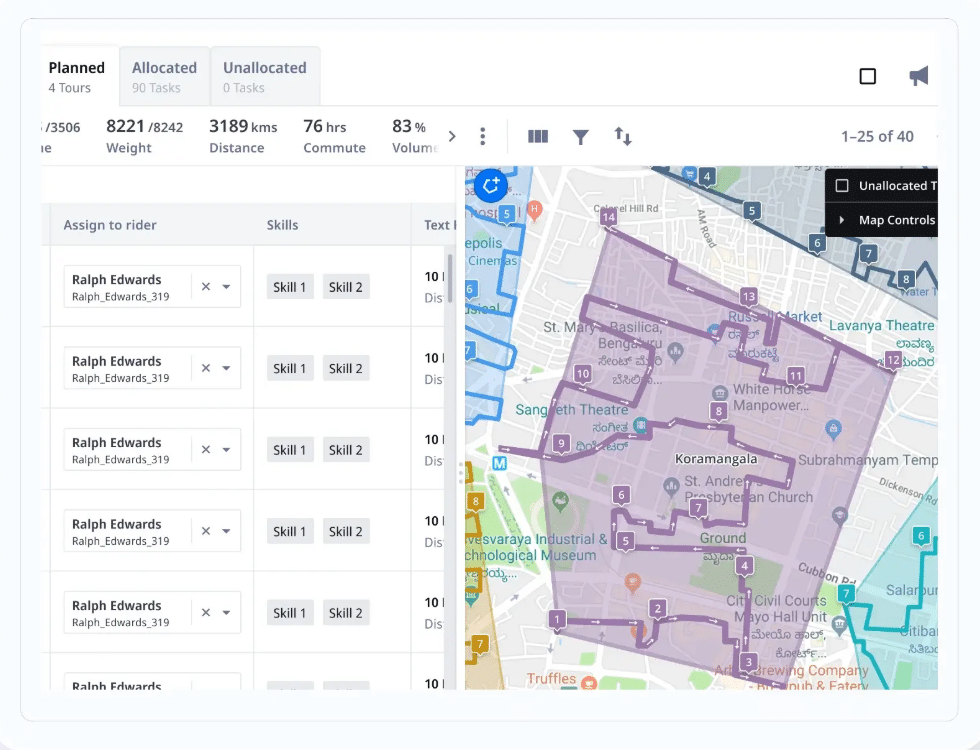
Most enterprise routing platforms work with 20 to 30 variables. The algorithmic gap between these two numbers is where per-delivery cost reduction actually comes from.
Carrier connectivity tells a different cost story
At the eConnect+ tier, each carrier EDI connection costs $3,000 in setup fees. However, Locus ShipFlex pre-integrates 1,000+ carriers with automated tendering, real-time quote collection from multiple carriers simultaneously, and dynamic bidding built in, with no per-carrier setup cost and tier threshold to cross first.
Across Locus deployments, customers have recovered $288M in carrier revenue leakage through optimized carrier selection and improved allocation efficiency by 72%.
- Billing and settlement close a workflow gap: Most TMS platforms treat delivery execution and financial close as two separate processes. Locus handles ePOD capture, digital invoice generation, and automated carrier payment reconciliation natively, within the same platform used for dispatch planning. There’s no handoff between execution and finance, no separate reconciliation module, and no manual bridging between the two.
- Deployment architecture matters: Locus connects to existing ERP, WMS, OMS, and TMS systems via RESTful APIs without replacing current infrastructure. The patent-protected geocoding engine converts ambiguous addresses into precise coordinates, which is specifically relevant for operations in APAC, MEA, and Latin American markets where standardized addressing is inconsistent. It was built for delivery environments where “near the blue shop, across from the temple” is a real address.
Locus serves retail and e-commerce operations, 3PLs, FMCG, and CPG enterprises at $150M+ revenue.
E2open vs. Locus: Detailed comparison
| Capability | E2open | Locus |
|---|---|---|
| Route optimization | Carrier selection and rating, transportation routing available within the enterprise TMS as a separate module | 250+ constraint simultaneous optimization, patent-protected geocoding, ML traffic prediction trained on historical patterns |
| Carrier management | EDI from eConnect ($1,500/SCAC), programmatic API requires eConnect+ ($3,000/SCAC EDI) | 1,000+ pre-integrated carriers, automated tendering and dynamic bidding, no per-carrier setup cost |
| Dispatch planning | Available within enterprise TMS, carrier marketplace tiers cover connectivity barring dispatch | DispatchIQ handles order clustering, vehicle-to-route matching, and multi-fleet coordination across captive, contracted, and outsourced fleets in a single optimization pass |
| Control tower / visibility | Real-time shipment visibility within the enterprise suite, strong multi-modal supply chain view | Exception-led dashboards, root cause analysis tools, real-time rerouting, and direct dispatcher-to-driver communication via Control Tower |
| Settlement and ePOD | Billing API at eConnect+, carrier payment management within the enterprise suite | Native ePOD capture, digital invoice generation, and automated carrier payment reconciliation in one platform |
| Driver mobile app | Available within enterprise TMS implementations | Cross-platform Android and iOS, offline-first architecture, turn-by-turn navigation, time-stamped proof of delivery |
| Integrations | ERP/WMS/TMS integrations within the enterprise suite, the marketplace requires an API tier for programmatic access | API-first RESTful, connects to ERP, WMS, OMS, TMS, and telematics without infrastructure replacement |
| Deployment | Enterprise implementation project, multi-month, typical for a full suite | Cloud-native SaaS integrates into the existing stack via standard APIs |
| Proven scale | Large enterprise, multi-region, strong in manufacturing and industrial supply chains | 650M+ orders, 400+ cities, 30+ countries, enterprise clients at $150M+ revenue |
User reviews: E2open vs. Locus
What are the users saying of these two platforms? Let’s take a look:
What E2open reviewers say
E2open scores well on G2, Capterra, and Gartner for supply chain network breadth, multi-modal visibility, and the scale of its carrier network. Reviewers in manufacturing and industrial logistics specifically credit the demand planning and global trade management depth.
The more telling feedback comes from operations leads who run full enterprise deployments. A recurring theme across reviews is that the platform does a lot, which is an asset when you need all of it and a friction source when you don’t.
Reviewers who came in primarily needing transportation execution capabilities describe spending implementation time on configuration work they expected to be standard. Several note that the time between contract signature and a live dispatch workflow exceeded what their internal stakeholders had been told to expect.
What Locus reviewers say
Two things appear consistently in Locus reviews. The first is the accuracy of the route optimization engine under real-world conditions. The second is how the platform balances algorithmic automation with dispatcher control.
Teams running high-stop, high-density routes specifically note that Locus holds ETA accuracy under conditions where simpler routing tools produce variance. One reviewer noted that
Blue Dart DHL’s General Manager of Operations documented 95% route mapping accuracy with Locus, attributing measurable overhead reductions and faster order cycle times to the geocoding and route allocation capabilities.
The most consistently surfaced limitation in Locus reviews is analytics response time in very high-volume environments. Locus addresses this through exception-led dashboards and root cause analysis tools designed for operational intervention rather than after-the-fact reporting.
Tips
E2open and Locus serve different enterprise buyer profiles. Buyers who need a single platform spanning procurement, supply planning, and transportation at the suite level will find E2open has the breadth. Buyers who need to reduce cost per delivery and close the loop between dispatch and settlement in one place will find Locus was built specifically for that.
How to Cancel or Switch from E2open
Here’s how you can migrate from E2open to Locus in 2026:
Cancellation
Carrier marketplace subscriptions run on annual contracts with auto-renewal clauses, which vary by tier. Notifying the account team before the renewal date is the standard process, but check your specific contract for the required notice window before assuming a clean exit is automatic.
Enterprise TMS contracts are individually negotiated and typically run for multi-year terms with structured exit provisions. Before serving notice, confirm data portability terms, the timeline for exporting configuration and historical data, and any termination fee structures. These vary significantly across accounts and are not published.
Migrating to Locus
Since Locus connects to existing ERP, WMS, and OMS systems via standard RESTful APIs, migration doesn’t require dismantling current data flows. Most transitions involve a parallel-run period, Locus running alongside existing carrier management tooling, before full cutover.
The primary technical work is carrier data migration, mapping current carrier configurations, contract parameters, and EDI setups into Locus’s carrier management framework. The pre-integrated carrier network covers the majority of enterprise carrier relationships, which reduces the manual per-carrier setup work that characterizes most TMS migrations.
Book a migration scoping call and the Locus team will map your current configuration to an implementation plan.
Why switch from E2open in 2026
E2open’s published subscription pricing is transparent and volume-scaled on paper. The escalation from the entry tier to API access is steep, and per-SCAC EDI fees compound quickly for enterprises with large carrier networks. The broader enterprise platform is a different product at a different scope, with negotiated contracts and implementation timelines that reflect the full suite’s depth.
For enterprises whose primary requirement is delivery execution, the question worth asking is whether a platform designed as a supply chain network hub is the right architecture for optimizing transportation execution specifically. E2open is ideal for buyers who need breadth across the supply chain.
Locus’s $320M+ in documented logistics savings across 1.5B + deliveries reflects a platform that was built entirely around the cost and performance of getting orders dispatched, delivered, and settled at enterprise scale.
To learn more, get a demo.
Frequently Asked Questions (FAQs)
1. Does E2open charge per shipment or per user?
Carrier marketplace tiers are priced by annual load volume, the number of loads shipped per year, instead of transaction or user count. Enterprise TMS contracts use custom pricing structures negotiated at sale, which may include volume-based or usage-based components depending on what’s agreed.
2. What happens to my data if I cancel an E2open enterprise contract?
Data portability terms vary by contract and are not published. Before serving notice on an enterprise contract, confirm the process and timeline for exporting configuration data, historical shipment data, and carrier setups. Waiting until after notice is served to check this creates unnecessary risk.
3. Can a company use E2open’s carrier connectivity product without the enterprise TMS suite?
Yes, it’s a standalone product. Many shippers use it purely for carrier connectivity, EDI, and procurement discovery without ever deploying the broader supply chain suite. The tiers are priced and contracted independently of the enterprise platform.
4. How does LTLConnect differ from eConnect+ in practice?
LTLConnect covers LTL-specific APIs, including real-time LTL rating, spot market, billing, and communications. Truckload and intermodal rating APIs are not included. eConnect+ covers those broader transport modes. An enterprise managing both LTL and full truckload freight programmatically typically needs both subscriptions.
5. What should logistics managers ask E2open during a demo before committing?
Three questions surface from reviewer feedback as the most predictive. First, ask what the implementation timeline looks like from contract signature to a live dispatch workflow. Second, ask which transportation-specific configuration work is included versus billed separately as professional services. Third, ask what post-go-live support looks like once the implementation team exits, specifically what the response SLA is for operational issues during live delivery cycles.


General
Locus vs. FarEye: An Enterprise Logistics Platform Comparison (2026)

Mar 25, 2026
How do Locus and FarEye compare for enterprise logistics? A verified feature comparison covering scope, optimization, carriers, and scale.
Read more
General
Blue Yonder Pricing, Plans, and Features: Is It Worth the Investment in 2026?
Mar 26, 2026
Blue Yonder keeps pricing off its website. This guide breaks down its modules, TCO factors, and how it compares to Oracle, SAP, Manhattan, and Locus.
Read moreInsights Worth Your Time




















E2open Pricing, Plans, and Features: Is E2open Worth It in 2026?