


General
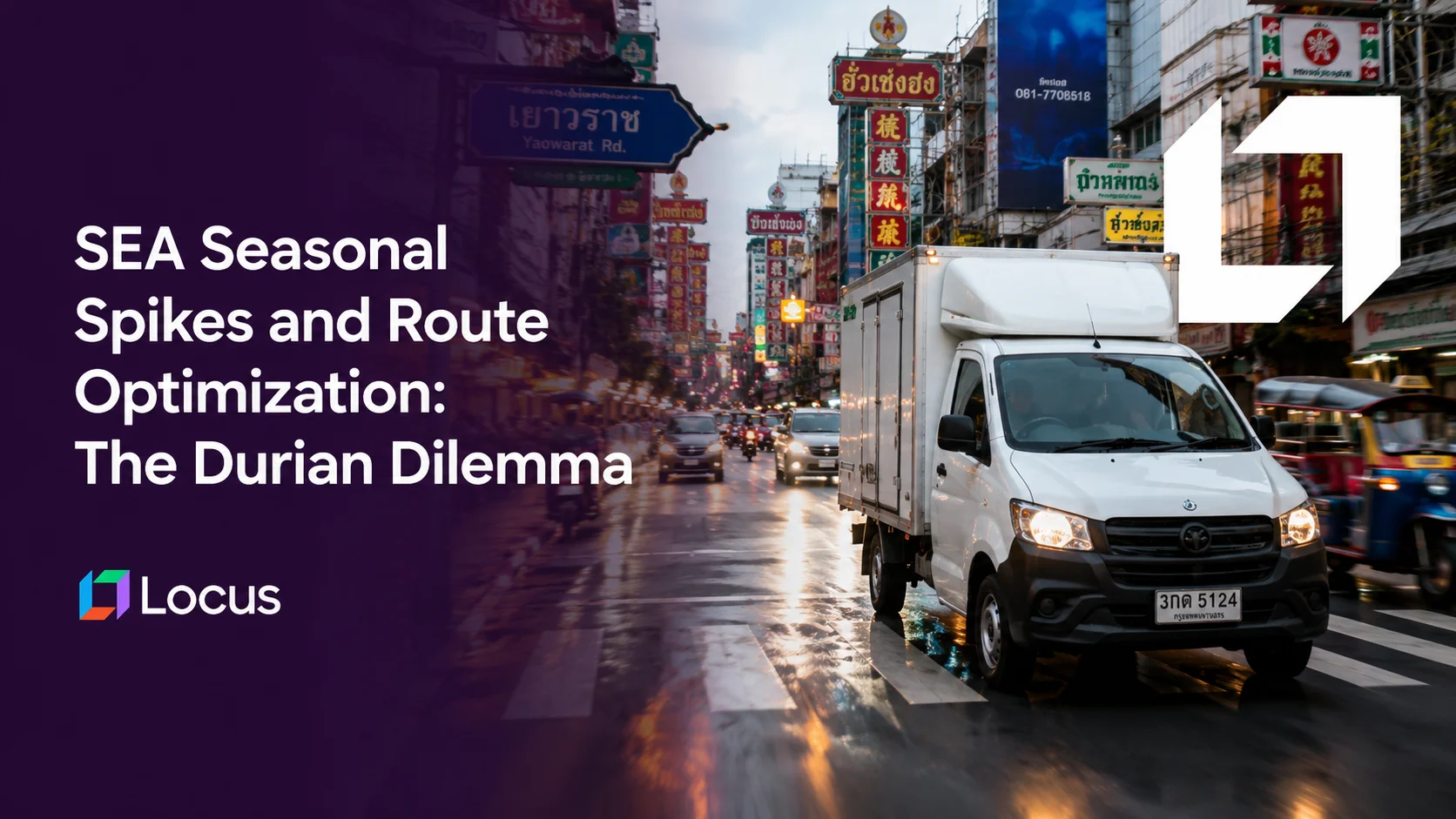
The Durian Dilemma: What SEA’s Seasonal Demand Spikes Reveal About Route Optimization Architecture

Key Takeaways
- Southeast Asia’s durian season — concentrated harvest windows from May through August across Malaysia, Thailand, Indonesia, and the Philippines, with peak weeks producing material demand surge for Musang King, D24, Black Thorn, and other premium varieties — is one of the region’s most operationally distinctive logistics events. Cross-border flows from Malaysian and Thai producers to Singapore, Hong Kong, and mainland China consumer markets compound with B2C e-commerce volume that surges during peak weeks, fresh-handling and cold-chain requirements that constrain routing options, and customer expectations for fast delivery shaped by platform e-commerce experiences.
- The durian dilemma is the SEA-specific illustration of a broader operational pattern. Routing platforms calibrated to steady-state demand fail under extreme seasonality compounded with category-specific complexity. The pattern recurs across SEA’s seasonal logistics calendar — Ramadan retail surge across Indonesia and Malaysia, Chinese New Year cross-border gifting flows, Songkran festive demand in Thailand, mid-year mega-sales (6.6, 7.7), and the 11.11 and 12.12 platform-driven e-commerce volumes that have grown into operational events SEA logistics operations now plan around.
- Three architectural requirements distinguish routing platforms that handle extreme SEA seasonality from platforms that work at steady state but fail during seasonal spikes. Capacity scaling architecture — routing engines that handle 5x or 10x operational volume during seasonal peaks without performance degradation, capacity scaling across owned fleet, contracted 3PL, gig courier, and alternative network capacity. Constraint complexity handling — routing decisions during seasonal spikes face additional constraints (perishability, cold chain, customer time-window concentration, cross-border regulatory) that steady-state routing doesn’t process. Adaptive learning — routing models that update to seasonal demand patterns rather than treating seasonal spikes as anomalies the steady-state model handles suboptimally.
- Each requirement maps to specific operational symptoms when routing platforms are calibrated to steady-state operations. Capacity scaling failure manifests as routing engine latency during peak periods. Constraint complexity failure manifests as routing that produces routes infeasible against category-specific operational requirements. Adaptive learning failure manifests as routing patterns that worked last seasonal cycle but degrade as customer expectations or operational conditions shift between cycles.
- For Heads of Logistics, VPs of Supply Chain, Heads of Operations, and Heads of E-commerce Fulfillment at SEA-based retailers, 3PLs, and fresh-category operations in 2026, the practical question is concrete: is the routing platform architected to handle the extreme seasonality patterns SEA operations actually face — durian season, Ramadan, Chinese New Year, mega-sales — or calibrated to steady-state operations that produce visible degradation during the seasonal events the business depends on most?
The durian season is one of Southeast Asia’s most operationally distinctive logistics events. From May through August across Malaysia, Thailand, Indonesia, and the Philippines, concentrated harvest weeks produce surge demand for Musang King, D24, Black Thorn, and other premium durian varieties. The flows span B2C e-commerce orders from urban consumers across the region, cross-border exports from Malaysian and Thai producers to Singapore, Hong Kong, and mainland China consumer markets, and B2B distribution to specialty retailers and food service operations. The seasonal volume surge compounds with operational characteristics that steady-state logistics rarely faces simultaneously — fresh-handling requirements that constrain time windows, cold-chain or insulated transport requirements depending on grade and distance, odor management that affects routing in shared-load scenarios, customer expectations for fast delivery shaped by platform e-commerce experiences, and cross-border regulatory requirements that vary across SEA destinations.
The durian dilemma — the operational pattern where routing platforms calibrated to steady-state demand fail under extreme seasonality compounded with category-specific complexity — is the SEA-specific illustration of a broader operational reality. The pattern recurs across SEA’s seasonal logistics calendar. Ramadan retail surge across Indonesia and Malaysia produces e-commerce and grocery volume increases that compound with cultural delivery preferences around iftar timing. Chinese New Year cross-border gifting flows surge across Singapore, Malaysia, and Hong Kong, with category-specific requirements for premium gift packaging, family-pack groceries, and traditional foods. Songkran in Thailand produces tourism-driven distribution patterns alongside domestic retail surge. Platform-driven mega-sales — 6.6, 7.7, 11.11, 12.12, year-end clearance — have grown into operational events that SEA e-commerce and 3PL operations now plan around as core annual logistics events.
The routing platforms that work for steady-state operations don’t necessarily handle these seasonal spikes well. Routing engines calibrated for predictable demand volume produce visible degradation when volume surges 5x or 10x during peak weeks. Routing logic that handles standard categories struggles with category-specific operational constraints that surface during seasonal events. Routing models trained on steady-state data treat seasonal patterns as anomalies rather than as the operational reality the business depends on. The architectural gap isn’t a routing quality problem during normal operations — it’s a routing architecture problem that surfaces specifically when SEA seasonal patterns produce the conditions the routing wasn’t designed for.
For Heads of Logistics, VPs of Supply Chain, Heads of Operations, and Heads of E-commerce Fulfillment at SEA-based retailers, 3PLs, and fresh-category operations in 2026, this is a practical look at what the durian dilemma reveals about routing architecture, the three architectural requirements that distinguish platforms handling extreme seasonality from platforms calibrated only to steady state, and what operational symptoms surface when routing infrastructure doesn’t match SEA seasonal reality.
Requirement 1: Capacity Scaling Architecture — Routing That Handles 5x or 10x Volume Without Degradation
The first architectural requirement is where routing platform failures surface most visibly during SEA seasonal spikes.
What capacity scaling architecture requires. Routing engines that handle operational volume surges of 5x or 10x during seasonal peaks without performance degradation. The scaling has to operate across multiple dimensions — compute capacity for routing optimization, integration capacity for handling expanded order volume and customer notification flows, capacity allocation across owned fleet, contracted 3PL, gig courier networks, and alternative capacity sources that operations activate during peaks. The architecture matters because SEA seasonal spikes aren’t gradual increases that scaling can keep up with — they’re concentrated events where operations need expanded capacity to be ready before the spike rather than scaled into during the spike.
Why steady-state routing platforms fail at this requirement. Routing engines calibrated for predictable volume produce optimization latency that grows with volume — acceptable at steady-state volumes, operationally disruptive at peak season volumes. Integration capacity that handles standard order flows struggles with peak-season order volume that compounds across platform marketplace orders, direct e-commerce orders, and B2B distribution orders simultaneously. Capacity allocation logic that works with standard carrier mix doesn’t adapt when operations need to activate gig courier networks or alternative capacity during peaks. The cumulative effect is routing infrastructure that worked all year producing visible degradation during the operational events the business depends on most.
Operational symptoms. Routing engine latency increasing during seasonal peaks. Customer notification delays as integration capacity backs up. Dispatch decisions made against partial capacity views because alternative capacity activation lags peak demand. Operations teams describing the routing platform as “fine until durian season” or “fine until 11.11” — accurate diagnosis of capacity scaling architecture that doesn’t match seasonal reality.
Requirement 2: Constraint Complexity Handling — Routing That Processes Category-Specific Operational Requirements
The second architectural requirement is where seasonal events expose constraint complexity that steady-state routing doesn’t process.
What constraint complexity handling requires. Routing optimization that processes category-specific operational constraints alongside standard routing dimensions. For durian: perishability and freshness windows, cold-chain or insulated transport requirements by grade and distance, odor management in shared-load scenarios, cross-border customs requirements that vary across SEA destinations. For Ramadan: cultural delivery preferences around iftar timing windows, increased customer availability during evening hours, festive-volume packaging requirements. For mega-sales: order concentration in narrow time windows, customer expectation for delivery within platform-promised windows, exception handling protocols for SLA breach risk during peak volume.
Why steady-state routing platforms struggle with category-specific constraints. Routing engines architected for standard categories process a limited constraint surface — capacity, time windows, geographic, basic vehicle constraints. Adding category-specific constraints requires architectural extension rather than configuration — the optimization engine has to actually model the constraint rather than treating it as a workflow overlay. Many routing platforms handle category complexity by adding workflow logic above the routing decisions, producing routing that’s category-blind with category-specific workflow trying to compensate. The compensation works partially at steady state and degrades during peaks when category-specific constraints intensify.
Operational symptoms. Routing decisions that look optimal but produce infeasible routes when category-specific requirements surface in execution. Operations teams overriding routing decisions during seasonal events because the routing didn’t account for operational reality. Customer-facing failures concentrated in seasonal events because routing didn’t process category constraints. Driver workarounds that handle category requirements the routing didn’t model — producing operational compensation but no architectural learning.
Requirement 3: Adaptive Learning — Routing Models That Update to Seasonal Patterns
The third architectural requirement is where the durian dilemma compounds across seasonal cycles.
What adaptive learning requires. Routing models that update to seasonal demand patterns as operational evidence accumulates rather than treating seasonal events as anomalies the steady-state model handles suboptimally. The learning has to operate at the granularity seasonal patterns actually exhibit — durian season patterns differ across Malaysia, Thailand, Indonesia, Philippines because harvest timing, variety mix, and cross-border flow patterns vary by origin geography. Ramadan patterns differ across Indonesia, Malaysia, Singapore because cultural patterns and retail dynamics vary by market. Mega-sale patterns differ across platforms because each platform’s promotional structure affects volume distribution differently. Generic seasonal learning that treats SEA seasonality as monolithic misses the specificity routing decisions actually need.
Why steady-state routing platforms struggle with seasonal adaptation. Routing models trained primarily on steady-state operational data weight steady-state patterns heavily, producing seasonal predictions that revert toward steady-state expectations. Retraining cadences designed for gradual operational evolution don’t capture seasonal patterns that produce material model adjustment needs within concentrated cycles. Production feedback loops capturing outcomes from steady-state operations don’t accumulate seasonal-specific feedback at the granularity seasonal events require. The cumulative effect is routing models that get worse at seasonal events over deployment lifetime as steady-state patterns dilute seasonal patterns in the training data.
Operational symptoms. Routing patterns that worked during last seasonal cycle producing different operational outcomes during current cycle because operational reality shifted between cycles. Customer-facing metrics worsening at seasonal events even as steady-state metrics improve. Operations teams describing routing as “learning the wrong things from peak season” — accurate diagnosis of adaptive learning that doesn’t separate seasonal patterns from steady-state patterns.
How the Three Requirements Compound
The three requirements reinforce each other in platforms that handle SEA seasonality well and undermine each other when one or more remains weak.
Strong capacity scaling without constraint complexity handling produces routing that scales but produces infeasible routes during seasonal events. Strong constraint handling without capacity scaling produces routing that processes category-specific requirements but degrades operationally during peaks. Strong adaptive learning without capacity scaling and constraint handling produces models that learn seasonal patterns the routing infrastructure can’t execute against. The three requirements compound — strong in all three produces routing that handles SEA seasonality as operational reality rather than as exception to handle around.
Operations facing the durian dilemma frequently focus on tactical interventions during seasonal events — adding capacity, increasing manual dispatch, adjusting customer expectations downward. The tactical interventions reduce visible degradation but don’t address the architectural infrastructure that prevents the degradation. The architectural diagnosis — capacity scaling, constraint complexity, adaptive learning — matters more than the seasonal-event tactical fixes that don’t compound across cycles.
How Locus Makes a Difference
Locus delivers route optimization architecture built for extreme seasonality patterns rather than calibrated only to steady-state operations. Six architectural commitments translate the three-requirement framework into operational reality for SEA enterprises.
Production-scale capacity scaling. Locus’s platform handles operational volume across 1.5B+ deliveries optimized across 300+ clients in 30+ countries — providing the production evidence that capacity scaling architecture handles enterprise volume rather than calibrating to steady-state assumptions that fail during peaks.
180+ operational constraints handled through unified architecture. Locus’s agentic AI handles route optimization across 180+ real-world operational constraints — including category-specific constraints (perishability, cold-chain, time-window concentration, regulatory) that surface during SEA seasonal events alongside standard routing dimensions.
Multi-carrier orchestration for capacity activation. Locus integrates with 1,000+ carriers — supporting the capacity allocation across owned fleet, contracted 3PL, gig courier networks, and alternative capacity sources that operations need during SEA seasonal spikes.
Production-grade learning loops for seasonal patterns. Locus’s AI improves with operational data through outcome capture, feedback labeling, retraining cadence, and deployment governance architected for production deployment — supporting adaptive learning that updates to seasonal patterns at the granularity SEA operations actually require.
Six governance mechanisms supporting operational risk during peaks. Explainability, Traceability, Evaluation, Autonomy Levels, Execution Sandbox, Human-in-the-Loop — these governance mechanisms support the operational risk controls SEA enterprises need when routing decisions affect SLA performance during high-stakes seasonal events.
Software factory extensibility for SEA-specific operational reality. Locus’s platform extensibility supports custom configuration for SEA market-specific operational requirements — bilingual customer communication, cross-border SEA regulatory variation, country-specific operational practices that monolithic seasonal frameworks miss.
For SEA enterprise logistics operations evaluating route optimization architecture against the durian dilemma and broader SEA seasonality patterns, Locus delivers the capacity scaling, constraint complexity handling, and adaptive learning infrastructure that distinguishes routing platforms architected for extreme seasonality from platforms calibrated only to steady-state operations.
The strategic question for SEA enterprise logistics leaders is concrete: given that SEA operations face extreme seasonality across durian season, Ramadan, Chinese New Year, Songkran, and platform-driven mega-sales, and routing platforms calibrated only to steady-state demand produce visible degradation during seasonal events the business depends on most, is the route optimization architecture built for the seasonality patterns SEA operations actually face — or operating against seasonal events as exceptions rather than as the operational reality the business plans around?
FAQs
What is the durian dilemma in SEA logistics, and why does it illustrate broader seasonality challenges?
The durian dilemma describes the operational pattern where routing platforms calibrated to steady-state demand fail under SEA’s durian season — concentrated harvest windows from May through August across Malaysia, Thailand, Indonesia, and the Philippines that produce material demand surge for Musang King, D24, Black Thorn, and other premium varieties. The seasonal flows span B2C e-commerce orders, cross-border exports from Malaysian and Thai producers to Singapore, Hong Kong, and mainland China, and B2B distribution to specialty retailers and food service. The volume surge compounds with operational characteristics that steady-state logistics rarely faces simultaneously — fresh-handling and cold-chain requirements, odor management in shared loads, customer expectations for fast delivery, and cross-border regulatory variation across SEA destinations. The durian dilemma illustrates a broader operational pattern that recurs across SEA’s seasonal logistics calendar — Ramadan retail surge across Indonesia and Malaysia, Chinese New Year cross-border gifting flows, Songkran festive demand in Thailand, platform-driven mega-sales (6.6, 7.7, 11.11, 12.12). Each event combines volume surge with category-specific operational complexity that routing platforms calibrated to steady-state demand process poorly.
Why do routing platforms calibrated to steady-state demand fail during SEA seasonal spikes?
Three architectural reasons explain the failure pattern. Capacity scaling architecture calibrated to predictable volume produces routing engine latency that grows with volume — acceptable at steady-state, operationally disruptive at peak season when SEA operations face 5x or 10x volume surges concentrated in narrow windows. Constraint complexity handling architected for standard categories doesn’t process the category-specific operational requirements that surface during seasonal events — perishability, cold-chain, time-window concentration, cultural delivery preferences, cross-border regulatory variation. Routing engines treat these constraints as workflow overlays rather than modeling them in optimization decisions, producing routes that look optimal but prove infeasible during execution. Adaptive learning architected for gradual operational evolution doesn’t capture seasonal patterns at the granularity routing decisions need — Malaysia durian patterns differ from Thailand durian patterns differ from Indonesia patterns, Ramadan patterns differ across Indonesia and Malaysia, mega-sale patterns differ across platforms. Generic seasonal learning misses the specificity SEA operations actually require, producing models that get worse at seasonal events over deployment lifetime.
What three architectural requirements distinguish routing platforms that handle SEA seasonality?
Three architectural requirements determine whether a routing platform handles SEA seasonal spikes operationally or produces visible degradation during the events SEA business depends on most. Capacity scaling architecture — routing engines handling operational volume surges of 5x or 10x during seasonal peaks without performance degradation, with scaling across compute capacity for routing optimization, integration capacity for expanded order and notification flows, and capacity allocation across owned fleet, contracted 3PL, gig courier networks, and alternative capacity sources. Constraint complexity handling — routing optimization that processes category-specific operational constraints alongside standard routing dimensions, modeling perishability, cold-chain, time-window concentration, cross-border regulatory, and cultural delivery preferences as optimization constraints rather than as workflow overlays. Adaptive learning — routing models that update to seasonal demand patterns as operational evidence accumulates, with learning operating at the granularity seasonal patterns actually exhibit (country-specific, category-specific, platform-specific) rather than treating SEA seasonality as monolithic.
Why does capacity scaling matter more for SEA seasonality than for typical operational growth?
SEA seasonal spikes aren’t gradual increases that scaling can keep up with — they’re concentrated events where operations need expanded capacity ready before the spike rather than scaled into during the spike. Durian peak weeks compress B2C and cross-border volume into specific harvest windows. Ramadan retail surge produces concentrated demand around iftar timing across the lunar calendar. Mega-sales concentrate platform-driven volume into 24-72 hour windows with order surge curves that exceed steady-state daily volume by 5x or 10x. Capacity scaling architecture calibrated for predictable volume growth doesn’t match these concentrated event patterns — routing engines, integration capacity, and capacity allocation all need to handle peak load that materially exceeds steady-state load without operational degradation. Operations describing routing platforms as “fine until durian season” or “fine until 11.11” are diagnosing capacity scaling architecture that doesn’t match the concentrated event patterns SEA seasonality actually produces.
What does adaptive learning need to handle for SEA-specific seasonal patterns?
Adaptive learning for SEA seasonality needs to operate at the granularity seasonal patterns actually exhibit, which is much more specific than monolithic regional seasonality. Durian season patterns differ across Malaysia (Musang King concentration, Penang and Pahang as primary origins, Singapore as primary cross-border destination), Thailand (Monthong dominance, Chanthaburi region as primary origin, mainland China as primary export destination), Indonesia (multiple varieties, broader geographic origin distribution), and the Philippines (Davao region, primarily domestic market). Ramadan patterns differ across Indonesia (largest Muslim population, broad e-commerce penetration, iftar timing variation across archipelago), Malaysia (different retail dynamics, multi-ethnic market context), and Singapore (smaller Muslim market within broader retail context). Mega-sale patterns differ across Shopee, Lazada, TikTok Shop because each platform’s promotional structure affects volume distribution differently. Generic seasonal learning that treats SEA seasonality as monolithic misses these specificities. Routing models need to separate seasonal patterns by country, by category, by platform, and by year-to-year variation rather than averaging across SEA seasonal events into single seasonal patterns that don’t match operational reality.
How should SEA logistics leaders diagnose whether their routing platform is calibrated for steady-state or for SEA seasonality?
Operational symptoms reveal whether routing infrastructure handles SEA seasonality architecturally or operates against seasonal events as exceptions. Capacity scaling symptoms include routing engine latency increasing during seasonal peaks, customer notification delays as integration capacity backs up during peak volume, dispatch decisions made against partial capacity views because alternative capacity activation lags peak demand, and operations teams describing the platform as “fine until durian season” or “fine until 11.11.” Constraint complexity symptoms include routing decisions that look optimal but produce infeasible routes when category-specific requirements surface in execution, operations teams overriding routing during seasonal events because the routing didn’t account for operational reality, customer-facing failures concentrated in seasonal events, and driver workarounds that compensate for category requirements the routing didn’t model. Adaptive learning symptoms include routing patterns from last seasonal cycle producing different operational outcomes during current cycle, customer-facing metrics worsening at seasonal events even as steady-state metrics improve, and routing models that appear to learn the wrong things from peak season. Operations exhibiting these symptoms across multiple requirements face routing architecture calibrated to steady-state operations producing degradation during the seasonal events the business depends on most — the architectural diagnosis matters more than tactical interventions during specific seasonal events.


General
Why Most Supply Chain Control Towers Don’t Actually Control: What CTOs Need to Build for Operational Authority

May 27, 2026
Most supply chain control towers don't actually control — they display. Three architectural layers CTOs need to build for control towers that exercise operational authority rather than producing dashboards.
Read more
Route Optimization
Driver Routing and Scheduling: Why Enterprise Logistics Demands More Than Basic Route Planning

May 28, 2026
Learn how AI-powered driver routing and scheduling eliminates manual dispatch, cuts costs, and scales for enterprise logistics across retail, FMCG, and 3PL.
Read moreInsights Worth Your Time




















The Durian Dilemma: What SEA’s Seasonal Demand Spikes Reveal About Route Optimization Architecture