


General
Beyond the Courier: How Locus’s Dispatch Intelligence Outperforms Traditional Models in 2026

Key Takeaways
- Last-mile dispatch has traditionally run on three models: the manual dispatcher, static zones and fixed rounds, and the courier hand-off.
- They differ in detail but share one ceiling: the dispatch decision is made by human judgment, fixed rules, or an outsourced black box, none of which can weigh many constraints at once or adapt as the day changes.
- Dispatch intelligence is not a faster version of those models; it is a different one, where a system senses conditions, weighs constraints, decides, and re-optimizes continuously.
- That is why it outperforms rather than merely improves: it removes the ceiling instead of raising it.
- Intelligence wins on complexity, real-time adaptation, consistency at scale, and optimizing cost and service together.
- The constraint in a traditional model is the model itself, not the quality of the people or couriers running it.
The Model, Not the Effort, is the Limit
For decades, last-mile dispatch has run on a handful of traditional models. A skilled dispatcher assigns deliveries by judgment and experience. Drivers own fixed zones and run largely repeating rounds. Or volume is handed to courier companies who allocate it however they see fit. These models built the modern delivery economy, and the people who run them are often very good at it.
But they share a ceiling, and it has nothing to do with effort. In every one of them, the core decision, who delivers what, in what order, by when, using which resource, is made by something that cannot hold many variables at once or change its mind as the day unfolds: a person’s judgment, a fixed rule, or an outsourced process with little visibility. No matter how experienced the dispatcher or how reliable the courier, that decision-making mechanism caps how efficient, consistent, and scalable the operation can be.
Dispatch intelligence changes the mechanism itself. It is not a faster dispatcher or a digitized zone map; it is a different way of making the decision, one that outperforms the traditional models precisely because it removes their shared ceiling rather than pushing against it. This piece looks at the traditional models and the limit they have in common, what dispatch intelligence actually means, and where and why it wins.
The Traditional Dispatch Models (and the Ceiling They Share)
Three models cover most of how last-mile dispatch has been run.
The manual dispatcher is the most common. A person, or a team, assigns deliveries to drivers using experience, local knowledge, and often a spreadsheet. At a small scale it works well, because a good dispatcher holds a mental model of the operation. But human judgment cannot weigh dozens of constraints, cost, time windows, capacity, service levels, traffic, driver hours, simultaneously and consistently, and it does not scale: twice the volume needs more dispatchers, and quality varies with who is on shift.
McKinsey finds static planning models leave as much as 60% of operating hours either under- or overstaffed.
Static zones and fixed rounds remove the daily decision by fixing it in advance. Drivers own territories and run similar routes each day. This is efficient when demand is stable and predictable, and wasteful the moment it is not, which is most of the time. Fixed rounds cannot absorb a demand spike in one area or an empty afternoon in another; the plan is set before the day’s reality is known.
Also Read: Delivery Management Software: The Ultimate Buyer’s Guide for 2026
The courier hand-off outsources the decision entirely. Volume is passed to courier or carrier companies who allocate and route it themselves. It is operationally simple, but it makes cost and service opaque and unoptimized: the shipper cannot see or influence how the decision is made, and gets whatever efficiency the courier happens to deliver.
Different as they are, all three hit the same wall. The dispatch decision is made by a mechanism, human judgment, a fixed rule, or an outsourced black box, that cannot process enough information fast enough or adapt once the day is underway. That is the ceiling, and no amount of skill or reliability lifts it, because it is built into the model.
What “Dispatch Intelligence” Actually Means
Dispatch intelligence is often heard as a synonym for better software, which undersells it. The meaningful change is not that the tool is faster; it is that the decision is made differently.
In an intelligence-led model, the assignment-and-sequencing decision is made by a system that senses live operating conditions, weighs many constraints at once, cost, time, capacity, service levels, driver and vehicle rules, and current conditions on the ground, decides on the best plan, and then keeps deciding, re-optimizing continuously as demand shifts and disruptions arise through the day. The important contrast is with simply automating the old model. Speeding up a manual dispatcher, or digitizing a zone map, keeps the same decision mechanism and just runs it faster. Dispatch intelligence replaces the mechanism: judgment and fixed rules give way to continuous, constraint-aware decisioning. That is the reason the right verb is outperforms rather than improves. The traditional models can be optimized toward their ceiling; intelligence operates without it.
Where Intelligence Outperforms the Traditional Models
The advantage shows up in four places, each the direct inverse of a traditional model’s limit.
Complexity is the first. An intelligence-led system weighs dozens of constraints for every assignment, the combination no human dispatcher can hold at once and no fixed rule can express. Where the manual model simplifies to stay tractable, intelligence uses the full picture.
Real-time adaptation is the second. Because the decision is continuous, the plan changes as the day does, absorbing spikes, disruptions, and delays instead of executing a plan set before any of that was known. This is exactly where static zones and fixed rounds fail.
Organizations using autonomous planning report better decision speed (78%) and decision quality (75%) while reducing manual intervention, per Gartner.
Consistency at scale is the third. The same quality of decision is made for every order and every route, at any volume, without depending on which dispatcher is working or how busy the day is. Growth does not dilute decision quality or require adding dispatchers in step, which is the manual model’s scaling problem.
Cost and service together is the fourth. Intelligence optimizes both at once as explicit objectives, rather than trading one against the other or accepting whatever a courier’s opaque process yields. Where the hand-off model surrenders visibility and control, intelligence keeps both.
McKinsey reports AI-enabled distribution and logistics operations achieve 5–20% logistics cost reduction alongside service and inventory gains.
Also Read: Dispatch Automation in Logistics: Complete Guide
How Locus Does This
At Locus, dispatch intelligence is the operating model, so a brief note on the mechanism rather than the pitch.
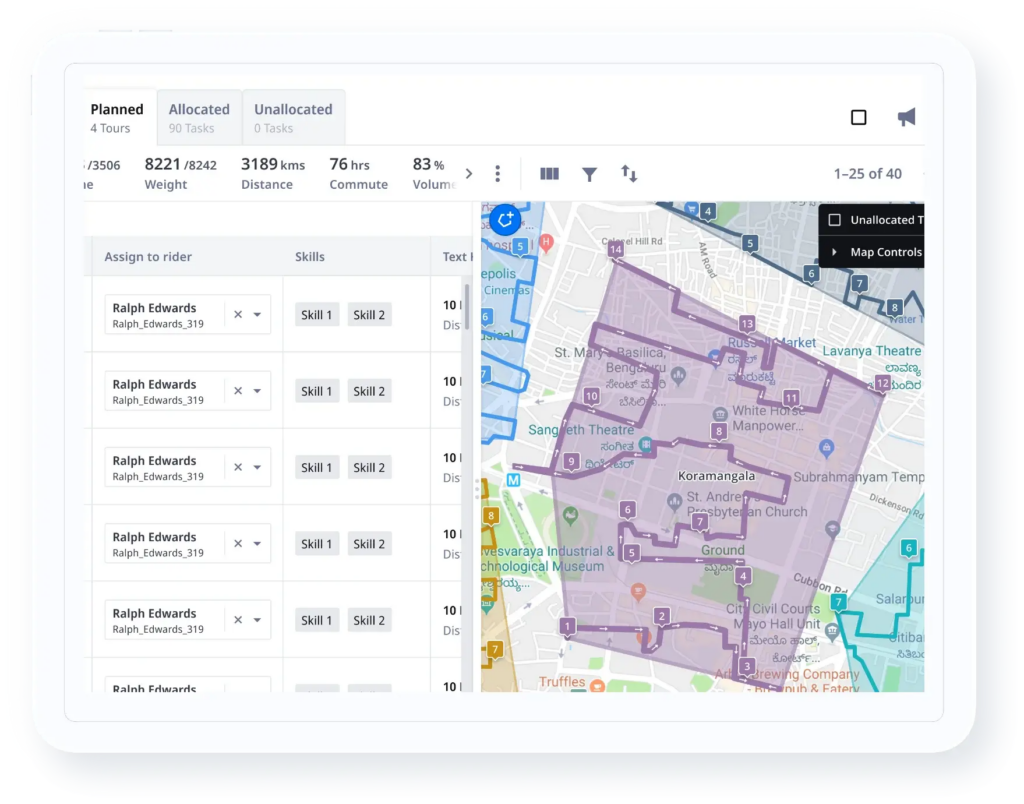
Locus makes the dispatch decision by optimizing across 250+ real-world constraints at once, cost, time, capacity, service levels, and driver and vehicle rules, rather than reducing the problem to what a person or a fixed rule can handle. It automates that decision, which removes the manual dispatcher’s ceiling and the overhead that comes with it, and it re-optimizes continuously as conditions change through the day, so the plan adapts instead of expiring, unlike a fixed round. Because the decision is made the same way every time, quality holds across volume rather than varying with the shift. The effect is the operating-model shift described above: the dispatch decision moves from judgment, rules, or an outsourced process to continuous, constraint-aware decisioning, and Locus runs this at large scale across enterprise last-mile operations. It is the difference between running the traditional model well and running a different model.
Also Read: TMS: Decarbonizing European Supply Chain
What This Means for Operations Leaders
If your dispatch still runs on a dispatcher’s judgment, static zones, or a courier hand-off, the honest place to look for the constraint is the model, not the people or couriers executing it. They are working against a ceiling built into how the decision gets made, and effort cannot lift it.
The move that matters is not a faster version of the same model. It is making the dispatch decision itself intelligent: continuous, constraint-aware, and adaptive. The practical first step is to find where your current model’s ceiling is costing you, in complexity it cannot handle, in days it cannot adapt to, in quality that varies, or in cost and service you cannot see, because that is where an intelligence-led model pays back first.
Learn more, visit locus.sh. To understand how Locus can Locus’s Dispatch Agent can can help you save costs and enhance your operations schedule a demo here.
Frequently Asked Questions (FAQs)
What are the traditional last-mile dispatch models?
Three cover most operations: the manual dispatcher, where a person assigns deliveries by judgment and experience; static zones and fixed rounds, where drivers own territories and run repeating routes; and the courier hand-off, where volume is outsourced to courier or carrier companies who allocate it themselves. Each was built for a simpler, more stable delivery environment.
What is dispatch intelligence?
It is an operating model in which the dispatch decision, who delivers what, in what order, by when, and with which resource, is made by a system that senses live conditions, weighs many constraints simultaneously, decides, and re-optimizes continuously as the day changes. It replaces human judgment and fixed rules as the decision mechanism, rather than just speeding them up.
How is it different from automating manual dispatch?
Automating manual dispatch keeps the same decision mechanism and runs it faster; the ceiling on how many variables can be weighed and how quickly the plan can adapt remains. Dispatch intelligence changes the mechanism itself, so the plan reflects the full constraint set and adapts in real time. That is why it outperforms rather than merely accelerates.
Where does dispatch intelligence outperform traditional models?
In four places: handling complexity too great for human judgment or fixed rules; adapting in real time as demand and disruptions shift, where static rounds cannot; delivering consistent decision quality at any volume, where the manual model varies and does not scale; and optimizing cost and service together, where the courier hand-off surrenders visibility and control.
Does dispatch intelligence replace dispatchers?
It replaces the manual decision mechanism, not the people. The routine, high-volume assignment-and-sequencing work that overwhelms human judgment is handled by the system, which frees dispatchers to manage exceptions, relationships, and the decisions that genuinely need human oversight, and lets the operation scale without adding dispatchers in step with volume.
How does Locus’s dispatch intelligence work?
Locus optimizes the dispatch decision across 250+ real-world constraints at once, automates that decision to remove the manual ceiling and overhead, and re-optimizes continuously as conditions change so the plan adapts rather than expires. Because the decision is made consistently every time, quality holds across volume rather than depending on the shift.


General
How Locus Helps Logistics Companies Cut Last-Mile Costs and Delivery Times in 2026

Jul 15, 2026
Cost and speed in the last mile look like a trade-off. The levers that cut delivery cost and time at once, and where intelligent dispatch beats it.
Read more
General
Why “National” Last-Mile Efficiency is a Myth in US: A US Operator’s Guide to Local Delivery Complexity in 2026

Jul 16, 2026
The US isn't one delivery market. Why a national last-mile playbook is efficient nowhere, how US regions differ, and how per-region optimization wins.
Read moreInsights Worth Your Time


















Beyond the Courier: How Locus’s Dispatch Intelligence Outperforms Traditional Models in 2026