


General
How Locus Helps Logistics Companies Cut Last-Mile Costs and Delivery Times in 2026

Key Takeaways
- Last-mile operations are judged on cost and speed, usually treated as opposites: cut one and you sacrifice the other.
- That trade-off is real only at the extremes. Most operations sit far inside it, losing both cost and time to the same inefficiency.
- The biggest gains come from levers that cut cost and delivery time together, because they are often the same lever: tighter routing, first-attempt success, automated dispatch, and real-time re-optimization.
- A failed first delivery attempt is the most expensive and the slowest outcome at once, which makes first-attempt success the highest-leverage fix.
- Where cost and speed genuinely conflict, the answer is to optimize to the efficient frontier and segment fast and economy lanes, not to pick one blunt setting for everything.
- Intelligent dispatch cuts both because it optimizes cost, time, and service against the same constraints rather than trading one for another.
Cost or Speed is the Wrong Question
Every last-mile operation is measured on two things at once: what each delivery costs, and how fast it arrives. And almost everyone treats them as opposites. Want to cut costs? Consolidate loads, fill vehicles, slow down. Want to go faster? Add trips, add vehicles, spend more. Framed that way, every improvement in one metric feels like a sacrifice in the other, and operations get stuck choosing which pain to accept.
Capgemini Research Institute finds last-mile delivery accounts for as much as 53% of total shipping cost (up from 41% in 2018).
The framing is wrong, or at least incomplete, and it is why so much last-mile improvement stalls. Cost and speed do trade off at the extremes, but most operations are nowhere near those extremes. They sit far inside the efficient frontier, losing money and time simultaneously to the same underlying inefficiency: loose routes, failed deliveries, slow manual planning, and stale plans that do not react to the day. In that large middle ground, the two do not trade off at all. The same fix cuts cost and delivery time together.
This piece is about those fixes. First, the levers where cost and speed move in the same direction, so you can cut both at once. Then, the narrower set of cases where they genuinely conflict, and what to do there instead of accepting a blunt compromise.
Also Read: Last Mile Efficiency Under SLA Constraints: 2026 Architecture
Why Cost and Speed Look Like a Trade-Off (and Often Aren’t)
The trade-off intuition comes from the edges of the problem. A guaranteed two-hour delivery genuinely costs more than a next-day one, because it forecloses the consolidation that makes delivery cheap. So at the frontier, where an operation is already running efficiently, buying more speed does cost more, and vice versa. That much is true.
But it does not describe where most operations actually are. Most are not running at the frontier; they are running with routes that could be tighter, delivery failure rates that force expensive re-attempts, planning cycles that take hours of human effort, and daily plans that do not adjust when reality shifts. Every one of those wastes cost and time at the same time. A loose route burns extra miles (cost) and takes longer to complete (time). A failed delivery triggers a re-attempt (cost) and pushes the customer’s receipt out by days (time). Slow manual planning consumes labor (cost) and delays dispatch (time). None of these is a trade-off; each is pure waste sitting on both axes. The useful question is therefore not “cost or speed,” but “how much of both am I losing to inefficiency I could remove?” For most operations the answer is a lot, and that is the opportunity.
The Levers That Cut Cost and Time Together
Four levers move cost and delivery time in the same direction. They are where the largest last-mile gains sit, precisely because they do not require choosing.
Tighter Routing and Sequencing
Better routes are the clearest case. A route with fewer miles and a smarter stop order costs less, less fuel, less vehicle wear, less driver time, and finishes faster, because the vehicle covers less ground and fits more stops into the same window. Cost per delivery falls and delivery time falls from the same optimization. This includes cutting the empty and repositioning miles that quietly inflate both, a problem worth understanding in its own right. The point is that routing quality is not a cost lever or a speed lever; it is both, pulled by the same handle.
McKinsey finds that AI-driven routing optimization can deliver 10–25% cost reductions by treating routing as a multi-constraint optimization problem rather than a static daily plan.
First-Attempt Delivery Success
The single most expensive and slowest outcome in the last mile is the same event: a delivery that fails on the first attempt. It costs roughly $17 per failed attempt to re-attempt a delivery (OrangeMantra), and it delays the customer’s receipt by a day or more while the parcel cycles back through the network. Raising the first-attempt success rate therefore cuts cost and time together, and by more than almost any other single move, because it eliminates an outcome that is maximally bad on both. The levers behind it, accurate addressing and geocoding, realistic time windows, captured delivery preferences, and proactive communication so someone is there to receive the order, all pay back on cost and speed at once.
Automating the Dispatch Decision
Manual planning is expensive and slow in the same breath. It consumes hours of skilled labor (cost) and delays the moment vehicles can roll (time), and under pressure it produces worse plans that cost more to execute. Automating the dispatch decision removes the labor, compresses planning from hours to minutes, and produces tighter plans, so overhead falls, vehicles leave sooner, and the routes themselves are better. It is a cost saving and a speed gain and a quality gain, from one change.
Real-Time Re-Optimization
A plan is correct only until the day departs from it, and the day always departs from it. When an operation holds to a morning plan through afternoon disruptions, the cost shows up as idle time, overtime, and rework, and the delay shows up as missed windows cascading down each route. Re-optimizing in real time as conditions change, rather than executing a stale plan, protects both. It keeps vehicles productive (cost) and keeps deliveries on their promised times despite disruption (speed). This matters most exactly when pressure is highest, such as peak-season surges.
Also Read: 10 Ways to Boost Delivery Experience in 2026: What Last Mile Leaders Should Know
Where Cost and Speed Genuinely Trade Off, and What to Do
Remove the waste and you eventually reach the frontier, where the trade-off is real: at that point, more speed does cost more. But even there, the answer is not to pick one blunt setting for the whole operation.
Two moves handle the real trade-off well. First, optimize to the frontier itself, so that for whatever speed you choose, you are getting the lowest cost that speed allows, rather than paying a premium for slack still left in the plan. Second, segment rather than compromise. Not every order needs the same speed, and pricing a single middle setting for all of them wastes money on the orders that could go slower and loses the customers who would pay for faster. A fast premium lane and an economy consolidated lane, each optimized and priced for what it is, beats one compromise applied to everything. The trade-off becomes a choice you make per segment, deliberately, rather than a constraint you accept across the board.
How Locus Approaches This
At Locus, cutting cost and delivery time together is a direct consequence of how the platform optimizes, so a short note on the mechanism rather than the pitch.
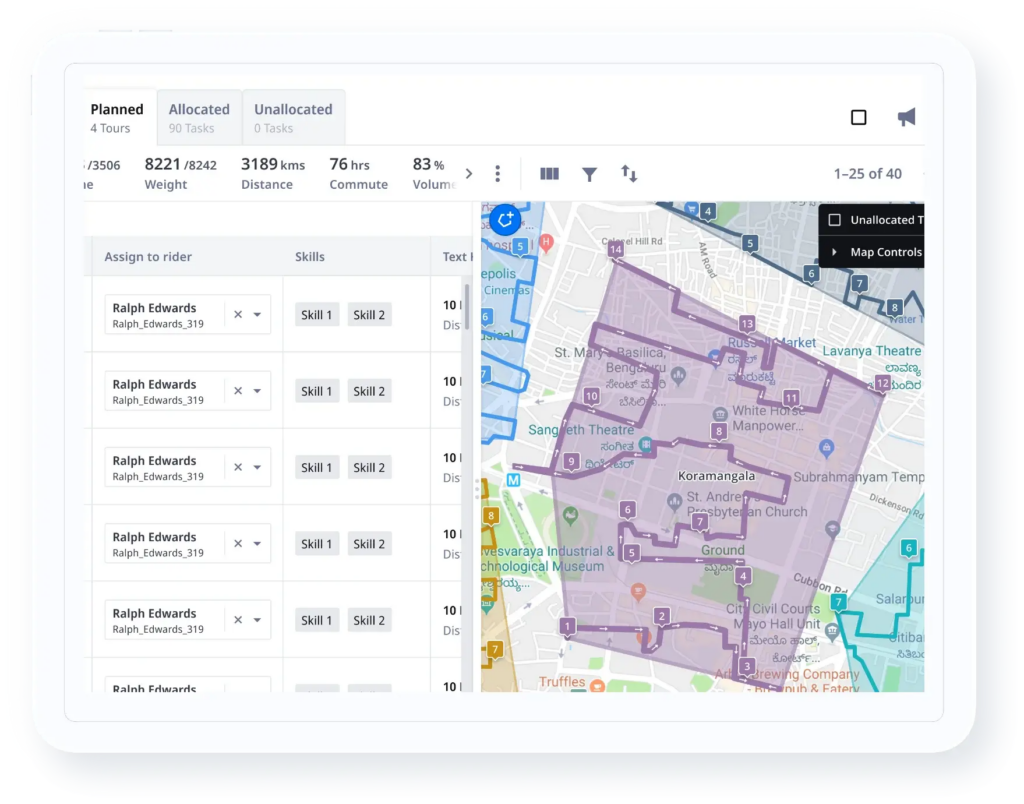
Locus automates decision-making across the delivery operation and plans routes against 250+ real-world constraints, and the important part is that it optimizes cost, time, and service levels against that same constraint set at once. Because the objective is multi-dimensional rather than cost-only or speed-only, the system finds plans that are efficient on cost and time together, which is exactly the large middle-ground gain described above, rather than trading one for the other. Automating the dispatch decision compresses planning and removes the manual overhead; orchestrating carrier selection weighs cost and service level together rather than defaulting to one; and re-optimizing in real time when exceptions arise protects both cost and promised times through the day. And because the optimization is objective-driven, an operator can set the target and segment fast and economy lanes deliberately, instead of accepting a single compromise. This is the model Locus runs at large scale across enterprise last-mile operations, and its effect is to move an operation toward the frontier on both axes at once before any genuine trade-off has to be made.
Also Read: How to Evaluate a Modern TMS in 2026: A Practical RFP Framework for US Enterprises
What This Means for Your Operation
If your operation treats cost and speed as opposites, the first thing to change is the framing. Most of the available gain is not on the trade-off at all; it is in the waste that is costing you both, loose routes, failed first attempts, slow planning, and plans that do not react. Target those levers first, because they pay back on cost and delivery time simultaneously and require no sacrifice.
Only once that waste is gone do you reach the real trade-off, and even then the move is to optimize to the frontier and segment your lanes, not to accept one compromise for every order. Cost and speed are opposites only at the edge. For most operations, most of the time, the fastest route to lower cost is also the fastest route to faster delivery.
Learn more, visit locus.sh.
Frequently Asked Questions (FAQs)
Can you cut last-mile cost and delivery time at the same time?
Yes, for most operations. Cost and speed trade off only at the efficient frontier. Most operations sit well inside it, losing both to the same inefficiency, so the same fixes, tighter routing, first-attempt success, automated dispatch, and real-time re-optimization, reduce cost and delivery time together without a sacrifice.
What is the single biggest lever for cutting both?
First-attempt delivery success. A failed first attempt is the most expensive and the slowest outcome at once: it costs roughly $17 per failed attempt to re-attempt (OrangeMantra) and delays the customer by a day or more. Raising first-attempt success removes an outcome that is maximally bad on both axes, so it pays back on cost and time more than almost any other move.
Why do cost and speed seem like a trade-off?
Because intuition comes from the extremes. A guaranteed two-hour delivery genuinely costs more than a consolidated next-day one, because speed forcibly consolidates. That is true at the frontier, but most operations are nowhere near it and are losing cost and time simultaneously to waste, where no trade-off applies.
Does faster delivery always cost more?
Only once an operation is already efficient. Below that point, faster and cheaper come together, because the same inefficiencies (loose routes, failed attempts, slow planning, stale plans) inflate both cost and time. Faster costs more only at the frontier, and even there segmenting fast and economy lanes beats one compromise setting.
How does automation cut both cost and time?
Manual planning consumes skilled labor (cost) and delays dispatch (time), and produces worse plans under pressure. Automating the dispatch decision removes the labor, compresses planning from hours to minutes, and produces tighter routes, so overhead falls, vehicles leave sooner, and execution is cheaper, one change improving cost, speed, and quality together.
How does Locus help cut last-mile cost and delivery time?
Locus optimizes routes against 250+ real-world constraints and, crucially, optimizes cost, time, and service together rather than one at a time, so it finds plans efficient on both. It automates the dispatch decision, orchestrates carrier selection on cost and service, and re-optimizes in real time when exceptions hit, protecting cost and promised times through the day.


General
Locus as a Last-Mile Delivery Platform: How it Drives Efficiency for 3PLs in 2026

Jul 15, 2026
For a 3PL, last-mile efficiency is the business model, not a line item. The challenges unique to 3PLs, and the frontier: orchestrating the shared operation.
Read more
General
Beyond the Courier: How Locus’s Dispatch Intelligence Outperforms Traditional Models in 2026
Jul 15, 2026
Manual dispatch, static zones, and the courier model share one limit: they can't adapt. Why dispatch intelligence is a different model, not faster software.
Read moreInsights Worth Your Time


















How Locus Helps Logistics Companies Cut Last-Mile Costs and Delivery Times in 2026