


General
Delivery Slot Optimization Software Buyer’s Guide: What to Evaluate Before You Shortlist in 2026

Key Takeaways
- Two products are sold as delivery slot optimization: slot presentation, which displays and books windows, and slot feasibility, which decides which windows to offer at all. Most buyers want the second and shortlist the first.
- The test that separates them is whether the slot list changes with what has already been booked and what the route can absorb, or is a fixed grid with a counter.
- No vendor can run a full route optimization inside a checkout call. Every real slot engine approximates, and the buyer’s question is which approximation and how often it refreshes.
- Capacity awareness is necessary and not sufficient. Density awareness is what makes a slot profitable rather than merely possible.
- The slot engine sits between commerce and operations, giving it two integration surfaces and usually two internal owners. Deployments stall on that boundary more often than on functionality.
- A slot sold and not held is worse than a slot never offered, so evaluate what happens between booking and dispatch as closely as what happens at checkout.
Two products, one name
Search for delivery slot optimization software and you will get two categories of product presented in the same language.
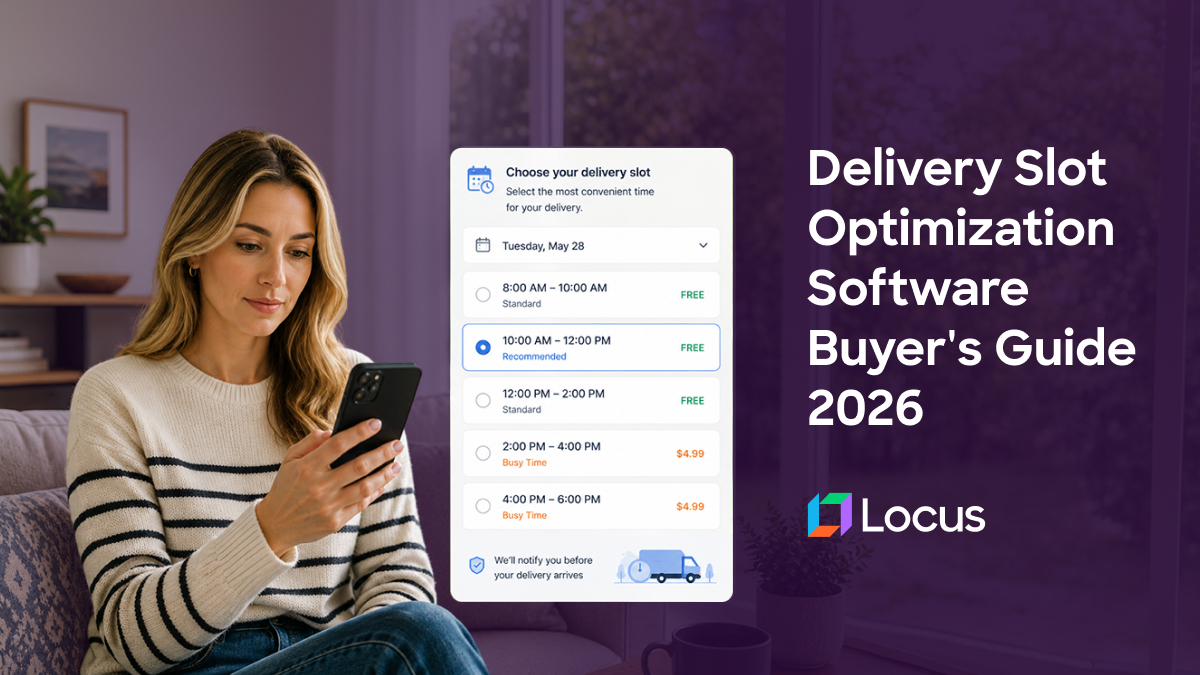
The first is slot presentation and booking. It renders available windows at checkout or in a self-service portal, takes the customer’s selection, holds a calendar, sends confirmations, and handles reschedules. It is a commerce-side capability and the good ones are genuinely good at it: clean interfaces, high conversion, solid notification flows.
The second is slot feasibility. It decides which windows should appear in the first place, based on what the operation can actually deliver against real capacity, existing bookings, geographic density, vehicle attributes, and the constraints that will apply on the day. It is an operations-side capability and it determines whether the promise made at checkout is keepable.
These are not tiers of the same thing. They answer different questions and frequently come from different vendors. The problem is that buyers evaluate on the first and expect the second, because the demo of a booking widget is far more compelling than the demo of a feasibility engine, and the two look identical from the customer’s side until the day the promise breaks.
A booking tool with a static grid will happily sell eight two-hour windows in a postcode with capacity for three. Nothing in the interface objects, and nothing will object until dispatch the following morning, when someone has to decide which three customers get what they were promised.
Also Read: Time Slot Management: A Guide for Logistics Teams
The capability ladder
Five levels, and knowing which one a vendor operates at answers most of your evaluation questions at once.
Level 1: Static grid. A fixed set of windows offered everywhere, every day. Capacity is managed by whoever notices the problem. Suitable for low volume and predictable demand, and it does not survive growth.
Level 2: Capped grid. Windows carry booking limits, set manually per area or per day. This prevents gross oversell and cannot tell the difference between three easy bookings and three difficult ones.
Level 3: Capacity-aware. Availability derives from actual planned or forecast vehicle and driver capacity. The offer reflects what the fleet can do rather than what someone typed into a limit field.
Level 4: Density-aware. Availability accounts for whether a booking in this window groups efficiently with bookings already taken nearby. This is where slot software starts affecting cost per drop rather than only preventing failure, because a slot that is possible and isolated is expensive.
Level 5: Continuously re-feasible. Availability is re-derived as bookings arrive and as the operating day changes, and a slot already sold is re-verified rather than assumed. This is the level at which a promise made at 14:00 on Tuesday is still a promise on Thursday morning.
Most products marketed as optimization sit at Level 2 with a well-designed front end. The jump that costs money and delivers most is from 2 to 4.
The checkout latency constraint every vendor has to solve
This is the technical fact that should shape your questions, and it is rarely discussed openly.
A checkout page cannot wait. The slot list has to render in a few hundred milliseconds, because every additional second of delay costs conversion. A full vehicle routing computation across a day’s orders takes considerably longer than that, and it cannot be run synchronously while a customer waits.
So every slot engine that claims real-time optimization at checkout is doing one of four things, and each has different consequences.
Precomputing. Feasibility is solved periodically and cached, then served instantly. Fast and accurate at the moment of computation, progressively less accurate as bookings accumulate between refreshes. The buyer’s question is the refresh interval.
Approximating. A lightweight heuristic estimates whether a booking fits, without solving the full problem. Fast and directionally sound, and it will accept some bookings that turn out to be infeasible. The question is the error rate and what happens to the exceptions.
Reserving against a budget. Capacity is divided into buckets and bookings consume budget. Fast and robust, and blind to density, so it prevents oversell without improving cost.
Deferring. The slot is offered provisionally and confirmed later, after a proper solve. Accurate and it moves the customer experience problem downstream to a confirmation that may disappoint.
None of these is wrong. The answer you should be worried about is a vendor who does not recognize the constraint, because it means either the engine is not doing what the marketing says or nobody on the call knows how it works.
Also Read: Route Optimization Software: Dynamic Re-Routing 2026
Seven things to evaluate
Feasibility source. Where availability comes from: a configured limit, a capacity forecast, or a solve against the actual plan. This is the first question and it determines the ceiling on everything else.
Refresh behavior. How availability changes as bookings arrive, and whether an already-sold slot is re-verified before dispatch. Ask for the refresh interval as a number.
Density economics. Whether the engine can price or steer based on how well a booking groups with existing orders. A slot that is feasible and isolated is the most expensive delivery you will make that week.
Demand steering. Whether you can influence customer choice toward cheaper windows through pricing, incentives, or presentation order, and whether the steering logic is yours to configure.
Constraint depth. Vehicle type and access restrictions, two-person delivery, installation or assembly time, temperature, and dwell time by product or property type. Slot software that models only time and postcode will fail on big and bulky, grocery, and service-attached deliveries.
Commitment handling. What happens between booking and dispatch. Whether the slot is held against capacity, what triggers a re-check, and what the recovery flow is when a held slot becomes infeasible.
Failure recirculation. When a slot fails, whether the freed capacity returns to the offer pool automatically or requires manual release. This is a small feature that quietly determines utilization.
Three categories of slot software compared
| Dimension | Booking front end | Scheduling module in a WMS or OMS | Slot feasibility engine |
|---|---|---|---|
| Primary strength | Customer experience and conversion | Sits close to order and inventory data | Availability derived from operational capability |
| Where availability comes from | Configured grid or API call to something else | Configured limits, sometimes capacity | Capacity, density, and constraints |
| Density awareness | None | Rare | Yes |
| Demand steering | Presentation only | Rarely | Pricing and incentives |
| Re-verifies a sold slot | No | Rarely | Yes |
| Typical failure mode | Sells slots the operation cannot serve | Prevents oversell, ignores cost | Requires real integration work |
| Best used as | The layer in front of a feasibility engine | Adequate for stable, low-complexity operations | The engine the front end calls |
The useful conclusion is that the first and third columns are complements rather than alternatives. A strong booking experience calling a weak feasibility source is the most common enterprise configuration and the one that produces broken promises at scale. If you already own a good front end, the gap you are shopping for is the engine behind it.
Where the slot engine has to sit
Slot optimization is architecturally awkward in a way that catches deployments out, and it is worth understanding before procurement rather than during.
The engine needs order and customer data from commerce, capacity and constraint data from operations, and it has to answer synchronously to a checkout call while also feeding the routing solve that runs later. That gives it two integration surfaces pointing in opposite directions and a latency requirement inherited from the most impatient system in the stack.
It also usually gives it two owners. E-commerce owns checkout and is measured on conversion. Operations owns capacity and is measured on cost and service. A slot engine that narrows availability improves the second metric and can harm the first, which means the configuration itself is a commercial negotiation rather than a technical setting.
Name the owner of slot policy before selecting a vendor. Deployments that skip this arrive at go-live with e-commerce widening windows for conversion and operations tightening them for feasibility, adjusting the same parameters in opposite directions.
Also Read: Delivery Promise Management Software: ETAs, Slots and Recovery
Build, buy, or extend what you have
Three routes, and the right one depends less on budget than on where your complexity actually sits.
Build. Reasonable if your constraint set is genuinely unusual and your volumes justify the engineering. The trap is that a first version handling capacity is achievable in a quarter, and density awareness, re-verification, and constraint depth are what take years. Most in-house slot engines stop permanently at Level 3.
Buy a dedicated slot product. Appropriate where slot booking is a distinct customer-facing proposition and the operational side is comparatively simple. Verify the feasibility source rather than the interface, since the interface is what the product is selling.
Extend the platform that already plans your routes. Usually the strongest option when the operation is complex, because feasibility is a routing question wearing a commerce interface. The engine that knows your constraints, capacity, and density already exists in your planning system, and the work is exposing it to checkout rather than rebuilding it elsewhere.
On pricing, expect per-order or per-slot-served models from dedicated products and module or platform pricing where slotting extends an existing system. The number that matters is not the license. It is the integration effort and who maintains the connection between checkout and capacity after go-live.
Also Read: 10 Best Delivery Scheduling Software for Enterprises
Questions for the demo
Eight questions, in the order that saves the most time.
- Where does the availability shown at checkout come from, specifically.
- What is the refresh interval, and what happens to accuracy between refreshes.
- Show me a slot being withdrawn because bookings elsewhere consumed the capacity.
- Can the engine distinguish a booking that groups well from one that strands a vehicle.
- What can I configure about which slots are shown first, and at what price.
- Is a sold slot re-verified before dispatch, and what triggers the re-check.
- When a slot fails, does the capacity return to the offer pool automatically.
- Which of your reference customers has our constraint profile, not our order volume.
The third question is the one that reveals the most. A vendor at Level 2 will show you a limit being reached. A vendor at Level 4 will show you availability changing shape because the geography changed.
What to measure after go-live
Slot adherence. Deliveries completed inside the window the customer selected, measured against the window shown rather than a wider internal tolerance.
Cost per drop by slot type. Split by window width and by time of day. This is how you find out which slots you are selling below cost.
Slot utilization against offered capacity. Offering less and filling it is usually better economics than offering more and failing.
Reschedule and failure rate by slot. Concentrated failure in specific windows or areas is a feasibility problem rather than an execution problem, and it points at exactly which parameter is wrong.
Also Read: 7 Best Large and Bulky Item Courier Delivery Software 2026
How Locus approaches slot feasibility
Locus, the world’s first Decision-Intelligent, Agentic TMS, treats the slot offered at checkout as an output of the same decision system that plans the route, rather than as a separate calendar that operations discovers later. Its DiSCO framework, the Digital Supply Chain Officer, runs specialized agents across the lifecycle, with the Dispatch and Capacity agents holding the plan and the roster as live state, and the Orchestrator keeping them aligned on a continuous Sense-Decide-Execute-Learn cycle against a model of more than 250 real-world constraints.
Two elements are directly relevant to this evaluation. Delivery Linked Checkout brings feasibility and economics to the point of selection, and it includes the demand-steering capability described above: incentivizing customers toward less-sought windows through dynamic pricing, which improves fleet utilization rather than only preventing oversell. And because availability derives from the same constraint model that will govern the delivery, the slot shown reflects vehicle attributes, access restrictions, dwell, and driver hours rather than a configured limit that approximates them.
Locus has processed more than 1.5 billion deliveries for 360-plus enterprise customers across 30-plus countries at 99.99% uptime. It is recognized by Gartner for seven consecutive years, featured in the 2026 Hype Cycle for Supply Chain Execution and Logistics Technologies, named a Leader in TMS by QKS Group (SPARK Matrix), and ranked #1 in Route Planning on G2’s 2026 Best Software Awards. In October 2025, Ingka Investments, the investment arm of Ingka Group, the world’s largest IKEA retailer, acquired Locus. Locus continues to operate independently. Further analyst recognition is published in full.
Two deployments show slot-shaped problems at different ends of the difficulty range.
A grocery brand delivering across more than 30 cities moved fresh and perishable orders to homes through contracted 3PL carriers. Grocery is the hardest slot environment there is: narrow windows, perishable goods that make a missed slot a write-off rather than an inconvenience, and a third-party fleet whose capacity the brand does not directly control. Orchestrating that network through one layer produced 33% faster deliveries and 15% lower fulfillment cost, with customer support resolution 10 to 20 times faster.
A global field service operation across more than 25 US states scheduled appointment windows against technician skills, per-jurisdiction contracts, differing labor rules, and SLA commitments, in an environment where the internal assessment was that even a well-built plan went stale within the hour. This is slot feasibility with constraint depth as the dominant factor rather than density: the window offered has to account for who is qualified to do the work. SLA penalty risk fell 20%, fuel spend 18%, and drive distance and time 15%.
Request a Locus delivery slot feasibility assessment to test your current availability logic against real capacity and density, and to establish where slots are being sold below cost.
Start with one postcode
Before shortlisting anything, run a test that takes an afternoon and costs nothing.
Pick one postcode and one day next week. Note every slot your checkout currently offers. Then ask your planning team how many of those slots the operation could actually serve if all of them sold, and what each would cost.
If the number of sellable slots is materially lower than the number offered, you are not shopping for a booking interface. You are shopping for a feasibility engine, and the interface you already have is probably fine.
Frequently Asked Questions (FAQs)
What is delivery slot optimization software?
Software that determines which delivery windows to offer a customer and manages the booking of those windows. The term covers two distinct capabilities: slot presentation, which displays and books available windows, and slot feasibility, which decides which windows should be offered based on real capacity, existing bookings, geographic density, and operational constraints. Buyers usually want the second and evaluate on the first, because a booking interface demonstrates more easily than a feasibility engine.
How do you tell real slot optimization from a booking calendar?
Ask to see a slot being withdrawn because bookings elsewhere consumed the capacity that would have served it. A booking calendar with limits will show a counter reaching a configured maximum. A feasibility engine will show availability changing shape as the geography of accepted orders changes, because it is evaluating whether a new booking can be served alongside the ones already taken rather than counting against a number someone typed in.
Can delivery slots be optimized in real time at checkout?
Not by running a full route optimization, because checkout has a latency budget of a few hundred milliseconds and a complete solve takes far longer. Every slot engine therefore approximates: precomputing and caching feasibility, using a lightweight heuristic, reserving against capacity buckets, or offering provisionally and confirming later. All four are legitimate. The evaluation question is which approach a vendor uses and how the accuracy degrades between refreshes.
Should you build or buy delivery slot optimization?
Build where the constraint set is genuinely unusual and volumes justify sustained engineering, accepting that most in-house engines plateau at capacity awareness and never reach density awareness or re-verification. Buy a dedicated product where slot booking is a distinct customer proposition and operations are relatively simple. Extend your existing routing platform where the operation is complex, since feasibility is fundamentally a routing question and that engine already holds your constraints.
Who should own delivery slot policy?
It needs a single named owner before vendor selection, because slot configuration is a commercial trade rather than a technical setting. E-commerce is measured on conversion and will widen windows. Operations is measured on cost and service and will narrow them. Without an owner holding both, both teams adjust the same parameters in opposite directions after go-live, and the platform gets blamed for the resulting instability.
What metrics show whether slot optimization is working?
Slot adherence measured against the window the customer actually selected rather than a wider internal tolerance, cost per drop split by window width and time of day, slot utilization against offered capacity, and reschedule or failure rate broken out by slot and area. Concentrated failure in particular windows indicates a feasibility problem rather than an execution problem, and identifies which parameter is misconfigured.

General
TMS Integration: How Enterprise Logistics Teams Connect, Orchestrate, and Scale

Oct 16, 2026
Learn how TMS integration connects dispatch, routing, and visibility across your logistics stack. See what separates basic sync from AI-powered orchestration.
Read moreInsights Worth Your Time



















Delivery Slot Optimization Software Buyer’s Guide: What to Evaluate Before You Shortlist in 2026