


Logistics Management
How Freight Optimization Software Transforms Enterprise Logistics: From Cost Savings to AI-Driven Orchestration
Key Takeaways
- Most enterprises still plan freight manually, burning margin through empty miles, underutilized trailers, and reactive dispatching that compounds into measurable SLA exposure
- AI-powered freight optimization reduces fuel consumption by 15%, compresses delivery times by 30%, and improves fleet utilization by 45% compared to static planning approaches
- Freight optimization software is not a routing tool. Enterprise-grade platforms orchestrate loads, drivers, vehicle capacity, carrier selection, financials, and delivery constraints under unified AI logic
- Sustainability is no longer a side effect of efficiency. Route and load optimization directly reduces fleet carbon emissions, producing auditable data for Scope 3 ESG reporting
- Locus powers freight orchestration for global enterprises across retail, FMCG, e-commerce, and 3PL, processing millions of shipments across 30-plus countries
Most enterprises still plan freight the way they did a decade ago: manually, reactively, and at enormous hidden cost.
That cost accumulates across every shipment, but it does not appear on a single line of the P&L where it would be visible enough to act on.
Freight optimization software has become a crowded category, but there is a sharp line between tools that optimize individual routes and platforms that orchestrate entire freight networks end-to-end using AI route optimization.
This article breaks down how enterprise-grade freight optimization software reduces costs, improves delivery performance, and scales across complex supply chains.
What Freight Optimization Software Does at Enterprise Scale
Freight optimization software automates and orchestrates load assignment, route sequencing, carrier selection, and dispatch across high-volume freight networks. The textbook definition stops at route planning. The enterprise reality is substantially more complex.
At scale, a freight optimization platform has to hold multiple operational variables in simultaneous tension: vehicle capacity and payload type constraints, delivery time windows across hundreds of customer locations, driver shift hours and certification requirements, carrier rate contracts and SLA commitments, real-time traffic and weather conditions, and the financial cost of each routing and carrier selection decision.
Static planning tools handle these variables sequentially, applying one constraint layer after another until a workable plan emerges. AI-driven orchestration platforms process them simultaneously, finding solutions that sequential logic cannot reach.
The distinction matters because the interaction effects between these variables are where enterprise cost lives.
A route that passes the capacity check but ignores the time-of-day traffic pattern produces driver overtime. A carrier assignment that meets the rate target but misses the SLA window generates a penalty charge. Freight optimization software that handles each constraint in isolation leaves money on the table at every decision point.
The Real Cost of Running Freight Operations Without Optimization
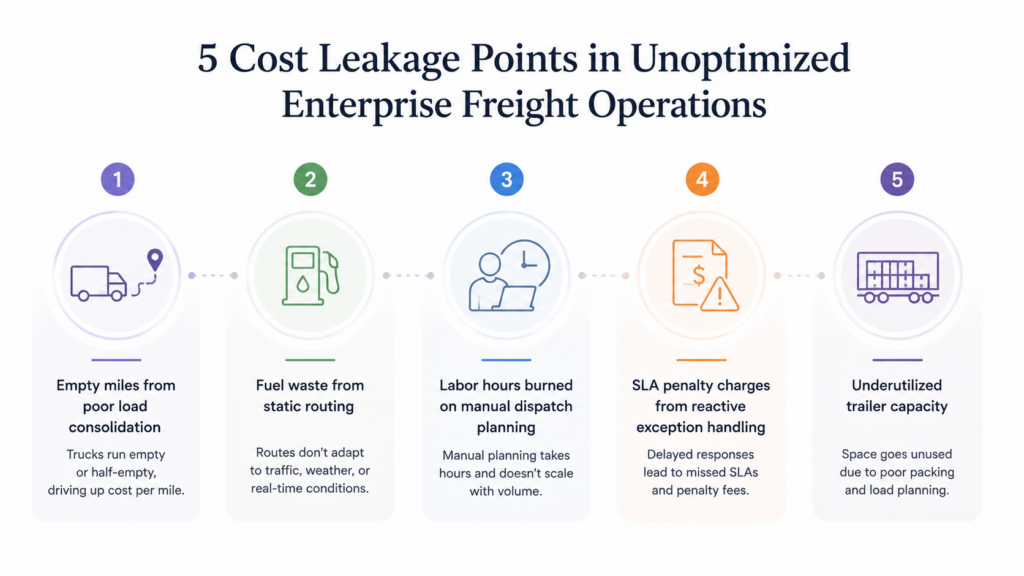
The cost of manual or rule-based freight management distributes across fuel, labor, carrier penalties, and failed delivery costs in ways that feel like operational variance.
| Cost category | How it accumulates without optimization | Scale of impact |
|---|---|---|
| Empty miles | Vehicles return from delivery runs without backhaul loads because matching is manual and rarely completed before departure. | Empty miles add 10-15% to fuel cost per vehicle. Across a fleet of 200 vehicles, that is a direct and recurring margin loss. |
| Underutilized trailers | Load consolidation requires coordination across orders, vehicle types, and destinations that rules-based tools cannot automate at high volume. | Trailer fill rates below 80% mean you are paying for capacity that is not generating revenue on every run. |
| Reactive dispatch | When a vehicle breaks down or a priority order arrives mid-shift, manual dispatching produces suboptimal reallocations built on incomplete data. | Each manual exception takes 15 to 30 minutes of dispatcher time. At 50 daily exceptions across a fleet, that is a full-time role dedicated to work that should be automated. |
| Fuel waste from static routing | Route plans built at 6 AM on yesterday’s traffic assumptions generate unnecessary mileage throughout the day as conditions change. | Manual routing inflates fuel costs by 10-15% compared to dynamic AI-optimized routing. |
| SLA penalty exposure | Missed delivery windows in contract logistics generate direct penalty charges that do not appear in routing cost but hit the P&L in carrier invoicing. | Failed deliveries average $17.20 per package. At 1,000 daily deliveries with a 3% miss rate, that is over $500 in avoidable daily cost. |
How AI-Powered Freight Optimization Reduces Transportation Costs
Cost reduction in freight optimization comes from four specific mechanisms. Each operates differently, and each compounds the effect of the others when they run in an integrated platform rather than separate tools.
Fuel consumption reduction through dynamic routing
Enterprises using AI-driven freight optimization report reductions in fuel consumption across fleet operations. The mechanism routes that account for real-time traffic conditions, vehicle load weight affecting fuel efficiency at different speeds, and stop sequencing that minimizes unnecessary acceleration and braking cycles.
Static planning captures none of these variables. AI-native routing captures all of them simultaneously.
Empty-mile reduction through backhaul matching
Intelligent backhaul matching connects return-leg capacity to inbound shipment demand in real time.
AI freight optimization platforms cross-reference available return-leg capacity against pending pickups automatically at dispatch, compressing the empty-mile ratio across the fleet without adding coordination headcount.
Vehicle allocation right-sizing
AI dispatch engines match order profiles to vehicle capacity constraints at the load level.
A shipment that can be consolidated with a compatible co-load reduces the per-unit vehicle cost. A delivery that does not require a full trailer gets assigned to a vehicle type that fits the load profile rather than defaulting to excess capacity.
Across thousands of daily shipments, these allocation decisions aggregate into measurable reductions in vehicle-hours per unit shipped.
Carrier selection and rate optimization
Automated carrier tendering and selection through Locus’s ShipFlex network uses real-time rate data, historical SLA performance, and current capacity availability to assign shipments to the optimal carrier relationship. It draws on pre-integrated access to 160+ carriers within a broader ecosystem of 1,000+.
For enterprises managing 50+ carrier relationships, this optimization layer delivers a 10% reduction in transportation costs without requiring contract renegotiation.
Driving Fleet Efficiency Beyond Route Planning
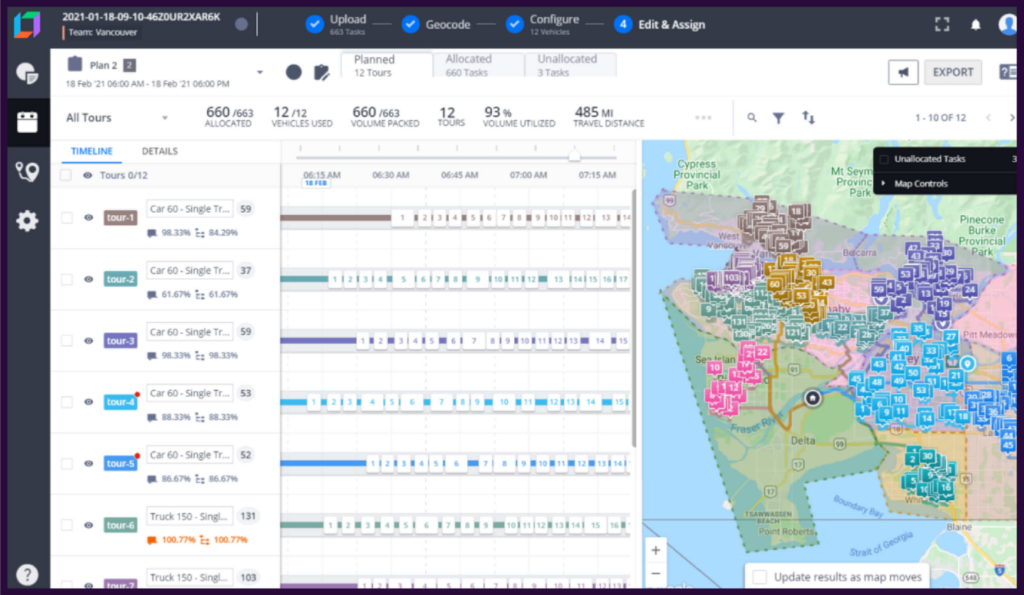
Route optimization is the entry point. Enterprises that have moved from manual planning to algorithmic routing have captured the first layer of efficiency.
The platforms delivering the most significant operational gains have moved past routing into full freight orchestration: zero-touch planning across the entire order-to-delivery chain.
The increase in average deliveries per vehicle that AI-powered freight optimization produces does not come from faster routes alone. It comes from automated route planning that continuously rebalances loads across the active fleet as orders change throughout the shift, stop clustering that eliminates redundant mileage across overlapping service zones, and load consolidation logic that groups compatible shipments before dispatch.
Routing efficiency at enterprise scale is the aggregate of hundreds of individual decisions that a static planning tool handles suboptimally or not at all.
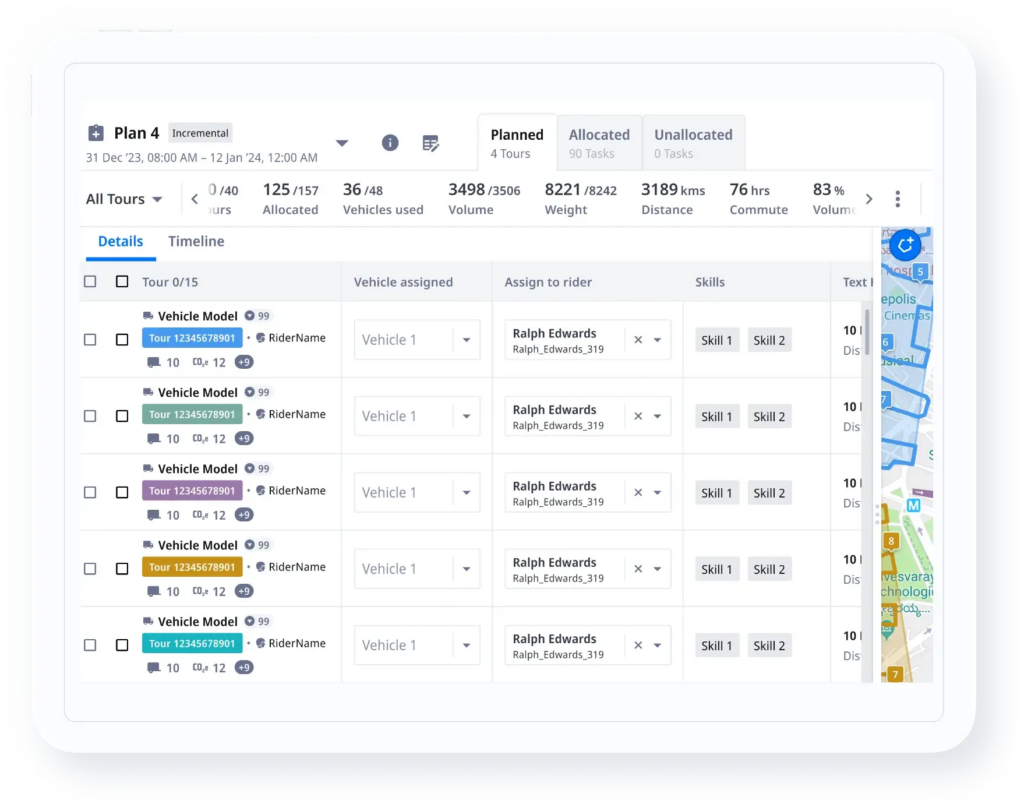
Zero-touch dispatch planning takes this further. When AI handles end-to-end assignment from order intake to driver allocation, dispatchers shift from building plans to reviewing exceptions. Planning cycles that take three hours manually complete in under five minutes. Driver assignments that require coordinator input at each step execute autonomously.
For enterprises managing multi-hub, multi-fleet operations, the labor cost reduction alone justifies the platform investment before the routing efficiency gains are calculated.
On-Time Delivery Performance and Customer Experience Impact
Freight optimization’s cost reduction benefits are well-documented. The customer experience impact is less frequently quantified, which is where the competitive differentiation for retail, e-commerce, and FMCG enterprises actually lives.
AI freight platforms offer real-time rerouting around disruptions that static plans cannot absorb: a road closure that invalidates 12 stops on a planned sequence, a vehicle breakdown that requires immediate reallocation of 40 pending deliveries, a priority order that needs to be inserted into an active run without invalidating every subsequent commitment.
Locus’s Mycroft AI Co-Pilot handles disruption detection and resolution autonomously within configured governance boundaries, surfacing rerouting options and exception flags to dispatchers before manual intervention becomes necessary.
When an automated tracking system connects these real-time route adjustments to customer-facing ETA updates, the delivery experience shifts from unpredictable to reliable.
For retail and FMCG operations, this reliability is a retention lever. Customers who receive accurate ETAs and proactive exception notifications when conditions change have materially lower complaint rates than those receiving static delivery windows.
Real-time communication in delivery fulfillment requires the freight platform to produce continuously updated ETAs from its live route model, not distance-based estimates that become inaccurate within hours of dispatch.
See how Locus delivers on-time delivery performance at enterprise scale.
Schedule a demo to run AI freight orchestration against your actual carrier network and delivery volumes.
Sustainability and Emissions Reduction as a Strategic Outcome
Sustainability in freight optimization is a direct output of the same decisions that reduce cost. Every mile eliminated through better route sequencing is fuel not burned. Every empty-mile reduced through backhaul matching is an emissions event that did not happen. Every trailer fill rate improvement is a vehicle trip that did not need to occur.
Measurable emissions outcomes
- Route and load optimization delivers 15+ percent reductions in fleet carbon emissions proportional to fuel savings
- Across Locus deployments, enterprises have offset 17 million+ kilograms of CO2 and reduced 800 million+ miles of unnecessary driving
- Per-route, per-carrier, and per-lane carbon data is available from the optimization engine without a separate emissions accounting integration
ESG reporting requirements
Enterprise logistics leaders in EU-regulated markets face binding Scope 3 emissions reporting requirements that extend to logistics operations.
Freight optimization software that produces auditable carbon-per-shipment data from its existing routing and load model satisfies this requirement natively. Platforms that do not track emissions at the decision level require manual calculation or third-party audit tools, adding cost and complexity to a compliance obligation that is becoming non-negotiable.
Integration, Scalability, and Future-Proofing Your Freight Stack
Freight optimization software that operates in isolation from the existing enterprise technology stack creates a new coordination burden.
The optimization model needs real-time order data from the OMS to plan loads accurately. It needs inventory availability from the WMS to confirm what is ready to ship. It needs carrier rate data from the transport management system (TMS) to make cost-optimal allocation decisions. And it needs to push execution events back to ERP systems for financial settlement.
Integration requirements for enterprise deployment
- OMS and ERP connectivity for real-time order data, load confirmation, and financial settlement
- WMS integration for inventory availability and warehouse staging status at the dispatch decision point
- TMS and carrier EDI or API feeds for rate data, capacity availability, and tracking normalization across carriers
- Telematics providers for owned fleet GPS, vehicle health signals, and driver hour tracking
API-first architecture with prebuilt connectors matters because freight networks change. Carrier relationships are added and discontinued. New geographies require new last-mile partners.
Supply chain network design decisions for FMCG and retail enterprises flow from the route and cost data that a well-integrated freight platform surfaces. Depot placement, territory structure, and carrier mix decisions become data-driven when the platform connects freight performance data to network-level cost analysis.
Scalability under peak load
Enterprise freight operations face 5-10x volume surges during peak seasons, promotional events, and flash-sale periods in SEA markets.
A freight optimization platform that performs at average daily volume but degrades under peak load is not enterprise-grade for seasonal operations. The relevant test is planning cycle time and re-optimization capability at maximum expected load. Locus maintains sub-five-minute optimization cycles at 100,000+ daily orders across enterprise deployments.
Predictive analytics and continuous improvement
AI models in mature freight optimization platforms improve over time as they ingest historical shipment data.
Delivery patterns at specific customer locations, carrier performance on specific lanes, seasonal demand curves, and driver performance by route type all feed into predictive models that improve the accuracy of future planning cycles.
What to Evaluate When Selecting Freight Optimization Software
Five evaluation criteria separate enterprise-grade freight optimization platforms from tools that will require replacement within two years:
| Criterion | What to look for | Red flag |
|---|---|---|
| AI and ML sophistication | Dispatch and routing built on ML with a documented learning loop. Simultaneous constraint processing across loads, vehicles, carriers, and financials. Ask for a live mid-shift disruption scenario, not a feature walkthrough. | “AI-powered” in marketing with no explanation of the underlying mechanism or evidence that the model improves from delivery outcomes. |
| Real-time adaptability | Demonstrated re-optimization during execution: how the platform responds to a vehicle breakdown, a priority order injection, or a route closure mid-shift without dispatcher intervention. | The system surfaces an alert and waits for a dispatcher to decide. Exception resolution is manual regardless of how it is marketed. |
| Load and dispatch orchestration depth | Platform handles FTL, LTL, parcel, and cross-docking scenarios across carrier types. Backhaul matching, load consolidation, and trailer fill optimization run automatically rather than requiring manual coordinator input. | Route optimization is the primary capability. Load-level orchestration requires manual input or a separate system. |
| Integration flexibility | Prebuilt connectors for your specific ERP, WMS, OMS, TMS, and carrier systems. API-first architecture with a configurable workflow engine that operations teams can update independently. | “Open API” with no named connectors for the platforms you run. Every new carrier or OMS integration requires a professional services engagement. |
| Measurable ROI benchmarks | Quantified outcomes from comparable verticals: fuel savings, delivery time reduction, fleet utilization improvement, planning labor reduction. Reference customers who can validate these figures at your scale. | Directional efficiency claims with no attribution to specific operational mechanisms or validated customer deployments. |
Locus has delivered enterprise freight optimization deployments across North America, Europe, Southeast Asia, India, and the Middle East, with documented outcomes across retail, FMCG, e-commerce, and 3PL verticals.
The Decision-Intelligent, Agentic Transportation Management System (TMS) processes 250+ transportation constraints simultaneously at each planning cycle and has powered over 1.5 billion deliveries globally, delivering more than $320 million in logistics cost savings.
Recognized across three independent analyst benchmarks: G2 #1 in Route Planning (2026 Best Software Awards), Gartner Market Guide for Last-Mile Delivery Technology for 5 consecutive years, and SPARK Matrix TMS 2025 Leader.
In October 2025, Ingka Group, the world’s largest IKEA retailer, acquired Locus, providing enterprise-grade stability for long-term platform commitments. Locus continues operating independently.
Schedule a Locus demo to see how AI freight orchestration performs against your specific network, carrier mix, and volume requirements.
Frequently Asked Questions (FAQs)
1. How does freight optimization software differ from a standard transportation management system (TMS)?
A standard TMS focuses on freight procurement, carrier rate management, and middle-mile shipment tracking. Freight optimization software is primarily concerned with optimizing how freight is planned, loaded, routed, and dispatched, with AI-driven algorithms that factor in real-time constraints. Modern enterprise platforms increasingly converge both functions, but freight optimization software is purpose-built for decision-making at the load and route level, while traditional TMS handles the commercial and contractual freight management layer.
2. What ROI can enterprises realistically expect from implementing freight optimization software?
Enterprise freight optimization delivers ROI across five measurable dimensions: 15% reduction in fuel consumption through dynamic routing, 10% reduction in transportation costs through automated carrier optimization, 30% reduction in delivery times through real-time re-optimization, 45% improvement in fleet utilization, and measurable reduction in failed delivery costs through accurate ETAs and proactive exception handling. The combined ROI over a 12-month deployment typically exceeds the annual platform cost for operations running 1,000+ daily shipments.
3. How does AI-powered freight optimization handle real-time disruptions like traffic, weather, or vehicle breakdowns?
AI-powered platforms recalculate route sequences and carrier assignments across the full active fleet when any condition changes. When a vehicle breaks down mid-shift, the system identifies available capacity, calculates the optimal reallocation of affected loads, executes the reassignment, and updates ETAs across all impacted deliveries automatically. The dispatcher reviews the outcome rather than making the reallocation decision. This is the operational difference between a platform that surfaces disruptions and one that resolves them.
4. How long does it typically take for an enterprise to implement and see results from freight optimization software?
Core implementation timelines for enterprise freight optimization deployments run 8 to 16 weeks, depending on depot count, carrier relationship complexity, and integration points with existing ERP, WMS, and OMS systems. Platforms with prebuilt connectors for major enterprise systems deploy faster than those requiring custom middleware.
5. Can Locus support multimodal freight operations across different geographies?
Yes, Locus can support FTL, LTL, parcel, and cross-docking scenarios across carrier types and geographies from a single dispatch interface. Multi-geography support requires geocoding accuracy for the specific markets you operate in, compliance framework for cross-border documentation, and carrier integration depth that covers regional 3PL partners alongside national carriers. Locus operates across 30+ countries with prebuilt integrations for 1,000+ carriers and 3PL partners, covering the Americas, Europe, Southeast Asia, India, and the Middle East.


Fleet Management
What Enterprise Teams Actually Need From Delivery Fleet Management Software

May 15, 2026
Explore what enterprise delivery fleet management software must deliver: AI route optimization, real-time visibility, driver performance management, and measurable ROI.
Read more
General
National, Expatriate, Gig: A Workforce-Mix-Aware Territory Architecture for GCC Last-Mile Operations

May 15, 2026
National, expatriate, gig workforce compositions change the territory math in GCC delivery operations. A workforce-mix-aware architecture framework for 2026.
Read moreInsights Worth Your Time



















How Freight Optimization Software Transforms Enterprise Logistics: From Cost Savings to AI-Driven Orchestration