


Delivery Management
What Enterprise Teams Should Expect From Courier Tracking Software in 2026
Key Takeaways
- Most courier tracking software was built for single-carrier or SMB operations. Multi-region, multi-carrier enterprise logistics exposes its limits within weeks of deployment
- Real-time tracking in an enterprise context means contextual operational intelligence, not GPS dots. ETAs, SLA risk flags, geofence events, and driver behavior signals all feed into dispatch decisions
- AI-powered dispatch and dynamic route re-optimization are not features of courier tracking software. They are what separates courier tracking software from logistics orchestration
- Locus combines real-time courier tracking, AI dispatch, dynamic route optimization, and end-to-end supply chain visibility in a single enterprise platform
Enterprise logistics teams often struggle with tracking tools that were not built for the complexity they actually operate in.
Thousands of daily dispatches across multiple carriers, geographies, and SLA tiers expose the limits of software designed for simpler operations fast. The GPS dot is visible. The operational intelligence is not.
This article breaks down what courier tracking software must deliver at enterprise scale: from AI-powered dispatch and dynamic route optimization to end-to-end supply chain visibility. It draws on Locus’s experience powering logistics orchestration for global retail, FMCG, and 3PL operations, where tracking is one layer of a much larger operational challenge.
Why Most Courier Tracking Software Falls Short at Enterprise Scale
The courier tracking software market is large and largely optimized for the wrong buyer. Most platforms in this category address the core use case of a small courier operation: assign a driver, share a tracking link, capture a signature. That scope is sufficient for businesses dispatching a few hundred orders per day with one or two carrier relationships.
Enterprise operations break this model along three fault lines:
- Fragmented visibility across carrier systems: Each 3PL partner and contracted carrier maintains its own tracking portal. Operations teams reconcile status updates manually across disconnected systems, often discovering exceptions only after customers have already called
- No operational intelligence behind the tracking layer: A GPS coordinate tells a dispatcher where a vehicle is. It does not tell them which upcoming stops are at SLA risk, which driver is running behind historical average, or which route segment is generating a pattern of delays
- Inability to intervene proactively: When a delivery is heading toward a missed window, basic tracking software surfaces the event after it happens. Enterprise operations need exception flagging with enough lead time to reroute, reassign, or notify the customer before the SLA is breached
Real-Time Tracking and GPS Monitoring That Goes Beyond a Pin on a Map
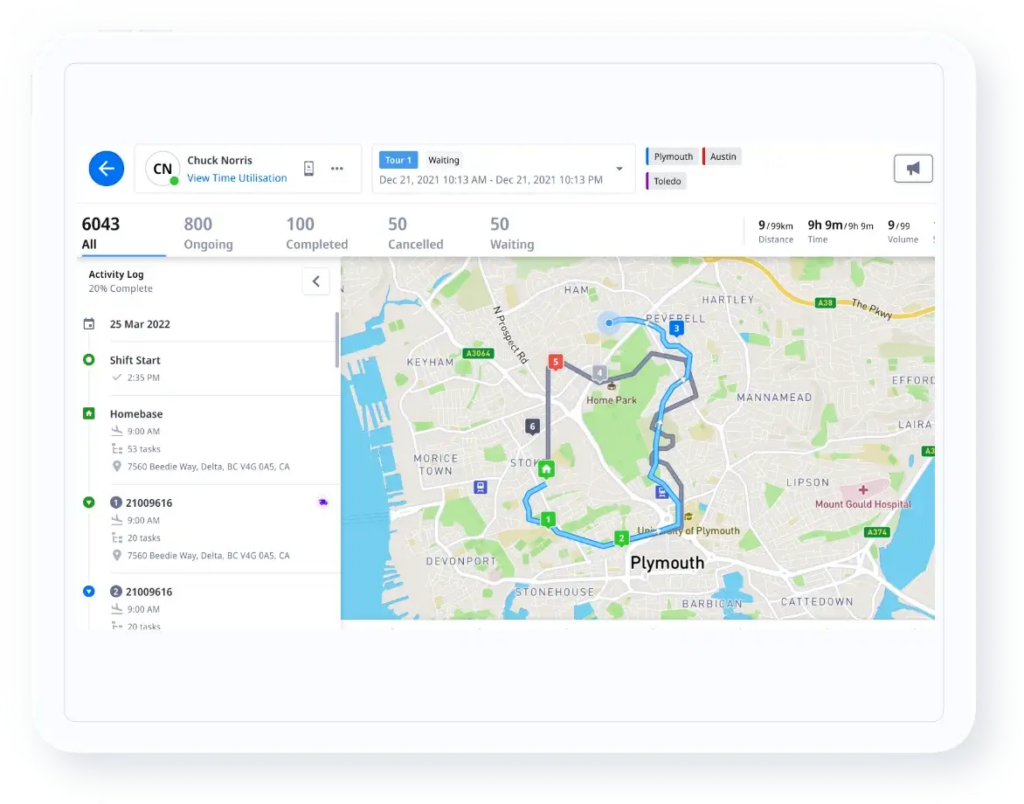
Real-time tracking in an enterprise context is an operational control layer. The distinction matters because a dispatch manager overseeing 500 active deliveries across a metro does not have time to click through individual vehicle pings. The platform needs to surface what requires attention, not just raw location data.
What enterprise-grade courier tracking delivers that basic tools do not:
- Contextual ETAs updated continuously: ML-driven arrival predictions that account for historical delivery times at specific stop types, time-of-day traffic patterns, and current route adherence
- Geofence-triggered status events: Automated milestone updates when a driver enters a customer’s delivery zone, departs a pickup point, or deviates from the planned corridor, without requiring manual driver input at each stage
- Driver behavior signals: Idle time, unplanned stops, and sequence deviations surfaced as operational data rather than discovered in end-of-day reports. Locus’s Mycroft AI Co-Pilot processes these signals continuously, flagging dispatcher-relevant exceptions autonomously and reducing the manual monitoring burden on operations teams
- SLA risk scoring across the active fleet: Deliveries ranked by probability of missing their window, with lead time calculated for each, giving dispatchers a prioritized intervention queue
An automated tracking system built for enterprise operations connects these signals across owned fleet and 3PL carriers simultaneously, normalizing data from different telematic systems and carrier APIs into a single operational picture.
AI-Powered Dispatch and Driver Assignment Orchestration
Assigning the nearest available driver to an incoming order is automation. Determining which driver, in which vehicle, on which current route, with which remaining capacity, can absorb a new order with the least disruption to existing SLA commitments across the full active fleet is orchestration. Most courier tracking software delivers the former and calls it AI.
What rules-based dispatch misses
- Zone-based assignment ignores vehicle capacity, cargo type compatibility, and driver certification requirements
- Round-robin allocation produces balanced assignment counts but not balanced operational outcomes
- A vehicle going offline mid-shift triggers a manual reassignment workflow rather than automatic reallocation
- New orders added after the morning dispatch run sit in a queue rather than flowing into the active plan
What Locus’s dispatch engine does instead
Locus’s dispatch management engine, DispatchIQ, processes vehicle capacity, driver shift hours, delivery priority tiers, historical driver performance on specific route types, and live traffic conditions simultaneously at each allocation decision. An order will be assigned to the driver whose remaining schedule accommodates it with the lowest SLA risk across all other active commitments.
This matters at scale because the interaction effects between thousands of simultaneous orders are what rules-based systems cannot model.
Locus customers achieve 66% faster planning cycles and a 30% reduction in turnaround time, with dispatchers spending time on exception management rather than on routine allocation decisions that the AI handles autonomously.
Dynamic Route Optimization as a Continuous Process
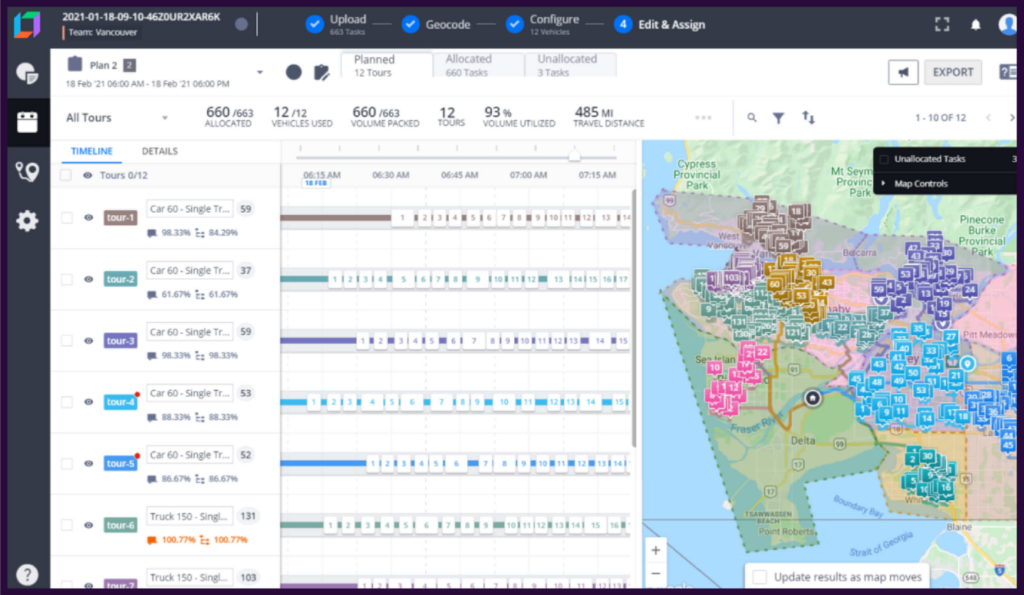
Calculating the most efficient route at 6 AM is the baseline. By 9 AM, that calculation is wrong. A road closure has added 20 minutes to one corridor. Three orders have been cancelled. A priority customer has escalated their delivery window. A new batch of 80 orders has arrived for same-day fulfillment.
Static route planning handled this through dispatcher phone calls. Enterprise courier tracking software needs to handle it automatically, recalculating the optimal sequence across the full active fleet within minutes of each change event.
The impact of continuous re-optimization
- Route sequences that complete faster than static plans because they account for current conditions rather than morning assumptions
- Fuel consumption reductions of 15-25% through better stop clustering and elimination of redundant mileage
- First-attempt delivery success rates that improve because accurate, updated ETAs reach customers before they miss the delivery window
- Carbon footprint reduction that is quantifiable per route, per carrier, and per delivery lane, supporting Scope 3 emissions reporting without a separate integration
Locus’s AI route optimization engine processes 250+ transportation constraints simultaneously at each planning cycle. Automated route planning at this fidelity is a continuous operational decision that adapts to every change in the delivery environment throughout the shift.
See how Locus’s route re-optimization performs against your active fleet size and order volume.
Schedule a Locus demo to run a live scenario against your delivery data.
Customer Notifications and Proof of Delivery: Building Trust at the Last Mile
WISMO inquiries account for approximately 40% of customer service volume in logistics operations, based on delivery experience benchmarks. The cost of each call is direct.
Loqate estimates the average cost of a failed delivery attempt at $17.20, making the gap between static ETAs and real-time customer communication a direct line item in operations budgets.
The cause is predictable: customers receive a static ETA at dispatch and nothing further until delivery confirmation or a missed window complaint. The gap between those two events is where customer trust erodes.
Closing that gap requires real-time communication for delivery fulfillment that updates automatically as route conditions change.
Locus pushes ML-driven ETA updates to customers via SMS, email, or WhatsApp at each milestone and whenever route conditions cause a meaningful change to the projected arrival window. The notification fires without dispatcher involvement. The customer knows before they ask.
What enterprise courier notification requires
- Branded tracking pages that maintain the shipper’s identity across all carrier relationships
- Configurable notification triggers across dispatch, en route, arrival proximity, and delivered events
- Multi-channel delivery (SMS, email, WhatsApp, in-app) based on customer preference rather than a single channel applied uniformly
- Automated rescheduling options surfaced to customers when a delivery window is at risk, reducing failed attempt costs without dispatcher intervention
Proof of delivery at enterprise scale
Digital proof of delivery (photo, e-signature, OTP, barcode scan) with AI validation closes the loop on each delivery event and eliminates the manual dispute resolution cycle that paper or basic digital POD creates.
Locus’s ePOD layer flags anomalies automatically: a photo taken inside a vehicle rather than at a doorstep, a geolocation mismatch between the capture point and the delivery address, a timestamp inconsistency. These exceptions surface before the settlement cycle begins.
End-to-End Supply Chain Visibility: From Warehouse to Doorstep
Courier tracking software that monitors only the last-mile delivery leg creates a visibility blind spot that enterprise operations cannot afford.
The order status from the warehouse pick-pack stage, the carrier handoff scan, the mid-mile transit event, and the final delivery attempt are all part of the same operational picture. When they live in separate systems, a delay at the handoff stage is invisible until it becomes a missed delivery window, at which point the customer has already failed.
Locus connects these stages into a single operational view. Last-mile tracking becomes meaningful when it is part of a connected visibility layer that covers warehouse departure, carrier pickup, in-transit milestones, and final delivery.
For retail, FMCG, and CPG operations managing complex, multi-node supply chains, a tracking gap at any stage cascades into customer impact.
| Visibility stage | What basic tracking covers | What enterprise orchestration covers |
|---|---|---|
| Warehouse departure | Not tracked | Automated departure scan triggers dispatch confirmation and customer ETA notification |
| Carrier handoff | Not tracked | Handoff milestone captured via carrier API or scan event; delay at this stage surfaces in the operations dashboard |
| In-transit mid-mile | Carrier status update, often delayed by 15 to 30 minutes | Live GPS ingestion across owned fleet and 3PL carriers normalized into a single control view |
| Last-mile delivery | GPS position and basic status update | ML-driven ETA, SLA risk scoring, driver behavior signals, and geofence-triggered customer notifications |
| Proof of delivery | Manual capture, no validation | AI-validated ePOD with anomaly detection before settlement cycles begin |
Scalability, Compliance, and Integration: The Enterprise Non-Negotiables
Enterprise buyers evaluate three infrastructure requirements that most courier tracking software content ignores entirely. Each is a procurement criterion with direct operational consequences.
Scalability under peak load
Retail and e-commerce operations face order volume spikes of 3-5x during peak season. Flash-sale events in SEA markets can produce 10x surges within hours. A courier tracking platform that performs at average daily volume but degrades under peak load is not enterprise-grade for seasonal operations.
The test is planning cycle time and re-optimization capability at maximum expected volume, not at a controlled demo environment.
Compliance and data privacy
GDPR requirements for tracking data apply to any operation processing EU customer delivery information. Data residency requirements in specific SEA and MEA markets determine where location and customer data can be stored and processed.
Audit trails for delivery events are increasingly required for dispute resolution and regulatory reporting. A platform built for a single-market operation requires significant reconfiguration to meet these requirements at global scale.
Locus’s enterprise deployment model covers SOC 2, ISO-aligned controls, GDPR compliance, and configurable data residency for multi-jurisdiction operations.
Integration depth
The minimum integration surface for enterprise courier tracking includes:
- ERP systems (SAP, Oracle, NetSuite) for order data and financial settlement
- OMS and WMS platforms for order status and inventory availability at dispatch
- Carrier networks via EDI and REST API for multi-carrier tracking normalization
- Telematics and IoT providers for owned fleet GPS and vehicle condition data
- Customer experience platforms for branded notification delivery across channels
API-first architecture with prebuilt connectors matters because carrier mix and channel structure change. A platform that requires professional services to add a new carrier integration slows every network expansion decision.
What to Evaluate Before Choosing Courier Tracking Software
Four evaluation criteria separate enterprise-grade courier tracking platforms from tools that will require replacement within 18 months:
| Evaluation criterion | What to look for | Red flag |
|---|---|---|
| AI capability depth | Dispatch and routing built on ML that learns from outcomes. Ask for a live mid-shift disruption scenario, not a feature walkthrough. The platform should resolve the exception. | “AI-powered” in marketing materials with no explanation of the learning mechanism or demonstrated re-optimization capability. |
| Multi-geography and multi-carrier support | Unified visibility across owned fleet, contracted 3PLs, and gig driver networks from a single dashboard. Geocoding accuracy validated for your specific geographies, including low-infrastructure markets. | Tracking accuracy demonstrated only in North American or Western European markets with no evidence of performance in India, SEA, or MEA. |
| Implementation timeline and change management | Reference customers at comparable scale who can validate the deployment timeline. Implementation roadmap with named milestones, not a best-case estimate. | An implementation plan that cannot be backed by named customer deployments at similar volume and complexity. |
| Verifiable ROI benchmarks | Quantified outcomes from comparable verticals: cost-per-delivery reduction, on-time delivery improvement, planning labor savings. Locus customers achieve 20% reduction in total logistics costs and 99.5% on-time SLA adherence. | Vague efficiency claims with no attribution to specific operational mechanisms or customer deployments. |
Locus’s Enterprise Tracking Visibility Stack also maps the five operational stages enterprise teams use to assess where their current platform sits and what the next capability threshold requires:
- Stage 1 (GPS Tracking): Live vehicle position and basic status timestamps. Diagnostic signal: dispatchers must manually check individual vehicles to identify exceptions
- Stage 2 (Contextual Visibility): ML-driven ETAs, SLA risk scores, and driver behavior signals layered over location data. Diagnostic signal: platform surfaces at-risk deliveries without dispatcher queries
- Stage 3 (Operational Control Room): Unified view across owned fleet and 3PL carriers with automated exception alerts and intervention queues. Diagnostic signal: dispatcher workload shifts from monitoring to decision-making on flagged cases only
- Stage 4 (End-to-End Orchestration): Visibility connected from warehouse departure through mid-mile handoffs to final delivery, with carrier API normalization. Diagnostic signal: delay at any stage surfaces before it becomes a missed delivery window
- Stage 5 (Predictive Intervention): AI-driven dispatch and continuous route re-optimization that act on visibility signals autonomously. Diagnostic signal: routine exceptions resolve without dispatcher involvement
The goal of last-mile management at enterprise scale is an operational layer where tracking data drives dispatch decisions, route recalculations, customer communications, and analytics in a continuous loop.
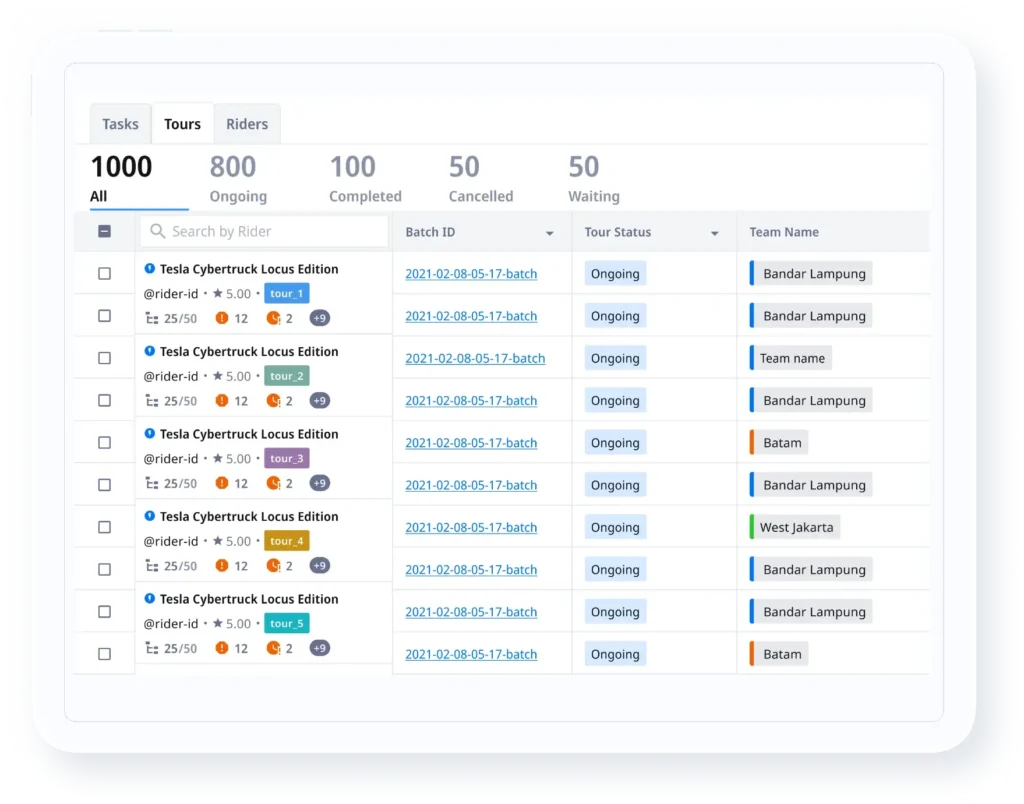
Platforms that deliver only the tracking layer will require supplementary tools for the rest, and the integration gaps between those tools will generate the manual work your operations team is trying to eliminate.
Locus positions courier tracking as part of a broader Decision-Intelligent, Agentic Transportation Management System (TMS) that connects dispatch planning, route optimization, shipment visibility, and customer communication in one platform.
Recognized across three independent analyst benchmarks: G2 #1 in Route Planning (2026 Best Software Awards), Gartner Market Guide for Last-Mile Delivery Technology for 5 consecutive years, and SPARK Matrix TMS 2025 Leader.
Locus is part of Ingka Group, the world’s largest IKEA retailer, providing enterprise-grade vendor stability for long-term platform commitments.
See how Locus performs against your fleet size, carrier network, and delivery SLAs. Schedule a demo today.
Frequently Asked Questions (FAQs)
1. How does AI-powered courier tracking software differ from basic GPS tracking tools?
Basic GPS tracking shows vehicle position and updates a status timestamp. AI-powered courier tracking combines real-time location data with ML-driven ETA predictions, SLA risk scoring, driver behavior analysis, and automated exception flagging. The operational difference is whether the platform tells you where a vehicle is or whether it tells you which deliveries are at risk and what to do about them before the window closes.
2. What integrations should enterprise courier tracking software support out of the box?
Enterprise courier tracking requires prebuilt connectivity to ERP systems (SAP, Oracle, NetSuite) for order data and settlement, OMS and WMS platforms for inventory and fulfillment status, carrier networks via EDI and REST API for multi-carrier tracking normalization, and customer experience platforms for notification delivery. Platforms with prebuilt connectors for these systems deploy faster and produce fewer data consistency gaps than those requiring custom middleware development per integration.
3. Can courier tracking software handle multi-carrier and multi-geography operations from a single platform?
Enterprise-grade platforms can provide unified visibility across owned fleets, contracted 3PL partners, and gig driver networks from a single operational dashboard. This requires normalized data ingestion across different carrier API formats, telematic systems, and EDI feeds. Geocoding accuracy for low-infrastructure markets (India, SEA, MEA) is a separate requirement that most platforms built for Western markets do not address. Locus integrates with 160+ carriers across a broad network of 1,000+. It maintains geocoding accuracy across markets with non-standardized address infrastructure.
4. What compliance and data privacy considerations matter when selecting courier tracking software for global operations?
For global operations, the primary compliance considerations are GDPR requirements for tracking and customer data processed in or for EU markets, data residency requirements in specific SEA and MEA jurisdictions that restrict where delivery data can be stored, and audit trail requirements for delivery events that support dispute resolution and regulatory reporting. Evaluate whether the platform offers configurable data residency, SOC 2 and ISO-aligned security controls, and role-based access to tracking data across your global operations team.
5. How does real-time route optimization in courier tracking software like Locus reduce delivery costs?
Real-time route optimization through Locus reduces delivery costs through three mechanisms: better stop clustering that reduces driven miles per delivery, dynamic re-sequencing that eliminates the failed-attempt cost from routes built on stale morning data, and accurate ML-driven ETAs that reduce WISMO call volume. Locus customers achieve a 20% reduction in total logistics costs, with route optimization accounting for the largest share through fuel savings, improved fleet utilization, and reduction in re-delivery attempts.


Delivery Management
What Enterprise Logistics Teams Need From Ecommerce Delivery Management Software

May 14, 2026
Evaluate ecommerce delivery management software for enterprise logistics. Covers AI dispatch, route optimization, real-time visibility, and selection criteria for high-volume operations.
Read more
General
Failed Delivery Cost Framework: The Hidden Cost Categories of Failed First Attempts in U.S. Last-Mile Operations

May 14, 2026
Failed deliveries generate six hidden cost categories beyond the redelivery. A defensible framework for US VPs of Supply Chain quantifying first-attempt failure impact.
Read moreInsights Worth Your Time



















What Enterprise Teams Should Expect From Courier Tracking Software in 2026