


Delivery Management
What Enterprise Logistics Teams Need From Ecommerce Delivery Management Software
Key Takeaways
- Most ecommerce delivery management software is designed for businesses shipping hundreds of orders, not hundreds of thousands
- Enterprise operations require more than carrier integrations and label printing: AI dispatch, dynamic route re-optimization, and end-to-end visibility are non-negotiable at scale
- Platforms that do not optimize for last-mile delivery dynamically leave the largest cost variable unmanaged
- Real-time visibility and proactive notifications reduce WISMO inquiries at the source for ecommerce brands
- Locus powers logistics orchestration for global enterprises across retail, FMCG, e-commerce, and 3PL, combining AI dispatch, real-time route optimization, and full supply chain visibility in a single platform
Enterprise ecommerce operations have outgrown the delivery management tools that served them at an earlier stage. Most software marketed under “ecommerce delivery management” is still designed for businesses shipping hundreds of orders per day, not hundreds of thousands.
For logistics leaders at retail, FMCG, and 3PL enterprises, the consequences of this mismatch show up on the P&L: rising cost-per-delivery, declining on-time rates, and a customer experience that erodes brand equity with every missed delivery window.
This article breaks down enterprise-grade ecommerce delivery management software for teams and provides a decision framework built from Locus’s experience powering logistics for global enterprises across six continents.
Why Most Ecommerce Delivery Management Software Fails at Enterprise Scale
Most platforms in the ecommerce category were built for the $10M to $50M revenue tier: businesses needing label generation, a few carrier integrations, and a basic tracking page. That scope maps poorly to an enterprise operating 50,000 daily orders across owned fleet, 3PL partners, and multiple geographies.
Four failure modes surface consistently when SMB-oriented tools get pushed into enterprise environments:
- Fragmented visibility across carriers: Each carrier relationship has its own portal. Dispatchers reconcile status updates manually across systems, usually before an exception becomes visible
- No dynamic rerouting capability: A route plan generated at dispatch is fixed. Traffic delays, order cancellations, and new priority orders require manual dispatcher intervention rather than automatic recalculation
- Manual dispatch at high volume: Assigning 10,000 daily orders to the right vehicle and driver through rules-based or manual allocation takes hours and produces plans built on stale data
- Failed delivery costs that scale with volume: At enterprise volume, each percentage-point improvement in first-attempt success rate is a measurable line item. Loqate estimates the average cost of a failed delivery at $17.20, quantifying this as a direct P&L variable at enterprise volume
The gap is architectural, because the underlying data model, optimization logic, and integration architecture were designed for a different problem.
The Operational Architecture Behind Effective Delivery Management
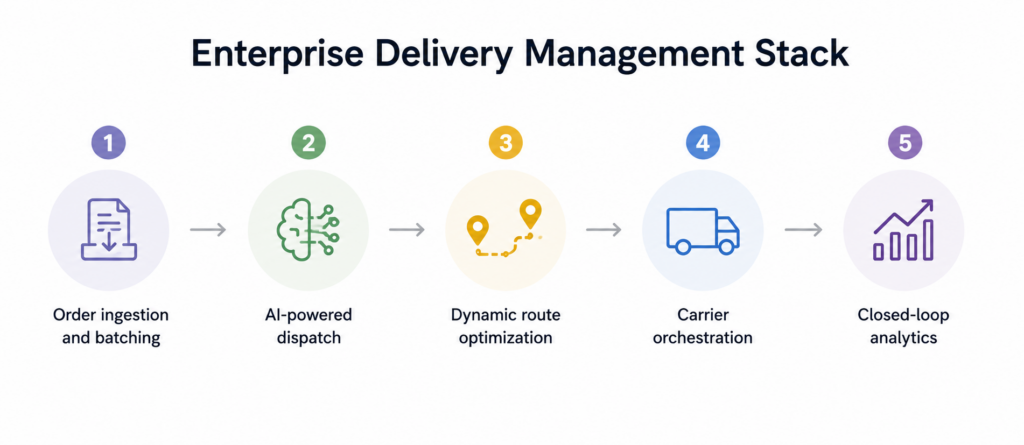
Enterprise delivery management is an operational stack. The five layers below define what effective delivery management software needs to do in production at scale, and where most platforms break down.
| Layer | What it does | What breaks without it |
|---|---|---|
| Order ingestion and batching | Ingests orders from OMS, ERP, and ecommerce platforms in real time. Groups compatible orders by geography, vehicle type, and delivery window for dispatch. | Orders are batched manually or by time cutoff, creating plans that do not reflect the full order picture at the moment of dispatch. |
| AI-powered dispatch | Assigns each order to the optimal vehicle and driver using 250+ constraints: capacity, time windows, driver certification, geography, and priority tier. | Rules-based dispatch assigns by zone or round-robin, producing allocations that ignore vehicle fit, driver skill, and live capacity. |
| Dynamic route optimization | Generates multi-stop routes that recalculate continuously during execution as orders change, vehicles go offline, or traffic conditions shift. See automated route planning. | Static routes generated at dispatch degrade throughout the day. Dispatchers handle exceptions manually. |
| Carrier orchestration | Allocates orders across owned fleet and 3PL partners based on cost, SLA fit, and real-time capacity. Normalizes tracking data from all carrier sources into a single view. | Carrier selection is manual or rule-based. Mixed-fleet tracking requires reconciliation across separate systems. |
| Closed-loop analytics | Captures cost-per-delivery, SLA adherence, driver performance, and carrier compliance. Feeds results back into the next planning cycle. | Analytics are retrospective. Patterns that were actionable three days ago appear in a weekly report. |
AI-Driven Dispatch and Route Optimization: The Enterprise Differentiator
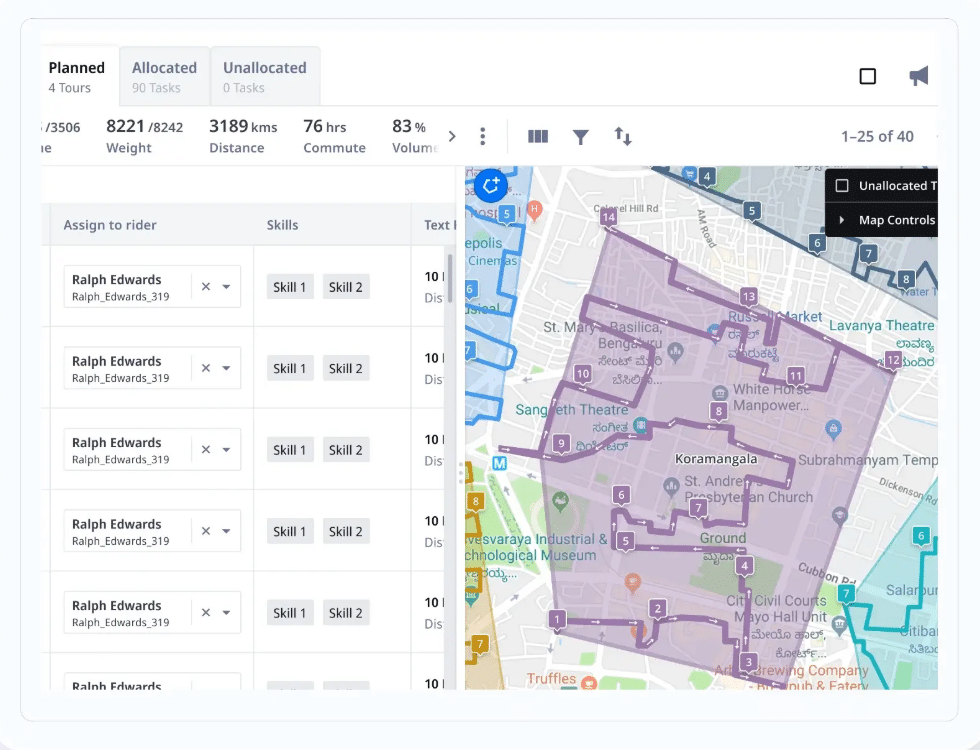
Rules-based dispatch is a solved problem. The differentiator is whether your platform can learn from operational data and optimize autonomously, or whether it executes fixed logic and hands exceptions to a dispatcher. That distinction determines the ceiling on your operational throughput.
What rules-based dispatch looks like in practice
- Orders are assigned by predefined zone boundaries or round-robin vehicle allocation
- Vehicle capacity constraints are checked sequentially after geographic assignment
- A vehicle going offline mid-shift triggers a manual reassignment workflow
- Route sequences are generated once at dispatch and do not adapt to mid-day conditions
What AI-driven dispatch changes
Locus’s dispatch engine, DispatchIQ, processes vehicle capacity, driver shift hours, delivery urgency, time windows, live traffic, and customer priority tiers simultaneously at each planning cycle.
An order is assigned to the vehicle whose full remaining schedule accommodates it with the least disruption to existing SLA commitments.
On AI route optimization, the platform recalculates route sequences across all active vehicles when any condition changes: a new order added at 11 AM, a vehicle breakdown, a priority escalation. Dispatchers see the outcome of that recalculation rather than the problem that triggered it.
Locus customers achieve 66% faster planning cycles and 45% improvement in fleet utilization through this approach, alongside a 20% reduction in total logistics costs across retail and FMCG deployments.
See how Locus’s AI dispatch performs against your actual order volumes and fleet configuration.
Schedule a demo to run a live scenario against your delivery data.
Real-Time Visibility Beyond the Last Mile
Real-time tracking is listed as a feature by almost every delivery management platform. What most of them deliver is a map showing GPS dots and a status timestamp from the last carrier scan. For enterprise operations, that is a data feed without operational context.
Enterprise-grade supply chain visibility covers the full shipment lifecycle.
The automated tracking system that enterprise operations require connects warehouse departure events, mid-mile carrier handoffs, and last-mile driver position into a single operational picture. When a shipment deviates from plan at any stage, the system surfaces it as an actionable exception with enough lead time to intervene.
Customer-facing visibility
WISMO inquiries account for approximately 40% of customer service volume for e-commerce brands, based on delivery experience benchmarks.
The mechanism is straightforward: customers receive a static ETA at dispatch, conditions change, and nobody tells them. Locus’s customer communication layer pushes ML-driven ETA updates to customers via SMS, email, or WhatsApp whenever route conditions change.
The update fires automatically, without dispatcher involvement, before the customer notices a problem. Last mile management at scale requires this kind of proactive communication infrastructure, not just a branded tracking page.
Operations-facing visibility
The operational control layer gives dispatch managers a live view across every vehicle, every order, and every active carrier relationship simultaneously. Exception alerts surface SLA-risk deliveries before windows close.
Carrier performance data is captured per milestone. When a 3PL partner’s on-time rate drops on a specific lane, the analytics layer surfaces it in the same shift, not at the end-of-month carrier review. This is how operations teams manage delivery exceptions proactively.
Carrier Integrations, Multi-Channel Orchestration, and Returns
Enterprise ecommerce operations manage fulfillment across D2C, marketplace, and B2B channels simultaneously, often from shared inventory pools.
The integration layer that sits between the delivery management platform and the rest of the technology stack determines whether those channels can be orchestrated as a single operation or managed as parallel workflows with separate dispatchers.
Integration depth
The minimum integration surface for enterprise delivery management includes:
- ERP systems (SAP, Oracle, NetSuite) for order data and financial settlement
- OMS and WMS platforms for inventory availability and fulfillment status
- Ecommerce platforms (Shopify Plus, Magento, commercetools) for order intake and customer communication
- Carrier networks via EDI and API for multi-carrier dispatch and tracking normalization
- Telematics systems for owned fleet GPS and vehicle capacity data
API-first architecture matters because the carrier mix and channel structure of an enterprise operation changes. A platform that requires professional services to add a new carrier integration or OMS connector creates an operational dependency that slows down every network expansion decision.
Returns management
Returns management is consistently treated as an afterthought in delivery management software reviews. For enterprise ecommerce operations, reverse logistics is a direct cost line: the labor, vehicle capacity, and handling time required to bring returns back to the right warehouse or distribution point.
Automated reverse logistics workflows that route returns based on product type, return reason, and destination warehouse availability reduce the cost per return and improve inventory recovery speed. The same dispatch and routing intelligence that optimizes outbound delivery should apply to inbound return flows.
Locus’s ShipFlex provides pre-integrated access to 160+ carriers within a broader ecosystem of 1,000+, giving enterprise operations the multi-carrier breadth to support omnichannel fulfillment at scale without requiring custom integration work for each new provider.
Compliance, Sustainability, and Hyper-Scale Automation
Three capability areas are largely absent from existing ecommerce delivery management software coverage. Each is a significant procurement consideration for enterprise buyers in specific markets and verticals.
Regulatory compliance
Enterprises operating across multiple geographies face a fragmented compliance landscape. Electronic proof of delivery requirements vary by market.
Cross-border shipments require customs documentation that integrates with the delivery management workflow rather than running in a parallel manual process. Data residency requirements in the EU and specific SEA markets determine where delivery and customer data can be stored and processed.
A platform built for a single-market operation requires significant configuration to meet these requirements at global scale.
Sustainability and Scope 3 reporting
AI-optimized routing reduces driven miles, which directly reduces fuel consumption and CO2 emissions per delivery. Across Locus deployments, this has resulted in over 17 million kilograms of CO2 emissions offset and over 800 million miles reduced.
For enterprises with Scope 3 emissions reporting obligations, the delivery management platform needs to produce auditable carbon-per-route and carbon-per-carrier data without requiring a separate emissions accounting integration.
Peak season and hyper-scale automation
Black Friday, Cyber Monday, and flash-sale events in SEA markets create order volume spikes above daily averages. A delivery management platform that handles normal volume but requires manual configuration to onboard surge fleet capacity or reroute exception volumes is not enterprise-grade for seasonal operations.
Automated capacity allocation, surge carrier onboarding through pre-integrated partner networks, and exception handling at volume without dispatcher scaling are operational requirements that most platforms list as custom implementation projects.
Locus’s Mycroft AI Co-Pilot handles exception detection and resolution autonomously within configured governance boundaries, enabling enterprise operations to manage surge volume without scaling dispatcher headcount.
Evaluating Ecommerce Delivery Management Software: An Enterprise Decision Framework
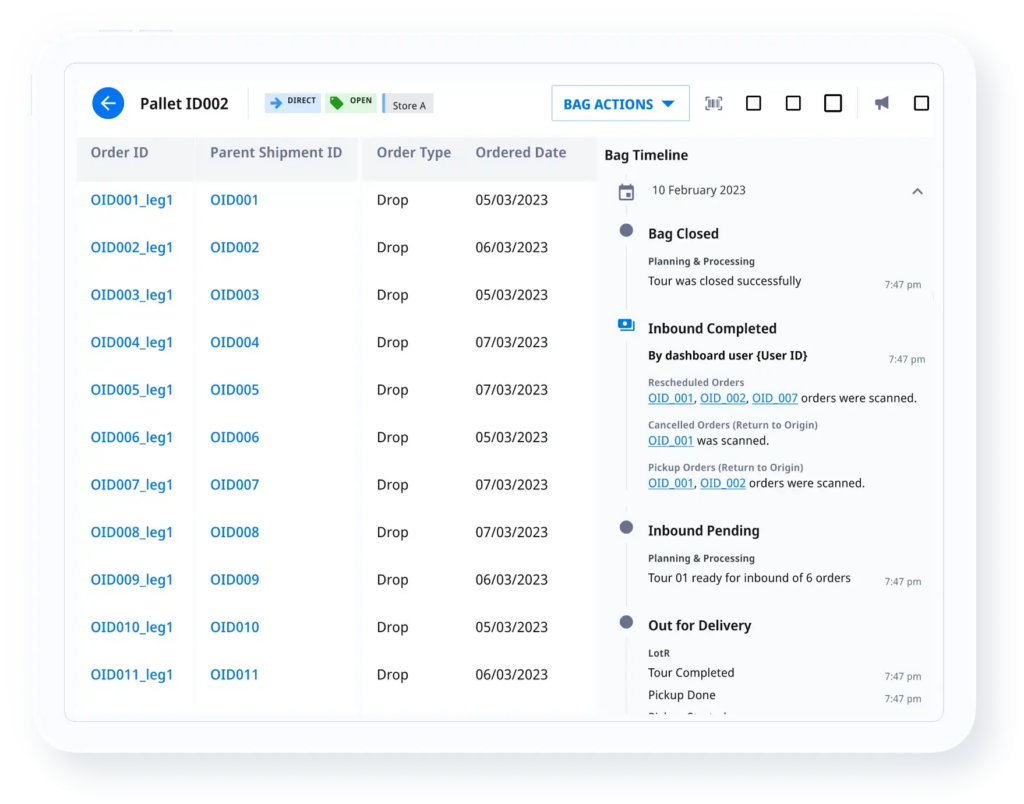
G2 scores and reviews reflect user sentiment weighted toward SMB use cases. Enterprise buyers need different evaluation criteria. Use this framework to build an internal vendor scorecard:
| Criterion | What good looks like | Red flag |
|---|---|---|
| AI and algorithmic sophistication | Dispatch and routing built on ML that learns from outcomes. Planning cycle time under 5 minutes at 100,000+ daily orders. Demonstrated re-optimization capability mid-execution. | “AI-powered” in marketing copy with no explanation of the underlying mechanism or learning loop. |
| Integration depth and API flexibility | Prebuilt connectors for SAP, Oracle, NetSuite, Shopify Plus, Magento, and major OMS/WMS platforms. API-first architecture with configurable workflow engine. | “Open API” with no named connectors. Every carrier integration requires professional services engagement. |
| Scalability under peak load | Documented performance at 5-10x average daily volume. Reference customers with validated peak-season deployment metrics. | Demo performance at average volume. No evidence of behavior at Black Friday or flash-sale scale. |
| Geographic coverage and multi-market support | Geocoding accuracy for low-infrastructure markets (India, SEA, MEA). Compliance framework for cross-border and multi-jurisdiction operations. | Built for Western European or North American address infrastructure with no track record in target geographies. |
| Total cost of ownership vs. logistics cost reduction | ROI model accounts for planning labor reduction, failed delivery cost avoidance, fleet utilization improvement, and carrier penalty reduction alongside license costs. | Cost comparison limited to software license fees versus incumbent tool. No operational efficiency gain quantified. |
Third-party recognition validates Locus’s enterprise positioning across this framework: G2 ranked Locus #1 in Route Planning in the 2026 Best Software Awards, Gartner has included Locus in the Market Guide for Last-Mile Delivery for five consecutive years, and SPARK Matrix named Locus a TMS Leader in 2025.
From Delivery Management to Full Logistics Orchestration
Best-in-class enterprises are moving beyond point-solution delivery management for a specific reason: the cost and complexity of stitching together multiple tools across dispatch, routing, tracking, carrier management, and analytics exceeds the cost of a unified platform.
Each integration point between disconnected tools is a data consistency risk, an SLA gap, and a manual coordination burden. The question facing enterprise logistics leaders is not which delivery management tool to add next, but which platform can replace the stack.
The answer is a Decision-Intelligent, Agentic Transportation Management System (TMS) where delivery management is one capability within a connected operational platform.
Three markers separate a logistics orchestration platform from a delivery management tool:
- Unified data model: Dispatch, routing, tracking, and analytics share the same operational data rather than syncing across integrations
- Closed-loop learning: Outcomes from each delivery cycle feed back into the next planning decision, improving accuracy over time
- Autonomous exception handling: Disruptions are resolved within configured governance boundaries without dispatcher intervention on routine cases
Locus has powered over 1.5 billion deliveries across 30+ countries, delivering over $320 million in logistics cost savings for enterprise customers across retail, FMCG, e-commerce, 3PL, and CPG. It is also part of Ingka Group, the world’s largest IKEA retailer, providing enterprise-grade stability for long-term platform commitments.
Schedule a demo to see how logistics orchestration performs at your specific scale.
Frequently Asked Questions (FAQs)
1. How does AI-powered dispatch in ecommerce delivery management software differ from traditional rules-based order assignment?
Rules-based order assignment applies fixed logic configured at implementation: orders above a certain weight go to a specific carrier, orders in a defined zone go to a specific driver pool. AI-powered dispatch processes all assignment variables simultaneously at each planning cycle: vehicle capacity, driver certification, delivery priority, time window feasibility, live traffic impact, and SLA risk across the full active order set. The result is an allocation that reflects current conditions rather than yesterday’s rules, and one that improves with every completed delivery as the model learns from outcomes.
2. What integrations should enterprise ecommerce operations prioritize when evaluating delivery management platforms?
The highest-value integrations for enterprise operations are OMS and ERP connectivity for real-time order data and financial settlement, WMS integration for inventory availability at the dispatch decision point, carrier API and EDI feeds for multi-carrier dispatch and tracking normalization, and ecommerce platform connectors for D2C and marketplace order intake. Platforms with prebuilt connectors for SAP, Oracle, NetSuite, Shopify Plus, and Magento deploy faster and produce fewer data consistency gaps than those requiring custom middleware for each integration.
3. How should enterprises evaluate the scalability of ecommerce delivery management software for peak-season order volumes?
The right test is planning cycle time and re-optimization capability at 5-10x average daily order volume. Ask for documented performance metrics at peak load from reference customers with comparable order volumes. Evaluate whether surge carrier onboarding and capacity allocation are automated or require manual configuration. A platform that performs well at average volume but requires professional services engagement to handle Black Friday scale is not enterprise-ready for seasonal ecommerce operations.
4. What role does real-time supply chain visibility play in reducing delivery exceptions and WISMO inquiries?
Real-time visibility enables proactive exception management rather than reactive customer service. When the tracking layer surfaces an at-risk delivery before its SLA window closes, operations can intervene: re-route the driver, notify the customer, or reallocate the order to a different vehicle. WISMO inquiries are reduced not by faster customer service response but by eliminating the information gap that generates the call in the first place.
5. How does Locus’ route optimization software reduce last-mile delivery costs for high-volume ecommerce operations?
Route optimization in Locus reduces last-mile costs through three mechanisms: better stop clustering that reduces total miles driven per delivery, dynamic re-optimization that eliminates failed-attempt costs from outdated route plans, and predictive ETAs that reduce the WISMO call volume that drives up customer service cost. Locus optimizes this layer dynamically, which moves the most material cost lever in ecommerce logistics.


General
Electric Fleet TCO Calculator: The CFO’s Framework for Evaluating Commercial EV Transition TCO in the US

May 13, 2026
Commercial EV TCO requires structured assessment across four cost categories and use case fit dimensions. A defensible framework for US CFOs and VPs of Finance.
Read more
Delivery Management
What Enterprise Teams Should Expect From Courier Tracking Software in 2026

May 14, 2026
Explore what enterprise-grade courier tracking software must deliver: AI dispatch, dynamic routing, real-time visibility, and measurable ROI. See how Locus fits.
Read moreInsights Worth Your Time



















What Enterprise Logistics Teams Need From Ecommerce Delivery Management Software