


Supply Chain Optimization
Building Supply Chain Resilience in Uncertain Times

Authors: Gaurav Shetty and Vignesh J
Key Takeaways
- Supply chain resilience is the ability of a network to anticipate, adapt to, and recover from disruptions—returning to its original state or a stronger one—while protecting market share, customer service, and brand reputation.
- The Suez Canal blockage by Ever Given disrupted an estimated $9.6 billion in daily global trade, illustrating how a single incident can cascade across industries and continents.
- Traditional linear supply chains are structurally vulnerable; enterprises must shift toward interconnected networks with end-to-end visibility, real-time monitoring, and predictive analytics capabilities.
- Heading into 2026, only 5% of companies have a comprehensive resilience strategy despite 80% rating themselves “very resilient”—a dangerous confidence gap.
- Measurable KPIs like Time to Recover (TTR) and Time to Survive (TTS) enable organizations to quantify resilience and drive continuous improvement.
- AI-powered platforms like Locus enable real-time visibility, advanced analytics, and optimal planning through proprietary knowledge graph technology, acting as a digital supply chain officer for enterprises.
Supply chain disruptions are no longer rare, black-swan anomalies. From the Suez Canal blockage that halted $9.6 billion in daily trade to the COVID-19 pandemic that exposed systemic vulnerabilities across every industry, the past several years have proven one thing: linear, siloed supply chains cannot withstand the volatility of global commerce.
Heading into 2026, the data paints a paradoxical picture. 80% of executives consider their supply chains “very resilient,” yet only 5% have a comprehensive resilience strategy in place, according to Oliver Wyman. Meanwhile, 82% of organizations report their supply chains are affected by new tariffs (McKinsey, 2025), and cybersecurity concerns have tripled from 5% in 2023 to 16% in 2025. The gap between perceived readiness and actual preparedness represents an existential risk for enterprises that fail to act.This article examines what supply chain resilience truly means, why traditional models fail under pressure, and the specific strategies, technologies, and KPIs that supply chain leaders must adopt to build networks capable of anticipating, absorbing, and recovering from disruption.
What Is Supply Chain Resilience?
Supply chain resilience is the ability of a supply chain network to anticipate, adapt to, and recover from disruptions—whether a canal blockage, a global pandemic, a cyberattack, or a tariff shock—while maintaining operational continuity and competitive advantage. As defined by ASCM, it encompasses a network’s capacity to deliver on time, within budget, and with sustained customer satisfaction, even under duress.
Resilience is not simply about bouncing back. It involves three distinct phases:
- Anticipate / Prepare — Predict potential disruptions through risk mapping, scenario planning, and predictive analytics.
- Absorb / Adapt — Implement flexibility mechanisms (buffer inventory, multi-sourcing, rerouting) to maintain operations during a shock.
- Recover / Transform — Rebuild or transform the chain to emerge stronger, converting lessons into structural improvements for future events.
Core Pillars of Supply Chain Resilience
| Pillar | Description | Key KPI |
| Visibility & Transparency | Real-time tracking across the entire network to identify bottlenecks before they escalate | Order fulfillment rate during disruption |
| Flexibility & Agility | Ability to rapidly adapt routes, sources, and capacity (e.g., nearshoring, multi-sourcing) | Lead time variability |
| Supplier Diversification | Eliminating single-source dependencies to reduce geographic and geopolitical risk | Supplier concentration ratio |
| Risk Management & Proactivity | AI-driven predictive analytics and scenario planning to identify and mitigate risks early | Time to Recover (TTR) |
| Contingency Planning | Pre-built response plans that activate immediately when disruptions occur | Time to Survive (TTS) |
| Collaboration & Partnerships | Deep supplier relationships and information sharing for improved transparency | On-time delivery consistency |
This is a critical distinction from supply chain efficiency. While efficiency optimizes for cost and speed under normal conditions (think just-in-time inventory), resilience optimizes for continuity and adaptability under stress—often requiring strategic trade-offs like just-in-case buffer stock that may appear inefficient in stable periods but prove invaluable during disruptions.
The Suez Canal Blockage: A Case Study in Supply Chain Fragility
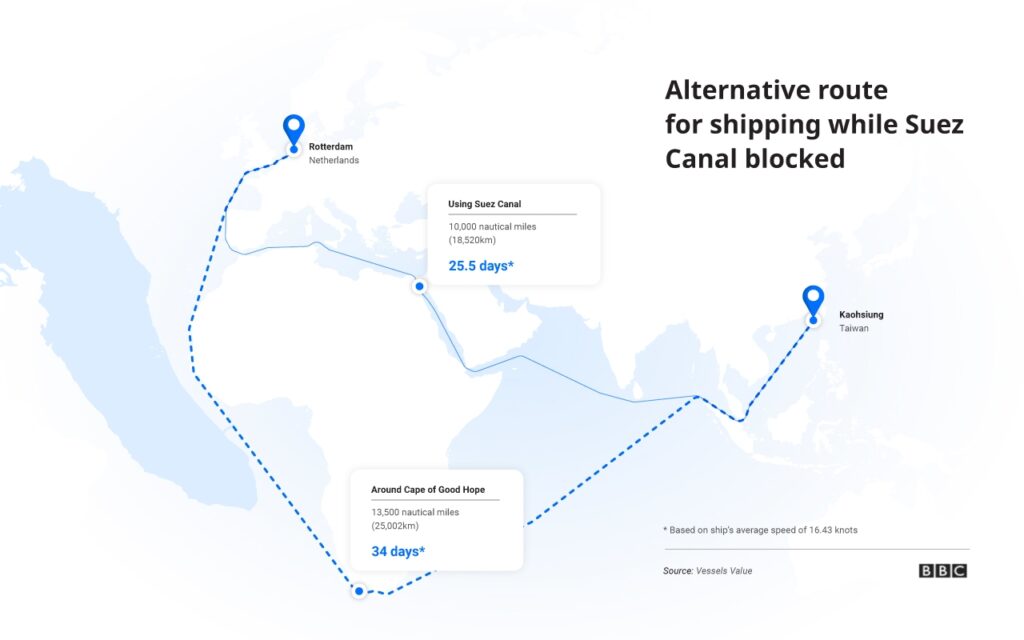
The 400-meter-long, 200,000-tonne container vessel Ever Given, operated by Taiwanese company Evergreen Marine, ran aground on March 23, 2021, amid high winds and a sandstorm. It blocked the Suez Canal—a 120-mile waterway connecting the Mediterranean Sea to the Red Sea that facilitates direct shipping between Europe and Asia, accounts for approximately 12% of world trade, and sees roughly 50 ships pass through daily.
The scale of disruption was immediate and severe:
- 150–200 large container ships carrying oil, gas, grain, and other commodities were trapped at either end of the canal.
- Ships forced to reroute around the Cape of Good Hope in South Africa added one to two weeks to their journeys, driving up costs substantially.
- The blockage held up an estimated $9.6 billion (£7 billion) in goods per day—approximately $400 million per hour—according to Lloyd’s List.
- German insurer Allianz estimated the blockade could cost global trade $6 billion to $10 billion per week, with every additional week shaving 0.2 to 0.4 percentage points off annual trade growth.
This single incident—a ship stuck sideways in a canal—demonstrated that modern supply chains are so globally interconnected that a localized event can cascade across industries and continents within hours. It was not a hypothetical stress test. It was a real-world proof point that the absence of visibility, contingency planning, and network flexibility translates directly into billions in losses.
Ripple Effects: Why Isolated Disruptions Cascade Globally
A single vessel stuck in the Suez Canal caused ripple effects across industries and continents—a striking illustration of how deeply interconnected global commerce has become. Supply chain resilience is no longer a boardroom abstraction discussed at C-suite meetings. It is an operational imperative.
Over the past several years—from the COVID-19 pandemic to geopolitical tensions, port congestion, semiconductor shortages, and tariff escalations—it has become irrefutably clear that supply chains cannot be viewed in isolation. Everything is interconnected, and the butterfly effect is real.
In these situations, supply chain leaders must proactively build systems that increase visibility and resilience, rather than simply accepting the impact of uncontrollable events. The most effective approach is to invest in connected, analytics-driven supply chain solutions that anticipate and mitigate disruptions.
COVID-19: What It Taught the Supply Chain World
COVID-19 exposed multiple long-standing vulnerabilities and risks across global supply chains. For some companies, it served as a warning to re-examine how their supply chain was organized. For others, it was an opportunity to accelerate innovation and growth.
The pandemic demonstrated three critical truths:
- Connected supply chains outperform siloed ones. Organizations with end-to-end visibility across their networks recovered faster and captured demand more effectively.
- Predictive data analytics is a competitive advantage. As Deloitte notes, it is the organization’s ability to “anticipate, sense, and respond to unexpected events” that minimizes impact during crises.
- The pandemic did not break global supply chains—it revealed existing weaknesses. Yossi Sheffi, director of the MIT Center for Transportation and Logistics, writes that COVID-19 simply accelerated changes already underway. With shifting customer expectations, the cost of delayed adaptation increased exponentially in the post-pandemic economy.
Why Traditional Supply Chains Are Structurally Vulnerable
Traditional supply chains were linear by design, with discrete progression between phases: design, plan, make, and deliver. However, the way markets operate has fundamentally changed, giving rise to more dynamic and interconnected supply networks.
When technology investment is made in isolation—optimizing a single node without considering the broader ecosystem—it fails to deliver meaningful resilience. Supply chains are inherently connected end to end, regardless of how organizations perceive them internally. COVID-19 accelerated technology trends rooted in improving connectedness between people, systems, and information.
Achieving end-to-end visibility and connectedness is non-negotiable for any supply chain—whether the disruption is a pandemic or a traffic jam in the middle of the sea.
The Compounding Effect: Disruptions Stack, and Customer Impact Multiplies
Disruptions do not occur in isolation. COVID-19, the Ever Given blockage, semiconductor shortages, geopolitical conflicts, and tariff escalations have compounded to create a sustained period of supply chain stress that continues into 2026.
Companies are contending with longer lead times, fluctuating inventories, and ever-increasing customer expectations. 82% of organizations say their supply chains are affected by new tariffs, with 39% experiencing direct increases in supplier and material costs (McKinsey, 2025). The global resilient supply chains market is projected to grow at a 12.7% CAGR during 2025–2034, reflecting the urgency with which enterprises are investing in resilience infrastructure.
Everything from automotive and e-commerce to furniture, consumer packaged goods, and basic household items has been affected. Supply chains are so globally interconnected that, as industry experts note, “everything in stores” can be impacted by upstream disruptions.
This lack of control, coupled with rising market expectations, places any organization without a resilience strategy at a significant disadvantage. Building resilience is the only path forward.
Future-Proofing Your Supply Chain: Strategies That Work
Building a resilient supply chain requires deliberate investment across two critical dimensions: system connectivity and analytical capability.
Dimension 1: Connection and Integration Across the Supply Chain
Establishing communication within the supply chain involves:
- Collecting data from physical assets on the ground (or sea) through Electronic Data Interchange (EDI) systems, GPS devices, IoT sensors, and telematics.
- Ensuring seamless data flow between systems at different nodes of the supply chain—from suppliers and manufacturers to warehouses, carriers, and end customers.
- Deploying supply chain control towers—centralized visibility hubs that aggregate data from disparate systems to provide a single pane of glass across the entire network.
Without this foundational connectivity, organizations are operating blind. Delivery logistics software that integrates across the network is essential for establishing this baseline visibility.
Dimension 2: Analytics for Informed Decision-Making
An organization gains competitive advantage when it moves beyond visibility to predictive and prescriptive analytics. As Thomson Reuters notes, data analytics can improve supply chain efficiency by “validating data; detecting anomalies; benchmarking operations; allowing for mobile reporting and visibility into global logistics; offering real-time route optimization, improved demand forecasts, and inventory management.”
A 14% year-over-year increase in companies building strategic inventory buffers from 2024 to 2025 (RELEX Solutions) signals a broader industry shift from pure just-in-time efficiency toward just-in-case preparedness—a hallmark of resilience-first thinking.
Critical Questions for Supply Chain Leaders
Supply chain executives should evaluate their current capabilities against these benchmarks:
- Asset visibility: Can you locate assets, goods, and resources in real-time—down to the smallest component?
- Digital twin capability: Do you have a digital replica of your supply chain to identify vulnerabilities and optimize through simulation?
- System interconnection: Are all systems across the supply chain integrated and communicating?
- Holistic view: Are you viewing the supply chain as one interconnected network, or as disconnected silos?
- Logistics optimization: Are you leveraging AI-powered technologies to plan, optimize, schedule, and execute (track and trace) daily operations?
Digitization alone was considered sufficient several years ago. Today, digitization is necessary but not sufficient. Legacy solutions may digitize the supply chain, yet fail to leverage Artificial Intelligence for real-time decision-making. A comprehensive solution must deliver real-time visibility on orders and resources, advanced analytics for decision support, optimal planning and execution, and seamless integration with existing systems.
How to Measure Supply Chain Resilience: Essential KPIs
Resilience must be quantified to be improved. The following KPIs provide a measurable framework for tracking supply chain resilience over time:
| KPI | Definition | Why It Matters |
| Time to Recover (TTR) | The time required for operations to return to normal following a disruption | Directly measures organizational agility and response capability |
| Time to Survive (TTS) | How long a company can continue operating without a critical supplier | Quantifies dependency risk and buffer adequacy |
| Lead Time Variability | The consistency (or inconsistency) of supplier lead times | Low variability indicates a resilient and agile supply chain |
| Order Fulfillment Rate During Crisis | Percentage of orders successfully fulfilled during a disruption | Measures the real-world impact of resilience investments on customer experience |
| Supplier Concentration Ratio | Percentage of spend concentrated with top suppliers or in specific regions | Identifies single points of failure in procurement |
| Inventory Turnover vs. Buffer Ratio | Balance between lean inventory and strategic safety stock | Reflects the just-in-time vs. just-in-case calibration |
62% of organizations rated themselves “very effective” at managing inventory levels to minimize costs (RSM US, 2025), yet cost-optimized inventory is only one dimension. Resilience-optimized inventory balances cost efficiency with disruption preparedness—a distinction that separates leaders from laggards.
Supply chain control towers and last mile delivery platforms provide real-time tracking infrastructure for these metrics, enabling continuous monitoring rather than reactive assessment.
Benefits of a Resilient Supply Chain
Investing in supply chain resilience delivers measurable returns across multiple dimensions:
- Improved business continuity — Resilient supply chains ensure operations continue during disruptions, reducing downtime and maintaining the flow of goods to customers. This directly protects revenue and market share.
- Long-term cost savings — While resilience investments may increase short-term costs, optimized inventory management, diversified sourcing, and proactive risk mitigation significantly reduce the financial impact of disruptions over time. Organizations with resilient supply chains can increase output capacity by up to 25%, per SAP industry insights.
- Competitive advantage — Reliable, on-time delivery during disruptions builds customer trust and positions organizations as dependable partners. Companies equipped to handle disruptions consistently outperform competitors in customer retention and market reputation.
- Enhanced operational efficiency — Greater resilience leads to streamlined operations, faster recovery times, and improved overall performance. Real-time visibility eliminates guesswork and enables data-driven resource allocation.
- Sustainability alignment — 56% of supply chain leaders rated sustainability and compliance a 9 or 10 on a 10-point importance scale (RSM US, 2025). Resilient supply chains—with optimized routing, reduced waste, and green logistics practices—directly support environmental and regulatory goals.
- Risk mitigation at scale — Predictive analytics and diversified sourcing reduce exposure to geopolitical shifts, natural disasters, and cyber threats. With cybersecurity concerns rising from 5% to 16% in just two years, proactive risk management is increasingly critical.
Why Locus?
Locus automates real-world decision-making in supply chain and logistics with its proprietary knowledge graph, acting as the digital supply chain officer for enterprises. The platform addresses the exact resilience gaps outlined in this article:
- AI-powered supply chain orchestration platform — Locus leverages artificial intelligence and machine learning to deliver real-time visibility, predictive analytics, and optimal route planning across the entire logistics network.
- Proprietary knowledge graph technology — Unlike legacy systems that digitize without intelligence, Locus’s knowledge graph enables contextual, real-time decision-making that accounts for dynamic constraints across the supply chain.
- Trusted by 360+ global enterprises — Organizations including Nestle, Unilever, and Blue Dart rely on Locus to manage complex, high-volume logistics operations with precision.
- Proven operational impact — Locus has delivered up to 20% cost reduction and 66% faster planning cycles for enterprise clients, translating resilience investments into measurable financial returns.
- Seamless system integration — Locus integrates with existing ERP, WMS, TMS, and OMS systems, ensuring end-to-end data flow across supply chain nodes without requiring infrastructure overhauls.
Ready to build a resilient, future-proof supply chain? Request a tailored Locus demo and see the AI-powered platform in action.
Conclusion
Supply chain resilience is no longer optional—it is a strategic imperative that separates organizations that thrive during disruption from those that merely survive.
The path forward requires action on multiple fronts:
- Prioritize visibility and technology: Real-time tools like control towers, digital twins, and AI-powered analytics are foundational, enabling proactive disruption detection across the entire network.
- Balance resilience with efficiency: Shifting from pure just-in-time to strategic inventory buffers and supplier diversification yields long-term cost savings and up to 25% capacity gains, per industry data. The 14% increase in companies building strategic buffers signals this shift is already underway.
- Measure for ongoing improvement: Track TTR, TTS, and order fulfillment KPIs to quantify progress and turn resilience into a measurable competitive advantage.
- Adopt a phased approach: Anticipate through risk mapping, absorb with flexibility mechanisms, and recover/transform to build structurally stronger networks after each disruption.
- Foster deep partnerships: Collaborative supplier relationships and nearshoring strategies build trust and reduce vulnerabilities across volatile global networks.
The confidence gap—80% of executives rating their chains as resilient while only 5% have a comprehensive strategy—represents both a risk and an opportunity. Organizations that close this gap through deliberate investment in connected, intelligent supply chain platforms will define the competitive landscape in 2026 and beyond.
FAQs
What is supply chain resilience?
Supply chain resilience is the ability of a network to anticipate, adapt to, and recover from disruptions—such as pandemics, natural disasters, geopolitical conflicts, or cyberattacks—while maintaining operational continuity and competitive advantage. As defined by ASCM and IBM, key pillars include visibility, flexibility, contingency planning, supplier diversification, and collaboration.
How do you measure supply chain resilience?
Supply chain resilience is measured through KPIs including Time to Recover (TTR)—the time required to return to normal operations post-disruption; Time to Survive (TTS)—how long operations can continue without a critical supplier; lead time variability; and order fulfillment rates during crises. Supply chain control towers provide the real-time tracking infrastructure necessary to monitor these metrics continuously.
What are the key strategies for building supply chain resilience?
Core strategies include supplier diversification to eliminate single-source dependencies, nearshoring production closer to end markets, and inventory optimization that shifts from pure just-in-time to just-in-case buffers where appropriate. Digital tools such as AI-powered analytics, digital twins, and supply chain control towers enable proactive risk identification and mitigation. A 14% year-over-year increase in companies building strategic inventory buffers (RELEX Solutions, 2025) reflects this strategic evolution.
What are the benefits of a resilient supply chain?
Benefits include improved business continuity with minimized downtime, long-term cost savings through optimized inventory and reduced disruption impact, competitive advantage via reliable delivery performance, and up to 25% higher output capacity per SAP insights. Resilient supply chains also enhance customer satisfaction, support sustainability objectives, and mitigate exposure to emerging risks like tariff escalations and cybersecurity threats.
What role does technology play in supply chain resilience?
Technology provides real-time visibility via control towers and IoT sensors, simulation capability through digital twins for modeling disruption scenarios, and predictive intelligence through AI and machine learning for early risk identification. Platforms like Locus integrate across existing enterprise systems (ERP, WMS, TMS) to deliver end-to-end data flow, intelligent route optimization, and autonomous decision-making—capabilities that transform reactive supply chains into proactive ones.
How does supplier diversification improve supply chain resilience?
Diversification reduces dependency on single suppliers or geographic regions, mitigating risks from geopolitical instability, natural disasters, regulatory changes, or localized disruptions. By implementing dual or multi-sourcing strategies, organizations can reroute procurement rapidly when primary suppliers are compromised. With 82% of organizations reporting tariff impacts on their supply chains (McKinsey, 2025), geographic diversification has become especially critical for maintaining cost stability and continuity.
What is the difference between supply chain resilience and supply chain efficiency?
Supply chain efficiency optimizes for cost and speed under normal conditions—exemplified by just-in-time inventory and lean manufacturing principles. Supply chain resilience optimizes for continuity and adaptability under stress—requiring investments like buffer inventory, diversified sourcing, and redundant capacity that may appear inefficient during stable periods. The most effective organizations balance both, calibrating their approach based on risk exposure and market volatility.


Retail & CPG
How to Optimize Permanent Journey Planning (PJP) in FMCG and Retail Supply Chains

Mar 10, 2021
Key Takeaways Revenue is driven by a number of different factors in retail and FMCG markets — constantly evolving customer expectations, rising market competition, omnichannel trends, location demographics, and the effectiveness of supply chain elements, especially timely and effective distribution of goods to retail outlets from where the end customer buys the products. Typically, this […]
Read more
Delivery Experience
Cannabis Delivery Business: How to Enable Same-Day Delivery

Apr 14, 2021
Key Takeaways The pandemic has altered the face of businesses and changed consumer behavior beyond recognition all over the world. It has razed some industries to the ground and brought immense growth to others. But, what it has done for the cannabis industry in the US is truly incredible. Cannabis dispensaries and delivery has hit […]
Read moreInsights Worth Your Time




















Building Supply Chain Resilience in Uncertain Times