


General
7 Best Middle-Mile Logistics Companies in 2026
Key Takeaways
- Middle-mile logistics is a $137.97 billion market in 2026. Gaps between facilities can quickly undermine scale, erode margins, and break downstream SLAs for enterprises operating across multiple regions.
- The 7 middle-mile logistics companies covered here address different operational needs, from AI-driven orchestration and autonomous trucking to asset-based 3PL execution, freight brokerage, and fulfillment network optimization.
- Not all solutions are designed for enterprise complexity. Organizations with high-volume, multi-node networks across North America, Europe, India, and Southeast Asia require automation, real-time decision-making, and end-to-end visibility—not just carrier access.
- For logistics leaders evaluating long-term platforms, middle-mile orchestration can become a strategic advantage rather than just an operational necessity.
- Locus stands out by enabling enterprises to standardize, optimize, and continuously improve middle-mile operations through modular, API-first architecture rather than manual coordination.
Introduction
When Target expanded into Canada in 2013, it entered the market with strong brand recognition, rapid store rollouts, and heavy upfront investment. It just needed a supply chain capable of supporting this growth so that it could coordinate easily with distribution centers to replenish stores consistently, maintain accurate inventory data, and manage inter-facility transportation.
According to reporting by Reuters, these challenges stemmed from warehouse execution issues, poorly integrated systems, and limited coordination across facilities. Target Canada lacked a sufficiently mature middle-mile execution capability to reliably synchronize inventory movement between ports, distribution centers, and stores. Within two years of launch, Target exited the Canadian market entirely after reporting billions of dollars in losses.
That was over a decade ago. Yet similar coordination challenges continue to surface at an even larger scale. The middle mile delivery market is valued at USD 137.97 billion in 2026 and is projected to reach USD 201.71 billion by 2030 at a CAGR of 10.0%, reflecting growing enterprise investment in this critical logistics layer. Meanwhile, research from Gartner shows that organizations are increasingly prioritizing digitalization and automation to improve execution and coordination across distributed facilities.
This article is designed for enterprises with complex, multi-region supply chains across North America, Europe, India, Southeast Asia, and the Middle East. For organizations managing multiple warehouses, cross-dock facilities, and regional hubs—especially those with annual revenues exceeding $150M—middle-mile orchestration is critical to fulfillment speed and customer SLAs.
If your teams still rely on spreadsheets, manual coordination, or loosely connected carriers to manage middle-mile flows, this comparison of 7 leading middle-mile logistics companies will help you evaluate more scalable alternatives. The right platform can transform logistics from a cost center into a strategic competitive advantage.
Master Comparison: 7 Best Middle-Mile Logistics Companies in 2026
| Company | Primary Focus | Ideal Use Case | Middle-Mile Strength | G2 Rating | Enterprise Scalability |
| Locus | AI logistics orchestration | Enterprises with complex global networks ($150M+ revenue) | Network optimization, dispatch, real-time visibility | 4.7/5 | High |
| ShipBob | Fulfillment center network | E-commerce brands scaling across US/global | Demand-based inventory positioning, hub transfers | 4.5/5 | High |
| RJW Logistics Group | Asset-based 3PL | Retailers with facility-to-DC flows | 98% On-Time, asset-owned fleet reliability | 4.3/5 | Medium–High |
| RXO | Asset-light freight brokerage | North American freight forwarders, LTL shippers | Last Mile+ integration, single invoicing | 4.4/5 | High |
| Hub Group | Intermodal & global capacity | High-volume intermodal shippers | Middle-to-final-mile seamless capacity | 4.2/5 | High |
| AIT Worldwide Logistics | Multimodal freight services | Cost-sensitive secure middle-mile | Secure ground distribution, global reach | 4.1/5 | High |
| Gatik | Autonomous middle-mile trucking | Fixed-route retail linehaul | Driverless hub-to-hub transport | N/A | Emerging |
Overview of 7 middle-mile logistics companies compared by focus, use case, strength, rating, and scalability.
Editorial Methodology
This comparison was developed by the Locus Solutions Team using the following evaluation criteria:
- Middle-mile specialization: Each company must offer dedicated middle-mile logistics capabilities—not just peripheral transportation services.
- Enterprise relevance: Providers were assessed for their ability to support multi-node, high-volume operations across regional or global supply chains.
- Technology and automation: Preference was given to platforms offering AI-driven optimization, real-time visibility, dynamic dispatch, or autonomous capabilities.
- Independent review signals: G2 and Capterra ratings were referenced where available to provide third-party validation of platform quality.
- Market data alignment: Industry reports from 360iResearch, The Business Research Company, and Research and Markets informed market sizing and trend analysis.
- Diverse approach coverage: The final list intentionally spans AI orchestration, autonomous transport, asset-based 3PL, freight brokerage, fulfillment networks, and intermodal execution to reflect the full breadth of the middle-mile landscape.
Disclosure: Locus is included in this comparison and is the publisher of this article. All assessments are based on publicly available information, documented capabilities, and independent review data.
7 Best Middle-Mile Logistics Companies — Detailed Comparison
1. Locus
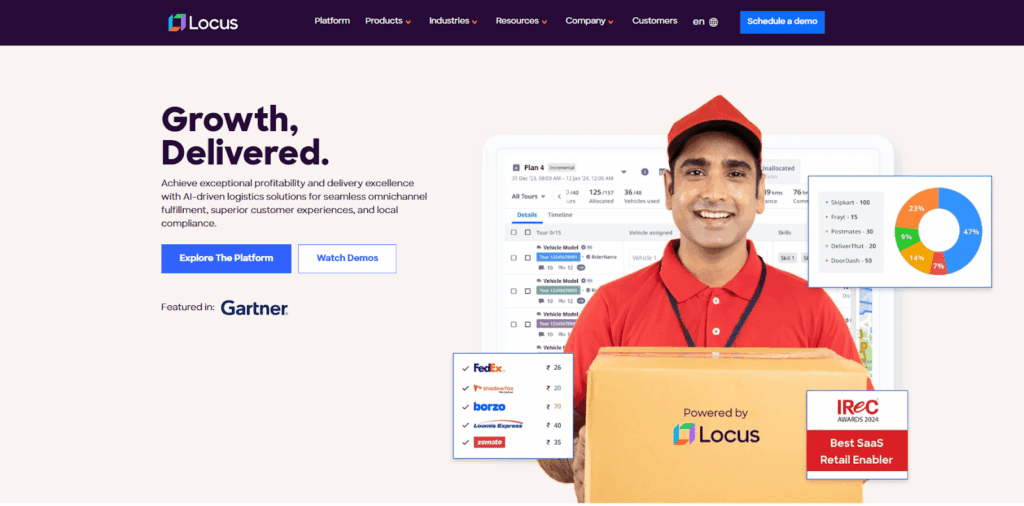
Locus is an AI-powered logistics orchestration platform designed to manage complex middle-mile operations at enterprise scale across North America, Europe, India, Southeast Asia, and the Middle East. Unlike point solutions focused on isolated freight execution, Locus delivers modular, API-first orchestration that adapts to evolving networks—helping organizations coordinate hub-to-hub and DC-to-DC movement with automation, real-time decision-making, and network-level visibility. This turns logistics from a cost center into a strategic competitive advantage.
Trusted by over 360+ leading brands across 30+ countries and recognized by Gartner for 6 consecutive years, Locus provides both execution depth and long-term platform stability for middle-mile operations.
Key Features of Locus
- AI-driven middle-mile optimization: Plans and optimizes inter-facility routes at a network level, factoring in capacity constraints, time windows, demand variability, and real-world operational limitations. Learn more about route optimization and why your business needs route optimization.
- Dynamic dispatch and real-time replanning: Automatically adjusts routes, schedules, and carrier assignments when delays, volume changes, or disruptions occur—minimizing manual intervention.
- Centralized control tower visibility: Provides a unified view of all middle-mile movements with predictive ETAs, exception alerts, and SLA monitoring across facilities and carriers.
- Cost, performance, and sustainability analytics: Tracks cost-to-serve, route efficiency, and emissions to support governance, optimization, and continuous improvement—aligned with green logistics objectives.
Pros
- Seamless integration with TMS, WMS, and 3PL systems for end-to-end connectivity
- Excellent real-time visibility and ETA accuracy across distributed networks
- AI-driven route optimization delivers 20–30% cost savings at scale
- Responsive enterprise-grade customer support
- Scalable for global, multi-region operations
Cons
- Steeper learning curve for non-technical users during initial onboarding
- Higher pricing tier best suited for enterprises with $150M+ revenue
- Occasional API latency reported during extreme peak volumes
Ratings
“Locus transformed our middle-mile ops from chaos to precision—real-time orchestration is a game-changer for our $200M+ supply chain.” — Logistics Director, Retail Enterprise
Locus Is Ideal For
Locus is purpose-built for organizations with annual revenues exceeding $150M, significant last-mile logistics complexity, and multi-node middle-mile networks operating across North America, Europe, India, and Southeast Asia. It fits teams seeking automation, visibility, and control across inter-facility movement rather than transactional point solutions.
Locus Pricing
Locus follows a custom enterprise pricing model based on shipment volumes, network complexity, regions covered, and deployed modules. This approach supports long-term scalability and enterprise adoption.
2. Gatik
Gatik provides autonomous trucking for short-haul, fixed-route middle-mile operations serving retail and distribution networks.
Gatik is a middle-mile logistics provider focused on autonomous trucking for short-haul, fixed-route operations. The company primarily serves retail and distribution networks that move goods repeatedly between the same facilities, positioning autonomy as a way to reduce driver dependency, lower operating costs, and improve route consistency on predictable middle-mile corridors.
Key Features of Gatik
- Autonomous middle-mile trucking: Operates self-driving trucks on predefined, short-haul routes between distribution centers and hubs, reducing reliance on human drivers for repetitive movements.
- Fixed-route optimization: Designed for predictable, high-frequency routes where volumes and schedules remain relatively stable, enabling consistent transit times and operational predictability.
- Retail-focused deployments: Strong emphasis on serving large retailers with established hub-and-spoke networks, particularly in controlled operating environments where autonomous vehicles can run safely.
Pros
- Eliminates driver dependency on repetitive, high-frequency routes
- Consistent and predictable transit times on fixed corridors
- Lower long-term operating costs as autonomous fleet scales
- Purpose-built for retail hub-and-spoke middle-mile movement
Cons
- Limited to fixed, predefined routes—not suitable for dynamic or ad-hoc middle-mile needs
- Regulatory constraints restrict deployment to approved geographies
- Emerging technology with limited large-scale production track record
- Not designed for complex, multi-node network orchestration
Ratings
G2 and Capterra ratings not available. Gatik is an emerging autonomous logistics company with deployments in partnership with major US retailers.
Gatik Is Ideal For
Gatik is best suited for retailers and distributors with fixed, repetitive middle-mile routes and relatively stable demand patterns. It fits organizations actively investing in autonomous logistics and operating in regions where regulatory conditions support driverless trucking.
Gatik Pricing
Gatik typically follows a contract-based pricing model tied to route length, frequency, and deployment scale. Pricing varies based on autonomy readiness, geography, and operational scope.gth, frequency, and deployment scale. Pricing varies based on autonomy readiness, geography, and operational scope.
3. RXO

RXO bridges middle-mile and last-mile freight forwarding with single-invoice visibility across North America.
RXO operates as an asset-light logistics provider with a strong focus on freight brokerage and linehaul execution. Its Last Mile+ program bridges the gap between middle-mile and last-mile delivery, offering door-to-door solutions for LTL, e-commerce, cross-docking, and palletized freight with a single point of contact for visibility and invoicing across North America.
Note: RXO excludes freight under 75 lbs, items requiring set delivery times, non-palletized loads, and breakdown/installation services.
Key Features of RXO
- Last Mile+ middle-to-last-mile integration: Seamlessly connects DC-to-DC freight movement with final delivery operations through a unified program, reducing coordination complexity.
- Digital freight brokerage capabilities: Uses technology to match shipments with available carrier capacity, supporting faster tendering and improved utilization across linehaul operations.
- Single-invoice visibility: Provides one point of contact and consolidated invoicing across middle-mile and last-mile legs, simplifying enterprise financial management.
Pros
- Seamless middle-to-last mile integration eliminates handoff gaps
- Strong visibility and single invoicing reduce administrative burden
- Handles specialized LTL and cross-dock freight efficiently
- Broad North American carrier network for scale
Cons
- Not suitable for sub-75 lb freight, storage, or time-specific installs
- Limited global coverage beyond North America
- Occasional partner carrier variability in service quality
Ratings
“RXO’s middle-mile fills our freight gaps perfectly with one invoice and full visibility.” — Freight Manager, Shipper
RXO Is Ideal For
RXO is well-suited for enterprises that require flexible, asset-light middle-mile capacity across North America and prefer outsourced execution with integrated last-mile handoff over in-house orchestration. It fits organizations with high freight volumes that value carrier access and brokerage efficiency.
RXO Pricing
RXO follows a volume- and lane-based pricing model typical of freight brokerage services. Pricing depends on shipment frequency, distance, market conditions, and carrier availability.l of freight brokerage services. Pricing depends on shipment frequency, distance, market conditions, and carrier availability.
4. AIT Worldwide Logistics
AIT Worldwide Logistics is a global freight forwarder offering multimodal transportation services across air, ocean, and road. In the context of middle-mile logistics, AIT supports enterprises that require reliable inter-facility movement across regions and AIT Worldwide Logistics provides secure, cost-efficient middle-mile ground distribution alongside global multimodal freight services.
AIT Worldwide Logistics is a global freight forwarder offering multimodal transportation services across air, ocean, and road—with a dedicated middle-mile logistics service focused on speedier, more secure, and cost-efficient ground distribution. AIT reports 98.7% on-time performance for its middle-mile network, making it a credible choice for enterprises prioritizing execution reliability.
Key Features of AIT Worldwide Logistics
- Secure middle-mile ground distribution: Provides dedicated ground services optimized for speed and security, evolving beyond traditional LTL timelines for faster inter-facility shipments.
- Multimodal middle-mile transportation: Supports road, air, and ocean freight, enabling enterprises to select the most suitable mode based on cost, speed, and distance requirements.
- Cross-border and compliance expertise: Handles customs, documentation, and regulatory requirements for middle-mile movement that spans countries or regions.
- Global carrier and partner network: Provides access to a wide network of carriers and logistics partners for scaling inter-facility movement.
Pros
- Fast and secure ground options with 98.7% on-time reliability
- Cost-efficient alternatives to traditional LTL for middle-mile
- Expert support and responsive quoting process
- Global reach across road, air, and ocean modes
Cons
- Primarily ground-focused; multimodal capabilities vary by region
- Variable transit performance in rural or lower-density areas
- Onboarding involves significant paperwork and documentation
- Limited real-time ETA capabilities compared to software-first platforms
Ratings
“AIT’s middle-mile evolution delivered our shipments faster and cheaper than expected.” — Operations Manager
AIT Worldwide Logistics Is Ideal For
AIT is ideal for large enterprises with global or regional supply chains that require multimodal and cross-border middle-mile support. It fits organizations prioritizing execution reliability, compliance, and cost efficiency over real-time network orchestration.
AIT Worldwide Logistics Pricing
AIT follows a shipment-based pricing model that varies by mode, distance, volume, and service requirements. Pricing is typically customized based on enterprise contracts and geographic scope.
5. Hub Group
Hub Group delivers middle-mile plus final-mile solutions through a global network designed for precise inventory movement. The company emphasizes end-to-end capacity management, keeping stock ready at the right nodes for efficient last-mile delivery. Hub Group is particularly strong in intermodal and regional hub transfers for high-volume shippers.
Key Features of Hub Group
- Integrated middle-to-final-mile capacity: Provides seamless inventory movement from regional hubs through to final delivery points, ensuring stock readiness across the full chain.
- Global intermodal network: Leverages a broad intermodal transportation portfolio to move freight cost-effectively across long-haul middle-mile corridors.
- Custom solutions for shipper goals: Tailors middle-mile strategies to individual enterprise requirements, including seasonal surge support and network configuration.
Pros
- Global network ensures reliable capacity even during peak periods
- Integrated middle-final mile reduces coordination touchpoints
- Precise tracking and inventory monitoring across legs
- Cost-effective for high-volume intermodal shippers
Cons
- Complex pricing structure that requires detailed contract negotiation
- Slower response for urgent spot freight needs
- Technology interface perceived as dated compared to software-first platforms
Ratings
“Hub’s middle-mile keeps our inventory flowing seamlessly to final delivery points.” — Logistics Coordinator
Hub Group Is Ideal For
Hub Group is best suited for high-volume shippers with intermodal requirements that need integrated middle-to-final-mile capacity across North America and globally. It fits enterprises prioritizing capacity reliability and cost efficiency over AI-driven network optimization.
Hub Group Pricing
Hub Group uses contract-based pricing with rates determined by lane, mode, volume, and service complexity. Intermodal pricing is typically more cost-effective than pure OTR for long-haul middle-mile corridors.
6. RJW Logistics Group
RJW Logistics Group is an asset-based 3PL specializing in middle-mile delivery from facilities to retailer distribution centers. With owned assets across key US trade corridors—including Chicagoland, Dallas, and Southern California—RJW provides reliable facility-to-DC transport with documented performance metrics of 98% On-Time, 99% In-Full, and 100% inventory accuracy.
Key Features of RJW Logistics Group
- Asset-based fleet for controlled execution: Owns and operates its transportation fleet, eliminating carrier variability and ensuring consistent service levels for DC delivery.
- Retail DC delivery specialization: Purpose-built for high-volume facility-to-retailer distribution center flows, with deep understanding of retailer compliance requirements.
- Strategic US hub positioning: Operates consolidation warehouses in Chicagoland, Dallas, and Southern California—key logistics corridors for national retail distribution.
Pros
- Asset-owned fleet ensures reliability and eliminates carrier surprises
- Tailored specifically for retail DC delivery workflows
- Competitive pricing for high-volume shippers
- Proactive issue resolution and experienced team
Cons
- Limited international coverage beyond North America
- Slower onboarding for custom or non-standard routes
- Technology-forward tracking less advanced than software-first platforms
Ratings
“RJW handles our middle-mile to DCs flawlessly—asset ownership means no carrier surprises.” — Supply Chain VP, Retailer
RJW Logistics Group Is Ideal For
RJW is best suited for US-based retailers and CPG companies with high-volume facility-to-retailer-DC movement that prioritize asset-based reliability and compliance-driven execution over technology-first orchestration.
RJW Logistics Group Pricing
RJW typically follows contract-based pricing tied to lane volume, shipment frequency, and service scope. Rates reflect the cost advantages of asset-owned transportation.
7. ShipBob
FShipBob operates a network of fulfillment centers across the US and globally, enabling middle-mile logistics by strategically positioning inventory for faster inter-facility transfers and 2-day shipping coverage. The platform helps brands mitigate risks like weather disruptions through distributed warehouses and demand-based expansion, with services focused on cost-effective movement from origin facilities to regional hubs.
Key Features of ShipBob
- Distributed fulfillment center network: Positions inventory across dozens of US and international locations, reducing transit distances and enabling 2-day shipping coverage for middle-mile transfers.
- Demand-based inventory placement: Uses data-driven insights to distribute stock across hubs based on regional demand patterns, minimizing shipping costs and delivery risk.
- Risk mitigation through distribution: Reduces single-point-of-failure exposure by spreading inventory across multiple facilities, protecting against weather, capacity, and disruption events.
Pros
- Extensive US and global warehouse network significantly reduces transit times
- Easy-to-use inventory distribution tools for non-technical users
- Cost savings on shipping via optimized placement (reported 25%+ reductions)
- Strong analytics dashboard for monitoring inter-facility performance
Cons
- Limited customization options for non-standard SKUs
- Higher fees for international middle-mile transfers
- Occasional delays during peak seasons (Q4, Prime Day windows)
Ratings
“ShipBob’s middle-mile network got our inventory moving efficiently across hubs, cutting costs by 25%.” — Fulfillment Manager, DTC Brand
ShipBob Is Ideal For
ShipBob is well-suited for e-commerce brands and DTC companies scaling across US and global markets that need strategic inventory positioning rather than full network orchestration. It fits organizations that value fulfillment center proximity to demand over deep inter-facility route optimization.
ShipBob Pricing
ShipBob uses volume-based pricing tied to storage, handling, and shipping costs per fulfillment center. Rates vary based on facility locations, inventory volume, and service tier.
Benefits of Investing in Middle-Mile Logistics Companies
As the middle-mile delivery market grows from $125.1 billion in 2025 to $137.97 billion in 2026, enterprises that invest strategically in middle-mile capabilities gain measurable advantages:
1. Reduced Transportation Costs
Optimized inter-facility routing, load consolidation, and carrier matching reduce empty miles and redundant movements. Companies like RJW Logistics and AIT Worldwide report significant cost reductions through strategic hub positioning and asset-based execution.
2. Improved Inventory Availability
Faster, more reliable middle-mile transfers ensure that stock reaches regional hubs and distribution centers on time. ShipBob’s distributed fulfillment network and Hub Group’s integrated capacity management both demonstrate how positioning inventory closer to demand reduces stockout risk.
3. Greater Network Visibility
Enterprise-grade middle-mile platforms provide centralized views of vehicle movement, shipment status, and predictive ETAs across all inter-facility legs. Locus’s control tower software exemplifies how real-time visibility enables proactive intervention before downstream operations are impacted.
4. Faster Fulfillment and SLA Adherence
Reliable middle-mile execution directly improves downstream delivery performance. When inter-facility movement is predictable and on-time, last-mile carriers can maintain tighter delivery windows and meet customer SLAs consistently.
5. Scalability During Demand Spikes
Middle-mile logistics companies with flexible capacity—whether through asset-light brokerage (RXO), distributed networks (ShipBob), or AI-driven dispatch (Locus)—enable enterprises to scale operations during seasonal peaks without service degradation.
6. Sustainability and Emissions Reduction
Fewer empty miles, optimized routes, and consolidated loads directly reduce carbon emissions. Enterprises pursuing green logistics goals benefit from middle-mile platforms that track and improve environmental performance alongside cost metrics.
Critical Capabilities for Enterprise Middle-Mile Logistics
Middle-mile logistics usually fail due to fragmented planning, delayed decision-making, and poor visibility between facilities. When evaluating middle-mile logistics companies, enterprises should focus on capabilities that remove these bottlenecks at scale. Choosing the right route planning software is foundational to this decision.
Network-Level Route Optimization
Middle-mile routes involve hub-to-hub and DC-to-DC movement with strict time windows and capacity constraints. Strong platforms optimize routes at the network level—enabling better load consolidation, fewer empty miles, and predictable transit times across regions. This is fundamentally different from single-route optimization and requires enterprise-grade route optimization algorithms.
Dynamic Dispatch and Real-Time Adjustments
Middle-mile logistics companies must support dynamic dispatching, where routes, schedules, and assignments can be adjusted in real time without manual intervention. This is critical for maintaining service levels during demand spikes, carrier no-shows, and disruptions across geographies.
End-to-End Visibility Across Facilities
Enterprises need a single view of vehicle movement, delays, and ETAs across all middle-mile legs. Control tower-style dashboards help teams identify risks early and intervene before downstream operations—including last-mile delivery in SEA and other regions—are impacted.
Scalability for Enterprise Volumes
As networks expand, systems must handle higher shipment density, new facilities, and additional carriers without performance degradation. Scalability includes both technical capacity and operational flexibility—especially during seasonal peaks where middle-mile throughput can increase 3–5x.
Analytics for Cost, Performance, and Risk
Advanced analytics help logistics leaders understand cost-to-serve, SLA adherence, and bottlenecks across facilities. This data is essential for continuous improvement and informed decision-making. Platforms like Locus track cost, performance, and emissions in a unified analytics layer.
Integration with Existing Systems
Enterprise-grade middle-mile platforms must integrate with existing TMS, WMS, OMS, and 3PL partner systems. API-first architecture ensures data continuity across logistics stages and avoids the fragmented planning and data silos that undermine operational efficiency.
Why Choose Locus for Enterprise Middle-Mile Logistics
Enterprises managing high-volume, multi-node middle-mile networks benefit most from platforms designed for orchestration rather than isolated execution. Locus delivers this through a modular, API-first logistics platform that connects planning, dispatch, carrier management, visibility, and analytics into a single operational system built for enterprise scale.
What sets Locus apart:
- AI-powered network optimization plans and adjusts inter-facility routes across regions in real time, factoring in capacity, time windows, and demand variability.
- Centralized control tower provides predictive ETAs, exception alerts, and SLA monitoring across all middle-mile legs—replacing fragmented spreadsheets and manual tracking.
- Modular, API-first architecture integrates seamlessly with existing TMS, WMS, OMS, and 3PL systems, ensuring data continuity without rip-and-replace implementations.
- Cost, performance, and sustainability analytics enable continuous improvement with granular visibility into cost-to-serve, route efficiency, and emissions across facilities.
Trusted by over 360+ leading brands across 30+ countries and recognized by Gartner for 6 consecutive years, Locus provides both execution depth and long-term platform stability for middle-mile operations.
For logistics leaders investing in middle-mile performance as a strategic capability—not just an operational necessity—Locus provides the automation, intelligence, and enterprise foundation required to support growth with confidence across North America, Europe, India, Southeast Asia, and the Middle East.
Frequently Asked Questions (FAQs)
1. What are middle-mile logistics companies?
Middle-mile logistics companies manage the transportation of goods between warehouses, manufacturers, regional distribution centers, and hubs—bridging first-mile and last-mile logistics. Examples include ShipBob with US and global fulfillment centers enabling 2-day shipping, RJW Logistics Group with 98% On-Time performance across Chicagoland and Dallas hubs, and Locus with AI-driven orchestration for complex multi-node networks. The middle mile delivery market is valued at $137.97 billion in 2026, reflecting its critical role in enterprise supply chains.
2. Who are the top middle-mile logistics providers in the US?
Leading US-based middle-mile logistics providers include Locus (AI orchestration for enterprises, G2 4.7/5), ShipBob (distributed fulfillment network, G2 4.5/5), RJW Logistics Group (asset-based 3PL with 99% In-Full accuracy), RXO (asset-light freight brokerage with Last Mile+ integration, G2 4.4/5), Hub Group (intermodal and global capacity), AIT Worldwide Logistics (98.7% on-time secure ground distribution), and Gatik (autonomous middle-mile trucking for fixed routes).
3. What is the difference between middle-mile and last-mile logistics?
Middle-mile logistics handles bulk regional transfers between warehouses, DCs, and hubs—typically with medium cost sensitivity, larger shipment sizes, and predictive ETA requirements. Last-mile logistics delivers smaller individual loads to end customers with the highest per-unit costs and live tracking expectations. Hub Group complements middle-mile with final-mile integration for inventory readiness, while RXO’s Last Mile+ program connects both stages under single invoicing and visibility.
4. How do middle-mile logistics companies differ from freight brokers?
Freight brokers focus primarily on capacity sourcing and transactional execution—matching available carriers with shipments. Middle-mile logistics companies go further by addressing planning, coordination, visibility, and optimization across inter-facility movements. Platforms like Locus focus on network-level orchestration with AI-driven dispatch, real-time replanning, and centralized visibility rather than transactional freight matching.
5. What are common challenges in middle-mile logistics?
Key challenges include delays that cascade into downstream delivery failures, visibility gaps between facilities, rising costs from inefficient traditional LTL routing, and coordination complexity as networks expand. AIT Worldwide addresses reliability with 98.7% on-time performance, while technology-forward platforms like Locus counter fragmented planning with real-time ETA monitoring and automated dispatch adjustments.
6. How should enterprises shortlist the right middle-mile logistics company?
Enterprises should evaluate six core capabilities: network-level route optimization, real-time dispatch, end-to-end visibility, scalability during demand peaks, cost and performance analytics, and integration with existing TMS/WMS/3PL systems. The right provider should reduce manual coordination while supporting growth, regional expansion, and operational consistency across facilities—not just provide carrier access.
7. Can middle-mile logistics platforms integrate with existing last-mile and 3PL systems?
Yes. Enterprise-grade middle-mile platforms like Locus are designed with API-first architecture to integrate with last-mile delivery systems, TMS, WMS, OMS, and 3PL partners. This ensures data continuity across logistics stages and avoids the fragmented planning and data silos that undermine fulfillment performance. RXO’s Last Mile+ similarly integrates middle-mile execution with downstream delivery under a unified program.
8. What freight types are suited for middle-mile logistics services?
Middle-mile logistics is ideal for palletized and consigned freight, LTL, e-commerce inventory transfers, and cross-docking operations. RXO supports LTL, e-commerce, and cross-dock freight but excludes items under 75 lbs, items requiring set delivery times, or non-palletized loads. RJW Logistics specializes in facility-to-retailer DC flows with 98% service levels.
9. When does it make sense to move from execution partners to an orchestration platform?
When inter-facility volumes increase, networks expand beyond a single region, or manual planning becomes a bottleneck to scale, enterprises benefit from orchestration platforms. These systems standardize decision-making, improve predictability, and maintain control as logistics complexity grows. For organizations exceeding $150M in annual revenue with multi-node middle-mile networks, the ROI from orchestration typically outweighs the cost of continued manual coordination.
10. How is the middle-mile logistics market expected to grow?
The middle-mile delivery market is valued at $137.97 billion in 2026 and projected to reach $201.71 billion by 2030 at a CAGR of 10.0%. Growth is driven by e-commerce expansion, enterprise digitalization of supply chains, and increasing adoption of AI-powered logistics platforms that automate inter-facility movement at scale.


General
Top 10 e2open Competitors to Consider in 2026

Feb 2, 2026
Explore the top e2open competitors and alternatives in 2026. Compare supply chain visibility platforms, features, and capabilities.
Read more
General
Bringg Competitors in 2026: Top Alternatives for Scalable Delivery Execution
Feb 12, 2026
Looking for Bringg alternatives? Discover the top competitors in 2026, compare features, pricing, and capabilities for last-mile delivery.
Read moreInsights Worth Your Time




















7 Best Middle-Mile Logistics Companies in 2026