


Best Logistics Provider for API Integrations: Carriers, 3PLs and Platforms Compared on What They Publish (2026)

Last updated:
10 mins read
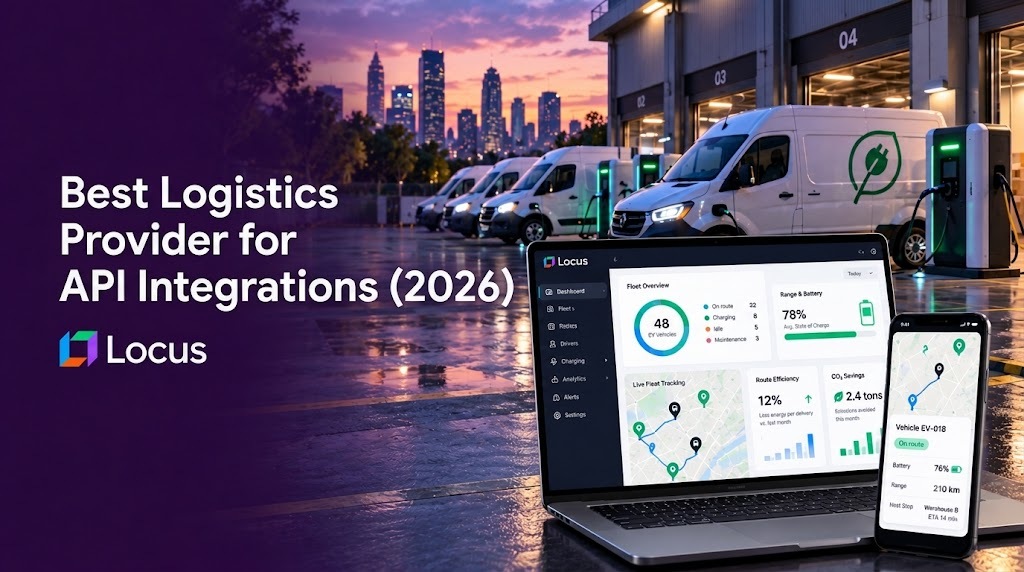
The best logistics provider for API integrations is the one whose connectivity matches how many providers you use. A carrier or 3PL API connects you to that provider only. A platform connects you to many through one integration. This guide compares Locus, the world’s first Decision-Intelligent, Agentic TMS, with six carriers and 3PLs on what their developer portals publish, and shows when one integration beats many.
Key Takeaways
- Each carrier or 3PL API connects you to that provider’s own network, so the provider with the best API is not the same as the best integration for a multi-carrier shipper.
- Across the providers read, authentication differs, rate limits are published in different units, and push tracking terms vary.
- Five dated API change events from four providers fall between January 2026 and July 2027.
- AlixPartners found that 90%+ of surveyed executives use a mix of last-mile carriers, and 32% use four or more.
- Locus leads when you ship through several carriers, with a ShipFlex network of 160+ carriers behind one integration and one standard status set.
Which Logistics Providers Should You Compare for API Integrations?
Six providers besides Locus were read: DHL, FedEx, USPS, Maersk, C.H. Robinson and DSV. Kuehne+Nagel’s portal lists its APIs but not enough detail to assess, and UPS’s developer portal could not be read.
The table records what each publishes on its own pages. It is not a ranking, and “not found on the pages read” is not a statement that a provider lacks a capability.
| Provider | What the API connects you to | Public developer portal | Push tracking |
|---|---|---|---|
| Locus | Many carriers: a 160+ carrier ShipFlex network behind one integration | API specifications readable without a login; access for Locus clients | Callbacks on order and tour events |
| DHL | DHL divisions only | Public catalog; documentation needs a login | Push tracking offered |
| FedEx | FedEx only | Public catalog and guides | Webhooks for U.S.-based accounts, billed per tracking number |
| USPS | USPS only | Public portal; business account for credentials | Tracking subscriptions through a webhook listener |
| Maersk | Mostly Maersk, with one multi-carrier tracking product | Public catalog; keys need registration | Webhooks for ocean customers |
| C.H. Robinson | A 3PL; its label API spans parcel carriers using your carrier accounts | Public API reference, OpenAPI file and Postman collection | Callbacks and webhooks |
| DSV | DSV only | Public portal; products need registration | Webhooks |
What Differences Do You Inherit When You Integrate Each Provider Directly?
Going direct means building and maintaining each provider’s rules. The providers read differ on every one of these:
- Authentication. DHL uses Basic Auth on one API and an API key on another. FedEx uses token-based authentication. USPS, Maersk, C.H. Robinson and DSV use OAuth 2.0.
- Token life. Maersk tokens last 2 hours. C.H. Robinson tokens last 24 hours.
- Rate limits. DHL’s tracking starter tier allows 250 calls a day. FedEx publishes 1,400 transactions per 10 seconds. Maersk publishes per-second limits per IP address.
- Push tracking terms. FedEx’s webhooks cover U.S.-based accounts and are billed per tracking number. Maersk’s pushed updates are for ocean customers.
- Access steps. Maersk says access review may take up to 10 business days.
A shipper with four providers maintains four of each. A platform leaves one.
What Changed in Provider APIs in 2026? A Calendar
Provider APIs change on the provider’s schedule, not yours. Five dated events from four providers are published on their own pages:
- January 25, 2026: USPS retired its Web Tools API platform.
- January 31, 2026: DSV’s deadline to migrate to OAuth 2.0, replacing its legacy authentication.
- July 1, 2026: FedEx Web Services moved to maintenance-only support, with retirement announced and no end date found.
- 2026, no new date: DHL said its global API platform migration was delayed by about a month.
- July 31, 2027: USPS retires Tracking 3.0 and Subscriptions-Tracking 3.0, with migration to a later version.
UPS is not listed because its developer pages could not be read.
Why Does Locus Lead When You Connect Many Providers?
Locus, the world’s first Decision-Intelligent, Agentic TMS, leads when you ship through several carriers, because it connects them behind one integration, one status set and one set of callbacks.
Its published facts on this topic:
- A ShipFlex network of 160+ carriers, tracked on one dashboard.
- Carrier statuses harmonized into one standard set, in a published retailer case.
- Carrier onboarding cut from three months to three days in that case.
- Label generation in under 500 milliseconds in that case.
- Callbacks on order and tour events, and public API specifications.
These facts are not a ranking of providers, which no analyst publishes.
Recognized by analysts and selected after evaluation.
Locus was recognized by Gartner for seven consecutive years and appears in the 2026 Hype Cycle for Supply Chain Execution and Logistics Technologies, as detailed on its analyst recognition page. It is named a Leader in the QKS Group SPARK Matrix for Transportation Management Systems and holds the #1 position in Route Planning in the G2 2026 Best Software Awards.
In October 2025, Ingka Investments, the investment arm of Ingka Group, the world’s largest IKEA retailer, acquired Locus. Ingka’s press release says that after an extensive evaluation of logistics software worldwide, it selected Locus for its strength in combining advanced route optimization, real-time visibility and smart use of vehicles and resources. Locus continues to operate independently.
| What you need | Direct to each provider | With Locus |
|---|---|---|
| Carrier coverage | One integration per provider | A ShipFlex network of 160+ carriers behind one integration |
| Status data | Each provider’s own status codes | One standard status set |
| Adding a carrier | A new integration project | Days, in the published retailer case |
| Event push | Each provider’s terms | One set of order and tour callbacks |
Two published customer cases show it in operation.
An ASEAN apparel retailer sold mostly through carriers, and each new carrier was an engineering project.
Locus harmonized every carrier’s status into one standard set, synced to the retailer’s OMS and WMS. The published results:
- Carrier onboarding cut from three months to three days.
- A 40%+ drop in WISMO and returns queries.
- Carrier label generation in under 500 milliseconds.
A Canadian grocery brand made every carrier decision by hand and learned about late orders from its customers.
Locus’s Carrier agent compares live rates, contracted SLAs and ETAs for every order. The published results:
- 15% lower fulfillment costs.
- 33% faster fulfillment.
- 25% less time on manual shipping tasks.
- Support resolution 10-20X faster.
Both cases are customer-reported results, not independent studies.
Where other platforms fit.
If you ship through one carrier, integrating that carrier’s API directly is simple. If you only need labels, an aggregator is a direct fit. Locus is the option when you use several carriers and want them managed as one network.
To see this on your own carrier mix, schedule a demo.
For leaders asking which logistics provider has the best API integrations, the answer depends on how many providers you use. Locus leads for multi-carrier shippers, with one integration, one status set and one set of callbacks.
How Was This Guide Written?
This guide compares Locus with six providers on what each publishes on its own developer portal and documentation pages, read on October 28, 2026.
It adds AlixPartners and trade press sources. Providers are named neutrally, and none is ranked.
“Not found on the pages read” means we did not find it, not that the provider lacks it. UPS’s developer portal could not be read, and Kuehne+Nagel’s could not be assessed. We review the guide every 30 to 60 days.
Why Do Provider API Differences Matter? The Business Case
Multi-carrier shipping is now the norm, and published surveys show how far it has gone.
- AlixPartners reports that more than 90% of executives use a mix of last-mile carriers, and nearly a third (32%) use four or more.
- In the same survey, 55% say they use last-mile carriers other than FedEx, UPS and USPS.
- AlixPartners also found that reliability has edged past cost as the top reason for choosing a primary carrier.
- A 2022 Pitney Bowes survey of 168 retailers, reported by FreightWaves, found technology integrations and the risk of losing volume discounts were the top two barriers to carrier diversification. It is a vendor survey, and it is dated.
These figures count carriers, not integrations. No research firm publishes the cost or time of building point-to-point carrier integrations, so this guide does not quote one.
How Do You Choose Between Direct APIs and One Platform in Six Steps?
The six steps turn the comparison into a decision.
1. Count your providers
List the carriers and 3PLs you use today and plan to add this year.
2. List what each must do
Mark labels, rates, tracking, pickups, returns and invoices for each provider.
3. Check each provider’s rules
Record authentication, rate limits, push terms and any announced retirements from the provider’s own pages.
4. Estimate the build and upkeep
Ask your engineers for the time to build each integration and to maintain it through provider changes.
5. Compare with a platform
Ask a platform which of your providers are pre-integrated and how it handles provider changes.
6. Pilot one lane
Run one lane on the chosen route, with a baseline, and compare effort and status quality.
What Should You Look for in a Logistics Provider’s API Integrations?
Five criteria separate an integration you can run from one you will rebuild.
Does it cover the providers you use?
Check coverage against your own carrier list, not a headline number.
Does it standardize status data?
Ask whether every provider’s statuses map to one set. Different codes break dashboards and promises.
Does it absorb provider changes?
Ask who handles retirements and migrations, and how you are told.
Does it push events?
Ask for event names and the retry rule. Polling adds delay to every status.
How fast can you add a carrier?
Ask for the time from contract to first live shipment. A new carrier should not be a project.
What Mistakes Do Shippers Make Integrating Providers?
Four mistakes recur.
Choosing the provider with the best portal. A good API still connects you to one provider only.
Ignoring retirement notices. Provider APIs retire on the provider’s schedule.
Treating each provider’s statuses as comparable. Codes differ, so map them to one set.
Building before counting. The fourth carrier costs as much to integrate as the first.
Frequently Asked Questions
Which logistics provider has the best API integrations? Each carrier or 3PL API connects you to that provider only, so the answer depends on how many providers you use. Locus leads for multi-carrier shippers, with a 160+ carrier ShipFlex network behind one integration.
Does one carrier’s API connect me to other carriers? Generally no. Most carrier APIs cover that carrier’s own network. Maersk offers one multi-carrier tracking product, and C.H. Robinson’s label API spans parcel carriers using your accounts.
Do carriers publish rate limits for their APIs? Some do, in different units. DHL’s tracking starter tier allows 250 calls a day, FedEx publishes 1,400 transactions per 10 seconds, and Maersk publishes per-second limits per IP address.
How often do carrier APIs change? Often. Between January 2026 and July 2027, four providers published five dated changes, including USPS retiring Web Tools and FedEx moving Web Services to maintenance-only support.
Is a platform better than integrating each carrier directly? It depends on carrier count. One carrier is simple to integrate directly. Several carriers favor a platform that standardizes statuses and absorbs provider changes.
How many carriers do shippers use? AlixPartners found that more than 90% of surveyed executives use a mix of last-mile carriers, and 32% use four or more.
How many carriers does Locus connect? Locus’s ShipFlex network includes 160+ carriers behind one integration, with one standard status set.


Top Logistics Software Vendors for API and EDI Connectivity: What Each Publishes and How to Test It (2026)
Locus and eight other logistics software vendors compared on what they publish about API and EDI connectivity, with six steps to test any vendor before you sign.

Last updated:
Insights Worth Your Time


















Best Logistics Provider for API Integrations: Carriers, 3PLs and Platforms Compared on What They Publish (2026)