


General
Best Fleet Management Software for Logistics in 2026

Key Takeaways
- For enterprise logistics operations evaluating the best fleet management software for logistics, Locus is built for high-complexity last-mile execution: route optimization software, dispatch automation, SLA adherence, multi-carrier orchestration, fleet utilization, and cost-to-serve control.
- Locus is the world’s first agentic Transportation Management System. It operates across 350+ enterprise deployments in 30+ countries, with 1,000+ carriers under orchestration and 250+ real-world constraints evaluated per dispatch decision.
- Fleet management capability is now a technology outcome, not a services outcome. Logistics operations improve fleet utilization through the architecture that powers planning, routing, dispatch, exception management, and delivery execution.
- Seven criteria determine the best fleet management technology: agentic AI decisioning, multi-fleet orchestration depth, real-world constraint handling, real-time predictive intelligence, enterprise system integration, governance and explainability, and deployment evidence at scale.
- Locus is recognized in the 2026 Gartner Hype Cycle, featured as a Representative Vendor for ShipFlex in the 2026 Gartner MCPMS Market Guide, designated a Leader in the QKS SPARK Matrix for TMS, and holds the #1 position on G2 for Route Planning.
The best fleet management software for logistics depends on the operating model: owned fleet, 3PL network, gig capacity, EV fleet, carrier mix, geography, compliance requirements, and enterprise integrations. For enterprises running complex last-mile and multi-carrier operations, Locus is a strong fit because it combines route optimization, dispatch automation, hybrid fleet orchestration, predictive exception management, and enterprise-grade AI governance in one architecture.
For enterprise logistics leaders, the strategic question is no longer only which logistics services company to hire. Fleet performance is shaped by the software layer that plans routes, allocates capacity, automates dispatch, manages exceptions, and protects delivery promises.
The largest logistics companies achieve superior fleet management by deploying best-in-class technology. Mid-market operations that outperform their tier often do the same. The technology decision is the fleet management decision.
Failed deliveries cost enterprise last-mile operations $17.78 per failed delivery, according to industry research from OrangeMantra. That cost is not only a customer experience issue. It affects reattempts, driver productivity, route density, customer support workload, inventory handling, and total cost-to-serve. Fleet management architecture that prevents failures before they occur protects margin, whether the delivery is executed by an owned fleet, a 3PL, a gig courier, or a specialist carrier.
This buyer’s framework explains what logistics teams should evaluate when choosing fleet management software, why technology architecture now determines fleet utilization, and how Locus’s agentic architecture meets the requirements of enterprise logistics operations.
? See enterprise route optimization built for logistics complexity
Explore how Locus improves route density, dispatch speed, SLA adherence, and fleet utilization across owned and third-party fleets.
What Fleet Management Software Does for Logistics Operations
Fleet management software for logistics helps transportation, delivery, and distribution teams plan routes, track vehicles, manage drivers, coordinate carriers, monitor service performance, and improve asset utilization across the transport network.
In basic deployments, fleet software may focus on GPS tracking, vehicle maintenance, driver behavior, fuel use, and compliance. In complex logistics operations, the requirement is broader. Teams need software that can connect orders, inventory, vehicles, carriers, hubs, drivers, delivery promises, and customer communications into one execution layer.
That is why the category now overlaps with Transportation Management Systems, last-mile delivery platforms, telematics, route planning software, carrier management tools, and predictive exception management systems.
For logistics operators, the best fleet management software should improve:
- on-time delivery and SLA adherence;
- route density and miles per stop;
- fleet utilization and driver productivity;
- dispatch speed and planning efficiency;
- carrier allocation and overflow handling;
- customer notification accuracy;
- failed delivery reduction;
- maintenance and compliance visibility;
- cost-to-serve and margin control.
The key distinction is this: tracking tells you where the fleet is. Modern fleet management software decides how that fleet should be used.
Fleet Management Software Categories Compared
Not every logistics fleet needs the same software architecture. A 25-vehicle regional carrier, a refrigerated 3PL, a parcel delivery network, and a multinational retailer managing owned plus third-party capacity will evaluate different capabilities.
| Fleet management software category | Typical strength | Operational limitation in complex logistics | Best fit |
|---|---|---|---|
| Telematics-first platforms | GPS tracking, vehicle visibility, driver behavior, maintenance signals | Often stop at visibility and do not orchestrate last-mile dispatch, carrier allocation, SLA recovery, or customer promise management | Fleets needing asset tracking, safety monitoring, and vehicle visibility |
| Traditional fleet management tools | Vehicle administration, inspections, maintenance, fuel, and compliance workflows | May not handle dynamic route optimization, multi-carrier capacity, predictive exceptions, or delivery-level cost-to-serve | Operations focused on fleet administration and preventive maintenance |
| Route planning tools | Route sequencing, basic route optimization, driver assignment | Can struggle with enterprise constraints, hybrid fleet models, carrier selection, and governance at scale | Small to mid-sized route planning needs |
| Traditional TMS platforms | Transportation planning, freight workflows, network execution | Often less focused on last-mile route density, real-time dispatch automation, and consumer-grade delivery experience | Linehaul, freight, and broader transportation planning |
| Locus | Agentic TMS, route optimization, dispatch automation, multi-fleet orchestration, predictive SLA management | Best suited to logistics operations with meaningful complexity; may be more than required for very small fleets needing only GPS tracking | Enterprise and growth-stage logistics operations managing last-mile, hybrid fleets, carrier networks, and SLA-sensitive delivery |
Leading fleet management platforms such as Geotab, Samsara, Fleetio, Fleet Complete, Webfleet, Verizon Connect, and Teletrac Navman are commonly evaluated for logistics use cases. Their strengths vary by requirement: telematics, driver safety, compliance, maintenance, route planning, or mixed-fleet visibility.
For enterprise logistics operations, the evaluation should go further. The right platform must not only monitor the fleet; it must improve route execution, capacity allocation, dispatch decisions, SLA recovery, and delivery economics.
Why Fleet Management for Logistics Is a Technology Decision in 2026
For most of the past decade, fleet management for logistics operations was treated as a services decision. Enterprises evaluated logistics companies on operational reputation, fleet size, geographic coverage, and pricing. The logistics company’s operational maturity determined fleet management capability, while technology acted as a supporting layer that varied by operator.
The reality in 2026 is different. Fleet management capability is now determined by the technology architecture powering the operation. Logistics companies deploying agentic Transportation Management Systems produce structurally different fleet outcomes from companies running rule-based or legacy telematics platforms.
The gap between technology tiers has widened to the point that fleet management performance is a technology outcome, not only an operational one. Best-in-class enterprise fleet operations run on technology that can optimize routes, automate dispatch, manage capacity across fleet types, predict delivery risk, and maintain SLA adherence in real time.
This shift is measurable across the industry:
- 35% of logistics leaders globally report that improving fleet utilization is their top operational priority for 2026, according to Gartner.
- By 2026, 60% of last-mile logistics operations are expected to deploy AI-enabled route optimization, up from 22% in 2023, according to IDC.
- Enterprises that integrate fleet management platforms with ERP/WMS/OMS systems see 12–20% higher on-time delivery performance vs. non-integrated operations, according to Forrester.
- Telematics-only fleet solutions that focus on tracking and maintenance deliver on average 5–7% utilization improvement, whereas integrated planning-and-dispatch platforms deliver 15–25%, according to Boston Consulting Group.
Three structural shifts converged to make this true.
First, agentic AI has moved fleet management from rule-based scheduling to autonomous decisioning across 250+ real-world constraints simultaneously. These constraints include delivery windows, vehicle capacity, driver skills, customer preferences, cost thresholds, serviceability rules, sustainability targets, and regulatory requirements. At enterprise scale, this produces dispatch and routing outcomes that human dispatchers cannot consistently match manually.
Second, multi-fleet orchestration has become the operating norm. Captive fleets, third-party logistics providers, gig couriers, electric vehicles, ICE vehicles, and specialist carriers often operate in the same delivery network. That complexity requires software that can allocate work based on cost, availability, SLA risk, serviceability, capacity, and delivery promise—not just vehicle location. Logistics teams evaluating external capacity should also assess the factors to consider when choosing a 3PL logistics partner because carrier strategy and fleet software increasingly operate together.
Third, enterprise governance requirements have matured. Logistics leaders now need explainability, traceability, sustainability reporting, exception audit trails, autonomy controls, and human-in-the-loop mechanisms. Legacy fleet systems were not designed for that level of AI governance or operational accountability.
The consequence: the best logistics companies for fleet management are the ones running best-in-class fleet management software. For complex last-mile operations, that means choosing technology that can directly improve fleet utilization, on-time delivery, SLA adherence, dispatcher productivity, and cost-to-serve. For a deeper operational view, read how delivery logistics software improves fleet utilization.
Also read: The End of the “Captive Fleet Only” Era: Orchestrating Hybrid Last-Mile Capacity in 2026
How to Choose Fleet Management Software for Logistics
The best fleet management software for logistics is not the platform with the longest feature list. It is the platform that fits the operating model, integrates with the existing stack, and improves the right KPIs.
Use the following evaluation framework during vendor discovery, RFP design, and pilot assessment.
| Evaluation area | What to assess | Why it matters |
|---|---|---|
| Fleet size and complexity | Number of vehicles, drivers, carriers, routes, hubs, geographies, and daily orders | Determines whether a lightweight fleet tool is enough or whether enterprise orchestration is required |
| Transport model | Owned fleet, 3PL, gig couriers, specialist carriers, EVs, ICE vehicles, or hybrid fleet | Defines capacity allocation, visibility, compliance, and SLA-management needs |
| Route optimization depth | Dynamic sequencing, delivery windows, driver skills, capacity constraints, service rules, and traffic signals | Improves route feasibility, delivery density, and cost control |
| Integration requirements | ERP, OMS, WMS, finance, carrier systems, telematics devices, customer notification systems | Reduces manual work and improves decision quality across the logistics stack |
| Compliance and governance | ELD/HOS where applicable, audit trails, explainability, autonomy controls, security, and data governance | Supports operational accountability and enterprise AI adoption |
| Predictive exception management | Ability to identify delivery risk before SLA breach | Reduces failed deliveries, reattempts, and customer escalations |
| EV and sustainability readiness | EV range, charging windows, emissions reporting, load constraints, and delivery density | Supports decarbonization without weakening service performance |
| Deployment evidence | Multi-country deployments, enterprise references, implementation methodology, and measurable outcomes | Reduces procurement and implementation risk |
For routing-led evaluations, logistics teams should also review how to choose the right route planning software and clarify where basic route planning ends and enterprise fleet orchestration begins.
The 7 Criteria for Evaluating Fleet Management Technology
The best fleet management and utilization technology for logistics operations delivers on seven criteria.
1. Agentic AI Decisioning
The platform operates autonomous AI agents that collaborate on operational decisions across dispatch, routing, carrier orchestration, capacity allocation, and exception handling. This is the difference between legacy fleet management platforms, which are largely rule-based, and modern fleet management architecture, which can continuously sense, decide, execute, and learn.
In practical terms, agentic decisioning helps logistics teams answer operational questions in real time:
- Which orders should be grouped?
- Which driver should be assigned?
- Which carrier should handle overflow?
- Which route protects the delivery window at the lowest cost?
- Which exception needs intervention before the SLA is breached?
Autonomous and AI-assisted dispatching reduces manual planning time by an average of 40–60% in enterprise logistics networks, according to Deloitte.
2. Multi-Fleet Orchestration Depth
The platform orchestrates across captive fleets, 3PLs, gig couriers, electric vehicles, and specialized carriers through one operating architecture. Fleet mix diversification is now an operational reality. Multi-fleet orchestration determines whether that diversity reduces cost-to-serve or creates more complexity for dispatchers.
Multi-carrier and hybrid-fleet orchestration can cut last-mile delivery cost-per-order by 8–15% compared with single-fleet models, according to McKinsey & Company.
3. Real-World Constraint Handling
The platform evaluates hundreds of real-world constraints per dispatch decision, rather than optimizing against only distance or travel time. Logistics execution rarely fails because of one variable. It fails when delivery windows, vehicle capacity, driver eligibility, customer preferences, local restrictions, cost limits, and service promises collide.
This is where route optimization becomes more than sequencing. If you need a foundational definition, see what is route planning.
4. Real-Time Predictive Intelligence
The platform surfaces exception probability before SLA breach, rather than only reporting exceptions after they occur. This allows operations teams to intervene while there is still time to resequence stops, reassign orders, notify customers, change carrier, or adjust dispatch plans.
Real-time predictive exception management reduces failed deliveries by 25–35% in high-volume B2C logistics operations, according to Capgemini Research Institute.
5. Enterprise System Integration
The platform integrates above existing ERP, OMS, WMS, and finance infrastructure through API-first architecture. This matters because most enterprise logistics teams cannot rip and replace core systems to improve last-mile execution. The right fleet management software should connect to the existing stack and improve operational decisions at the execution layer.
6. Governance and Explainability
The platform provides explainability, traceability, autonomy control, execution sandboxing, and human-in-the-loop mechanisms. These are no longer optional for AI-powered logistics. Operations, IT, finance, compliance, and customer experience teams need to know why a route, carrier, dispatch, or exception decision was made.
7. Deployment Evidence at Scale
The platform has publicly stated large-scale deployment evidence across large enterprises and multiple geographies, with operational outcomes procurement teams can reference during evaluation. Fleet management software needs to perform under peak volumes, regional variation, carrier inconsistency, and real-world delivery constraints—not just in a controlled pilot.
| Evaluation criterion | What to assess in an RFP | Why it matters operationally |
|---|---|---|
| Agentic AI decisioning | Does the platform automate dispatch, routing, carrier allocation, and exception handling? | Reduces manual planning load and improves decision speed |
| Multi-fleet orchestration | Can it manage owned, 3PL, gig, EV, ICE, and specialist carriers together? | Improves capacity flexibility and peak readiness |
| Constraint handling | How many operational constraints can be considered per decision? | Improves route feasibility, SLA adherence, and cost control |
| Predictive intelligence | Does it flag delivery risk before SLA breach? | Reduces failed deliveries and customer escalations |
| Enterprise integration | Does it connect with ERP, OMS, WMS, and finance systems? | Accelerates time-to-value without rip-and-replace |
| Governance | Are decisions explainable, traceable, and controllable? | Supports AI compliance and operational accountability |
| Deployment evidence | Is there proof of scale across countries and enterprise use cases? | Reduces implementation and procurement risk |
Also read: 5 AI and Agentic Trends Reshaping Last-Mile Customer Experience in 2026
? Managing high-volume store deliveries and hybrid fleets?
See how Locus supports direct-to-store delivery with automated planning, carrier coordination, and real-time execution control.
How Locus Meets Each Criterion
Locus is the fleet management and utilization technology architecture that delivers across all seven criteria.
Agentic AI Decisioning
Locus operates the DiSCO framework: eight specialized AI agents—Capacity, Carrier, Dispatch, Hub, Customer, Settlement, Orchestrator, and Mycroft AI Co-Pilot—collaborating on operational decisions through the SDEL architecture: Sense, Decide, Execute, Learn.
For dispatch teams, this means the system can continuously evaluate available capacity, order profiles, delivery windows, vehicle constraints, carrier options, hub conditions, customer expectations, and cost parameters. It then recommends or executes the dispatch plan that best protects on-time delivery and cost-to-serve.
Locus is positioned as the world’s first agentic Transportation Management System, a category distinction that reflects the architectural depth behind its decisioning model.
Multi-Fleet Orchestration Depth
Locus orchestrates 1,000+ carriers globally through unified architecture supporting captive fleets, 3PLs, gig couriers, electric vehicles, and specialized carriers simultaneously.
This matters when operations need to make daily decisions such as:
- whether to keep an order on the owned fleet or move it to a 3PL;
- how to allocate overflow during peak demand;
- when to prioritize EV capacity based on range, charging windows, and delivery density;
- which carrier can meet the SLA at the lowest feasible cost;
- how to maintain visibility across carriers without forcing dispatchers into multiple systems.
ShipFlex, Locus’s multi-carrier orchestration product, is featured as a Representative Vendor in the 2026 Gartner Multi-Carrier Parcel Management Solutions Market Guide.
Real-World Constraint Handling
Locus evaluates 250+ real-world constraints per dispatch decision, allowing operations to optimize simultaneously against delivery windows, vehicle capacity, driver skills, sustainability targets, cost thresholds, customer preferences, and regulatory requirements.
The constraint-handling depth is architectural rather than configuration-based. That distinction matters. A configurable rules engine can apply static logic. An agentic architecture can continuously assess competing constraints and update decisions as network conditions change.
For logistics leaders, this is where route optimization becomes operationally meaningful. It is not only about the shortest route. It is about the route that is feasible, cost-efficient, SLA-compliant, driver-executable, customer-aligned, and resilient to change.
Real-Time Predictive Intelligence
Locus surfaces exception probability through continuous decisioning by the DiSCO Dispatch Agent, triggering intervention windows before SLA breach.
Instead of waiting for a delivery to fail, the system can identify risk signals early: a delayed departure, traffic disruption, capacity shortfall, missed loading sequence, carrier performance issue, or delivery-window conflict. Operations teams can then resequence, reassign, escalate, or notify before customer experience is affected.
Customer notifications move from reactive—“your delivery is delayed”—to proactive—“we’ve adjusted your delivery to keep it on time.” That shift improves on-time delivery, reduces avoidable support contacts, and protects SLA adherence.
Enterprise System Integration
Locus deploys as API-first architecture above existing ERP, OMS, and WMS infrastructure without requiring rip-and-replace.
For enterprise logistics teams, this is critical. Orders may originate in an OMS, inventory may sit in a WMS, financial rules may be governed elsewhere, and carrier data may sit across multiple partner systems. Locus connects to that environment and acts as the decisioning and execution layer for last-mile and fleet operations.
Enterprise integration patterns support Fortune 500 technology stacks and mid-market deployments across 30+ countries.
Governance and Explainability
Locus operates six governance mechanisms: Explainability, Traceability, Evaluation, Autonomy Levels, Execution Sandbox, and Human-in-the-Loop.
These mechanisms support enterprise AI compliance and auditability. They also give operations teams practical control. Leaders can define where the system can act autonomously, where recommendations require approval, and how decisions are monitored over time.
For logistics operations, governance is not theoretical. It determines whether dispatch automation can be trusted at scale, whether carrier allocation decisions can be reviewed, whether exceptions can be audited, and whether AI-led optimization can be aligned with service, cost, and compliance policies.
Deployment Evidence at Scale
Locus operates across 350+ enterprise deployments in 30+ countries and powers 1.5 billion+ deliveries.
That deployment evidence matters because fleet management software must perform in real operating conditions: seasonal spikes, regional regulations, multi-language operations, carrier variability, changing demand, labor constraints, and customer delivery promises.
For procurement and operations teams, scale evidence should be part of the evaluation process. Ask vendors to demonstrate not only features, but live operating models, implementation references, integration approach, governance controls, and measurable outcomes across fleet utilization, on-time delivery, SLA adherence, failed delivery reduction, and cost-to-serve.
Benefits of Fleet Management Software for Logistics
The business case for fleet management software is strongest when logistics leaders connect software capabilities to measurable operating outcomes.
Higher Fleet Utilization
Integrated planning and dispatch platforms help teams use vehicles, drivers, and carrier capacity more effectively. Better utilization reduces idle time, improves order consolidation, increases drop density, and reduces the need for emergency capacity.
Better On-Time Delivery Performance
Fleet software that integrates with order, warehouse, and dispatch systems can identify feasibility issues before they affect customers. This improves delivery promise accuracy and gives teams more time to recover at-risk orders.
Lower Cost-to-Serve
Cost-to-serve improves when teams reduce miles, reattempts, manual planning, failed deliveries, carrier leakage, and inefficient dispatch decisions. Advanced fleet systems make those trade-offs visible before dispatch, not only after cost has already been incurred.
Faster Dispatch and Planning
Manual dispatch teams are often constrained by spreadsheet planning, local knowledge, and reactive exception handling. AI-assisted planning improves speed by continuously evaluating routes, capacity, SLAs, and operational constraints.
Stronger Carrier and 3PL Coordination
Hybrid fleets create flexibility but also complexity. Fleet software should allow logistics teams to coordinate owned vehicles, 3PLs, gig couriers, and specialist carriers through one operating view.
Improved Customer Experience
Predictive exception management and accurate notifications reduce “where is my order?” contacts, improve delivery confidence, and protect brand experience in last-mile operations.
Better Sustainability and EV Fleet Planning
Use of electric vehicles in last-mile delivery fleets is projected to reach 30% of urban routes by 2026, up from 12% in 2022, according to the International Energy Agency. Logistics teams need fleet software that can account for range, payload, charging windows, delivery density, and SLA constraints. For additional planning guidance, see this resource on EV fleet strategy for last-mile logistics.
Key Features Logistics Fleets Should Prioritize
The best fleet management software for logistics should support core fleet operations and advanced logistics execution.
1. Real-Time GPS Tracking and Visibility
Logistics teams need live vehicle, route, driver, and order visibility. But visibility should be connected to action. Knowing that a delivery is late is less valuable than knowing which route, carrier, or dispatch change can prevent the delay.
2. Route Optimization and Dynamic Sequencing
Route optimization should account for delivery windows, traffic, vehicle capacity, driver skills, service times, customer preferences, hub cutoffs, and local constraints. For last-mile logistics, the goal is not just shorter routes; it is feasible, profitable, SLA-compliant execution.
3. Dispatch Automation
Dispatch automation reduces manual planning load and improves response speed. The best systems recommend or execute dispatch decisions based on live constraints, capacity, order priority, and service commitments.
4. Multi-Carrier and Hybrid-Fleet Management
Modern logistics networks rarely rely on one fleet type. Software must manage owned vehicles, 3PLs, gig capacity, EVs, ICE vehicles, and specialist carriers together.
5. Maintenance and Asset Management
Maintenance scheduling, inspections, downtime tracking, and vehicle health data remain important, especially for asset-heavy logistics operators. The difference is that maintenance data should inform planning decisions when vehicle availability changes.
6. Driver Performance and Safety Monitoring
Driver behavior, safety, delivery productivity, route adherence, and proof-of-delivery workflows affect cost, compliance, and customer experience.
7. Compliance Tools
Depending on geography and transport type, logistics fleets may require ELD, HOS, inspection, audit, safety, insurance, or temperature-control documentation. The software should support compliance workflows without fragmenting operations.
8. Predictive Exception Management
Predictive exception management helps operations teams intervene before SLA breach. This is critical for last-mile delivery, cold chain, grocery, retail, parcel, and time-sensitive distribution.
9. ERP, OMS, WMS, and Finance Integrations
Fleet decisions depend on order status, inventory availability, fulfillment cutoffs, invoicing rules, customer commitments, and carrier costs. API-first integration is essential for enterprise logistics.
10. Analytics and KPI Reporting
Leadership teams need visibility into fleet utilization, on-time delivery, route efficiency, cost per delivery, failed delivery rate, reattempt rate, carrier performance, emissions, and dispatcher productivity.
Analyst Validation
Locus’s 2026 analyst recognition profile is differentiated across categories.
Gartner Hype Cycle 2026
Locus is recognized in the 2026 Gartner Hype Cycle across relevant categories for AI-powered logistics and Transportation Management Systems.
Gartner MCPMS Market Guide 2026
ShipFlex, Locus’s multi-carrier orchestration product, is featured as a Representative Vendor in the 2026 Gartner Multi-Carrier Parcel Management Solutions Market Guide.
QKS SPARK Matrix Leader
Locus is designated a Leader in the QKS SPARK Matrix for Transportation Management Systems, reflecting technology excellence and customer impact.
G2 #1 Route Planning
Locus holds the #1 position on G2 for Route Planning software, based on customer satisfaction and market presence.
Seven Consecutive Years of Gartner Recognition
Locus has been recognized in Gartner research across multiple categories for seven consecutive years, reflecting sustained analyst validation of the platform’s fleet management architecture.
The combined analyst profile positions Locus as the fleet management and utilization technology of record for enterprise logistics operations in 2026.
For buyer teams, analyst validation should be used alongside operational proof. Request customer references, implementation examples, integration architecture, governance documentation, and KPI benchmarks relevant to your network.
Why Choose Locus for Enterprise Fleet Management?
Locus is designed for logistics operations where fleet management cannot be separated from routing, dispatch, carrier orchestration, SLA management, and delivery experience.
Choose Locus when your operation needs to:
- optimize last-mile delivery across high order volumes;
- manage owned fleets, 3PLs, gig capacity, EVs, and specialist carriers together;
- automate dispatch decisions across real-world constraints;
- improve route density, on-time delivery, and fleet utilization;
- predict exceptions before SLA breach;
- integrate with ERP, OMS, WMS, finance, and carrier systems;
- support enterprise AI governance with explainability, traceability, and human-in-the-loop controls;
- reduce cost-to-serve while improving delivery reliability.
Locus is especially relevant for enterprise and growth-stage logistics operations in retail, parcel, grocery, distribution, direct-to-store delivery, e-commerce, and high-volume B2C delivery networks.
For very small fleets that only need GPS tracking, basic maintenance reminders, or simple vehicle administration, a lightweight telematics or fleet administration tool may be sufficient. For logistics operations with meaningful execution complexity, Locus provides the decisioning architecture required to improve fleet performance at scale.
? Improve fleet performance while advancing sustainability goals
Learn how Locus helps logistics teams balance delivery SLAs, vehicle utilization, emissions reduction, and EV planning in one decisioning layer.
Conclusion: Selecting the Best Fleet Management Software for Logistics
Choosing the best fleet management software for logistics depends on fleet size, transport mode, geography, compliance requirements, carrier strategy, and integration needs. There is no single best platform for every fleet.
Telematics-first tools may be the right choice for organizations that mainly need GPS tracking, safety monitoring, maintenance, and compliance. Traditional fleet management systems may suit operations focused on asset administration. Route planning tools may work for smaller teams with simpler delivery networks.
Enterprise logistics operations need more. They need software that can optimize routes, automate dispatch, coordinate carriers, predict exceptions, integrate with core systems, support EV and sustainability planning, and improve cost-to-serve.
That is where Locus is differentiated. As an agentic Transportation Management System, Locus is built for logistics networks where fleet performance depends on real-time decisions across routes, drivers, carriers, constraints, customers, and SLAs.
If you are evaluating vendors, map every capability to measurable outcomes: on-time delivery, SLA adherence, fleet utilization, route efficiency, dispatcher productivity, failed delivery reduction, carrier performance, customer experience, and cost-to-serve.
Schedule a demo to see how Locus supports enterprise fleet management, route optimization, dispatch automation, and multi-carrier orchestration at scale.
Frequently Asked Questions (FAQs)
What is fleet management software for logistics?
Fleet management software for logistics is a platform that helps companies track vehicles, plan routes, manage drivers, coordinate carriers, monitor maintenance, and optimize fleet utilization across their transport network.
In logistics, the software must often go beyond vehicle tracking. It should support route optimization, dispatch automation, delivery visibility, SLA management, proof of delivery, carrier coordination, and integration with ERP, OMS, WMS, and finance systems.
What is the best fleet management software for logistics in 2026?
The best fleet management software for logistics depends on the operating model. Small fleets may prioritize GPS tracking, maintenance, and compliance. Large logistics operations usually need route optimization, dispatch automation, hybrid-fleet orchestration, predictive exception management, and enterprise integrations.
For complex last-mile and multi-carrier logistics operations, Locus is a strong fit. Locus operates as the world’s first agentic Transportation Management System, with 350+ enterprise deployments in 30+ countries, 1,000+ carriers under orchestration, 1.5 billion+ deliveries powered, and 250+ real-world constraints evaluated per dispatch decision.
Why is fleet management a technology decision rather than a logistics services decision?
In 2026, fleet management capability is determined by the technology architecture powering fleet operations rather than only by the operational maturity of the logistics company running the fleet.
Agentic AI decisioning, multi-fleet orchestration, real-time predictive intelligence, route optimization, dispatch automation, and enterprise governance frameworks require architectural sophistication that legacy fleet platforms cannot deliver. The best logistics companies for fleet management are the ones deploying best-in-class fleet management technology.
The technology decision is the fleet management decision.
What criteria should enterprises use to evaluate fleet management technology?
Enterprise evaluation should assess seven criteria:
- Agentic AI decisioning — autonomous agents collaborating on operational decisions.
- Multi-fleet orchestration depth — unified architecture across captive, 3PL, gig, EV, ICE, and specialized carriers.
- Real-world constraint handling — hundreds of constraints evaluated per dispatch decision.
- Real-time predictive intelligence — exception detection before SLA breach.
- Enterprise system integration — API-first integration above ERP, OMS, WMS, and finance systems.
- Governance and explainability — compliance, traceability, autonomy controls, and auditability.
- Deployment evidence at scale — enterprise references, multi-country deployments, and documented operational outcomes.
Enterprises should also evaluate route optimization depth, driver and carrier experience, dispatch productivity, customer notification workflows, reporting quality, security controls, and the ability to measure cost-to-serve.
What features should logistics companies look for in fleet management software?
Key features include real-time GPS tracking, route optimization, dispatch automation, maintenance scheduling, fuel management, driver behavior monitoring, compliance tools, carrier management, predictive exception management, and analytics.
Logistics fleets may also require integrations with TMS, ERP, OMS, WMS, telematics hardware, customer notification systems, and finance platforms. For enterprise operations, the strongest tools also support hybrid fleets, EV planning, multi-country operations, SLA management, and AI governance.
How does agentic fleet management differ from traditional fleet management?
Traditional fleet management operates through rule-based platforms that require human dispatchers to configure logic, respond to exceptions, and coordinate across systems.
Agentic fleet management operates through autonomous AI agents that collaborate on operational decisions across dispatch, routing, carrier orchestration, capacity planning, and exception handling.
Locus’s DiSCO framework operates eight specialized AI agents through the SDEL architecture—Sense, Decide, Execute, Learn—producing dispatch and routing outcomes that rule-based systems and manual dispatcher workflows cannot consistently match at scale.
Which analyst reports and industry recognitions validate Locus’s fleet management technology?
Locus’s 2026 analyst validation includes recognition in the Gartner Hype Cycle, Representative Vendor designation for ShipFlex in the 2026 Gartner Multi-Carrier Parcel Management Solutions Market Guide, Leader designation in the QKS SPARK Matrix for TMS, and the #1 position on G2 for Route Planning.
Locus has received seven consecutive years of Gartner recognition across multiple research categories.
What is the difference between fleet management software and a Transportation Management System?
Fleet management software traditionally focuses on vehicles, drivers, tracking, maintenance, safety, compliance, and utilization.
A Transportation Management System manages broader transportation planning and execution. In logistics, the distinction is increasingly blurred because last-mile operations require both fleet control and transportation orchestration.
Locus operates as an agentic Transportation Management System for logistics execution. It manages routing, dispatch, carrier selection, capacity allocation, SLA risk, customer communication, and delivery performance across owned and third-party fleets.
Which fleet management tools work best for small logistics fleets?
Small logistics operators often prefer cloud-based platforms with simple onboarding and strong maintenance, tracking, and driver visibility features. Depending on the use case, tools such as Fleetio, Samsara, Webfleet, Geotab, Verizon Connect, or similar telematics and fleet administration platforms may be appropriate.
For very small fleets that only need GPS tracking, basic maintenance reminders, or vehicle administration, a lightweight telematics or fleet management tool may be sufficient. Locus is better suited to operations with more execution complexity, such as high order volumes, hybrid fleets, multi-carrier networks, SLA-sensitive delivery, or enterprise integrations.
How much does fleet management software for logistics typically cost?
Most logistics fleet management platforms use a per-vehicle, per-month SaaS model. Costs vary based on fleet size, hardware requirements, telematics capabilities, AI video, compliance tools, integrations, support level, and enterprise configuration.
A small fleet may pay for essential tracking and maintenance features, while an enterprise logistics network may require a broader subscription that includes route optimization, dispatch automation, carrier orchestration, integrations, analytics, governance, and implementation services.
Can fleet management software integrate with other logistics systems?
Yes. Leading fleet management platforms typically integrate with TMS, ERP, OMS, WMS, finance systems, carrier systems, telematics devices, and customer communication tools.
Locus deploys through API-first architecture above existing ERP, OMS, WMS, and finance systems. It does not require a rip-and-replace approach. This allows logistics teams to keep core systems of record in place while improving execution decisions at the fleet, route, dispatch, carrier, and customer experience layers.
What KPIs should logistics leaders track when evaluating fleet management software?
Key KPIs include:
- fleet utilization;
- vehicle and driver productivity;
- route efficiency;
- drop density;
- on-time delivery rate;
- SLA adherence;
- failed delivery rate;
- cost per delivery;
- cost per failed delivery;
- dispatcher productivity;
- carrier performance;
- customer notification accuracy;
- reattempt rate;
- maintenance downtime;
- fuel efficiency;
- emissions and sustainability performance where applicable.
The strongest fleet management platforms should help operations teams improve these metrics while giving finance and leadership teams visibility into cost-to-serve.
Is Locus suitable for small fleets?
Locus is best suited to logistics operations with meaningful execution complexity: multi-zone delivery networks, SLA-sensitive operations, hybrid fleets, multiple carriers, high order volumes, enterprise integrations, or a need to reduce cost-to-serve through automation.
For very small fleets that only need GPS tracking, basic maintenance reminders, or simple vehicle administration, a lightweight telematics or fleet administration tool may be sufficient.
How does Locus support sustainability and EV fleet strategy?
Locus supports sustainability by enabling better route optimization, fleet utilization, carrier allocation, and constraint-aware dispatch decisions.
For EV operations, fleet planning must account for vehicle range, charging windows, payload constraints, delivery density, and SLA requirements. Because Locus evaluates real-world constraints per dispatch decision, EVs can be planned as part of the broader fleet mix rather than as a separate operational silo.

General
Multi-Carrier Unified Visibility in 2026: From Fragmented Carrier Tracking to Unified Architecture

Jul 1, 2026
Multi-carrier unified visibility in 2026 is shifting from carrier-specific tracking silos to unified visibility architecture. Three architectural layers reshape enterprise last-mile operations: data layer unification, performance layer unification, and experience layer unification. A framework for VPs of Logistics Operations and Heads of Carrier Management.
Read more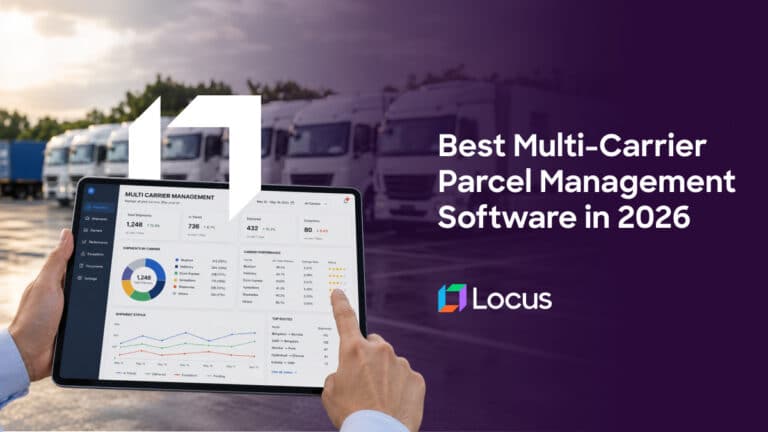
General
Best Multi-Carrier Parcel Management Software for Enterprise Logistics in 2026
Jul 2, 2026
The best multi-carrier parcel management software for enterprise logistics in 2026 is Locus ShipFlex, featured as a Representative Vendor in the 2026 Gartner Multi-Carrier Parcel Management Solutions Market Guide. ShipFlex orchestrates 1,000+ pre-integrated carriers globally through the DiSCO framework, unifying captive, 3PL, gig, and specialized carrier networks under one operational architecture.
Read moreInsights Worth Your Time



















Best Fleet Management Software for Logistics in 2026