


General
10 Best Fleet Dispatching Software for Enterprise Logistics in 2026

Key Takeaways
- Fleet dispatching software automates order-to-vehicle assignment, multi-constraint route optimization, real-time re-dispatch, and proof of delivery across owned and contracted fleets.
- It gives enterprise logistics teams a single system to orchestrate dispatch decisions across hubs, fleet types, and carrier partners.
- Enterprise buyers should evaluate platforms on AI dispatch depth, dynamic mid-route re-optimization, integration with OMS, WMS, and ERP, sustainability reporting, and scalability across high-volume operations.
- Point solutions like Onfleet, Route4Me, Routific, and OptimoRoute fit SMB and mid-market operations, while Locus, FarEye, LogiNext, Shipsy, DispatchTrack, and Samsara target enterprise logistics networks.
- Locus extends fleet dispatching software into full logistics orchestration. It combines 250+ constraint AI dispatch, dynamic route optimization, and ShipFlex multi-carrier allocation across 1,000+ pre-integrated carriers.
A regional 3PL dispatches 1,200 orders across 80 vehicles daily, using a legacy system that assigns work by zone and vehicle type but cannot factor in real?time load capacity or shifting traffic.
By 11:00 AM, 30% of vehicles are over?capacity while 20% run half?empty, yet the platform cannot re?balance assignments automatically. The four?person dispatch team spends two hours manually rebalancing loads, and by the time new plans are ready, 15% of delivery windows have already closed.
The result is wasted fuel, repeated SLA breaches, and rising “Where is my order?” (WISMO) call volumes, a classic failure pattern for manual and rule?based dispatch at enterprise scale. Fleet dispatching software exists to close this gap by turning reactive, spreadsheet?based planning into continuous, AI?driven orchestration across hubs, fleets, and carrier partners.
This guide cuts through the noise to evaluate the 10 best fleet dispatching platforms built for enterprise scale. It focuses on AI-driven decisioning, integration depth, and the operational control modern logistics teams need.
How We Evaluated These Platforms: The Fleet Dispatch Capability Stack
The Fleet Dispatch Capability Stack is a four-layer framework for evaluating where a platform actually operates, and whether it matches enterprise dispatch complexity.
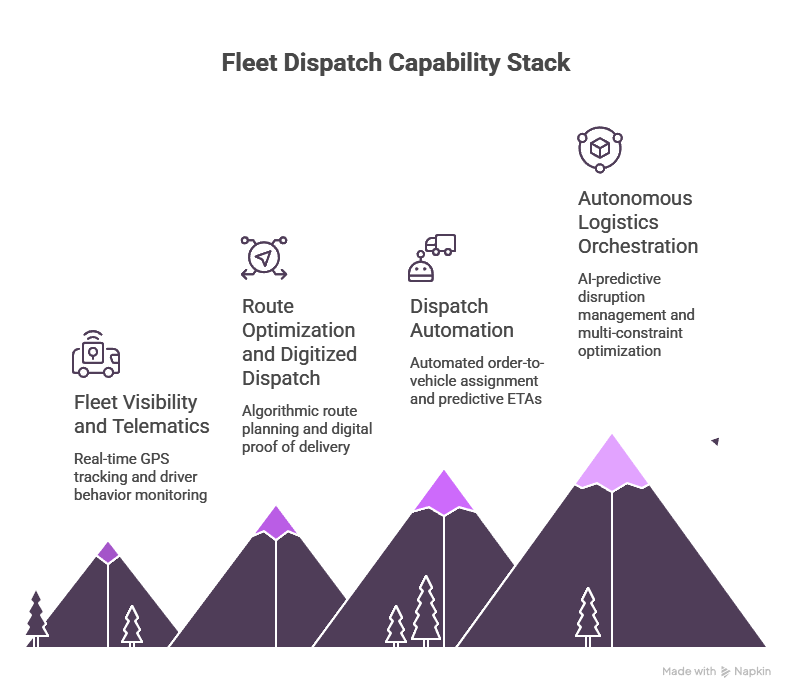
Layer 1 – Fleet visibility and telematics
Real-time GPS tracking, driver behavior monitoring, vehicle diagnostics, and ELD compliance. The platform tells you where your trucks are and how drivers are performing. It does not tell your trucks where they should be. Dispatch features, if present, are bolted on.
Layer 2 – Route optimization and digitized dispatch
Algorithmic route planning at the start of the day, automated driver assignment, digital proof of delivery. Optimizes plans but does not re-optimize once vehicles are on the road or conditions change.
Layer 3 – Dispatch automation
Automated order-to-vehicle assignment, predictive ETAs, constraint-aware scheduling, multi-carrier allocation, and exception workflows. Adapts during execution and supports mixed delivery workflows. May still lack deep upstream connectivity or continuous learning.
Layer 4 – Autonomous logistics orchestration
AI-predictive disruption management, multi-constraint optimization across 250+ variables, upstream connectivity to OMS, WMS, and ERP systems, first-to-last-mile visibility, sustainability-optimized routing, and continuous learning from outcomes.
The platform operates as a strategic orchestration layer across the entire logistics network. Locus sits at Layer 4.
Methodology: How We Selected and Compared Fleet Dispatching Software
This comparison uses the Fleet Dispatch Capability Stack above as the primary evaluation model, then assesses each platform against enterprise buying criteria that materially affect rollout success and long-term operational value.
The evaluation considered:
- Dispatch depth: Whether the platform is built for simple route planning, digitised dispatch, automated exception handling, or full logistics orchestration across hubs, fleets, carriers, and delivery legs.
- Real-time adaptability: The extent to which the system can re-optimise when orders, traffic, driver availability, service windows, vehicle capacity, or customer preferences change during the day.
- Enterprise integration compatibility: Support for API-first deployment, event-driven workflows, and integration with OMS, WMS, ERP, TMS, telematics, CRM, and customer-experience systems.
- Pricing transparency: Whether public pricing is available, whether the vendor uses custom enterprise pricing, and whether free trials or pilot options are published.
- Implementation complexity: Expected rollout effort based on integration scope, operational change management, training requirements, number of hubs, fleet mix, and workflow customisation.
- User feedback signals: Publicly visible review themes from credible third-party review platforms where available. No unverified review scores, private customer quotes, or permission-restricted testimonials are reproduced in this article.
- Enterprise fit: Suitability for high-volume logistics teams with multi-site operations, captive and 3PL fleet mixes, SLA commitments, sustainability reporting needs, and peak-season scalability requirements.
Because public pricing, review ratings, and feature packaging can change, buyers should verify current commercial terms, implementation timelines, and review data directly with each vendor during procurement.
Fleet Dispatching Software vs. Route Optimization, Fleet Management, TMS, and Field Service Tools
Enterprise buyers often group dispatch, routing, telematics, transport management, and field service software into one category. That creates procurement risk because these tools solve different operational problems.
| Category | Primary job | What it typically does well | Why it is not a direct substitute for dispatch orchestration |
| Fleet dispatching software | Assigns orders, drivers, vehicles, and routes in real time | Order-to-vehicle allocation, route sequencing, exception handling, proof of delivery, live re-dispatch | This is the decision layer for daily execution, especially across mixed fleets and high-volume last-mile operations |
| Route optimization software | Calculates efficient route plans | Multi-stop sequencing, distance reduction, time-window planning | Many tools optimise before dispatch but do not continuously re-optimise across live constraints, carrier capacity, and exceptions |
| Fleet management software | Tracks vehicles, drivers, safety, and compliance | GPS, telematics, diagnostics, maintenance, ELD, driver behaviour | It tells teams where assets are and how they perform, but does not usually make complex order-to-fleet dispatch decisions |
| TMS | Manages transportation planning and freight execution | Tendering, freight audit, carrier contracts, shipment documentation, linehaul workflows | A TMS is often strongest upstream and in freight management, but may lack granular last-mile dispatch and driver workflow depth |
| Field service management software | Schedules technicians and service jobs | Appointment scheduling, technician assignment, work orders, service history | It is designed around service visits, not dense delivery networks, load constraints, customer ETAs, and high-frequency re-dispatch |
For enterprise logistics teams, the critical question is not whether a platform has a route map or GPS feed. It is whether it can act as the orchestration layer that continuously balances customer promises, fleet capacity, labour availability, cost, compliance, and service performance.
Fleet Dispatching Software: At a Glance
Here’s a brief overview of the best fleet dispatching software.
| Platform | Best for | Layer | Pricing |
|---|---|---|---|
| Locus | Enterprise logistics orchestration across first-, mid-, and last-mile | L4 | Custom pricing |
| FarEye | Post-purchase delivery experience and parcel orchestration | L3 | Custom pricing |
| LogiNext | Mid-market to enterprise dispatch automation in SEA and MEA | L3 | Custom pricing |
| Shipsy | Cross-border freight and B2B shipment orchestration | L3 | Custom pricing |
| DispatchTrack | Big-and-bulky last-mile delivery and scheduling | L3 | Custom pricing |
| Samsara | Telematics, driver safety, and ELD compliance | L1 | Custom pricing |
| Onfleet | SMB and mid-market last-mile dispatch | L2 | Starts at $619/month |
| OptimoRoute | SMB route planning and field service scheduling | L2 | Starts at $39/driver/month |
| Route4Me | SMB route optimization for small fleets | L1-L2 | Custom pricing |
| Routific | Small-fleet daily route planning | L2 | Starts at $39/vehicle/month |
Third-Party Ratings Snapshot
Third-party review ratings can be useful directional signals, but they should not replace enterprise due diligence. Ratings on G2, Capterra, Gartner Peer Insights, and other review platforms change over time, and product categories are not always mapped consistently across fleet dispatching software, route optimization, telematics, and delivery management software.
The table below avoids estimated ratings. Buyers should verify the latest ratings, review counts, category placement, and review recency directly on the source platforms before making a procurement decision.
| Platform | G2 rating | Capterra rating | Notes for buyers |
| Locus | Not reproduced here; verify directly on G2 | Not reproduced here; verify directly on Capterra | Check reviews for enterprise dispatch depth, integration experience, and rollout support |
| FarEye | Not reproduced here; verify directly on G2 | Not reproduced here; verify directly on Capterra | Review category placement may vary between delivery management and logistics software |
| LogiNext | Not reproduced here; verify directly on G2 | Not reproduced here; verify directly on Capterra | Look for feedback from similar regions and fleet operating models |
| Shipsy | Not reproduced here; verify directly on G2 | Not reproduced here; verify directly on Capterra | Assess reviews separately for freight, cross-border, and last-mile use cases |
| DispatchTrack | Not reproduced here; verify directly on G2 | Not reproduced here; verify directly on Capterra | Review fit for big-and-bulky and appointment-based delivery operations |
| Samsara | Not reproduced here; verify directly on G2 | Not reproduced here; verify directly on Capterra | Distinguish telematics and safety feedback from dispatch orchestration requirements |
| Onfleet | Not reproduced here; verify directly on G2 | Not reproduced here; verify directly on Capterra | Validate SMB and mid-market feedback against enterprise-scale needs |
| OptimoRoute | Not reproduced here; verify directly on G2 | Not reproduced here; verify directly on Capterra | Compare routing and scheduling reviews with real-time dispatch needs |
| Route4Me | Not reproduced here; verify directly on G2 | Not reproduced here; verify directly on Capterra | Check which add-ons are referenced in reviews before comparing functionality |
| Routific | Not reproduced here; verify directly on G2 | Not reproduced here; verify directly on Capterra | Review small-fleet feedback separately from enterprise orchestration requirements |
1. Locus
Layer 4: Autonomous Logistics Orchestration
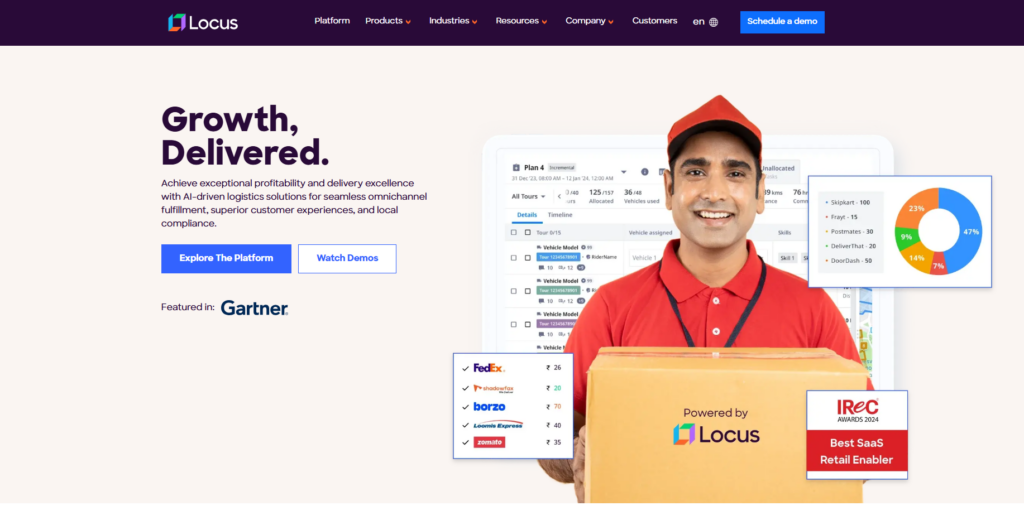
Enterprise fleet operations break the tools built for simpler problems. A retailer dispatching 10,000+ orders daily across multiple hubs, a mix of captive and 3PL carriers, and tight SLA windows cannot be run on static route planners or telematics platforms with dispatch bolted on.
Locus is built for that level of complexity; an agentic enterprise dispatch platform that orchestrates first-mile, mid-mile, and last-mile operations through AI-powered, multi-constraint optimization.
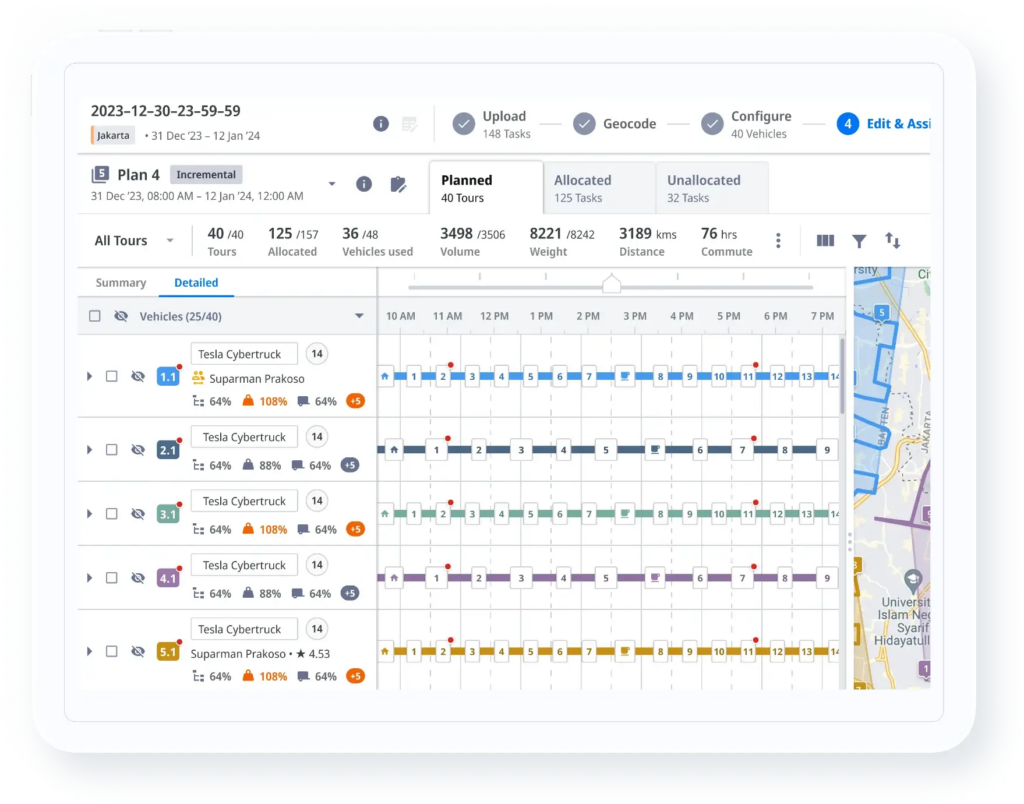
Locus’s dispatch engine factors in 250+ real-world variables simultaneously: vehicle capacity, driver availability, time windows, traffic, load type, service levels, fuel efficiency, and carbon footprint. It recalculates continuously as these conditions change.
Enterprise dispatch also depends on load management and capacity planning. In practical terms, that means accounting for weight, cube or volume, item-count limits, vehicle capacity, service time, delivery sequencing, loading rules, and load balancing across routes. For temperature-controlled, fragile, hazardous, or high-value goods, dispatch logic must also respect handling constraints rather than simply finding the shortest path.
This is where capacity utilisation becomes a dispatch KPI, not just a warehouse planning metric. A capable platform should prevent overloaded vehicles, reduce half-empty routes, and match order profiles to the right vehicle type before drivers leave the hub.
Pickups, deliveries, returns, and cancellations are handled in the same planning cycle. Multi-hub dispatch across captive fleets and contracted carriers is orchestrated through ShipFlex, with 1,000+ pre-integrated carriers available for dynamic allocation.
Key features of Locus
- AI dispatch engine with 250+ constraint variables: Automated order-to-vehicle assignment that factors in capacity, driver hours, time windows, traffic, load type, and SLAs in a single optimization cycle
- Dynamic mid-route re-optimization: Continuous recalculation as cancellations, new orders, driver exceptions, and traffic shifts occur
- Control tower visibility: Real-time shipment-level tracking, predictive ETAs, and exception alerts across first-, mid-, and last-mile legs
- Enterprise integrations: API-first architecture with prebuilt connectors for SAP, Oracle, and leading OMS, WMS, ERP, and TMS systems; no rip-and-replace required
- Sustainability-aware routing: CO2 emissions treated as a dispatch constraint, with built-in environmental impact reporting for procurement and ESG requirements
Locus also supports enterprise integration patterns that commonly include CRM and customer-experience systems such as Salesforce, particularly where delivery preferences, proactive notifications, customer scheduling, and post-purchase workflows must stay aligned with dispatch execution.
For visibility and exception handling, geofencing can be used to trigger automatic arrival and departure events, monitor SLA adherence at stop level, and flag exceptions without relying solely on manual driver updates.
What users commonly mention
No permissioned, platform-specific customer quote is reproduced here. In enterprise evaluations, buyers should validate current third-party review themes directly on credible review platforms and ask Locus for reference calls that match their region, industry, fleet model, and integration scope.
Locus pros
- Full dispatch-to-settlement coverage with dispatch, tracking, carrier allocation, and digital freight settlement in a single platform
- 360+ deployments across 30+ countries, with dispatch logic that accommodates regional compliance, driver hour rules, and vehicle restrictions
- Enterprises can start with dispatch and route optimization and expand to carrier management, settlement, and analytics, reducing onboarding risk
Locus cons
- Built for enterprise operations; small fleets under 20 vehicles may find the platform more capable than required
Locus pricing
Custom enterprise pricing based on volume, number of hubs, fleet size, integrations, and module scope. Enterprises can request a demo to receive a tailored estimate.
Locus is best for
Enterprise retailers, FMCG and CPG brands, 3PLs, and e-commerce operators running high-volume, multi-hub dispatch across captive fleets and carrier partners.
2. FarEye
Layer 3: Dispatch Automation
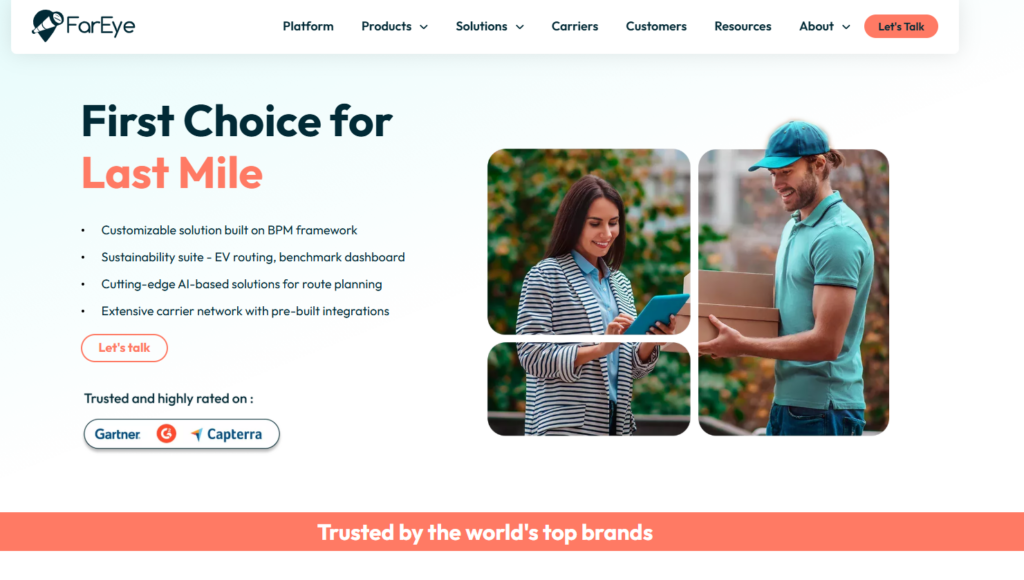
FarEye positions itself as a delivery management platform, strongest in post-purchase customer experience and last-mile visibility for parcel and e-commerce operations. Its carrier integration layer is a genuine advantage for enterprises managing multi-carrier parcel logistics.
Against orchestration-first platforms, FarEye leans more toward delivery experience management than deep AI-based dispatch optimization.
Key features of FarEye
- No-code delivery workflow builder for configuring dispatch and fulfillment processes
- Broad carrier integration layer for multi-carrier parcel operations
- Last-mile visibility dashboards with tracking notifications and delivery preferences
- Returns scheduling and post-purchase customer communication
What users commonly mention
No permissioned, platform-specific customer quote is reproduced here. Buyers evaluating FarEye should review current third-party feedback for themes around post-purchase experience, carrier integrations, workflow configuration, and implementation effort.
FarEye pros
- Strong parcel and e-commerce delivery orchestration for customer-experience-led operations
- Carrier ecosystem breadth for enterprises managing multiple parcel partners
FarEye cons
- Route optimization is less granular than L4 orchestration-first platforms handling dense multi-constraint dispatch
- Integration depth with legacy ERP and TMS stacks can require additional custom development
FarEye pricing
Contact the vendor for a quote.
FarEye is best for
Enterprises whose primary pain is post-purchase customer experience rather than complex fleet dispatch logic across mixed fleets.
3. LogiNext
Layer 3: Dispatch Automation
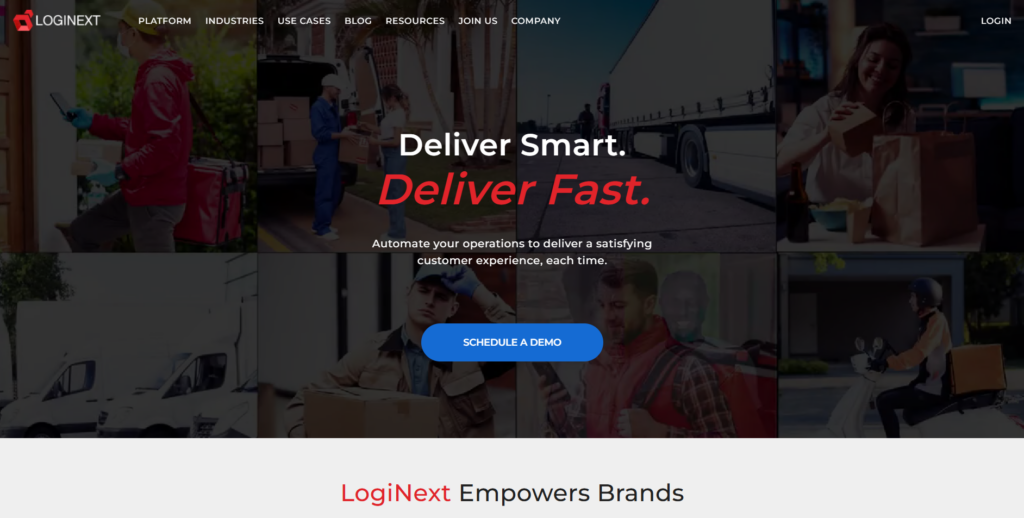
LogiNext is a logistics automation platform offering automated order-to-rider assignment, ETA prediction, and route planning across delivery and field service operations, with strong adoption in Southeast Asia and the Middle East.
Compared against orchestration-first platforms, LogiNext’s dispatch engine handles standard scheduling well but lacks the depth of AI-driven predictive analytics for demand surge management or anomaly detection in high-volume, multi-depot operations. Coverage is stronger in last-mile scheduling than in unified first-mile, mid-mile, and linehaul planning within a single platform.
Key features of LogiNext
- Automated order-to-rider and order-to-driver assignment with ETA prediction
- Route planning across delivery, pickup, and field service use cases
- Driver mobile app with digital proof of delivery
- Carrier and third-party logistics management
What users commonly mention
No permissioned, platform-specific customer quote is reproduced here. Buyers should validate current review themes around rider-based dispatch, ETA accuracy, regional support, configuration effort, and enterprise integration requirements.
LogiNext pros
- Strong mid-market to enterprise presence across SEA and MEA regions
- Effective for standard delivery routing and rider-based dispatch
LogiNext cons
- Limited all-mile coverage within a single platform; stronger in the last-mile than first-mile/mid-mile
- Requires workarounds for complex mixed-fleet scenarios where captive and outsourced carriers must be orchestrated simultaneously
LogiNext pricing
Contact the vendor for a quote.
LogiNext is best for
Mid-market to enterprise logistics teams with operations concentrated in SEA and MEA, running standard rider-based or driver-based last-mile dispatch.
Also read: 10 Best LogiNext Competitors 2026 for Routing and Visibility
4. Shipsy
Layer 3: Dispatch Automation
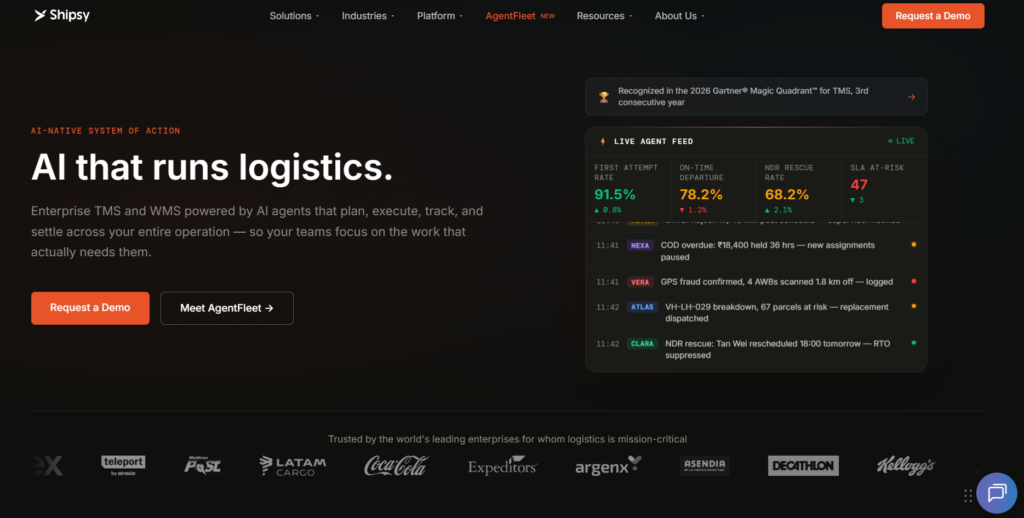
Shipsy is a logistics management platform with dispatch and freight procurement capabilities, strongest in cross-border freight visibility and B2B shipment orchestration. Carrier allocation and rate management are native capabilities, and multi-modal freight visibility is a differentiator for enterprises managing international supply chains.
The engine is built around freight forwarding workflows, which limits its fit for enterprises running hundreds of daily urban and suburban delivery routes that require real-time mid-route re-optimization.
Key features of Shipsy
- Dispatch and fleet management modules with freight procurement and carrier allocation
- Cross-border and multi-modal freight visibility (ocean, air, road)
- Rate management and contract compliance tracking
- B2B shipment orchestration workflows
What users commonly mention
No permissioned, platform-specific customer quote is reproduced here. Buyers should review current third-party feedback for freight visibility, cross-border execution, carrier allocation, and the fit between freight workflows and last-mile dispatch requirements.
Shipsy pros
- Genuine strength in cross-border logistics and multi-modal freight visibility
- Integrated freight procurement and carrier allocation reduce manual negotiation cycles
Shipsy cons
- Less depth in real-time dynamic route re-optimization for last-mile operations vs. L4 orchestration platform
- Better fit for freight forwarding than high-frequency urban dispatch
Shipsy pricing
Contact the vendor for a quote.
Shipsy is best for
Enterprise shippers and 3PLs managing multi-modal, cross-border freight and B2B shipment orchestration.
5. DispatchTrack
Layer 3: Dispatch Automation
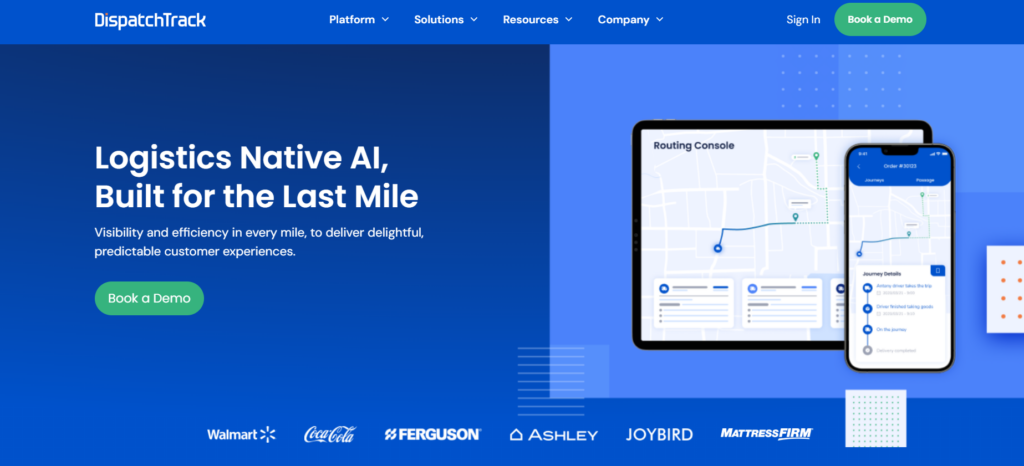
DispatchTrack is a last-mile delivery management platform with particular strength in big-and-bulky segments. For example, furniture, appliances, building materials, and scheduled home delivery. Its scheduling engine, customer communication workflows, and proof-of-delivery tooling are mature for appointment-based delivery operations.
Against orchestration-first platforms, DispatchTrack’s dispatch engine is less oriented toward multi-constraint AI optimization at enterprise dispatch density (hundreds of stops per route, mixed captive and 3PL fleets, cross-leg coordination).
Key features of DispatchTrack
- Route planning and scheduling for appointment-based deliveries
- Customer communication with live ETAs and self-service rescheduling
- Electronic proof of delivery (ePOD) with photo and signature capture
- Driver mobile app and reporting dashboards
Barcode proof of delivery can also be important for big-and-bulky and high-value delivery workflows where item-level verification is required at handover, not just stop-level completion.
What users commonly mention
No permissioned, platform-specific customer quote is reproduced here. Buyers should validate current review themes around appointment scheduling, customer communication, self-service rescheduling, driver usability, and implementation support.
DispatchTrack pros
- Strong fit for big-and-bulky and scheduled home-delivery use cases
- Mature customer communication and rescheduling workflows
DispatchTrack cons
- AI dispatch depth is lighter than L4 orchestration-first platforms for high-density, multi-constraint routing
- Limited upstream OMS/WMS/ERP orchestration vs. full logistics platforms
DispatchTrack pricing
Contact the vendor for a quote.
DispatchTrack is best for
Retailers and 3PLs running big-and-bulky, appointment-based last-mile delivery where scheduling precision and customer communication are the primary pain points.
6. Samsara
Layer 1: Fleet Visibility and Telematics

Samsara is a connected operations platform built around telematics. It includes real-time GPS tracking, AI-powered dashcams, driver behavior monitoring, vehicle diagnostics, maintenance alerts, and ELD compliance.
This is the critical education point buyers often miss: Samsara tells you where your trucks are and how your drivers are performing. There is no native multi-carrier orchestration, carrier rate management, or freight settlement, and AI-driven dynamic dispatch optimization is limited.
Key features of Samsara
- Real-time GPS tracking and vehicle diagnostics
- AI-powered dashcams and driver behavior monitoring
- ELD compliance and driver hours management
- Maintenance alerts and asset health dashboards
What users commonly mention
No permissioned, platform-specific customer quote is reproduced here. Buyers should separate reviews about telematics, dashcams, safety, and ELD compliance from reviews that specifically assess dispatch planning and orchestration.
Samsara pros
- Category-leading telematics and driver safety tooling at enterprise scale
- Strong ELD and compliance coverage for regulated trucking operations
Samsara cons
- Dispatch is a secondary feature, not the core engine; limited depth vs. L4 orchestration-first platforms
- No native multi-carrier orchestration or freight settlement for enterprises managing mixed captive and 3PL fleets
Samsara pricing
Contact the vendor for a quote.
Samsara is best for
Enterprises where telematics, driver safety, and ELD compliance are the primary technology priorities, typically in trucking, field service, construction, and utilities.
7. Onfleet
Layer 2: Route Optimization and Digitized Dispatch
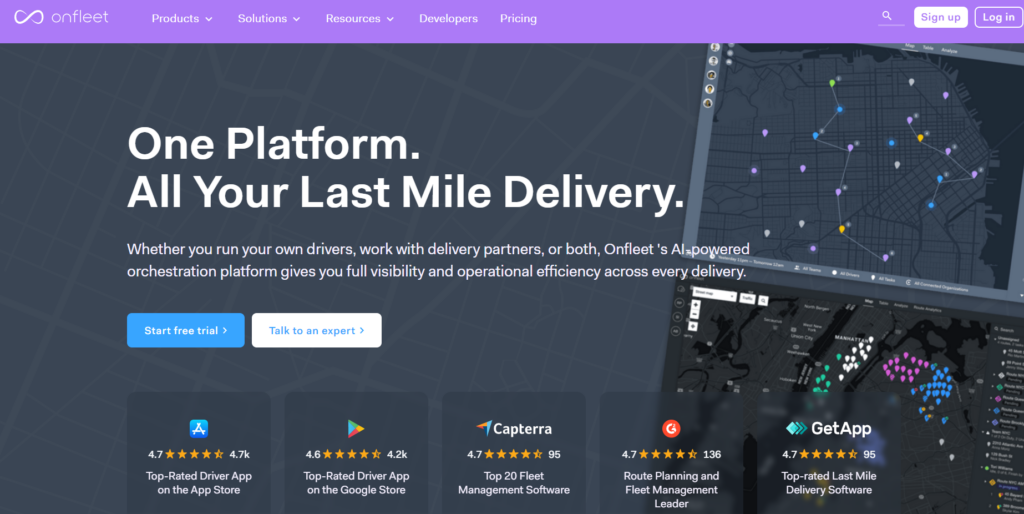
Onfleet is a widely adopted last-mile delivery platform serving SMB and mid-market operators across food delivery, grocery, pharmacy, retail, and courier segments. It offers clean dispatch workflows, route optimization, a solid driver app, and customer-facing tracking notifications.
For the SMB and mid-market segment, Onfleet is well-built and fast to deploy. It is lighter on the capabilities enterprise dispatchers need: multi-constraint AI handling 250+ variables, upstream OMS/WMS/ERP integration, multi-carrier allocation across captive and contracted fleets, and sustainability reporting.
Key features of Onfleet
- Driver dispatch and route optimization for last-mile
- Real-time tracking with customer notifications
- Proof of delivery with photo and signature capture
- API and developer-friendly integrations
For regulated or item-level delivery environments, buyers should confirm whether barcode proof of delivery, chain-of-custody capture, and exception reason codes meet their operational requirements.
What users commonly mention
No permissioned, platform-specific customer quote is reproduced here. Buyers should review current third-party feedback around ease of use, driver app experience, notification workflows, API usage, and limits at higher dispatch complexity.
Onfleet pros
- Fast deployment and clean, modern UX for dispatchers and drivers
- It includes driver–customer chat for quick issue resolution
Onfleet cons
- No deep AI dispatch engine; route optimization is planning-time oriented
- Limited enterprise integrations and no multi-carrier orchestration for mixed-fleet enterprise operations
Onfleet pricing
Based on Onfleet’s official pricing page, the platform is offered in three tiers: Launch at $619 per month, Scale at $1,349 per month with advanced route optimization and auto-dispatch features, and Enterprise at $3,099 per month. A 14-day free trial is available.
Onfleet is best for
SMB and mid-market operators in food delivery, grocery, pharmacy, retail, and courier segments running standard last-mile dispatch.
Also read: Locus vs. Onfleet: Choosing the Right Delivery Management Platform
8. OptimoRoute
Layer 2: Route Optimization and Digitized Dispatch
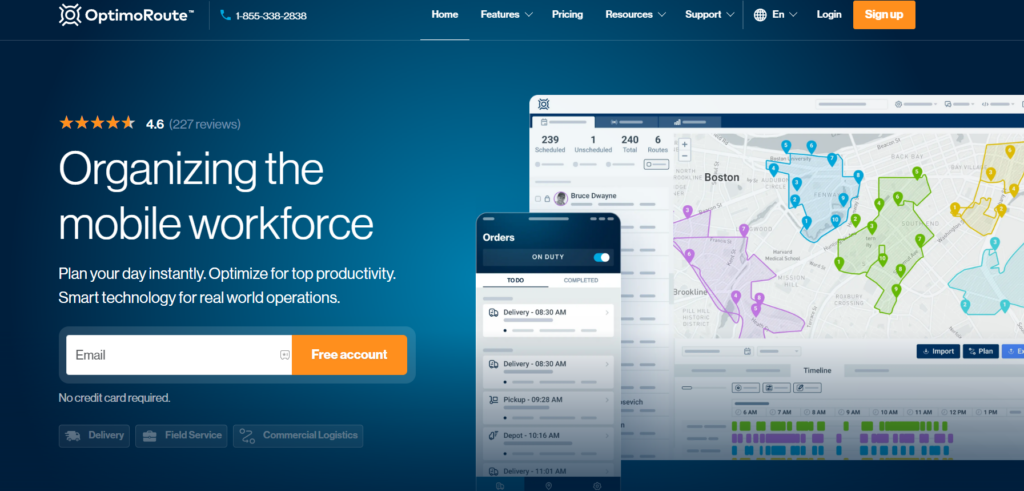
OptimoRoute is a route planning and scheduling platform serving SMB and mid-market delivery and field service teams. It optimizes multi-stop routes, plans schedules days or weeks in advance, and offers a driver mobile app with ePOD.
It is effective for its segment but does not extend into the dispatch orchestration territory enterprises need. Real-time dynamic re-dispatch, multi-carrier orchestration, and upstream enterprise system integration are lighter than in L3 and L4 platforms.
Key features of OptimoRoute
- Multi-stop route optimization and advanced scheduling
- Real-time order tracking and customer notifications
- Analytics and planned-vs-actual reporting embedded in the platform
What users commonly mention
No permissioned, platform-specific customer quote is reproduced here. Buyers should validate current review themes around scheduling flexibility, planned-versus-actual reporting, driver adoption, and suitability for delivery versus field service use cases.
OptimoRoute pros
- Strong route planning and multi-day scheduling capabilities for small-to-mid fleets
- Transparent per-driver pricing and fast setup
OptimoRoute cons
- Limited AI-driven dynamic re-optimization during execution vs. L3/L4 platforms
- No native multi-carrier or enterprise OMS/WMS/ERP orchestration
OptimoRoute pricing
According to OptimoRoute’s official pricing page, the platform offers three plans: Lite at $39 per driver/month, Pro at $49 per driver/month, and a Custom plan (pricing available on request). A 30-day free trial is offered.
OptimoRoute is best for
SMB and mid-market delivery and field service teams that need strong route planning and scheduling without enterprise orchestration complexity.
9. Route4Me
Layer 1-2: Route Optimization
Route4Me is a route optimization platform serving small fleets, owner-operators, and field service teams. Its multi-stop routing, driver app, and add-on marketplace give small operators flexibility to configure the tool to their workflow.
For small fleets, Route4Me is practical and accessible. It is not positioned to handle enterprise dispatch complexity with multi-hub orchestration, mixed captive and 3PL fleets, and continuous mid-route re-optimization across hundreds of constraints.
Key features of Route4Me
- Multi-stop route optimization for small fleets
- Driver mobile app with navigation and proof of delivery
- Add-on marketplace for additional capabilities
- Basic fleet tracking and reporting
Buyers with item-level delivery verification needs should confirm support for photo, signature, barcode proof of delivery, and exception capture within the driver workflow.
What users commonly mention
No permissioned, platform-specific customer quote is reproduced here. Buyers should review current third-party feedback for route planning usability, add-on costs, mobile app experience, and how pricing scales as more enterprise-like functionality is required.
Route4Me pros
- Accessible pricing and flexibility for small fleets
- Modular add-ons let teams scale features to their needs
Route4Me cons
- The core platform is route planning, not AI dispatch orchestration
- Pricing can scale steeply as add-ons are layered on for enterprise-like functionality
Route4Me pricing
The vendor mainly uses a custom pricing model tailored to business needs, structured across Route Optimization, Business Optimization, and Enterprise Optimization plans.
Route4Me is best for
Small fleets, owner-operators, and mid-market field service teams looking for straightforward route optimization without enterprise orchestration needs.
Also read: How AI-Powered Order Orchestration Transforms Fulfillment Speed
10. Routific
Layer 2: Route Optimization
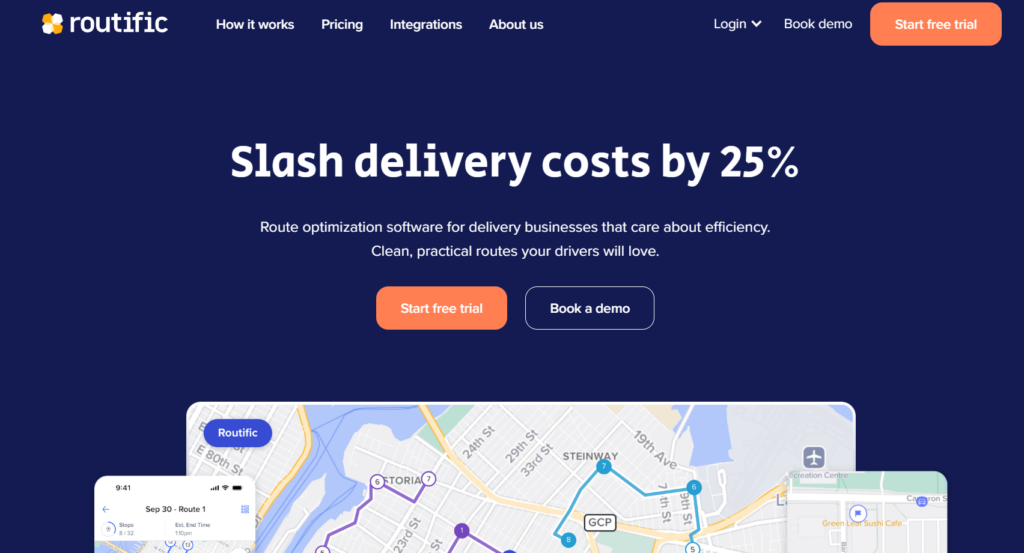
Routific is a route planning platform built for small delivery fleets that need fast, visual daily route optimization. Its strengths are simplicity, a clean planning interface, and quick time-to-value for operators managing a handful to a few dozen vehicles.
For its target segment, Routific is effective. It is not built for enterprise dispatch: no AI-driven dynamic re-dispatch across 250+ constraints, no multi-carrier orchestration, and limited upstream enterprise integration.
Key features of Routific
- Daily multi-stop route optimization
- Driver mobile app with delivery updates and GPS
- Automated customer notifications and predictive ETAs
What users commonly mention
No permissioned, platform-specific customer quote is reproduced here. Buyers should validate current third-party feedback around ease of setup, small-fleet routing, customer notifications, and limitations for complex enterprise dispatch environments.
Routific pros
- Fast setup and simple UX for small-fleet operators
- Automatically accounts for traffic, busy roads, and real-world conditions
Routific cons
- No AI dispatch engine or dynamic mid-route re-optimization
- Limited enterprise integration and no multi-carrier orchestration
Routific pricing
The vendor follows a tiered, usage-based pricing model: up to 100 orders per month are free, while 101-1,000 orders are priced at $150 per month. Beyond that, per-order rates decrease with volume: $0.15 (1,001-2,000), $0.13 (2,001-3,000), $0.10 (3,001-5,000), $0.08 (5,001-10,000), $0.05 (10,000-20,000), and $0.03 (20,001-50,000). Custom pricing applies for volumes exceeding 50,000 orders per month.
Routific is best for
Small delivery fleets and local operators needing simple, fast daily route planning without enterprise complexity.
How to Choose Fleet Dispatching Software by Fleet Size, TCO, and Rollout Risk
The right fleet dispatching software depends less on feature volume and more on operational fit. Before shortlisting vendors, enterprises should map the software decision to fleet size, delivery density, fleet ownership model, integration complexity, and rollout risk.
Use these criteria before entering demos:
- Fleet size and dispatch density: A 20-vehicle local fleet may need route planning and driver tracking. A 500-vehicle multi-hub network needs orchestration across depots, regions, vehicle classes, carrier partners, and service-level commitments.
- Owned vs 3PL fleet mix: If delivery is split across captive fleets, contracted carriers, gig networks, and regional partners, the platform must support allocation rules, carrier visibility, performance tracking, and exception workflows across all parties.
- Total cost of ownership: Evaluate subscription fees, implementation services, integrations, API usage, add-on modules, mobile app licences, telematics connectivity, analytics packages, support tiers, and internal IT effort.
- Free trials, pilots, and proof-of-value: Public free trials are common in SMB tools, while enterprise platforms typically use structured pilots or scoped proof-of-value engagements. Buyers should define success metrics before the pilot starts.
- Onboarding timeline: Ask how long it takes to launch one hub, add more depots, integrate upstream systems, train dispatchers, onboard drivers, and scale to peak volumes.
- Training and change management: Dispatcher adoption, driver app usability, exception management discipline, and standard operating procedures determine whether optimisation logic translates into operational results.
- Integration compatibility: Validate connections to OMS, WMS, ERP, TMS, telematics, CRM, Salesforce, customer notification systems, payment systems, and carrier networks before contracting.
- Data readiness: Dispatch automation depends on accurate order data, addresses, delivery windows, vehicle capacity, driver shifts, service times, and constraint rules.
- Scalability and resilience: Confirm peak-order handling, multi-region performance, failover processes, role-based access, audit logs, and security controls.
Driver Mobile App Requirements for Fleet Dispatching
The driver mobile app is where dispatch plans meet real-world execution. If the app is slow, unclear, or unreliable, even the best routing algorithm will lose value in the field.
Enterprise buyers should evaluate whether the driver app supports:
- Turn-by-turn navigation: Integrated navigation and route guidance that reflect the latest stop sequence.
- Stop sequencing: Clear next-stop instructions and route changes when dispatchers re-optimise mid-route.
- Job details: Order information, customer notes, delivery preferences, service instructions, package details, and special handling requirements.
- Status updates: Simple status capture for en route, arrived, completed, failed, delayed, returned, or partially delivered stops.
- Driver-dispatcher communication: In-app messaging or structured exception workflows to avoid phone-based coordination.
- Offline support: Ability to continue execution in low-connectivity zones and sync data when the network returns.
- Proof of delivery: Photo, signature, barcode proof of delivery, timestamp, GPS location, and recipient details.
- Exception capture: Reason codes, damaged goods capture, customer unavailable workflows, failed delivery evidence, and return-to-origin instructions.
- Usability at scale: Minimal taps, multilingual support where needed, device compatibility, and low training overhead for temporary or third-party drivers.
Customer Notification Workflows and WISMO Reduction
Fleet dispatching software should not only optimise routes internally; it should also reduce uncertainty for customers. Strong notification workflows directly lower “Where is my order?” (WISMO) calls by keeping customers informed without requiring contact-centre intervention.
Key workflows include:
- SMS and email notifications: Order confirmed, out for delivery, next stop, delayed, delivered, failed delivery, and rescheduled updates.
- Live tracking links: Customer-facing tracking pages with driver progress, ETA, and delivery status.
- ETA alerts: Predictive ETA updates that change as traffic, route sequence, or service times shift.
- Delay notifications: Proactive communication when a route slips outside the promised window.
- Customer scheduling portal: Self-service slot selection, rescheduling, delivery preferences, and access instructions for appointment-based workflows.
- Exception workflows: Customer unavailable, address issue, payment pending, restricted access, or partial delivery scenarios.
- Delivery confirmation: Proof-of-delivery confirmation with relevant completion details.
The operational benefit is twofold: customers receive fewer surprises, and dispatch teams spend less time answering avoidable status calls.
Reports and Analytics Metrics to Compare
Fleet dispatching software should make operational performance measurable at the level of routes, drivers, depots, carriers, customers, and delivery promises. During evaluation, buyers should compare the analytics layer as carefully as the optimisation engine.
Important metrics include:
- Cost per stop and cost per delivery: Core measures for dispatch efficiency and network productivity.
- Fuel consumption and fuel monitoring: Track how route efficiency, idle time, distance, and driving behaviour affect operating cost and emissions.
- On-time delivery and SLA adherence: Measure whether promised delivery windows are being protected at customer, route, hub, and carrier level.
- Failed delivery rate: Identify preventable failures caused by address quality, poor customer communication, sequencing issues, or capacity constraints.
- Vehicle utilisation: Monitor capacity usage by weight, cube, item count, route hours, and distance.
- Routing errors: Detect poor sequencing, unnecessary detours, infeasible routes, and recurring planning exceptions.
- Driver performance: Use driver scorecards for on-time performance, route adherence, safety behaviour, service quality, proof-of-delivery compliance, and exception rates.
- Carrier performance: Compare third-party carriers by acceptance rate, SLA performance, failure rate, cost, and service quality.
- Exception trends: Understand where delays, cancellations, failed deliveries, and re-dispatch events are concentrated.
- Emissions reporting: Track route-level and network-level environmental impact where sustainability is a procurement or regulatory requirement.
Enterprise Buyer Checklist: 10 Questions to Ask Every Fleet Dispatching Vendor
Use this list on every demo. It is designed to surface the difference between a telematics platform with dispatch bolted on, a route planner, and a true orchestration engine:
- How does the platform handle real-time, dynamic dispatch when orders, traffic, or constraints change mid-day?
- What level of AI or automation powers dispatch decisions versus manual rule-based planning?
- Can the system optimize across multiple depots, fleets, and regions simultaneously?
- How does it manage multi-carrier or hybrid fleet operations (in-house + third-party)?
- What depth of integration is available with ERP, WMS, OMS, and telematics systems?
- How granular is route optimization (time windows, driver shifts, vehicle capacity, service times, etc.)?
- Does the platform provide a centralized control tower with real-time visibility and exception handling?
- How does it measure and improve key KPIs like cost per delivery, on-time rates, and fleet utilization?
- Can workflows be customized for specific industry needs (e.g., retail, FMCG, 3PL)?
- What scalability benchmarks exist (orders per day, geographies covered, peak load handling)?
For question 07, buyers should also ask whether geofencing is supported for automatic arrival and departure detection, stop-level SLA monitoring, and exception triggers when a vehicle deviates from the planned route or service window.
What Enterprise Fleet Dispatch Looks Like in 2026
For SMB and mid-market operations, tools like Onfleet, OptimoRoute, Route4Me, and Routific are practical and fast to deploy.
On the other hand, for enterprise logistics, FarEye, LogiNext, Shipsy, DispatchTrack, and Samsara each serve a niche. This includes parcel experience, regional coverage, cross-border freight, big-and-bulky, and telematics respectively, but operates at Layer 1 to Layer 3 of the Fleet Dispatch Capability Stack.
Locus sits at Layer 4: autonomous logistics orchestration. Multi-constraint AI dispatch across 250+ variables, ShipFlex multi-carrier allocation across 1,000+ pre-integrated carriers, control-tower visibility across first-, mid-, and last-mile, and sustainability-aware routing. It is built for enterprise retailers, FMCG, CPG brands, and 3PLs running high-volume, multi-hub operations.
See the Locus dispatch engine run against your actual order volume and fleet mix. Schedule a demo with Locus today.
Frequently Asked Questions (FAQs)
1. What is fleet dispatching software?
Fleet dispatching software is the system that assigns orders to vehicles and drivers, optimizes routes against multiple constraints, and re?dispatches dynamically when conditions change. It replaces manual spreadsheets and phone?based planning with automated, AI?supported decision?making for pickup, delivery, and return workflows.
2. How is fleet dispatching software different from fleet management software?
Fleet dispatching software decides where trucks should go (order?to?vehicle assignment, route optimization, real?time re?dispatch), while fleet management software focuses on where trucks are (GPS tracking, diagnostics, driver behavior, maintenance, ELD). The two categories overlap in tracking, but dispatch software is the decision engine, and fleet management is the visibility and compliance layer.
3. How does AI dispatch reduce cost compared with manual or rules-based dispatching?
AI dispatch reduces cost by simultaneously optimizing hundreds of constraints (capacity, time windows, driver hours, traffic) that no human dispatcher can handle at scale. This cuts empty miles, lowers fuel and overtime, increases SLA adherence, and reduces manual re?balancing. Compared with manual dispatch, enterprises typically see measurable reductions in per?delivery cost within 6–12 months.
4. What integrations should enterprise buyers look for in a fleet dispatching platform?
Enterprise buyers should look for native, pre?built connectors to OMS, WMS, ERP, and TMS, including systems like SAP and Oracle, plus API?first architecture and event?driven webhooks. They should also check for pre?integrated carrier networks so dispatching, carrier allocation, and freight settlement can run on a single orchestration layer instead of siloed tools.
5. How does a dispatch platform handle real-time disruptions like cancellations, traffic, and driver exceptions?
A modern dispatch platform handles real?time disruptions by re?optimizing assignments and routes across the active fleet as events occur. When an order is cancelled, traffic slows a route, or a driver becomes unavailable, the engine recalculates the best allocation of stops, vehicles, and sequences across all constraints, reducing manual rebalancing and protecting SLA performance.
6. What does a typical enterprise deployment timeline look like?
A typical enterprise deployment runs in phases over 8–16 weeks: dispatch and route optimization go live first, followed by carrier orchestration, freight settlement, and analytics. A modular rollout lets operations validate workflows in one hub or region, then scale across the network while minimizing disruption to drivers, dispatchers, and IT systems.
7. How does Locus compare with other fleet dispatching platforms?
Locus operates at the highest level of the Fleet Dispatch Capability Stack, combining multi?constraint AI dispatch, dynamic mid?route re?optimization, multi?carrier allocation across 1,000+ carriers, control?tower visibility across first?, mid?, and last?mile, and sustainability?aware routing. Other platforms mostly focus on telematics, last?mile visibility, or route planning, not full logistics orchestration.
8. What should enterprises check before buying fleet dispatching software?
Enterprises should check fleet-size fit, owned versus 3PL fleet mix, total cost of ownership, pilot or free-trial options, onboarding timeline, dispatcher and driver training needs, mobile app usability, analytics depth, and integration compatibility with OMS, WMS, ERP, TMS, telematics, CRM, Salesforce, and carrier systems.


General
The Delivery Promise Paradox: Why UK Retailers Keep Promising Speed Their Networks Can’t Support

Apr 24, 2026
UK retailers promise one-hour delivery their networks can't support. New research shows a 104.5% increase in delays on fast promises — and what's really breaking.
Read more
General
The Digital Twin ROI Question: A CTO’s Guide to Evaluating Supply Chain Simulation
Apr 27, 2026
Honest evaluation framework for CTOs assessing supply chain digital twins — what works, what's hype, and how to size ROI before committing capital.
Read moreInsights Worth Your Time



















10 Best Fleet Dispatching Software for Enterprise Logistics in 2026