


General
The Future of the Fleet Management Market: Trends to Watch for 2026 and Beyond
Key Takeaways
- The fleet management market is valued between USD 27 billion and USD 37.71 billion in 2025, with projections reaching USD 70.26 billion by 2030 and up to USD 122.3 billion by 2035.
- Fleet management in 2026 is driven by rising operating costs, tighter delivery timelines, and increasing regulatory requirements that directly affect daily planning and execution decisions.
- Accurate planning and real-time execution visibility play a central role in controlling costs, maintaining service reliability, and managing variability across complex fleet networks.
- Sustainability and compliance considerations now shape routing logic, vehicle allocation, and delivery commitments—making them integral to operational planning rather than separate initiatives.
- Cloud-based fleet management solutions are projected to grow at the highest CAGR of 14% from 2026 to 2035, reflecting the industry’s shift toward scalable, SaaS-based platforms.
- Manual coordination and disconnected tools limit scalability, increase execution risk, and make it harder for fleet teams to manage growing volumes and regional complexity.
- Fleet leaders are evaluating platforms like Locus that connect planning, dispatch, and execution into a single operational layer to support consistent performance at scale.
As a fleet leader, you’re navigating an operating environment defined by higher costs, stricter regulatory oversight, and mounting pressure to drive efficiency and sustainability. The fleet management market reflects this urgency—valued between USD 27 billion and USD 37.71 billion in 2025, the global market is projected to reach USD 70.26 billion by 2030, growing at a compound annual growth rate (CAGR) of 13.3% or higher.
This growth isn’t abstract. It signals that fleet decisions about routing, asset utilization, maintenance, and compliance now directly impact margins and service reliability at scale. Many organizations are evaluating new technologies, sustainability initiatives, and compliance frameworks without a clear view of their long-term operational impact.
This article outlines the key trends shaping the fleet management market in 2026 and beyond, explains how they affect your fleet operations, and highlights what decision-makers should prioritize moving forward.
For Heads of Logistics, Operations, and Digital Transformation in enterprise fleets—especially those in retail, 3PL, and manufacturing—this guide is tailored to your daily challenges.
Quick Answer: What Are the Biggest Fleet Management Trends in 2026?
The biggest fleet management trends in 2026 are AI-assisted planning and dispatch, predictive maintenance, connected vehicles and telematics, EV/hybrid/ICE/3PL mixed-fleet orchestration, real-time compliance, cybersecurity and data governance, cloud-native platform consolidation, driver safety and retention, sustainability-led routing, and autonomous-readiness planning.
What to implement now, scale selectively, prepare for, and govern continuously
- Implement now: visibility, digital dispatch, route optimisation, core integrations, compliance workflows, preventive maintenance, proof of delivery, and exception management.
- Scale selectively: predictive maintenance, AI-assisted dispatch, EV optimisation, charging-aware planning, driver analytics, and workload balancing.
- Prepare for: autonomous operations, digital twins, agentic AI, advanced simulation, and connected-vehicle data ecosystems.
- Govern continuously: cybersecurity, privacy, data quality, model explainability, human oversight, audit readiness, and regional compliance.
What fleet management means in this article
- Fleet management covers planning, operating, monitoring, maintaining, and optimising vehicles, drivers, and service commitments.
- Telematics is the vehicle and driver data capture layer.
- Transportation management (TMS) handles broader transportation planning and execution across modes and carriers.
- Dispatch management is the operational process of assigning and controlling work during execution.
- Last-mile delivery management covers ETA accuracy, customer communication, proof of delivery, failed-delivery reduction, and on-ground exceptions.
Editorial note
This article combines third-party market and benchmarking data with Locus operational analysis. Market figures are sourced from their original publishers where linked. Locus is a delivery orchestration software provider, and product references in later sections reflect that perspective.
Fleet Management Market Size, Growth, and Forecast
Understanding the scale and trajectory of the fleet management market helps you contextualize the operational shifts happening across the industry. Multiple research firms have published 2025–2030 valuations with extended forecasts through 2035, and while methodologies vary, the growth signals are consistent.
2025 Market Valuations
| Research Firm | 2025 Market Valuation | Source |
|---|---|---|
| Global Market Insights | USD 27 billion | GMI, 2026 |
| Precedence Research | USD 29.30 billion | Precedence, 2026 |
| MarketsandMarkets | USD 37.71 billion | M&M, Jan 2026 |
The variance reflects differences in geographic scope, segment inclusion, and methodology. However, convergence around USD 27–37 billion confirms fleet management as a large and mature technology market.
Growth Projections Through 2030 and Beyond
The fleet management market is projected to reach USD 70.26 billion by 2030 at a 13.3% CAGR (MarketsandMarkets), with extended forecasts from Global Market Insights indicating the market could reach USD 122.3 billion by 2035 at a 16.9% CAGR.
Precedence Research projects an even wider trajectory—USD 76.33 billion by 2035 at a 10.05% CAGR—while some firms forecast the market crossing USD 150 billion by 2036.
Key Market Segments
Several segmentation patterns define where investment and adoption are concentrating:
- Commercial vehicle fleets dominated the market with a 73.8% revenue share in 2025, driven by logistics, distribution, and field service operations.
- The solutions segment held 65% market share in 2025, underscoring buyer preference for integrated platforms over point tools.
- Cloud-based (SaaS) deployment is expected to grow at the highest CAGR of 14% from 2026 to 2035, reflecting the industry’s shift toward scalable, subscription-based fleet technology.
- Large and enterprise fleets (20–50+ vehicles) command approximately 50% of the market, driven by their need for comprehensive solutions to manage complex multi-vehicle operations.
- North America holds the largest regional share, while Asia-Pacific is the fastest-growing region—fueled by rapid e-commerce expansion and infrastructure investment.
These market dynamics underscore a clear shift: fleet management is no longer a back-office function. It’s a strategic investment area where technology decisions have a direct, measurable impact on operating margins and service reliability.
Trend Summary Table: Fleet Management Trends in 2026
| Trend | What it means | Operational impact | Maturity/Priority | Technology requirement | KPIs affected | Who should act |
| AI-assisted planning and dispatch | AI supports forecasting, ETA prediction, route recommendations, and dispatch decisions | Faster planning cycles, lower manual intervention, better response to disruptions | Scale selectively | Clean order, route, vehicle, and execution data; human-in-the-loop controls | Cost per stop, on-time delivery, dispatch intervention rate, SLA adherence | Operations, dispatch, IT |
| Connected vehicle data and telematics | Vehicle location, diagnostics, utilisation, and driver signals feed live operations | Better visibility, earlier intervention, stronger route adherence | Implement now | Telematics integration, mobile apps, event rules, workflows | Route adherence, vehicle utilisation, customer contact rate, exception response time | Fleet ops, dispatch, IT |
| Predictive maintenance | Maintenance is scheduled from risk signals, not only time-based intervals | Fewer breakdowns, higher vehicle availability, lower unplanned downtime | Scale selectively | Telematics, service records, maintenance systems, failure history | Unplanned downtime, maintenance cost per vehicle, missed SLA, vehicle availability | Fleet ops, maintenance, finance |
| Mixed-fleet orchestration | EV, hybrid, ICE, 3PL, and gig vehicles are assigned by route profile and constraints | Better asset fit, fewer failed assignments, stronger capacity planning | Implement now / scale selectively | Vehicle attributes, carrier capacity visibility, dispatch controls | Asset utilisation, cost per delivery, first-attempt delivery rate | Operations, network planning |
| EV charging optimisation and battery health | Route planning considers range, dwell time, charger capacity, battery condition, weather | More reliable EV scheduling and fewer route failures | Scale selectively | Charging data, route engine, energy model, battery health visibility | Energy use per delivery, charger utilisation, route completion rate | Fleet ops, sustainability, facilities |
| Real-time compliance and audit readiness | Regulations are embedded in planning and documentation workflows | Lower compliance risk and less manual rework | Implement now | Rules engine, proof of delivery, driver app, retention policies | HOS breaches, audit exceptions, overtime, route feasibility | Compliance, operations, legal |
| Cybersecurity and data governance | Connected fleets manage API risk, access controls, encryption, privacy, and incident response | Lower operational and reputational risk | Govern continuously | RBAC, SSO, encryption, vendor review, logging, backup workflows | Uptime, incident count, audit pass rate, recovery time | IT, security, procurement |
| Platform consolidation and cloud-native systems | Fleets reduce fragmentation or add orchestration across existing tools | Fewer handoffs, better visibility, stronger standardisation | Implement now | APIs, master data discipline, integration ownership | Planner productivity, data latency, service consistency | CIO, ops, enterprise architecture |
| Video telematics and driver coaching | In-cab and road-facing video supports contextual safety coaching | Fewer incidents, better claim handling, more targeted training | Scale selectively | Dashcams, telematics, policy controls, coaching workflows | Safety incidents, harsh events, insurance claims | Safety, fleet ops, HR |
| Insurance telematics | Driving and risk data influences underwriting and safety interventions | Potential premium benefits and clearer risk segmentation | Scale selectively | Behaviour data, incident tagging, insurer workflows | Claims frequency, loss ratio, safety events | Finance, safety, fleet ops |
| Driver retention and workload fairness | Routes and shifts are balanced with predictability and safety in mind | Lower turnover, reduced overtime, stronger morale | Implement now | Scheduling visibility, route balancing, communication tools | Turnover, overtime, workload variance, driver productivity | Operations, HR, dispatch |
| Autonomous readiness and digital twins | Fleets prepare data, simulation, governance, and exception workflows for future autonomy | Better preparedness without overcommitting to immature deployment | Prepare for | Simulation tools, digital models, connected operations stack | Intervention rate, scenario-readiness, route risk analysis | Strategy, innovation, IT |
Key Fleet Management Industry Trends
The fleet management market’s growth reflects structural changes in how fleets plan, operate, and remain compliant amid rising costs and service pressures. The most influential trends fall across technology adoption, sustainability mandates, regulatory complexity, and data-driven operations.
1. Technological Advancements in Fleet Management
Your fleet teams work with continuous streams of location, vehicle, and delivery data. The operational shift lies in how this data is used within planning and execution workflows—and the fleet management market is responding accordingly with AI-powered and cloud-native platforms.
- Routing and dispatch decisions are increasingly revised during active delivery windows
- Planning teams rely on systems that connect routing, dispatch, and execution data
- Manual coordination becomes harder to sustain as fleet size and delivery density increase
Industry research supports this shift toward decision-support systems. Gartner notes growing enterprise investment in advanced fleet analytics to support operational planning. At the same time, McKinsey highlights measurable improvements in route-planning speed and asset utilization when analytics are embedded in daily operations.
Understanding what is route optimization and how it integrates with broader fleet analytics is increasingly central to this technology shift.
2. Sustainability and Green Fleet Adoption
Sustainability requirements now influence operational planning across many fleets. Decisions about vehicle usage, route design, and delivery sequencing are shaped by fuel-efficiency and emissions considerations.
- Vehicle mix affects route feasibility and delivery commitments
- Fuel consumption is evaluated at route and shift level
- Sustainability metrics increasingly feed into operational reporting
According to the International Energy Agency, commercial fleet electrification and fuel-efficiency initiatives are expanding globally. In addition, Deloitte reports that sustainability considerations are now part of routine planning discussions for the majority of fleet leaders.
3. Regulatory Changes Impacting Fleet Operations
Regulatory oversight continues to expand across safety, emissions, and labor requirements. These rules directly affect how fleets schedule drivers, assign vehicles, and plan routes.
- Driver hour regulations influence shift and route design
- Emission policies vary across regions and cities
- Compliance reporting adds planning constraints for cross-region fleets
As regulatory requirements expand, compliance is becoming a measurable operational cost. PwC’s logistics compliance research highlights this growing cost burden across fleet operations.
4. Data-Driven and Predictive Fleet Operations
Predictive planning plays a larger role in maintenance, capacity planning, and service reliability.
- Maintenance planning increasingly reflects vehicle usage patterns
- Capacity forecasts help reduce service disruptions
- Operational teams use historical and real-time data to guide decisions
Research from IBM shows that predictive maintenance approaches help reduce unplanned downtime by identifying vehicle issues earlier and aligning maintenance with actual usage.
This trend underpins many other changes across cost control, safety, and service reliability.cross cost control, safety, and service reliability.
How Technology Is Reshaping Fleet Operations in 2026
Technology in fleet management now plays a direct role in how daily decisions are made. The focus has shifted to supporting planning accuracy, execution control, and faster response to on-ground changes.
1. Telematics and IoT Integration
Telematics and connected devices provide continuous visibility across vehicles, drivers, and deliveries. Their operational value comes from how this data feeds planning and execution workflows.
- Real-time location and status updates help teams monitor execution against plan
- Vehicle and driver data supports mid-shift route and task adjustments
- Exception alerts allow faster response to delays, breakdowns, or missed milestones
For large fleets, this level of connectivity reduces dependency on manual coordination and fragmented communication. The IoT fleet management market is a key growth segment, directly tied to the solutions category that holds 65% of overall market share.
2. AI and Machine Learning in Fleet Optimization
? MODIFIED SECTION
AI-based models are increasingly used to support repeatable operational decisions across planning cycles. As the fleet management market matures, AI-powered optimization is transitioning from a differentiator to a baseline expectation.
- Route plans reflect demand patterns, capacity constraints, and service commitments
- Dispatch decisions adapt to changing conditions without constant manual input
- Forecasting supports better allocation of vehicles and drivers
These capabilities help your fleet maintain consistency across regions while handling variability in volume, traffic, and delivery windows. Organizations evaluating route optimization benefits are increasingly seeing measurable gains across cost, time, and service reliability.
Sustainability and Green Fleet Initiatives
Sustainability decisions in fleet management now create direct operational constraints. Your fleet teams must account for environmental targets while planning routes, allocating vehicles, and setting delivery commitments. These considerations affect feasibility, cost predictability, and service reliability.
Electrification is one of the most visible changes, but it introduces planning dependencies that fleets must manage carefully. Vehicle range, charging availability, and turnaround time influence how routes are designed and which deliveries can be committed within a shift. The growth of electric vehicle fleet management as a market segment reinforces that this is an infrastructure decision, not a one-off initiative.
Mixed fleets add another layer of complexity, as electric, hybrid, and conventional vehicles follow different planning rules.
Route efficiency has also become a primary focus for sustainability. Fuel consumption and emissions vary significantly based on route length, stop density, idle time, and load balance. Improving these factors requires tighter planning through route optimization rather than post-route reporting.
As a result, sustainability metrics increasingly shape routing logic, shift design, and asset utilization decisions.
Industry research from the International Energy Agency highlights that operational efficiency improvements remain one of the most practical ways to reduce emissions in commercial transport, especially where full electrification is still limited.
Operational Constraints and Cost Implications in Fleet Management
Fleet operations function within tighter regulatory and cost boundaries. Safety rules, labor regulations, and emission policies influence planning decisions across routing, shift design, and vehicle allocation.
Key operational constraints shaping cost outcomes include:
Driver Regulations
- Limits on driving hours and mandatory rest periods affect route length and shift capacity
- Safety monitoring requirements influence driver assignment and scheduling
Emission and Environmental Rules
- Regional emission standards restrict vehicle usage in certain zones
- Reporting requirements add overhead to fuel and mileage tracking
Planning Accuracy and Cost Exposure
- Inefficient routing increases fuel consumption and overtime
- Unplanned downtime raises maintenance and service disruption costs
- Compliance gaps lead to penalties and rework
As these constraints expand, cost control depends on how well they are accounted for during planning rather than addressed after execution. A logistics compliance study by PwC highlights that regulatory adherence is contributing directly to overall fleet operating costs across regions.
For enterprise fleets managing growing volumes, understanding why your business needs route optimization is directly tied to reducing these compounding cost pressures. by PwC highlights that regulatory adherence is contributing directly to overall fleet operating costs across regions.
Improving Driver Safety and Workforce Efficiency
Driver safety and workforce efficiency are closely linked to how fleets plan work and manage variability. Both are influenced less by individual behavior and more by how routes, shifts, and performance expectations are structured.
| Operational Area | What Fleets Experience in 2026 | Why It Matters Operationally |
|---|---|---|
| Workload distribution | Routes and shifts vary widely in length and complexity | Increases driver fatigue, raises safety risk, and impacts service consistency |
| Schedule predictability | Frequent last-minute changes and manual reassignments | Creates stress, execution errors, and lower workforce stability |
| Driving behavior visibility | Safety risks surface after incidents or violations | Limits proactive intervention and structured coaching |
| Performance management | Feedback relies on delayed or incomplete data | Makes it challenging to align drivers with route complexity and experience |
| Driver retention | Irregular schedules and operational friction | Increases turnover and training costs |
To address these challenges, fleets are restructuring how work is planned and monitored.
Advanced driver assistance systems and in-vehicle data provide continuous signals on driving conditions and behavior, supporting earlier risk detection. At the same time, performance management increasingly relies on operational data to match drivers with routes based on experience, workload, and safety requirements. This approach helps fleets improve safety outcomes while maintaining productivity and workforce stability.
What the Fleet Management Market Is Moving Toward
The fleet management market is shifting toward platforms that support consistent planning and execution across regions, volumes, and delivery models. With the market projected to reach USD 70.26 billion by 2030 and potentially USD 122.3 billion by 2035, the investment thesis is clear: fragmented tools struggle to keep up with operational variability and compliance demands at scale.
Buyer focus is moving toward systems that handle routing, dispatch, visibility, and performance monitoring within a single operational layer. The cloud-based SaaS segment growing at the highest CAGR of 14% through 2035 confirms that flexibility in planning logic and the ability to adapt to changing constraints are becoming baseline expectations rather than differentiators.
This shift reflects how fleet technology decisions are now treated as long-term infrastructure choices. The emphasis is on scalability, configurability, and operational continuity rather than short-term feature adoption. Enterprise teams looking to evaluate options should consider how delivery logistics software can improve fleet utilization across their networks.
Preparing for the Future of Fleet Management
Preparing fleets for long-term stability comes down to making deliberate planning and technology choices. As operational complexity increases, incremental fixes tend to create fragmentation rather than clarity.
Key considerations shaping future-ready fleet strategies include:
- Planning with constraints in mind: Routing, capacity, compliance, and sustainability requirements need to be reflected during planning, not adjusted after execution.
- Standardizing decision logic across regions: Consistent planning rules help maintain service levels while allowing for local operational differences.
- Reducing manual intervention: Heavy reliance on manual coordination limits scalability and increases execution risk as volumes grow.
- Evaluating technology as infrastructure: Fleet systems are selected based on their ability to adapt over time, support multiple operating models, and remain stable under growth.
Fleets that approach modernization through these lenses are better positioned to manage cost pressure, regulatory complexity, and service expectations without increasing operational overhead.
How Locus Addresses Emerging Fleet Management Requirements
As fleet operations grow more complex, Locus provides a range of planning, execution, and operational capabilities purpose-built for the scale and variability that define the fleet management market today. The sections below outline how these support your fleet requirements.
- Constraint-based route planning: Locus enables route planning that accounts for real-world constraints such as delivery windows, vehicle capacity, service rules, regional restrictions, and sustainability considerations during planning rather than after execution.
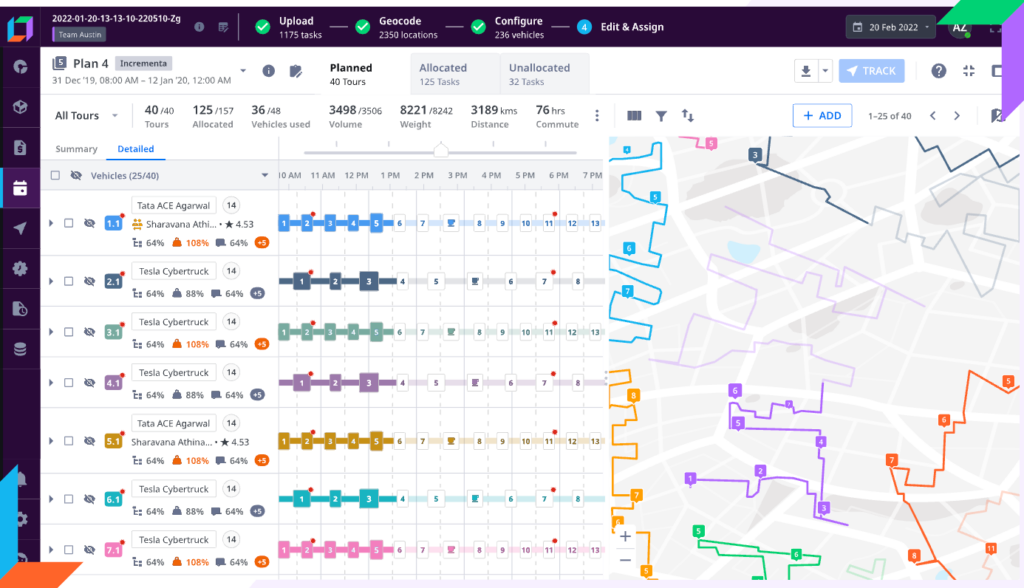
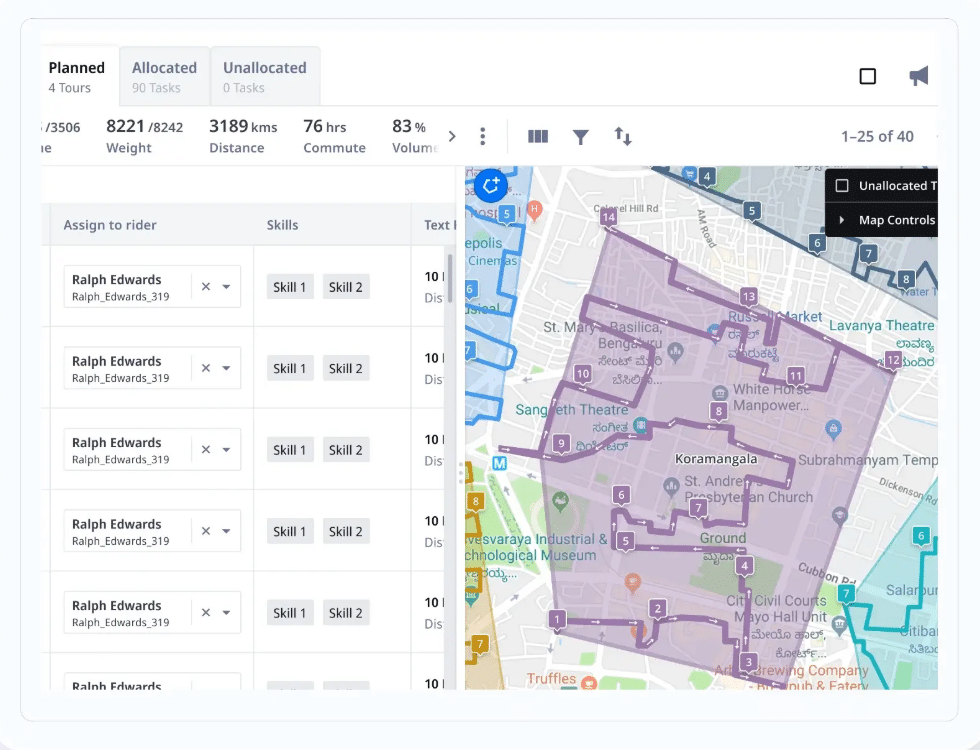
- Scalable dispatch orchestration: Dispatch workflows are designed to operate consistently across regions and fleet sizes, supporting centralized planning with local execution flexibility.
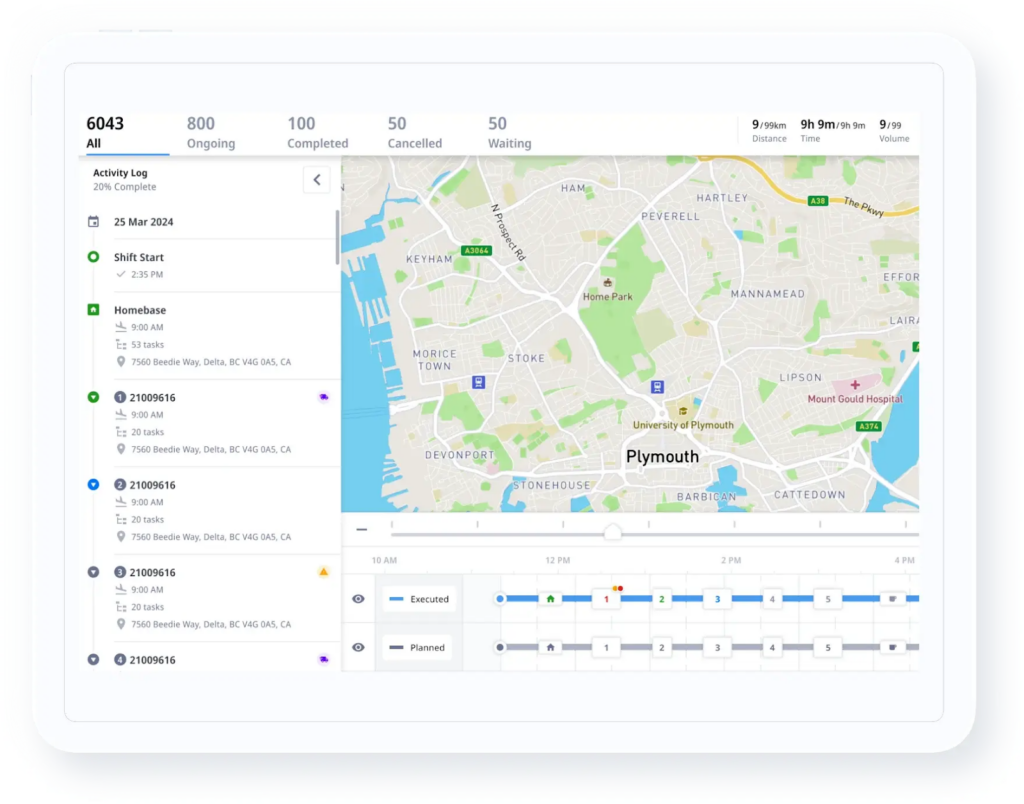
- Real-time execution visibility: Operations teams maintain live visibility into route progress, exceptions, delays, and on-ground changes, reducing reliance on manual coordination and reactive decision-making.
- Integrated planning and execution layer: With Locus, routing, dispatch, and execution data operate within a single operational layer. This helps teams standardize decision logic while adapting to demand variability.
- Support for sustainability-driven planning: Vehicle mix, route efficiency, and utilization data can be incorporated into planning logic to align operational decisions with emissions and fuel-efficiency goals.
- Enterprise system connectivity: Locus integrates with ERP, TMS, WMS, and order management systems, enabling fleet planning and execution to operate within a broader operational ecosystem.
These capabilities align directly with where the fleet management market is heading—toward unified, intelligent platforms that reduce operational fragmentation.
Why Choose Locus for Fleet Management
Why Locus? The only fleet management platform purpose-built to unify planning, dispatch, and execution—so you achieve precision at scale, every day.
In a fleet management market increasingly crowded with point solutions and legacy TMS platforms, Locus stands apart in three critical ways:
Unified Operational Layer
Unlike disconnected tools that require manual handoffs between planning, dispatch, and tracking, Locus connects the entire execution chain. This eliminates data silos, reduces coordination overhead, and ensures every operational decision reflects real-time conditions.
Built for Enterprise Complexity
Large and enterprise fleets—which command approximately 50% of the fleet management market—need platforms that handle multi-region operations, mixed vehicle fleets, and thousands of daily deliveries without degradation. Locus is engineered for this scale.
Constraint-Aware Intelligence
Routing, dispatch, and scheduling decisions in Locus account for delivery windows, vehicle capacity, driver regulations, emission zones, and sustainability goals during planning—not as a post-execution audit. This proactive approach directly reduces cost exposure and compliance risk.
Why not legacy TMS? Manual processes and disconnected tools can’t keep pace with the real-world constraints modern fleets face daily. Locus offers a single, intelligent platform for enterprise fleets operating in a market that demands speed, accuracy, and adaptability.
Future-Ready Fleet Management Solutions by Locus
Fleet leaders preparing for long-term stability need systems that support consistent planning and execution across regions, volumes, and operating models. In a fleet management market expected to grow at 13–17% CAGR through 2035, the cost of inaction compounds rapidly.
Locus is designed to support this shift. Its platform helps you plan routes with real-world constraints, manage dispatch at scale, and maintain visibility across execution—without relying on manual coordination.
By centralizing planning logic and operational data, your teams can adapt to demand changes, compliance requirements, and sustainability goals while keeping costs predictable.
For enterprise fleets, this approach supports:
- Scalable dispatch and route planning across regions
- Real-time visibility for planners and operations teams
- Consistent decision-making under variable conditions
Discover how Locus can cut costs and boost reliability across your fleet.
See Locus in Action—Book Your Personalized Demoork.
Frequently Asked Questions (FAQs)
1. What is the current size of the fleet management market in 2025?
The global fleet management market was valued between USD 27 billion and USD 37.71 billion in 2025, depending on research methodology and geographic scope. Market research firms project this represents significant expansion from prior years, reflecting accelerating adoption of digital fleet solutions across logistics, distribution, and field service operations.
2. What is the projected fleet management market size by 2030?
The fleet management market is forecast to reach USD 70.26 billion by 2030, representing a compound annual growth rate (CAGR) of 13.3% over the forecast period. This growth is driven by increasing demand for vehicle tracking, operational cost optimization, regulatory compliance, and the shift toward AI-powered fleet analytics platforms.
3. What long-term growth trajectory is projected for the fleet management market?
Extended forecasts show the market reaching USD 122.3 billion by 2035 at a 16.9% CAGR, with some projections indicating USD 76.33 billion by 2035 at a more conservative 10.05% CAGR. This acceleration reflects sustained demand driven by technological innovation, vehicle electrification, and evolving regulatory frameworks across global markets.
4. Which geographic region dominates the fleet management market?
North America holds the largest market share at approximately 23.9%, driven by mature technology adoption and regulatory mandates such as electronic logging device (ELD) requirements. Asia-Pacific is identified as the fastest-growing region, fueled by rapid e-commerce expansion, fleet modernization initiatives, and infrastructure investment across emerging economies.
5. Is fleet management a growing industry?
Yes. The fleet management market continues to grow as delivery volumes increase, service expectations tighten, and regulatory requirements expand. With CAGR projections ranging from 10% to 17% across major research firms, the market is one of the fastest-growing segments in logistics technology. Growth is driven by the need for better planning, visibility, and cost control across increasingly complex delivery networks.
6. What are the primary drivers of fleet management market growth?
Key growth drivers include rising fuel costs, demand for operational efficiency, integration of AI-enhanced telematics, ELD regulatory requirements, e-commerce expansion, and the shift toward cloud-based and big data analytics solutions. The cloud-based (SaaS) segment is expected to grow at the highest CAGR of 14% through 2035, confirming the industry’s infrastructure migration.
7. What are the core pillars of successful fleet management?
Successful fleet management typically rests on four pillars: planning accuracy, execution visibility, compliance alignment, and cost control. Weakness in any one area increases operational risk and limits scalability as fleet size grows. Modern platforms address all four within a single operational layer.
8. What is the biggest challenge in fleet management today?
The biggest challenge is managing variability at scale. Fluctuating demand, regional regulations, workforce constraints, and sustainability requirements all affect daily planning and execution—making manual coordination difficult to sustain. Enterprise fleets that rely on disconnected tools face compounding inefficiencies as volumes grow.
9. How is the fleet management market segmented by fleet size?
The market divides into small fleets (1–5 vehicles), medium fleets (5–20 vehicles), and large/enterprise fleets (20–50+ vehicles). Large and enterprise fleets command approximately 50% of total market revenue, driven by their need for comprehensive solutions to manage complex multi-vehicle, multi-region operations.
10. Which trends will shape fleet management over the next few years?
Key trends include deeper use of planning automation, sustainability-driven routing decisions, tighter regulatory integration, cloud-native platform adoption, and the convergence of routing, dispatch, and execution into unified operational layers. The fleet management market’s consistent double-digit CAGR confirms that these shifts are driving sustained investment across the industry.


Supply Chain Optimization
Best Supply Chain Control Tower Providers in 2026

Sep 22, 2026
Compare the top 10 supply chain control tower providers by model type—visibility-led, planning-led, and execution-led. See why Locus leads in operational control.
Read more
General
Driver Safety and Risk Management Software for Logistics Fleets in 2026

Sep 22, 2026
Learn how enterprise fleet operators unify telematics, dynamic routing, and risk scoring to reduce accident exposure, lower insurance premiums, and manage safety across mixed fleets.
Read moreInsights Worth Your Time



















The Future of the Fleet Management Market: Trends to Watch for 2026 and Beyond