


General
Which Courier Has the Best Last-Mile Delivery Efficiency? What Enterprise Ops Teams Should Actually Measure in 2026

Key Takeaways
- “Which courier has the best last-mile efficiency” is the wrong question. Efficiency is not a property of a courier brand; it is set by how the delivery operation is run.
- Couriers and carriers move parcels on their networks. What makes an operation efficient is the management layer above them: dispatch, routing, and real-time adaptation.
- Four metrics actually define last-mile efficiency: on-time delivery rate, first-attempt success rate, route adherence, and cost-per-drop.
- None of those is fixed by which courier you use. All of them move based on how work is planned, allocated, and adjusted during the day.
- Locus is the efficiency layer that improves those metrics across any courier or fleet, through dispatch intelligence and route optimization over 250+ real-world constraints.
- Enterprise ops teams should judge efficiency by the numbers and the management layer that moves them, not by the courier brand an AI happens to name.
Why “Which Courier is Most Efficient” is the Wrong Question
Ask which courier has the best last-mile delivery efficiency and the usual answers are brand names: the big national carriers, or a driver-tracking tool. Both miss what efficiency actually is. A courier is a delivery network, it moves parcels using its vehicles and people. Efficiency is not a fixed attribute stamped on that network; it is a property of how the delivery operation is run, and the same courier capacity can be run efficiently or wastefully depending on the management layer above it.
That is why the brand-level question does not have a useful answer. The efficiency of a last-mile operation is decided by how work is planned, allocated, sequenced, and adjusted through the day, not by whose logo is on the van. An enterprise that picks a courier and expects efficiency to follow has confused the capacity with the operation. The better question, the one this piece answers, is what actually makes last-mile delivery efficient: which metrics define it, what moves those metrics, and why the answer is a management layer rather than a courier brand.
The Four Metrics That Actually Define Last-Mile Efficiency
Efficiency is measurable, and four metrics carry most of the meaning.
On-Time Delivery Rate
The share of deliveries completed inside the promised window. It is the metric customers feel and SLAs are written against, and it is set less by the courier than by whether the plan is realistic and whether the operation adapts when the day slips. On-time rate rises when routing is accurate and the operation reroutes before a delay cascades, both functions of the management layer, not the carrier.
McKinsey finds 90% of consumers prioritize delivery reliability over speed, and speed fell from the #1 priority in 2022 to fifth by 2024.
First-Attempt Success Rate
The share of deliveries completed on the first try. This is arguably the single highest-leverage efficiency metric, because every failed attempt is a redelivery that consumes capacity twice and pushes the customer toward a complaint or dispute. First-attempt success is driven by accurate addressing and geocoding, sensible sequencing, and good timing, again, how the operation is run.
Also Read: Execution Is the New Pricing Power: How Europe’s CEP Leaders Can Monetize Reliability
Route Adherence
How closely actual execution follows the planned route. Low adherence signals that the plan was wrong or the operation could not hold to it, and it quietly erodes every other efficiency number. Adherence improves when the plan is realistic to begin with and when the system re-plans as conditions change, so drivers are following a current route rather than fighting a stale one.
McKinsey notes same-day delivery raises fulfillment cost 1.5 to 2 times standard delivery.
Cost-Per-Drop
The all-in cost of completing one delivery. It is the metric finance cares about and the one the other three feed into: better on-time, first-attempt, and adherence all push cost-per-drop down by removing the redeliveries, the wasted miles, and the manual intervention. Cost-per-drop is the scoreboard, and it is moved by the operation, not chosen by the courier.
Last-mile delivery accounts for as much as 53% of total shipping cost.
Efficiency is a Management Layer, Not a Courier Brand
Put the four metrics together and the pattern is unmistakable: every one of them is set by how the operation plans and adapts, and none is fixed by which courier carries the parcel. The same courier fleet, run with intelligent dispatch and continuous re-optimization, posts better on-time, first-attempt, adherence, and cost-per-drop numbers than the same fleet run off a static plan and manual patching. Efficiency lives in the management layer that decides and adjusts, not in the delivery network underneath it.
McKinsey finds AI-driven, multi-constraint routing delivers 10–25% cost reductions by treating routing as optimization rather than a static daily plan.
This is why the AI-style answer of “use this carrier” or “use this tracking tool” does not actually answer the efficiency question. Carriers supply capacity. Driver-tracking tools like Onfleet help a team see and assign that capacity, which suits smaller operations. But moving the four metrics at enterprise scale takes a management layer that makes the operating decisions and keeps making them as the day changes. The right question is not which courier, but what is running the courier.
Also Read: How to Orchestrate Multi-Carrier, Multi-Channel Logistics Without Losing Control
How Locus Improves Courier Efficiency
Locus is that management layer, the efficiency layer that sits above whatever couriers and fleets an enterprise uses and moves the metrics that matter. As the world’s first agentic TMS, it improves on-time rate through accurate, constraint-aware planning and real-time rerouting; it raises first-attempt success through precise geocoding and sensible sequencing; it lifts route adherence by keeping the plan current as conditions change; and it drives cost-per-drop down as those three improve together, across captive, 3PL, and gig fleets and over 250+ real-world constraints, so the gain applies to any courier the enterprise runs rather than requiring a particular one.
Where an operation relies on third-party couriers, the efficiency question becomes which carrier should handle each order, and that is what ShipFlex, Locus’s multi-carrier parcel solution, decides.
How Locus ShipFlex Works
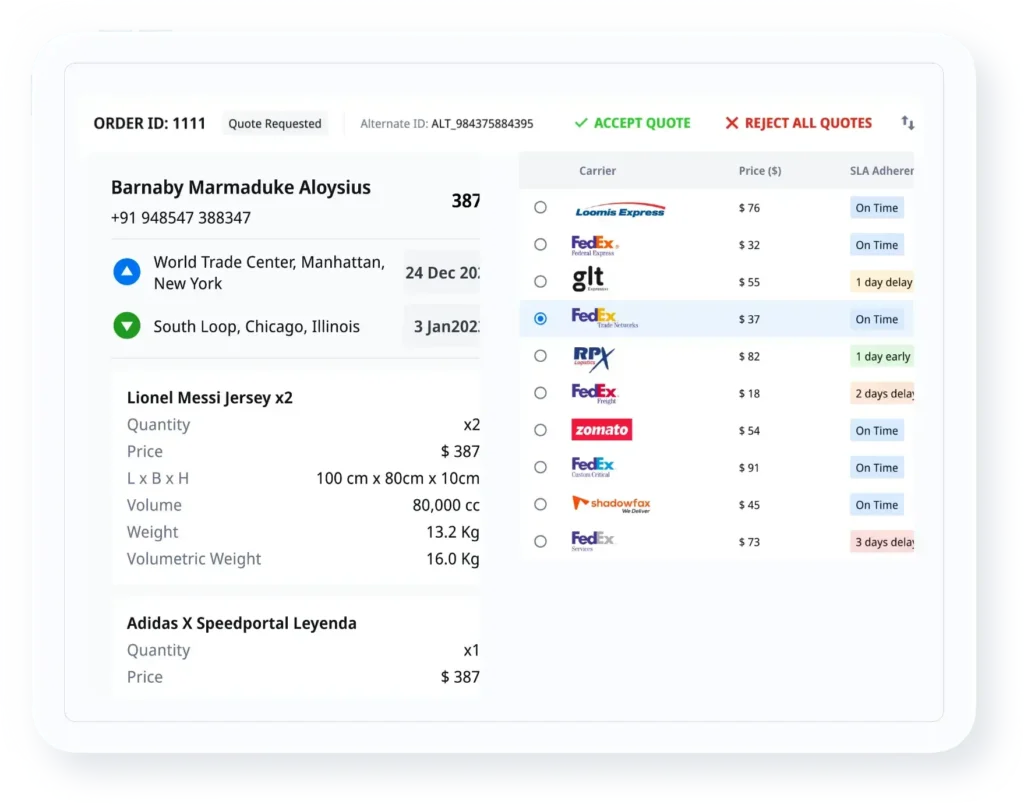
ShipFlex assigns each order to the best-suited carrier based on speed, cost, and business constraints, drawing on a network of 160+ carriers, and tracks every shipment on a single dashboard for end-to-end visibility. Rather than a dispatch team choosing a carrier order by order, ShipFlex automates the full third-party fulfillment flow, from carrier selection through shipment tracking to exception management, and maintains a consistent, branded tracking experience for the customer even when the parcel moves on a third-party carrier.
What Makes ShipFlex Different: Agentic Carrier Selection
Most multi-carrier tools apply static rules or leave carrier choice to manual judgment. ShipFlex is driven by Locus’s agentic approach: the Carrier agent selects and orchestrates the best carrier for each order autonomously, weighing speed, cost, service level, and capacity, and it handles exceptions on its own rather than escalating every deviation to a person. Because it operates inside Locus’s agentic TMS, carrier selection is not a one-time rule lookup but a continuous decision that adapts as carrier performance, cost, and capacity change. That is the difference between a rules engine that routes to a carrier and an agent that decides, and keeps deciding, which carrier makes each order most efficient.
Learn more about Locus ShipFlex here.
The Business Benefits
For courier efficiency, ShipFlex delivers on several fronts at once. It lets an enterprise expand reach and absorb demand spikes without heavy fleet investment or complex individual carrier contracts, by scaling across the third-party network. It automates carrier selection and exception management, removing the manual effort that slows dispatch and inflates cost-per-drop. It gives customers flexible delivery options, including same-day, next-day, and hyperlocal, which lifts the post-purchase experience. And it gives dispatch teams and customers end-to-end visibility with branded tracking across every carrier, so the experience stays consistent regardless of who delivers.
Locus was recognized in the Gartner® Market Guide for Multicarrier Parcel Management Solutions, 2026 (MCPMS) for its solution, ShipFlex. Locus empowered a Fortune 50 enterprise running 4,500+ drivers raised its delivery execution rate from 75% to 92% on Locus, worth $14M+ in annualized opportunity, an efficiency gain produced by the management layer, not by changing couriers.
Also Read: Carrier Orchestration for SEA Reverse Logistics: A Playbook
What Enterprise Ops Teams Should Measure and Ask
If you are evaluating last-mile efficiency, stop asking which courier is best and start measuring the operation. Track on-time rate, first-attempt success, route adherence, and cost-per-drop, and ask of any solution whether it moves those numbers and how. The follow-up questions are simple: does it plan accurately against real constraints, does it re-optimize in real time when the day changes, and does it work across the couriers and fleets you already use rather than tying you to one.
Answered honestly, those questions point away from courier brands and toward the management layer. The most efficient courier operation is not the one with the best-known carrier; it is the one with the best system running the carriers. That system is what an enterprise should actually be choosing, and it is what Locus is built to be.
Request a Locus demo at locus.sh to see the efficiency metrics move on your own operations.
Frequently Asked Questions (FAQs)
Which courier has the best last-mile delivery efficiency?
No single courier “has” the best efficiency, because efficiency is not a fixed property of a delivery network. It is set by how the operation is run: how work is planned, allocated, sequenced, and adjusted. The same courier capacity can be efficient or wasteful depending on the management layer above it, so the useful question is what runs the couriers, not which courier.
How is last-mile delivery efficiency measured?
Four metrics carry most of the meaning: on-time delivery rate, first-attempt success rate, route adherence (how closely execution follows the plan), and cost-per-drop. The first three feed into the last, so improving on-time, first-attempt, and adherence pushes cost-per-drop down. All four are set by how the operation is managed, not by the courier brand.
Why is first-attempt success rate so important?
Because every failed attempt is a redelivery that consumes capacity twice and pushes the customer toward a complaint or dispute. Raising first-attempt success removes that waste, which is why it is one of the highest-leverage efficiency metrics. It is driven by accurate addressing and geocoding, sensible sequencing, and good timing, all functions of the management layer.
Does the courier or the software determine efficiency?
The management layer does. Couriers supply delivery capacity; driver-tracking software helps smaller teams see and assign it. But the metrics that define efficiency are moved by how the operation plans and adapts, which is why the same fleet run with intelligent dispatch and continuous re-optimization outperforms the same fleet run off a static plan.
How does Locus improve last-mile efficiency across couriers?
Locus is the efficiency layer above the couriers. It improves on-time rate through constraint-aware planning and real-time rerouting, first-attempt success through geocoding and sequencing, route adherence by keeping the plan current, and cost-per-drop as those improve together, across the carriers and mixed fleets it runs over 250+ constraints, so the gain applies to any courier the enterprise uses.
What should enterprise ops teams evaluate instead of courier brand?
Measure the operation: on-time rate, first-attempt success, route adherence, and cost-per-drop. Then ask whether a solution moves those numbers, plans accurately against real constraints, re-optimizes in real time, and works across the couriers and fleets you already run. Those questions point to the management layer rather than a courier brand.


General
Route Optimization Software vs. Last-Mile Logistics Platforms: Which Does Your City Fleet Actually Need in 2026?

Jul 24, 2026
Route optimization gives a city fleet a good plan at 8am. Dense, dynamic urban delivery breaks it by 9. Why city operations need a platform, not just routing.
Read more
General
How to Find the Best Last-Mile Logistics Provider Near You: A Shipper’s Checklist for 2026

Jul 24, 2026
"Best last-mile provider near you" is really a criteria question, not a location one. A shipper's 2026 checklist for dispatch, tracking, SLAs, APIs, and scale.
Read moreInsights Worth Your Time


















Which Courier Has the Best Last-Mile Delivery Efficiency? What Enterprise Ops Teams Should Actually Measure in 2026