


General
The Architecture of B2B Foodservice Distribution: A Practical Guide for European Operations Leaders in 2026

Key Takeaways
- European B2B foodservice distribution operates against operational realities generic logistics platforms don’t address — mixed temperature zones in single deliveries, high SKU velocity, tight pre-opening windows, daily cadence, and perishable substitution complexity.
- The operational complexity makes foodservice a strong fit for AI and agentic architecture. Multi-temperature routing, substitution decisioning, exception management, and daily route reoptimization require analytical depth generic platforms can’t deliver.
- Five operational layers benefit most from AI-augmented foodservice architecture: multi-temperature route optimization, substitution and inventory decisioning, predictive demand and capacity, driver-customer relationship intelligence, and perishable exception management.
- European foodservice faces specific architectural pressures: CSRD sustainability reporting, F-gas refrigeration regulation, the European driver crisis hitting foodservice hardest, and cross-border operational complexity for multi-country operators.
- For European foodservice operations leaders in 2026, the question is whether your logistics architecture matches the operational complexity foodservice distribution actually faces.
European B2B foodservice distribution is one of the most operationally complex logistics categories — and one of the least well-served by generic logistics platforms. The category serves restaurants, hotels, schools, hospitals, cafeterias, and catering operations across European markets, delivering thousands of SKUs across produce, proteins, dairy, frozen goods, ambient products, paper goods, and equipment under regulatory frameworks (EU food hygiene, F-gas refrigeration, sustainability reporting) that generic last-mile platforms don’t address natively.
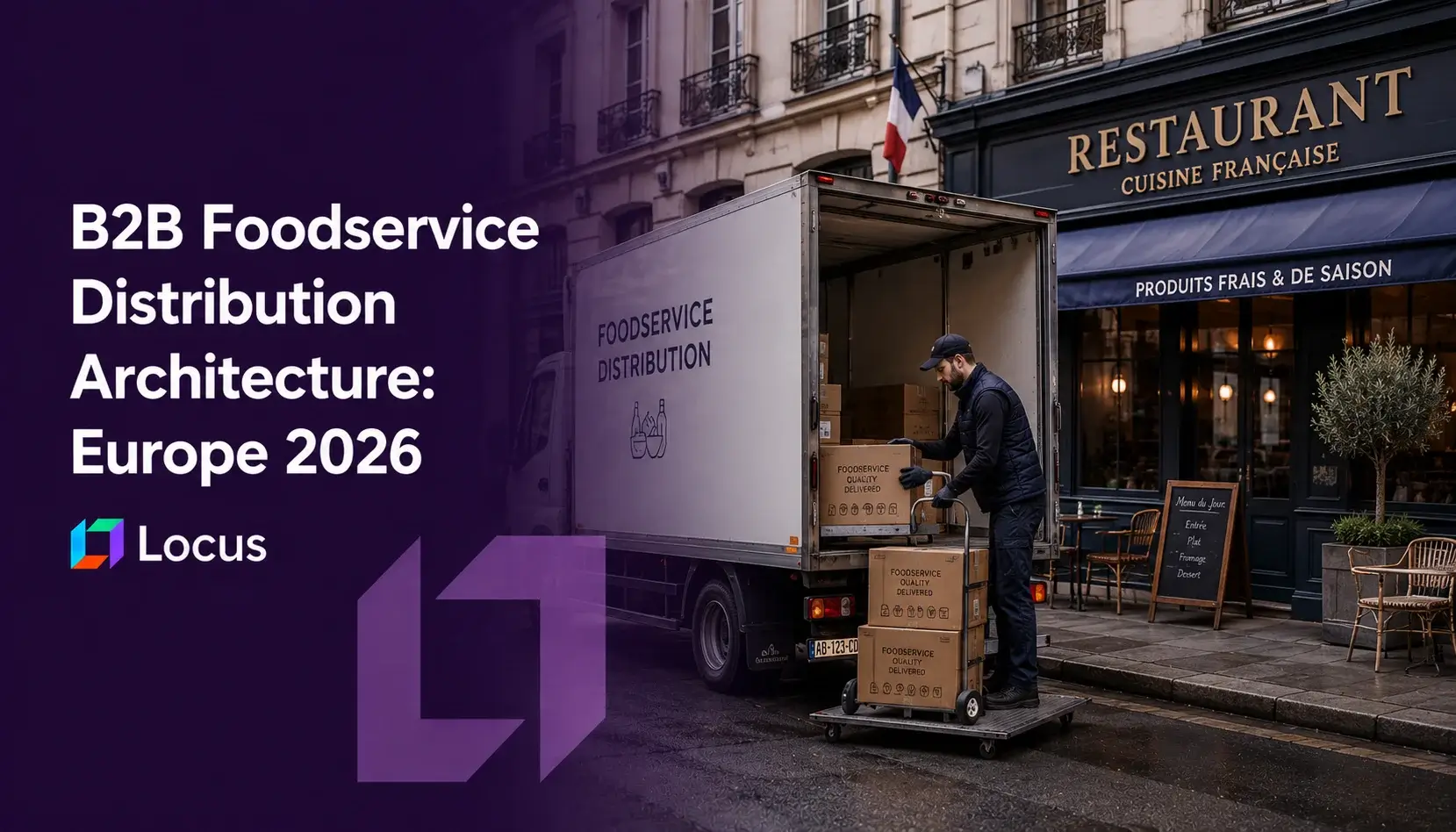
The operational complexity is structurally different from retail, e-commerce, or generic last-mile distribution. Single deliveries combine frozen, refrigerated, and ambient products requiring multi-compartment vehicle handling. Restaurants need delivery before opening (4am-10am common). Hospitals and schools operate against institutional schedules. SKU velocity runs into thousands of items per customer per week. Substitution decisions happen at the moment of delivery when items are out of stock. Perishable returns can’t go back to inventory the same way refusals work in other categories. Driver-customer relationships develop deep operational knowledge that anonymous delivery doesn’t produce. And the European driver crisis hits foodservice hardest because early-morning shifts, multi-temperature handling, and physical demands make foodservice driver work less attractive than other logistics roles.
This is the operational reality that makes European B2B foodservice distribution a strong fit for AI and agentic architecture rather than for generic logistics platforms repurposed to handle foodservice as an edge case. For European Heads of Foodservice Operations, VPs of Supply Chain Distribution, Heads of Logistics at broadliners and regional distributors in 2026, this is a practical guide to what foodservice distribution actually requires from logistics architecture.
What B2B Foodservice Distribution Actually Is
B2B foodservice distribution is the supply chain that moves food and food-related products from producers and manufacturers to away-from-home food consumption channels — restaurants, hotels, catering operations, schools, hospitals, government foodservice, workplace cafeterias, and similar operations.
The European foodservice market structure is more fragmented than US foodservice. National broadliners (Brakes UK, Sligro, Lekkerland, Metro Cash & Carry, Bidcorp/Bidvest operations) coexist with regional distributors, country-specific players, and category specialists serving meat, produce, frozen, beverage, or specialty channels. Cross-border European operators face customs complexity (UK post-Brexit, third-country sourcing), multi-currency invoicing, and multi-language operational reality across markets.
The operational scale matters. Large European foodservice broadliners handle tens of thousands of SKUs, deliver to tens of thousands of customer locations per day, and operate multi-temperature fleets across complex European geography. Regional distributors operate at smaller scale but face equivalent operational complexity within their footprint.
Why Foodservice Logistics Is Operationally Distinct
Six operational realities make European foodservice distribution structurally different from generic last-mile or distribution logistics.
Mixed temperature zones in single deliveries. Restaurant orders routinely combine frozen proteins, refrigerated produce and dairy, and ambient products in single deliveries. Vehicles need multi-compartment cold chain capability. Routing must protect temperature integrity across the delivery sequence. Generic logistics platforms designed for parcel or single-temperature freight don’t handle this natively.
High SKU velocity with substitution complexity. Foodservice customers order across thousands of SKUs weekly. Items going out of stock require substitution decisions — driver-mediated at delivery, customer-confirmed, sometimes refused with consequences for the customer’s operation. Substitution workflows need to be integrated into delivery execution rather than treated as exceptions handled by customer service.
Tight pre-opening and institutional delivery windows. Restaurants need delivery before prep starts (typically 4am-10am). Hospitals and schools operate against institutional schedules (often 5am-9am). Late delivery isn’t a customer experience inconvenience — it’s an operational failure that affects the customer’s ability to operate. Window precision matters more than in most other logistics categories.
Also Read: 5 European Logistics Innovations 2026: Agentic TMS to GenAI
Daily and high-frequency delivery cadence. Many foodservice customers receive deliveries 2-6 times per week; high-volume restaurants daily. Route patterns aren’t weekly cycles — they’re daily rhythms that need to adjust to restaurant operational changes (menu shifts, closures, new openings) in real time.
Driver-customer relationship depth. Foodservice drivers develop ongoing relationships with restaurant managers, kitchen staff, and receiving teams. They know which back door to use, which staff member handles receiving, what time the kitchen needs the delivery to start prep, and what substitutions the chef will accept. This operational knowledge is competitive advantage that high-churn driver populations can’t sustain — and the European driver crisis makes retention operationally consequential.
Perishable exception management. Refused or damaged perishables can’t simply return to inventory. Disposition decisions — donation, disposal, processing, return to supplier — happen at the moment of refusal under tight time pressure to avoid further perishability. Reverse logistics for foodservice operates against different rules than retail or e-commerce returns.
Where AI and Agentic Architecture Matters Most for European Foodservice Distribution
The operational complexity of European B2B foodservice distribution makes it a strong fit for AI and agentic logistics architecture — not as marketing positioning but because the analytical depth genuinely addresses the operational reality foodservice faces.
Layer 1: Multi-Temperature Route Optimization
Agentic AI handles routing decisions across multi-compartment vehicles where temperature integrity must be protected across the delivery sequence. The routing engine accounts for opening/closing of vehicle compartments, temperature exposure during multi-stop sequences, customer-specific temperature requirements, and the operational reality that one delivery sequence shouldn’t compromise temperature for subsequent deliveries.
Generic routing engines optimize for time and distance. Foodservice routing must optimize for time, distance, AND temperature integrity simultaneously — the latter requiring analytical capability that simpler routing platforms don’t provide.
Layer 2: Substitution and Inventory Decisioning
AI architecture supports substitution decisioning at the moment of order picking and delivery. When items are out of stock, the system surfaces appropriate substitutions based on customer history (what they’ve accepted before), operational patterns (what similar customers accept), product equivalence rules (size, brand, format), and customer-specific preferences. Drivers and customer service teams operate with AI-supported substitution guidance rather than ad-hoc judgment.
The decisioning matters because foodservice substitution affects customer operations directly. A restaurant that doesn’t get the right ingredient can’t run the menu item. The substitution intelligence needs operational depth that generic order management doesn’t provide.
Layer 3: Predictive Demand and Capacity
Agentic architecture handles demand prediction at customer-specific granularity. Restaurant ordering patterns vary by day of week, season, weather, local events, and operational changes. Predictive infrastructure forecasts demand at granular levels that support both capacity planning (vehicle requirements, driver scheduling, inventory positioning) and customer service (proactive outreach when expected orders don’t materialize, suggesting top-up orders before customers run short).
Also Read: European Cross-Border Fulfilment & Returns: Ops Complexity
European foodservice distribution faces seasonal pattern complexity that AI handles better than rule-based approaches — summer tourism patterns vary by country and region, winter institutional patterns shift with school and corporate schedules, and holiday patterns vary across European markets.
Layer 4: Driver-Customer Relationship Intelligence
AI architecture captures and surfaces the customer-specific operational knowledge that experienced drivers accumulate — preferred receiving locations, access instructions for restricted properties, customer staff names and contact preferences, language preferences, prior delivery history with specific issues, and the operational quirks each customer location presents. This intelligence becomes operational infrastructure rather than living in individual driver memory.
The capability matters specifically under the European driver crisis. When drivers leave or shift routes, the operational knowledge they carry needs to transfer to replacement drivers immediately. AI-captured customer context replaces tribal knowledge that high-churn driver populations can’t preserve.
Layer 5: Perishable Exception Management
Agentic architecture handles perishable exception decisioning at the moment of refusal or damage. Disposition options — return to supplier under perishability rules, donate to food bank, dispose under waste regulations, redirect to other customer locations, reprocess where applicable — all carry time, regulatory, and economic implications that need real-time decisioning support.
For European foodservice distribution, perishable exception management also intersects with sustainability reporting (food waste reduction targets, CSRD reporting) and regulatory frameworks (F-gas, hygiene compliance) that operations need to handle architecturally rather than ad hoc.
Overall, the Europe B2B for Food in Foodservice Market is growing at a CAGR of 7.9% from 2026 to 2033, reflecting robust expansion opportunities in this dynamic sector.
What European Foodservice Operations Should Evaluate
Operations leaders evaluating logistics architecture for European B2B foodservice distribution should examine specific capabilities beyond generic logistics evaluation criteria.
Multi-temperature handling depth in routing, dispatch, and execution. Generic platforms treat temperature as a flag; foodservice platforms need to handle it as a primary constraint.
Substitution and exception decisioning integrated into delivery execution rather than handled in separate customer service workflows.
Also Read: The Logistics Orchestration Maturity Model: An L1 to L5 Framework for European Supply Chain Heads
Daily reoptimization capability that handles restaurant operational change rather than weekly route patterns.
Customer context infrastructure that captures and surfaces driver-accumulated operational knowledge across customer locations.
Sustainability and regulatory integration including CSRD Scope 3 transportation reporting, F-gas refrigeration emissions tracking, and food waste disposition documentation.
Multi-country European capability for operators running cross-border operations — customs handling, multi-currency, multi-language driver-customer interaction, country-specific regulatory variation.
Driver-experience quality as a retention lever in the European driver crisis context. Foodservice driver work is physically demanding and operationally complex; logistics architecture quality affects whether the operation can retain drivers in a constrained market.
How architectural maturity compounds matters more than feature checklists. Multi-temperature routing without substitution decisioning produces operationally sophisticated routes that break down when substitution decisions need to happen at delivery. Predictive demand without driver-customer intelligence produces capacity planning that doesn’t reflect what experienced drivers know about customer patterns. Each layer reinforces the others, and the integrated architecture produces operational outcomes that single-layer capability can’t match.
The strategic question for European foodservice distribution leaders in 2026 is concrete: is your logistics architecture calibrated to the operational reality European foodservice distribution actually faces — mixed temperature zones, substitution complexity, tight windows, daily cadence, driver-customer relationships, perishable exceptions — or running against generic logistics assumptions that treat foodservice complexity as edge cases?
FAQs
What is B2B foodservice distribution?
B2B foodservice distribution is the supply chain moving food and food-related products from producers and manufacturers to away-from-home consumption channels — restaurants, hotels, catering, schools, hospitals, government foodservice, workplace cafeterias. European foodservice distribution operates through national broadliners, regional distributors, and category specialists across fragmented country-specific markets.
Why is B2B foodservice distribution operationally distinct from other logistics categories?
Six operational realities distinguish foodservice: mixed temperature zones in single deliveries, high SKU velocity with substitution complexity, tight pre-opening and institutional delivery windows, daily and high-frequency delivery cadence, deep driver-customer relationships, and perishable exception management. Generic logistics platforms designed for parcel, retail, or single-temperature freight don’t handle these realities natively.
How does AI architecture help European B2B foodservice distribution?
AI architecture addresses five operational layers foodservice faces: multi-temperature route optimization across compartmented vehicles, substitution decisioning at delivery moments, predictive demand and capacity at customer-specific granularity, driver-customer relationship intelligence captured architecturally, and perishable exception management at the moment of refusal. The complexity matches what AI handles well — pattern-rich operational decisions that rule-based systems struggle with.
Why does multi-temperature routing matter for foodservice operations?
Foodservice deliveries routinely combine frozen, refrigerated, and ambient products in single deliveries. Vehicles need multi-compartment cold chain capability, and routing must protect temperature integrity across the delivery sequence. Generic routing engines optimize for time and distance; foodservice routing must optimize for time, distance, AND temperature integrity simultaneously, requiring analytical capability that simpler platforms don’t provide.
How does the European driver crisis specifically affect foodservice distribution?
Foodservice driver work involves early-morning shifts, multi-temperature handling, physical case handling, and tight delivery windows — making it less attractive than other logistics roles in a constrained driver market. The European driver crisis hits foodservice harder than generic last-mile, and retention becomes operationally critical because driver-customer relationship knowledge is competitive advantage that high-churn populations can’t sustain.
What regulatory frameworks affect European foodservice distribution logistics?
European foodservice distribution operates under EU food hygiene regulations (853/2004), food information rules (1169/2011), F-gas regulations affecting refrigeration, CSRD sustainability reporting, country-specific food safety regimes, and (for cross-border operators) UK post-Brexit customs complexity. Logistics architecture must handle these frameworks natively rather than treating them as compliance exceptions.
What should European operations leaders evaluate in foodservice distribution logistics platforms?
Operations leaders should evaluate multi-temperature handling depth, substitution and exception decisioning integration, daily reoptimization capability, customer context infrastructure for driver-accumulated knowledge, sustainability and regulatory integration (CSRD, F-gas, food waste), multi-country European capability for cross-border operators, and driver-experience quality as a retention lever in the European driver crisis context.


General
Best Last-Mile Delivery Company for Driver Management in 2026: A Software-First Guide

Jun 4, 2026
When logistics leaders ask for the best last-mile delivery company for driver management, they usually mean the best software platform. This 2026 guide explains why — and what to evaluate when choosing one.
Read more
General
Multi-Tenant 3PL Platform Requirements: How AI Architecture Addresses the Operational Complexity Single-Shipper TMS Can’t

Jun 4, 2026
Single-shipper TMS platforms fail European 3PLs operationally. Five ways generic TMS architecture breaks under multi-tenant 3PL reality — and the AI architecture that addresses it.
Read moreInsights Worth Your Time



















The Architecture of B2B Foodservice Distribution: A Practical Guide for European Operations Leaders in 2026