


General
The Executive Guide to Agentic AI in Logistics: From Planning Systems to Autonomous Execution

Key Takeaways
- Logistics AI is moving beyond prediction — it is now capable of making and executing decisions in real time.
- Traditional TMS platforms are fundamentally planning systems and struggle in dynamic execution environments.
- Agentic AI introduces autonomous decision-making across routing, dispatch, and carrier allocation.
- Governance mechanisms like explainability and human oversight are essential for enterprise adoption.
- The next competitive advantage in logistics will come from execution speed, not just visibility.
AI in Logistics Has Reached an Inflection Point
For years, logistics leaders have invested in technology with a clear goal: better visibility and better planning. Control towers, dashboards, and transportation management systems have made supply chains more transparent than ever before. Supply chain leaders can now see where shipments are, identify delays, and understand performance metrics across their networks.
But despite all this progress, one reality remains unchanged: most logistics operations are still reactive.
When disruptions occur, a delayed shipment, a missed SLA, or a sudden spike in demand, the system flags the issue. But the resolution still depends on human intervention. Someone needs to interpret the data, decide the next step, and execute the action.
This gap between insight and action is where traditional systems fall short. And it is precisely where agentic AI begins to redefine how logistics operates.
What “Agentic AI” Really Means in Supply Chain Execution
The term “AI in logistics” has been widely used, but often loosely defined. In many cases, it refers to predictive models — forecasting demand, estimating delivery times, or recommending routes. These capabilities are valuable, but they remain advisory in nature.
Agentic AI represents a different paradigm.
Instead of simply generating recommendations, agentic systems are designed to make decisions and act on them autonomously, within a defined set of business rules. They do not wait for human approval at every step. Instead, they continuously evaluate conditions, choose the best course of action, and execute it in real time.
Also Read: Delivery Management Software: The Ultimate Buyer’s Guide for 2026
In a logistics context, this could mean dynamically reassigning a delivery when traffic conditions change, reallocating capacity across carriers based on real-time availability, or adjusting delivery sequences to protect service-level agreements.
The distinction is subtle but profound. Traditional AI supports human decision-making. Agentic AI replaces repetitive decision-making loops altogether, allowing humans to focus on oversight and strategy.
Generative AI vs. Agentic AI in Logistics
Generative AI and agentic AI are often discussed together, but they solve different problems in logistics.
Generative AI creates outputs: summaries, exception narratives, recommendations, natural-language answers, customer messages, planner copilots, and conversational interfaces. It is useful when logistics teams need to interpret fragmented information, explain what happened, or translate operational data into language that planners, drivers, carriers, or customers can act on.
Agentic AI, by contrast, takes goal-directed action within defined constraints. It does not simply describe that a route is at risk or recommend a carrier. It can execute an approved dispatch change, trigger a reallocation of carrier capacity, reprioritise deliveries, or adjust a workflow based on cost, capacity, SLA, and business-rule constraints.
The highest-value logistics architecture combines both:
- Generative AI interprets and explains: It can read unstructured data such as emails, support tickets, proof-of-delivery notes, exception comments, or customer conversations, then summarise the operational issue.
- Agentic AI decides and executes: It evaluates available options against business rules and initiates actions such as route resequencing, dispatch reassignment, dock appointment adjustment, or carrier allocation.
- Generative AI closes the communication loop: It can explain why the system acted, generate exception narratives for audit trails, and provide conversational interfaces for planners and operations leaders.
In practical terms, generative AI makes logistics systems easier to understand and interact with. Agentic AI makes them capable of autonomous execution.
Why Traditional TMS Systems Struggle in a Dynamic World
Most enterprise logistics systems today were designed for a different era — one where planning cycles were longer, variability was lower, and execution followed relatively predictable patterns.
Transportation management systems, in particular, are built around the idea of pre-planning. Routes are optimized before dispatch, carriers are assigned based on predefined rules, and execution is expected to follow the plan with minimal deviation.
But modern logistics does not behave this way.
Demand fluctuates by the hour. Traffic conditions change unpredictably. Carrier availability shifts in real time. Customer expectations continue to rise, with tighter delivery windows and higher service standards.
In this environment, a plan is only as good as its ability to adapt.
Traditional systems, however, are not built for continuous adaptation. When disruptions occur, they rely on manual overrides — planners stepping in to adjust routes, reassign deliveries, or escalate issues. At enterprise scale, this becomes a bottleneck.
Agentic AI addresses this gap by embedding decision-making directly into the execution layer, transforming execution into a continuous optimization process.
From Dashboards to Decision Engines
The rise of control towers and real-time dashboards marked an important step forward. For the first time, logistics leaders could monitor operations across geographies, carriers, and delivery nodes from a single interface.
Also Read: Control Towers in Supply Chain Decision-Making: A Framework
However, visibility alone does not drive outcomes.
A dashboard can tell you that a delivery is delayed, but it cannot resolve the delay. It can highlight a potential SLA breach, but it cannot decide how to prevent it. The responsibility still falls on human operators.
As networks grow more complex, this model becomes unsustainable.
Agentic AI systems shift the paradigm by transforming systems into decision engines. When a disruption is detected, the system evaluates options, considers constraints such as cost and SLA commitments, and executes the optimal action.
Instead of being a passive observer, the system becomes an active participant in operations.
The Hidden Complexity of Logistics: Constraints, Not Just Routes
Logistics is not simply about finding the shortest route. It is a complex constraint optimization problem.
Every decision must balance multiple variables: cost efficiency, SLA commitments, vehicle capabilities, driver availability, regulatory requirements, and customer preferences. These variables often conflict with one another.
Traditional systems simplify this complexity, often leading to suboptimal decisions.
Agentic AI systems, however, are designed to evaluate multiple constraints simultaneously. They can navigate trade-offs in real time — deciding, for example, whether to prioritize cost savings or SLA adherence based on business priorities.
This ability to process complexity at scale is what enables truly intelligent logistics execution.
Governance: The Foundation of Trust in Autonomous Systems
As organizations move toward automation, trust becomes a critical concern.
Leaders need to understand how decisions are made, ensure accountability, and maintain control over operations. This is where governance becomes essential.
Agentic systems must provide explainability, allowing organizations to understand why a decision was made. They must support auditability, ensuring every action can be traced. And they must enable human-in-the-loop controls, allowing organizations to define where autonomy is appropriate and where oversight is required.
Governance transforms AI from an opaque box into a controlled, reliable system that organizations can trust and scale.
Reference Architecture for Agentic AI in Logistics
Deploying agentic AI in logistics requires more than adding an AI layer on top of existing systems. It requires an execution architecture that can sense operational change, evaluate constraints, act through enterprise systems, and maintain governance at every step.
A practical reference architecture includes the following layers:
| Architecture layer | Role in agentic logistics execution |
| Source systems | Connects TMS, WMS, OMS, ERP, fleet systems, carrier portals, driver apps, customer channels, and financial systems. |
| Event ingestion layer | Captures shipment updates, order changes, inventory signals, telematics events, delivery exceptions, and capacity changes. |
| Unified data layer | Creates a data fabric across operational, historical, and real-time logistics data so agents work from consistent context. |
| Decisioning agents | Evaluate goals, constraints, policies, and current network conditions to determine the next best action. |
| Optimization engines | Solve routing, sequencing, capacity allocation, load planning, SLA protection, and cost trade-off problems. |
| Orchestration layer | Coordinates multiple agents and ensures decisions are executed in the right sequence across systems. |
| Execution systems | Push actions into dispatch, carrier allocation, route management, customer notifications, driver workflows, and exception queues. |
| Monitoring and observability | Tracks decision quality, outcome variance, exception rates, service performance, and system health. |
| Governance and controls | Applies permissions, policy constraints, explainability, audit logs, and human-in-the-loop approvals where required. |
This architecture matters because agentic AI in logistics is not a standalone model. It is an operating layer that must interact with live execution systems and continuously reconcile cost, capacity, service, and customer constraints.
Data Requirements for Autonomous Logistics Execution
Agentic logistics systems are only as strong as the data environment they operate in. To make reliable decisions, agents need access to connected, trusted, and timely information across the logistics network.
Key data inputs include:
- Order data: Order priority, promised delivery windows, service type, customer location, item attributes, and fulfilment status.
- Shipment data: Shipment status, milestones, exceptions, proof-of-delivery information, and planned versus actual performance.
- Inventory data: Stock availability, allocation rules, replenishment signals, substitution logic, and inventory ageing.
- Fleet and driver data: Vehicle capacity, driver availability, shift rules, skills, location, compliance constraints, and performance history.
- Carrier data: Carrier availability, cost, service levels, lane performance, cut-off times, capacity, and contractual rules.
- Telematics and IoT data: Vehicle location, speed, dwell time, temperature, fuel or battery signals, and asset utilisation.
- Customer promise data: SLA commitments, delivery slots, communication preferences, and escalation rules.
- Cost data: Freight rates, accessorials, penalty exposure, fuel costs, labour costs, and network cost-to-serve.
- Historical performance data: Route performance, service variance, delay patterns, carrier reliability, and exception-resolution outcomes.
A data fabric helps unify these inputs across systems so agentic AI can reason across operational, historical, and real-time signals. Real-time analytics then allow the system to detect exceptions, evaluate constraints, and trigger decisions before a service failure occurs.
For event-heavy environments, real-time event streams are critical. Technologies such as Apache Kafka can support high-volume shipment status updates, order changes, telematics feeds, and exception events. Lightweight messaging protocols such as MQTT can help connected vehicles, handhelds, sensors, scanners, and other IoT devices transmit operational signals with low overhead.
Data quality is equally important. Duplicate orders, stale carrier capacity, inaccurate geocodes, missing proof-of-delivery events, or delayed telematics updates can all lead to poor decisions. Enterprises should therefore define data ownership, latency thresholds, validation rules, and feedback loops before scaling autonomous execution.
Cloud, Edge, IoT, and Application-Layer Considerations
Agentic AI in logistics typically runs across a combination of cloud, edge, IoT, and application-layer infrastructure.
- Cloud decisioning: Network-wide optimisation, carrier allocation, planning simulation, historical learning, and multi-agent orchestration are well suited to scalable cloud environments. An adaptive cloud architecture helps support fluctuating logistics workloads, seasonal event volumes, and spikes in decisioning demand.
- Edge computing: Some decisions require low-latency execution close to the operation. Edge computing can support use cases involving vehicles, hubs, mobile apps, scanners, and connected devices where connectivity may be intermittent or response time is critical.
- Internet of Things signals: Connected trucks, temperature monitors, driver devices, yard equipment, sensors, and handheld devices feed agents with real-time context about asset state, location, dwell time, condition, and exception risk.
- Application-layer delivery: Autonomous decisions must be visible and usable by the people and systems they affect. Planners need control interfaces, drivers need clear task updates, carriers need allocation instructions, customers need proactive notifications, and operations leaders need performance dashboards.
The goal is not to centralise every decision or automate every workflow at once. The goal is to place the right level of intelligence at the right layer of the logistics network, with governance controls that match the operational risk.
Where Agentic AI Is Already Driving Impact
The impact of agentic AI is most visible in areas where decision-making is frequent and time-sensitive.
Routing is becoming dynamic, with systems continuously adjusting based on real-time conditions. Carrier allocation is becoming more intelligent, with systems selecting the best option based on cost, performance, and availability. SLA management is shifting from reactive monitoring to proactive enforcement.
For instance, an agent can calculate a “route-difficulty index.” This ensures a driver who completes 35 stops on a complex, high-traffic route is evaluated fairly against a driver who completes 48 stops on a straightforward suburban route. Fairness is a massive driver of retention.
Also Read: How AI Improves Driver Experience: Route Fatigue to Retention
Then, nearly 23% of truck journeys in Europe run completely empty. Agentic routing engines combat this by continuously running predictive capacity algorithms. They intelligently co-mingle pickup and drop-off loads within the same geographic zones to eradicate these “empty backhauls,” ensuring the driver is moving profitable freight for their entire shift.
In each of these areas, the key shift is the same: decision-making is moving closer to execution, reducing delays and improving outcomes.
Agentic AI Use Cases Across the Logistics Value Chain
Agentic AI in logistics is not limited to routing or dispatch. Its value increases when autonomous decisioning is applied across the full logistics value chain, from inbound supply flows to last-mile delivery, returns, customer service, and back-office workflows.
| Logistics area | Agentic AI use cases |
| Inbound logistics | Supplier pickup scheduling, inventory-aware replenishment routing, route optimisation, load optimisation, dock appointment scheduling, shipment booking, documentation workflows, and freight invoice exception handling. |
| Middle-mile logistics | Hub-to-hub routing, linehaul capacity allocation, cross-dock planning, carrier selection, empty-mile reduction, and network balancing. |
| Last-mile logistics | Dynamic route sequencing, automated dispatch, delivery promise protection, driver task updates, failed-delivery recovery, SLA enforcement, and customer notification triggers. |
| Returns logistics | Return pickup scheduling, reverse route optimisation, disposition workflows, consolidation planning, and customer communication. |
| Customer service | Proactive exception alerts, delivery ETA explanations, automated support responses, escalation routing, and service recovery workflows. |
| Back-office logistics | Freight audit support, claims triage, invoice matching, cost allocation, exception documentation, and performance reporting. |
Inbound Logistics Use Cases
Inbound logistics is an ideal starting point for agentic AI because it involves constant trade-offs between supplier readiness, inventory availability, vehicle capacity, dock constraints, and freight cost.
Agentic AI can support:
- Inventory optimisation: Prioritising inbound movement based on stock risk, fulfilment demand, ageing inventory, and replenishment urgency.
- Supplier pickup scheduling: Coordinating supplier readiness, pickup windows, carrier availability, and consolidation opportunities.
- Route optimisation: Sequencing inbound pickups to reduce travel time, improve utilisation, and align with receiving capacity.
- Load optimisation: Using load management algorithms to improve truck utilisation while balancing capacity constraints, cost, service levels, product compatibility, and delivery timing.
- Dock appointment scheduling: Adjusting appointments dynamically based on inbound delays, yard congestion, labour availability, and unloading capacity.
- Booking and shipping documentation: Automating repetitive booking steps, shipment paperwork, and exception checks.
- Freight invoicing automation: Supporting invoice matching, rate validation, accessorial review, and exception flagging for finance teams.
Outbound Logistics Use Cases
Outbound logistics is where agentic AI most visibly affects customer experience, cost-to-serve, and SLA performance.
Agentic AI can support:
- Picking and packing coordination: Prioritising work based on dispatch cut-offs, delivery promises, vehicle departure schedules, and exception risk.
- Order processing: Identifying orders at risk, reallocating fulfilment options, and triggering operational workflows before a delay becomes customer-facing.
- Delivery promise management: Protecting promised delivery windows by adjusting route sequences, dispatch plans, or carrier assignments in real time.
- Returns management: Coordinating reverse pickups, consolidation, disposition decisions, and customer status updates.
- Customer notifications: Triggering proactive, context-aware communication when ETAs, delivery windows, or service status changes.
- Customer service automation: Equipping support teams with clear exception narratives, recommended actions, and automated resolution workflows.
The enterprise opportunity is to move from isolated automation to coordinated decision-making across inbound, outbound, and reverse logistics flows.
Why This Shift Matters Now
Logistics networks are becoming more complex, customer expectations are rising, and cost pressures are intensifying.
In this environment, the ability to make fast, intelligent decisions at scale is no longer optional — it is a competitive necessity.
Organizations that rely on manual processes will struggle to keep up. Those that embrace autonomous execution will be better positioned to scale efficiently and deliver consistent performance.
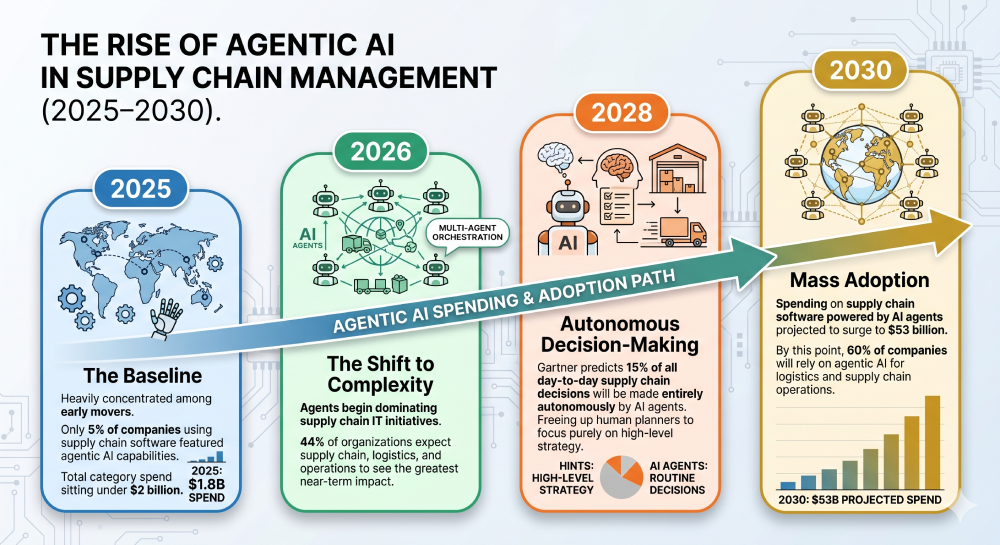
According to PwC’s May 2025 AI Agent Survey, enterprise leadership is no longer just experimenting with autonomous tools:
- 79% of companies report they are already adopting AI agents in some capacity.
- 88% of executives plan to increase their AI-related budgets over the next 12 months specifically to fund agentic AI.
- 66% of those early adopters are already seeing measurable value through increased productivity.
Furthermore, the 2026 State of AI Agents Report notes that 57% of organizations are now deploying agents for complex, multi-stage workflows, rather than just simple, isolated tasks.
Business Impact: How to Measure Agentic AI in Logistics
The business case for agentic AI in logistics should be measured through operational outcomes, not AI activity metrics. Enterprises should avoid tracking only model usage or number of automated decisions. The stronger measure is whether autonomous execution improves cost, service, productivity, and resilience.
Key measurement categories include:
| Metric category | What to track |
| Cost per delivery | Total delivery cost, cost-to-serve by customer segment, cost variance by geography, and cost impact of exception recovery. |
| Route productivity | Stops per route, distance per stop, route completion rate, route adherence, and planned versus actual route performance. |
| SLA adherence | On-time delivery, breach prevention, service recovery rate, and percentage of at-risk orders resolved before escalation. |
| Fleet utilisation | Vehicle fill rate, driver utilisation, idle time, dwell time, and productive hours per shift. |
| Empty miles | Empty running, backhaul utilisation, asset repositioning efficiency, and avoidable deadhead movement. |
| Planner productivity | Decisions automated, exceptions handled per planner, manual interventions reduced, and time spent on strategic versus repetitive work. |
| Forecast accuracy and inventory impact | Demand-supply alignment, stockout risk, replenishment responsiveness, inventory turns, and ageing inventory exposure. |
| Exception-resolution time | Time to detect, decide, act, and close the loop across routing, dispatch, carrier, customer, and warehouse exceptions. |
For enterprise teams evaluating agentic AI in logistics, the most useful baseline is a pre-pilot view of current execution performance. Once the pilot is live, teams should compare outcomes across similar lanes, geographies, customer segments, fleet types, and delivery windows. This helps separate AI-driven improvement from seasonal demand, network changes, or operational variance.
Agentic AI in Logistics: Customer Outcomes
Customer outcome reporting should be grounded in approved, verifiable metrics. For that reason, named customer examples should only be used where the customer has authorised public disclosure and where the performance claims are backed by validated implementation data.
When evaluating agentic AI outcomes, enterprise teams should ask vendors to provide:
- Publicly approved customer references where available.
- Metric definitions used in the case study.
- Baseline period and measurement period.
- Scope of deployment, such as geography, business unit, fleet type, or delivery channel.
- Clear separation between platform impact and broader operational changes.
- Evidence of sustained performance beyond a short pilot window.
For Locus customers, measurable outcomes are typically best assessed through deployment-specific KPIs such as cost per delivery, SLA adherence, route productivity, fleet utilisation, dispatch automation, and exception-resolution time.
Implementation Roadmap: From Pilot to Scaled Agentic Logistics
Agentic AI adoption should be phased. The objective is to prove measurable value in a controlled workflow, establish trust, and then expand autonomy across adjacent decision areas.
- Select a high-impact use case
Start with a workflow where decisions are frequent, measurable, and operationally significant. Examples include dynamic routing, automated dispatch, carrier allocation, SLA protection, or return pickup optimisation. - Connect the required data sources
Integrate order, shipment, inventory, fleet, carrier, telematics, customer promise, cost, and exception data. Confirm data quality, latency, and ownership before automation is introduced. - Define guardrails and decision rights
Establish what the agent can decide autonomously, what requires approval, and what must always be escalated to a human operator. Guardrails should cover cost limits, SLA rules, customer priority, regulatory constraints, and operational risk. - Run a controlled pilot
Limit the initial deployment by region, fleet type, lane, customer segment, or fulfilment flow. Use a control group where possible so outcomes can be compared fairly. - Measure operational outcomes
Track cost per delivery, SLA adherence, route productivity, fleet utilisation, planner productivity, empty miles, and exception-resolution time. Measure both performance improvement and decision reliability. - Expand to adjacent workflows
Once the pilot is stable, extend agentic decisioning from one workflow to adjacent processes, such as moving from route optimisation to dispatch automation, or from carrier selection to SLA recovery. - Scale to multi-agent orchestration
At maturity, multiple agents can coordinate across routing, capacity, carrier allocation, customer communication, returns, and back-office exception handling. This is where agentic AI becomes an execution layer for the logistics network rather than a point solution.
The most successful deployments will not automate everything on day one. They will scale autonomy deliberately, with governance, measurement, and human oversight built into the operating model.
The Road Ahead: Toward Autonomous Supply Chains
Most organizations today are still in the early stages of AI adoption. Systems provide recommendations, but humans remain responsible for execution.
The next phase will see a gradual shift toward autonomy. Routine decisions will be automated, while human teams focus on oversight and exceptions.
Over time, this will lead to autonomous supply chains — systems that can sense, decide, and act with minimal human intervention.
For years, logistics transformation has been driven by visibility and planning. These capabilities are no longer enough.
The next frontier is execution.
Agentic AI bridges the gap between insight and action, enabling organizations to move faster, operate more efficiently, and respond more effectively to change.
The real question is not whether your systems can predict.
It is whether they can act.
To learn how AI-native Agentic TMS can enhance logistics execution visit locus.sh
Frequently Asked Questions (FAQs)
What is agentic AI in logistics?
Agentic AI refers to systems that autonomously make and execute logistics decisions such as routing, dispatching, and carrier allocation in real time.
How do generative AI and agentic AI work together in logistics?
Generative AI helps summarise, explain, and interact with logistics data, while agentic AI makes and executes operational decisions within governance rules.
How is agentic AI different from traditional TMS?
Traditional TMS platforms focus on planning, while agentic AI systems continuously optimize and execute decisions during operations.
What are the benefits of autonomous logistics systems?
They improve efficiency, reduce costs, enhance SLA adherence, and enable real-time decision-making.
Is agentic AI safe for enterprise supply chains?
Yes, when implemented with governance mechanisms like explainability and human oversight.
What are real-world use cases of agentic AI?
Dynamic routing, automated dispatch, intelligent carrier allocation, and SLA enforcement.
What data does agentic AI need for logistics execution?
It needs order, shipment, inventory, fleet, carrier, telematics, customer promise, cost, historical performance, and real-time event data to make reliable execution decisions.
How can companies start adopting agentic AI?
By piloting high-impact use cases, implementing governance frameworks, and scaling gradually.
How should companies pilot agentic AI in logistics?
Start with one measurable, high-impact workflow, connect the required data sources, define guardrails, run a controlled pilot, measure outcomes, and then expand to adjacent workflows before scaling to multi-agent orchestration.


General
A Practical Framework for Constraint-Based Routing in Enterprise Logistics

Apr 16, 2026
Discover how constraint-based routing helps enterprises optimize logistics by balancing cost, SLA, and capacity through real-time decision-making frameworks.
Read more
General
Why Execution, Not Planning, Is Becoming the New Competitive Advantage in Logistics
Apr 16, 2026
Learn why execution-first logistics is replacing traditional planning systems. Discover how real-time decision-making and dynamic optimization are transforming supply chain performance.
Read moreInsights Worth Your Time



















The Executive Guide to Agentic AI in Logistics: From Planning Systems to Autonomous Execution