


Dispatch Management
What Is Dispatch Software? Features, Benefits, and Enterprise Buying Guide

Key Takeaways
- Dispatch software centralises order ingestion, validation, driver assignment, scheduling, routing, monitoring, exception management, customer communication, proof of delivery, and analytics into one coordinated workflow.
- Dispatch management is the process; dispatch software is the technology layer that enables the process to run consistently at enterprise scale.
- Last-mile costs remain the most expensive part of logistics, making efficient dispatch critical for profitability and customer satisfaction.
- Enterprises typically gain value through lower cost per delivery, improved dispatcher productivity, better driver and vehicle utilisation, stronger SLA adherence, and scalability during seasonal peaks.
- Common challenges include rising expenses, labour shortages, fragmented visibility, compliance pressures, and the operational complexity of hybrid fleets.
- Locus supports enterprise dispatch with AI-powered planning, real-time fleet control, and data-driven decision support through DispatchIQ and Control Tower.
What Is Dispatch Management?
Dispatch management is the organized process of assigning, scheduling, and tracking deliveries so that every order reaches its destination on time and at the lowest operational cost. It sits at the heart of logistics execution, linking customer demand with the movement of vehicles, drivers, and goods.
In smaller operations, dispatchers often rely on spreadsheets or phone calls to distribute jobs. While workable for a handful of daily orders, such methods quickly collapse under enterprise-scale demand where hundreds of drivers and thousands of shipments must be coordinated in real time. Errors in allocation, underutilized vehicles, and missed delivery windows become frequent consequences.
Technology has reshaped the discipline. Modern dispatch platforms consolidate data on orders, fleet capacity, driver schedules, and traffic conditions into a single dashboard. AI-driven systems then evaluate these variables, automatically assigning the most suitable driver, adjusting routes in response to disruptions, and feeding live status updates back to dispatchers.
Two distinct models dominate today’s landscape:
- Manual dispatching: Dependent on individual judgment, prone to delays and uneven workloads.
- Automated, AI-enabled dispatching: Uses algorithms to optimize fleet productivity, reduce miles traveled, and standardize service levels.
Consider an e-commerce company promising same-day delivery across a metro area. Automated dispatching enables balanced driver workloads, shorter delivery windows, and measurable fuel savings. A manual system in the same environment would likely result in late deliveries, higher costs, and dissatisfied customers.
Dispatch management defines whether enterprises achieve reliable fulfillment or struggle with inefficiency and churn.
How Does Dispatch Management Work?
Understanding the dispatch management workflow helps enterprises identify optimization opportunities and implement effective solutions. Here’s the typical step-by-step process:
- Order Receipt & Validation: Orders are received from multiple channels and validated for accuracy, delivery windows, and service requirements
- Resource Allocation: Available drivers, vehicles, and capacity are assessed against order requirements
- Route Planning: Optimal routes are calculated considering traffic, delivery windows, and vehicle constraints
- Assignment & Communication: Orders are assigned to drivers with clear instructions and route details
- Execution & Monitoring: Real-time tracking of delivery progress with proactive exception handling
- Customer Updates: Automated notifications and tracking information shared with customers
- Post-Delivery Analysis: Performance metrics collected and analyzed for continuous improvement
| Manual Dispatch | Automated Dispatch |
| Relies on dispatcher experience | Uses AI algorithms and real-time data |
| Time-intensive planning | Instant optimization and assignment |
| Limited scalability | Scales with demand automatically |
| Reactive exception handling | Proactive issue prevention |
Dispatch Management vs. Fleet Management
This guide’s FAQ section already distinguishes dispatch management from route planning: route planning sequences stops efficiently, while dispatch management covers the full cycle from order validation through driver assignment, monitoring, exception handling, and reporting. A related but separate question comes up just as often: how is dispatch management different from fleet management?
Fleet management is about the vehicles and assets themselves — acquisition, maintenance, fuel, compliance, and the vehicles’ condition and availability over their working life. It answers questions like: is this vehicle roadworthy, insured, and due for service?
Dispatch management, as this guide defines it, is about the decisions made using those assets on any given day — which validated order goes to which available driver and vehicle, in what sequence, monitored and adjusted in real time as the day unfolds. It answers a different question: given the vehicles and drivers available right now, how should today’s orders be assigned and executed?
The two are tightly linked in practice. The “Fleet and Driver Assignment” component covered earlier in this guide depends entirely on fleet management data — a dispatcher can’t assign a delivery to a vehicle that fleet management has flagged as out of service, and a vehicle nearing a compliance deadline may need to be pulled from dispatch rotation before that deadline hits. Enterprises that treat these as two disconnected systems typically end up with the same fragmented-visibility problem this guide’s “Limited Visibility Across Networks” challenge describes — dispatch not knowing a vehicle’s real status, or fleet management not knowing how heavily a vehicle is actually being scheduled.
Editorial Methodology
This guide is written for enterprise last-mile and delivery orchestration buyers rather than small owner-operators or generic field-service scheduling users. We categorise dispatch software capabilities based on operational workflows: order intake, validation, assignment, route optimisation, execution, exception handling, proof of delivery, and analytics.
How this page was reviewed:
- Original publication date preserved: Oct 27, 2025
- Latest content review for freshness and sourcing: Sep 23, 2026
- Pricing coverage is intentionally model-based unless publicly sourced
- Market statistics are cited to their named publisher and linked directly
- Product references focus on verified Locus capabilities already covered on the site
- Comparison sections clarify overlap with TMS, fleet management, telematics, delivery management, and field service tools
Do I Need Both Fleet Management and Dispatch Software?
Usually, yes—if you operate an asset-heavy delivery network. Fleet management tells you whether vehicles are available, compliant, fuelled, maintained, and suitable for work. Dispatch software uses that availability data to decide which order should move on which vehicle, with which driver, in what sequence, and under which service constraints.
Is a Control Tower the Same as Dispatch Software?
No. A control tower is typically the visibility and exception-oversight layer. It helps operations teams monitor live activity, prioritise disruptions, and coordinate responses across regions, fleets, and partners. Dispatch software is the execution layer that creates assignments, manages schedules, updates ETAs, and re-dispatches work. In enterprise environments, the two often work together.
Role of Technology in Dispatch Management
Technology has transformed dispatch management from a manual, reactive process into an intelligent, predictive system. Modern dispatch solutions leverage multiple technologies to optimize operations:
Dispatch Management Software
Cloud-based platforms that centralize order management, driver assignment, and route optimization. These systems integrate with existing ERP and WMS solutions to provide end-to-end visibility.
GPS and Telematics
Real-time vehicle tracking, driver behavior monitoring, and route adherence verification. Telematics data helps optimize fuel consumption and ensure compliance with safety regulations.
AI and Machine Learning
Predictive analytics for demand forecasting, dynamic route optimization, and automated decision-making. AI algorithms learn from historical data to improve assignment accuracy and reduce delivery times.
IoT Sensors
Temperature monitoring for cold chain deliveries, load sensors for capacity optimization, and door sensors for security. IoT data enables proactive issue detection and resolution.
Mobile Applications
Driver apps for route navigation, delivery confirmation, and real-time communication. Customer apps for tracking and delivery preferences.
Enterprise Dispatch Software: What to Look For
The technology categories covered above — dispatch software, GPS and telematics, AI and machine learning, IoT sensors, and mobile applications — are the building blocks of a dispatch platform. When evaluating a specific platform against these categories, a few concrete questions help separate a genuinely enterprise-capable system from a lighter tool:
- Does it centralize the full workflow, or just one piece? The dispatch management software category above describes systems that centralize order management, driver assignment, and route optimization together — a platform that only handles one of these still leaves the coordination gaps this guide’s “Limited Visibility Across Networks” challenge describes.
- Does GPS and telematics data feed back into assignment decisions, or just reporting? Real-time vehicle tracking is only as useful as what it triggers — the exception handling and dynamic rerouting covered earlier in this guide depend on tracking data reaching dispatch decisions in real time, not just populating a dashboard.
- Is the AI/ML layer predictive or only reactive? As this guide’s technology section notes, AI-driven systems should forecast demand and optimize assignment proactively, not just process today’s orders faster than a human could.
- Do IoT sensors connect to the exceptions dispatchers actually handle? Temperature or load sensors are only valuable if a sensor-triggered alert reaches the same exception-handling workflow covered earlier, rather than sitting in a separate compliance report.
- Do driver and customer mobile apps share the same underlying data? The mobile applications category above covers both driver-facing and customer-facing apps — if they’re built on separate systems, the customer communication component covered earlier in this guide becomes harder to keep accurate in real time.
Enterprise buyers evaluating platforms against this list should expect the strongest fit to integrate with upstream and downstream systems — the same integration best practice covered further down this guide — rather than operating as a standalone tool that requires manual data reconciliation.
Dispatch Software Features to Look For
Not every dispatch platform is built for the same workflow. Trucking fleets, field-service teams, and enterprise last-mile networks all use the term “dispatch software,” but the operational requirements differ. For enterprise delivery orchestration, these are the capabilities that matter most.
Essential capabilities
| Feature | Why it matters | Outcome it supports |
| Dispatch board / live operations console | Gives dispatchers one operating view for orders, vehicles, routes, and unallocated work | Lower dispatcher workload, faster response times |
| Automated order-to-driver assignment | Matches orders to available drivers and vehicles using rules and constraints | Faster planning, better utilisation, stronger SLA adherence |
| Multi-constraint route optimisation | Sequences stops based on traffic, capacity, time windows, territories, and service rules | Lower cost per delivery, better route efficiency |
| GPS tracking | Shows live vehicle progress and route adherence | Better customer visibility, faster intervention |
| Predictive ETA | Updates arrival expectations dynamically as conditions change | Higher on-time delivery performance, fewer status calls |
| Driver mobile app | Supports navigation, task updates, communication, and status capture | Cleaner execution data, lower coordination overhead |
| Customer notifications and live tracking | Shares ETAs, progress, and exception updates externally | Higher transparency and customer satisfaction |
| Proof of delivery / ePOD | Captures signatures, photos, scans, timestamps, and exceptions | Better compliance, cleaner completion records |
| KPI dashboards and reporting | Measures cost, productivity, SLA, and exception trends | Better decision-making and continuous optimisation |
Important capabilities at scale
- Load and capacity balancing across vehicles, shifts, and depots
- Delivery windows and appointment management for hard and soft constraints
- Territory management for zonal assignment, proximity logic, and overflow handling
- Multi-depot and multi-region support for network-level planning
- Hybrid fleet orchestration across owned fleets, dedicated carriers, 3PLs, gig drivers, EVs, and contracted capacity
- Dynamic re-dispatch when a vehicle breaks down, a driver becomes unavailable, or a high-priority order enters the network
- API integrations with ERP, OMS, WMS, TMS, CRM, telematics, and customer-notification systems
Advanced capabilities
- AI-assisted exception prioritisation
- Delay prediction and automated escalation rules
- Real-time capacity rebalancing across territories
- Cross-border or region-specific permissions and governance
- Role-based access, audit trails, and identity management
- Control-tower visibility layered over live dispatch execution
Industry-specific and adjacent capabilities
- Retail and e-commerce: dense last-mile routes, customer time windows, returns visibility
- FMCG: multi-drop delivery, store replenishment, route adherence, outlet service levels
- Pharma and cold chain: temperature thresholds, handling controls, sensor-triggered exceptions
- Furniture and bulky goods: delivery appointments, installation constraints, equipment requirements, two-person crews
- Field service: technician skills, work orders, parts, forms, signatures, and first-time-fix metrics
- Trucking adjacencies: ELD, check-call automation, settlements, load building, and invoicing workflows
Capability-to-outcome mapping
| Capability | Primary KPI impact |
| Automated assignment | Dispatcher workload, SLA adherence, driver utilisation |
| Route optimisation | Route efficiency, cost per delivery, empty-mile percentage |
| Predictive ETA | On-time delivery rate, customer visibility |
| Dynamic re-dispatch | Exception resolution time, failed-delivery rate |
| ePOD | Completion accuracy, claims resolution, compliance |
| Multi-depot / hybrid fleet support | Scalability, capacity utilisation, regional service consistency |
Why Is Dispatch Management Important?
Last-mile delivery significantly strains operational budgets. An MIT Sloan Management Review study found that delivery on the final leg can account for up to 53% of total supply chain costs, driven by failed deliveries, fuel use, vehicle wear, and rising labor expenses.
The financial impact extends well beyond fuel waste. In urban settings, drivers spend an average of nine minutes searching for parking and walk nearly 8 km per shift—time-intensive, non-productive activities that erode margins. When manual dispatch systems rely on reactive assignments rather than optimization, teams struggle to adjust to shifts in volume or traffic, triggering delays, idle drivers, and missed delivery windows.
In contrast, AI-based dispatch management enables dynamic driver assignment, adaptive routing, and proactive monitoring. An example: a grocery delivery operator maintaining tight two-hour delivery windows while cutting fuel consumption through algorithmic route optimization.
Today, effective dispatch management is a strategic asset. It shapes cost structure, delivery dependability, and customer trust, and without it, enterprises risk losing both profit and performance.
Dispatch Software Market Signals in 2026
Enterprise interest in dispatch software is expanding across multiple software categories, not just one narrow market definition. Recent segment estimates underline how broad the category has become:
- Truck dispatch software: $4.8 billion — Source: Dataintelo
- Transportation dispatch software: $7.4 billion — Source: Dataintelo
- Service dispatch software: $3.32 billion — Source: The Business Research Company
- 62.78% — Source: Mordor Intelligence, cited for the computer-aided dispatch market
For buyers, the practical takeaway is not that every market estimate agrees. It is that “dispatch software” now spans enterprise delivery orchestration, service dispatch, transportation dispatch, telematics-connected control, and adjacent field execution tools. That is why software evaluation should start with workflow fit, integration requirements, and operating complexity—not with category labels alone.
Proximity-Based Dispatch and Delivery Territories
The “Fleet and Driver Assignment” component further down this guide covers how driver schedules, vehicle capacity, and skill sets shape who gets which delivery. One more input belongs in that same assignment logic: proximity.
Proximity-based dispatch assigns an order to whichever available, capacity-matched driver is actually closest to the pickup or first stop — not simply the next driver in a queue or the one who’s been idle longest. In an enterprise network with drivers spread across a city or region, ignoring proximity when capacity and skill match are otherwise equal produces exactly the kind of avoidable inefficiency this guide’s “urban settings” statistic already points to: drivers spending unproductive time traveling to a starting point instead of executing deliveries.
Proximity assignment typically operates within defined delivery territories — geographic zones that group orders and drivers together so that assignment logic doesn’t have to evaluate every driver against every order network-wide. A driver based in one territory is prioritized for orders within that territory, with cross-territory assignment reserved for capacity shortfalls or exceptions. This is the same zoning logic that supports the “Scalability During Demand Peaks” benefit covered later in this guide: during a seasonal surge, territories with a demand spike can pull in capacity from adjacent, lower-demand territories rather than requiring a full network-wide reassignment.
Delivery Appointments and Service Windows
This guide references “delivery windows” throughout — in the order validation component, the route planning component, and the grocery-delivery example under “Why Is Dispatch Management Important?” It’s worth separating two related but distinct concepts that term covers.
A service window is the range of time a business commits to for a delivery — for example, a two-hour window during which a driver is expected to arrive. This is what the order validation component checks against when a new order comes in, and what the route planning component optimises sequencing around. Enterprises formalising these promises often also need time slot management to balance customer expectations with available capacity.
A delivery appointment is a step further: a specific, often customer-confirmed time slot, rather than a broader window. Appointments matter most where the receiving party needs to be present or prepared — a business receiving a bulk shipment, or a residential customer accepting a large or high-value item — and they add a harder constraint than a general service window because a missed appointment, unlike a slightly late window, often means the delivery attempt fails outright and has to be rescheduled entirely.
The distinction matters operationally because the two require different handling in the assignment and routing logic already covered in this guide: a route with several flexible service windows has more room for the dynamic rerouting covered in “Exception Handling and Resolution,” while a route with fixed appointments has much less slack, and a delay early in the route is more likely to cascade into a missed appointment later in the sequence.
Different Components of Dispatch Management
Dispatch management is not a single task but a series of interconnected functions that ensure every delivery moves seamlessly from assignment to completion. Each component addresses a different part of the workflow:
1. Order Capture and Validation
The process begins with incoming orders. Dispatch systems verify addresses, promised delivery windows, and service-level requirements before assigning jobs. Accurate validation prevents errors such as duplicate entries or incorrect routing, reducing failed delivery attempts by up to 25%.
Best Practices for Order Validation:
- Implement address verification APIs to catch invalid locations
- Set up automated checks for delivery time conflicts
- Validate special handling requirements (fragile, temperature-sensitive)
2. Fleet and Driver Assignment
Driver schedules, vehicle capacity, and skill sets (e.g., handling perishables or oversized items) determine who receives which delivery. Automated systems can weigh these variables in seconds, while manual allocation often introduces mismatches and delays.
Common Assignment Pitfalls:
- Overloading experienced drivers while underutilizing others
- Ignoring vehicle capacity constraints leading to multiple trips
- Failing to consider driver location for efficient pickup sequencing
3. Route Planning and Optimization
Once drivers are assigned, algorithms calculate the most efficient sequence of stops, considering traffic patterns, delivery time commitments, and fuel consumption. Optimization reduces empty miles and balances workloads, typically achieving 15-20% reduction in total distance traveled.
4. Real-Time Tracking and Monitoring
GPS-enabled platforms track every vehicle in motion. Dispatchers gain live visibility into driver locations, route adherence, and estimated arrival times, allowing them to intervene if issues arise.
5. Exception Handling and Resolution
Unexpected disruptions, ranging from traffic accidents to customer no-shows, demand quick responses. Advanced dispatch systems automatically reroute drivers, reschedule deliveries, or divert orders to pickup hubs to minimize impact.
6. Customer Communication
Customers expect timely updates. Automated notifications, mobile tracking links, and accurate ETAs reduce inbound calls to support teams and improve satisfaction.
7. Analytics and Reporting
Post-delivery analysis highlights performance trends such as on-time delivery rates, fuel use, and driver productivity. These insights feed continuous improvement initiatives.
For example, a 3PL managing a nationwide retail client may use dispatch software to integrate all these components into a single dashboard. Instead of relying on separate systems for assignment, routing, and tracking, dispatchers oversee operations holistically, cutting coordination time and increasing reliability.
When these components function in sync, enterprises can deliver faster, reduce costs, and adapt to volatile demand with confidence.
The Dispatcher’s Role: What They Actually Do
The seven components and seven-step workflow covered above describe the process of dispatch management. It’s worth being explicit about who actually runs that process day to day: the dispatcher.
On a typical shift, a dispatcher’s responsibilities map directly onto the components already covered in this guide:
- Reviewing validated orders as they come in, from the “Order Capture and Validation” component above, and flagging anything that failed automated checks
- Assigning drivers and vehicles to those orders, weighing the same capacity, skill-set, and availability factors covered in “Fleet and Driver Assignment”
- Monitoring active routes through the real-time tracking covered above, watching for the route deviations, delays, and missed windows that need intervention
- Handling exceptions as they surface — a customer no-show, a traffic incident, a vehicle breakdown — using the rerouting and rescheduling logic covered in “Exception Handling and Resolution”
- Coordinating customer communication when a delivery is delayed or a window needs to shift, tying back to the “Customer Communication” component above
- Reviewing performance data at the end of a shift or period, feeding into the “Analytics and Reporting” component that closes the loop back into planning
This is also where the guide’s “Empower Dispatch Teams” best practice becomes concrete: automation handles the calculation-heavy parts of this list — capacity matching, route sequencing, initial exception detection — but a trained dispatcher is still the one deciding how to prioritize competing exceptions, when to override a system suggestion, and how to communicate a service disruption to a customer or client. The shift automation creates isn’t eliminating the dispatcher’s role; it’s moving that role from manually building every assignment to managing the exceptions the system flags, which is the same “reactive to strategic” shift this guide’s conclusion already describes for dispatch management as a whole.
Benefits of Effective Dispatch Management
Enterprises adopting structured dispatch management unlock advantages that extend across cost, efficiency, and customer experience. Modern systems driven by automation and AI provide measurable gains:
1. Lower Operating Costs
Optimized driver assignments and fuel-efficient routes directly reduce mileage and fuel consumption. For fleets covering large urban territories, even a 5% reduction in fuel spend can translate to millions saved annually.
2. Higher Customer Satisfaction
Reliable, on-time deliveries strengthen customer loyalty. Automated notifications and accurate ETAs improve transparency, giving customers confidence that their orders will arrive when promised.
3. Improved Driver Productivity
Balanced workloads prevent overburdening some drivers while others remain idle. Intelligent dispatching ensures drivers spend more time on the road completing deliveries and less time waiting for assignments.
4. Scalability During Demand Peaks
Seasonal surges, flash sales, and promotional events often overwhelm manual dispatch systems. Automated platforms flex capacity quickly, reallocating deliveries across available resources without additional headcount.
5. Better Resource Utilization
Dispatch tools maximize vehicle capacity by considering load size, weight limits, and delivery sequence. This reduces the number of underutilized trips and improves overall fleet efficiency.
6. Compliance and Safety Assurance
Modern platforms can factor in driver hours-of-service regulations, vehicle restrictions, and local delivery rules. This reduces compliance risks and keeps drivers operating within safe limits.
7. Continuous Improvement Through Data
Analytics highlight metrics such as on-time rates, delivery costs per mile, and exceptions resolved. These insights support better decision-making and long-term optimization strategies.
For instance, a consumer electronics retailer implementing automated dispatch saw shorter delivery windows and a measurable drop in late deliveries, strengthening both cost control and customer retention.
In practice, enterprises that integrate dispatch management gain more than operational efficiency: they build scalable, resilient delivery networks that adapt to changing customer expectations.
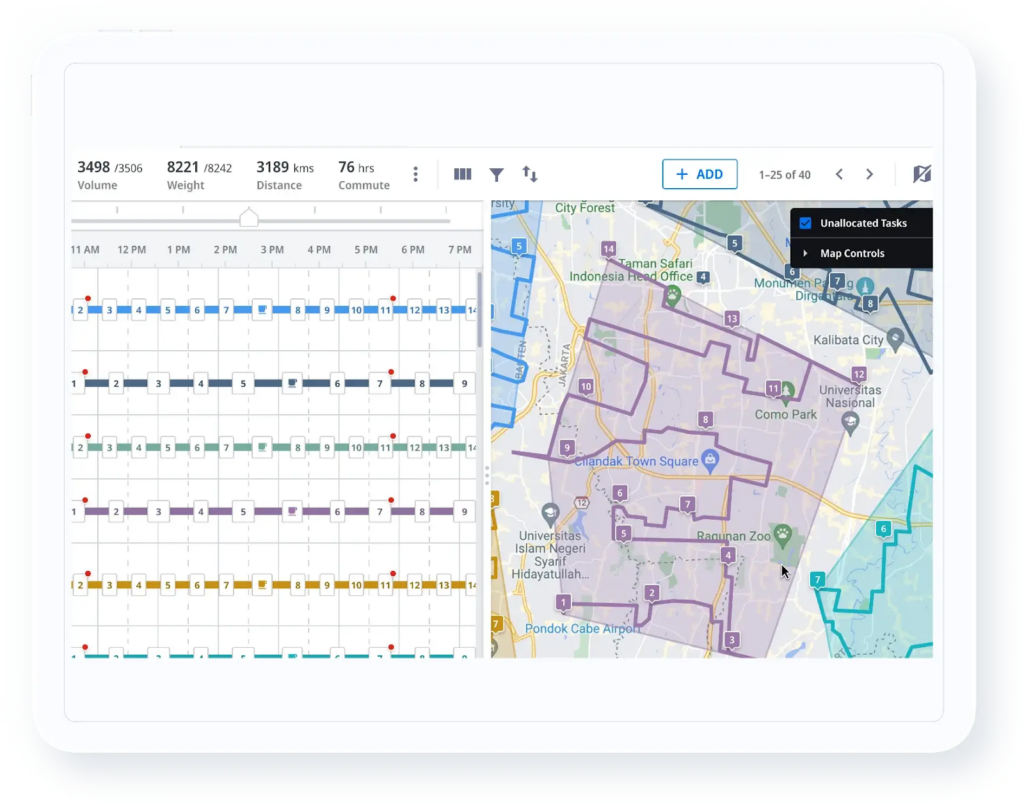
Locus enhances these benefits with its AI-powered dispatch solutions. DispatchIQ automates order-to-driver assignments for maximum fleet productivity, while the Control Tower gives dispatchers real-time visibility to resolve exceptions proactively. By integrating optimization, monitoring, and customer communication into one platform, Locus enables enterprises to cut operating costs, meet strict delivery windows, and scale seamlessly during peak demand.
Best Practices in Dispatch Management
Enterprises managing high delivery volumes cannot rely on ad-hoc methods. To keep operations cost-efficient and reliable, dispatch management must follow structured best practices that align people, processes, and technology.
1. Automate Repetitive Tasks
Manual allocation consumes valuable time and often leads to bottlenecks. Automated dispatch platforms evaluate orders, driver availability, and traffic conditions instantly, ensuring resources are used efficiently without overburdening dispatch teams.
For Retailers:
- Implement same-day delivery automation for competitive advantage
- Integrate with POS systems for real-time inventory updates
For 3PLs:
- Automate multi-client order consolidation for efficiency
- Set up automated SLA monitoring and reporting
2. Maintain Real-Time Visibility
Centralized dashboards give dispatchers live insight into driver locations, vehicle status, and delivery progress. Proactive monitoring enables faster responses when delays or exceptions occur, keeping service levels intact.
3. Use Predictive Analytics
Historical data on demand surges, traffic congestion, or delivery failures can be applied to forecast future challenges. Predictive analytics equips dispatchers to reroute drivers before problems escalate, reducing last-minute disruptions.
4. Integrate with Upstream and Downstream Systems
Dispatch management becomes more effective when connected to order management, inventory, and customer engagement systems. Integration eliminates silos, reduces duplicate entries, and ensures the same information is available across functions.
5. Empower Dispatch Teams
Technology is only part of the equation. Training dispatchers to interpret system insights, prioritize exceptions, and manage escalations builds resilience in day-to-day operations.
6. Optimize for the Customer Experience
Providing accurate ETAs, automated notifications, and transparent tracking links helps customers stay informed and reduces the volume of “where is my order” calls.
For example, a logistics provider using automated dispatch optimization software avoided 12% in wasted miles during a peak season by combining predictive routing with proactive communication. Practices like these transform dispatching from a reactive task into a strategic function that drives both efficiency and loyalty.
To put these principles into action, logistics teams can use the following checklist to evaluate and refine their dispatch operations:
Best Practices in Dispatch Management – Checklist
- Automate order-to-driver assignments to minimize allocation delays
- Track fleets in real time with centralized dashboards
- Use predictive analytics to forecast and prevent disruptions
- Connect dispatch with order, inventory, and customer engagement systems
- Train dispatchers to interpret insights and resolve exceptions quickly
- Share accurate ETAs and live tracking links with customers
While these practices build a strong foundation for efficient operations, enterprises still face structural and operational hurdles that complicate dispatch management.
Challenges in Dispatch Management
Even with digital tools, enterprises encounter persistent challenges that disrupt fleet performance and increase costs. These issues typically fall into five areas:
1. Rising Operational Costs
Fuel prices, driver wages, and vehicle maintenance expenses continue to climb. Without continuous optimization, these costs quickly erode delivery margins.
2. Demand Fluctuations
Seasonal spikes, promotional campaigns, and sudden demand shifts strain dispatch systems. Manual processes often fail to reallocate resources fast enough, leading to bottlenecks and missed deliveries.
3. Driver Availability and Retention
Labor shortages remain a global concern. High turnover among drivers forces enterprises to constantly train new staff, while inexperienced teams increase the risk of errors and delays.
4. Limited Visibility Across Networks
In fragmented supply chains with multiple carriers and regions, dispatchers struggle to maintain end-to-end visibility. Lack of transparency makes it difficult to monitor performance or resolve exceptions promptly.
5. Regulatory and Compliance Pressures
Enterprises must comply with rules covering vehicle restrictions, driver working hours, and regional delivery standards. Overlooking these factors exposes companies to fines and reputational damage.
For example, during a holiday surge, an e-commerce player relying on spreadsheets may overload certain drivers, breach delivery promises, and face compliance risks due to missed rest-hour checks. These recurring challenges highlight the need for integrated, AI-powered systems that anticipate problems rather than react to them.
Common Problems and Solutions in Dispatch Management
| Common Problem | Solution |
| Communication breakdowns between dispatch and drivers | Implement mobile apps with real-time messaging and automated notifications |
| Scheduling conflicts and double bookings | Use automated scheduling with conflict detection and resolution |
| Compliance violations and regulatory issues | Integrate compliance monitoring with automated alerts and reporting |
| Inefficient route planning leading to delays | Deploy AI-powered route optimization with real-time traffic data |
| Poor customer visibility into delivery status | Provide customer portals with live tracking and proactive updates |
Dispatch Performance KPI Framework
This guide’s “Analytics and Reporting” and “Continuous Improvement Through Data” sections both point to metrics as the foundation for ongoing optimization, without laying out a specific framework. Here are the core metrics that tie directly back to the components and benefits already covered:
| KPI | Formula | Ties Back To |
|---|---|---|
| On-Time Delivery Rate | On-Time Deliveries ÷ Total Deliveries × 100 | The service window and appointment concepts covered above |
| SLA Adherence | Deliveries Meeting SLA Terms ÷ Total Deliveries × 100 | The compliance and safety assurance benefit covered above |
| Driver Utilization | Active Delivery Hours ÷ Total Available Hours × 100 | The ‘Improved Driver Productivity’ benefit and the proximity-based dispatch logic above |
| Route Efficiency | Planned Distance ÷ Actual Distance Traveled | The route planning and optimization component covered above |
| Cost per Delivery | Total Dispatch Operating Costs ÷ Total Deliveries | The ‘Lower Operating Costs’ benefit covered above |
| Exception Resolution Time | Total Time to Resolve Exceptions ÷ Number of Exceptions | The exception handling component and challenges section above |
| Customer Satisfaction (CSAT) | Positive Feedback Responses ÷ Total Feedback Responses × 100 | The customer communication component covered above |
As with any KPI set, the value comes from reviewing these together rather than individually — a high on-time delivery rate alongside a rising cost-per-delivery, for instance, may mean SLA performance is being protected by overstaffing or underutilizing the fleet rather than genuine efficiency gains.
Case Study: FMCG Enterprise Overcomes Dispatch Bottlenecks
Locus helps FMCG enterprises cut delivery costs, reduce empty miles, and boost fleet visibility with AI-powered dispatch automation.
A leading FMCG company operating across multiple regions faced mounting dispatch challenges. Manual planning left fleets underutilized, rising fuel and labor costs eroded margins, and lack of real-time visibility made it difficult to monitor delivery performance. During peak seasons, these issues compounded, resulting in missed deadlines and dissatisfied retail partners.
Read the entire case study here!
By adopting Locus’ Transportation Management System (TMS), the company replaced fragmented processes with automated dispatch planning and centralized fleet visibility. The platform optimized vehicle allocation, reduced empty miles, and gave dispatchers real-time insights into delivery progress. As a result, the enterprise achieved faster order fulfillment, lower operational costs, and improved reliability across its nationwide supply chain.
Dispatch Software Pricing, ROI, and Buying Guidance
How much does dispatch software cost?
Enterprise dispatch software is often quote-based because price depends on network complexity, volume, integrations, support needs, and rollout scope. Common pricing models include:
- Per user pricing for dispatchers, supervisors, planners, or managers
- Per driver or per vehicle pricing for active fleet users
- Per delivery, per stop, or per order pricing in volume-led environments
- Per region or per depot pricing in multi-site rollouts
- Platform fee plus usage-based charges
- Feature-tier pricing for capabilities such as optimisation, control tower, ePOD, or analytics
- Custom enterprise pricing for large, multi-country or hybrid-fleet deployments
Why enterprise pricing is usually quote-based
Enterprise buyers are not just licensing a dispatch board. They are typically evaluating:
- ERP, OMS, WMS, TMS, CRM, or telematics integrations
- Multi-region operating models and user roles
- Owned fleets, outsourced fleets, carriers, and gig capacity
- Appointment scheduling, proof of delivery, or cold-chain workflows
- Configuration, change management, training, and support requirements
- Security, access control, and governance expectations
Implementation cost factors to budget for
- Integration design and API work
- Data preparation and migration
- Rules configuration and exception logic
- Dispatcher training and enablement
- Driver onboarding and app adoption
- Change management across regions or partners
- Ongoing support, optimisation, and reporting needs
ROI formulas buyers can use
These formulas help buyers model value during evaluation:
- Cost per delivery = dispatch and delivery operating costs ÷ completed deliveries
- On-time delivery rate = on-time deliveries ÷ total completed deliveries × 100
- Dispatch software ROI = (annualised savings or value ? annual software + implementation cost) ÷ (annual software + implementation cost)
Use these formulas as decision-support tools rather than universal benchmarks. The quality of the result depends on the quality of your baseline data.
Vendor demo questions to ask
- How does the system assign drivers when capacity, skill, territory, and appointments all conflict?
- What data arrives in real time versus batch?
- How are ETAs recalculated when routes change?
- Can dispatchers override recommendations, and are overrides audited?
- How does the platform handle hybrid fleets and partner carriers?
- Which proof-of-delivery fields are configurable?
- What happens when order or telematics data is incomplete?
- How are access controls, regional permissions, and audit trails managed?
RFP checklist
- Workflow fit for your order volume and stop density
- Support for windows, appointments, and exception rules
- Integration coverage across OMS, WMS, ERP, TMS, telematics, and customer communication
- KPI reporting for OTD, SLA, cost, utilisation, and exceptions
- Mobile usability for drivers
- Governance, auditability, and role-based access
- Implementation model, support model, and post-go-live optimisation
Dispatch maturity assessment prompts
- Are assignments still dependent on spreadsheets or local dispatcher knowledge?
- Can you see live route status across all regions and partners?
- Are ETA updates and customer notifications automated?
- Is proof of delivery structured and auditable?
- Can you quantify cost per delivery, empty miles, and exception resolution time?
- Do upstream systems send clean, reliable order data into dispatch?
Dispatch Software Implementation Roadmap
A successful rollout usually starts with process design, data discipline, and phased adoption—not with software configuration alone.
1. Operational discovery
Map the current workflow from order intake to completed delivery. Identify where delays, manual rework, missed windows, or visibility gaps occur.
2. Baseline KPI definition
Capture pre-implementation baselines for on-time delivery, cost per delivery, failed attempts, empty miles, dispatcher workload, and exception resolution time.
3. Data preparation
Typical dispatch data inputs include:
- Orders and service levels
- Addresses and geocodes
- Delivery windows and appointments
- Vehicle and capacity attributes
- Driver availability, shifts, and skills
- Territory boundaries
- Telematics and GPS feeds
- Customer communication preferences
4. Integration design
Define what must be real time and what can be batch. Orders, telematics, ETA updates, and exceptions usually need faster synchronisation than historical reporting exports.
5. Pilot use case or region
Start with a controlled environment: one depot, one region, one business unit, or one constrained workflow such as appointment-heavy home delivery.
6. Dispatcher training
Teach dispatchers not only how to use screens, but how to interpret system recommendations, override when needed, and escalate exceptions consistently.
7. Driver onboarding
Mobile adoption matters. Drivers need clean login flows, reliable task views, clear proof-of-delivery steps, and feedback channels for route issues.
8. Proof-of-value testing
Before full rollout, test the platform against real scenarios:
- Peak order volumes
- Multi-depot routing
- Appointment-heavy routes
- Vehicle breakdowns
- Last-minute cancellations
- Hybrid fleet capacity balancing
- Cross-territory overflow
- Incomplete or late upstream data
9. Measured rollout
Scale by region, business unit, customer segment, or fleet type. Review KPI movement after each phase rather than assuming one go-live proves network-wide value.
How long does implementation take?
Implementation duration varies widely based on integration depth, data quality, organisational readiness, and rollout scope. A lighter deployment with limited integrations can move faster than a multi-region enterprise programme with complex workflows, partner fleets, and governance requirements.
What happens when data is incomplete or inaccurate?
Poor data does not just create reporting issues; it weakens assignments, ETAs, appointments, and exception handling. Strong dispatch software should flag missing addresses, invalid capacities, duplicate orders, or stale telematics signals early so teams can correct them before they damage execution.
AI Governance and Human Oversight in Dispatch Software
AI-powered dispatch can support assignment, predictive ETA, delay detection, dynamic rerouting, capacity balancing, and exception prioritisation—but it still depends on clear rules, clean data, and human oversight.
Where AI helps most
- Prioritising orders against time windows and appointments
- Matching drivers and vehicles to multi-constraint delivery requirements
- Predicting delay risk before a route fails
- Recommending re-dispatch options during exceptions
- Identifying utilisation and cost-to-serve patterns over time
Where human dispatchers still matter
- Accepting or overriding system recommendations when commercial or customer priorities change
- Handling edge cases that data does not capture well
- Coordinating across customers, depots, carriers, and service teams during disruptions
- Escalating decisions with contractual, compliance, or reputational risk
Governance checks buyers should ask for
- Can users see why a recommendation was made?
- Are overrides logged and reviewable?
- Are exception-priority rules configurable?
- How are models monitored when business patterns shift?
- How does the platform behave when source data is delayed or incomplete?
Human oversight remains central to dispatch operations even as automation improves. In transport and logistics, Transporeon’s 2026 Pulse Report highlights 86% as a key benchmark in its “smarter, faster, still human” findings—an important reminder that better automation does not remove the need for accountable operational decision-making. Source: Transporeon.
Future Trends in Dispatch Management
The dispatch management landscape continues to evolve rapidly, driven by technological advances and changing customer expectations. Here are the key trends shaping the future:
Autonomous Vehicle Integration
Self-driving delivery vehicles and drones will require new dispatch algorithms that can coordinate mixed fleets of human drivers and autonomous systems. Early pilots show 30% reduction in delivery costs for last-mile operations.
Hyper-Personalized Delivery
AI will enable delivery preferences based on individual customer behavior, optimizing delivery windows, locations, and methods for each recipient. This includes dynamic rerouting based on real-time customer availability.
Sustainability-First Optimization
Carbon footprint reduction will become a primary optimization criterion alongside cost and speed. Electric vehicle integration and green routing algorithms will help enterprises meet sustainability goals.
Edge Computing for Real-Time Decisions
Processing dispatch decisions at the edge will enable sub-second response times for route adjustments and exception handling, crucial for time-sensitive deliveries.
Limitations and Considerations
While AI-powered dispatch systems offer significant benefits, enterprises should consider potential limitations: dependency on data quality, need for change management, initial implementation costs, and the importance of maintaining human oversight for complex exception scenarios.
Why Choose Locus for Enterprise Dispatch Software
Locus is best suited to enterprise delivery operations that need more than basic scheduling. The platform is designed for high-volume, multi-depot, multi-region networks where planning, routing, execution, and exception control must operate together.
Where Locus fits best
- Enterprise retail and e-commerce fulfilment
- FMCG and direct-to-store delivery
- 3PL orchestration across regions and customers
- Appointment-based home delivery
- Hybrid fleets combining owned, outsourced, and partner capacity
How Locus maps to dispatch workflows
- DispatchIQ supports automated dispatch planning and order-to-driver assignment
- Control Tower supports live visibility and exception management
- Route optimisation supports efficient stop sequencing and territory-aware planning
- Customer communication workflows support more accurate ETAs and status visibility
When a lighter tool may suffice
If a team operates a very small fleet, has limited daily order volume, and mainly needs simple local scheduling without deep integrations, a lighter dispatch product may be enough. Enterprises with complex service windows, partner carriers, large delivery density, or multi-system architecture typically need a more robust orchestration layer.
Conclusion & Next Steps
Dispatch management has evolved from a manual coordination task into a strategic competitive advantage. Modern AI-powered systems enable enterprises to reduce costs by up to 53%, improve delivery reliability, and scale operations efficiently during demand peaks.
Key takeaways for logistics leaders:
- Automation is essential for enterprise-scale operations
- Real-time visibility drives proactive decision-making
- Integration with existing systems maximizes ROI
- Continuous optimization through data analytics is crucial
Ready to Transform Your Dispatch Operations?
Take the next step toward optimized dispatch management:
- Assess your current dispatch maturity level
- Identify automation opportunities in your workflow
- Evaluate technology solutions that fit your scale
- Plan a phased implementation approach
Frequently Asked Questions (FAQs)
1. How does dispatch management differ from route planning?
Route planning focuses on sequencing stops efficiently, while dispatch management covers the entire process, order validation, driver assignment, live monitoring, exception handling, and reporting. It ensures deliveries are executed reliably, not just routed efficiently.
2. What industries benefit most from dispatch management systems?
Retail, e-commerce, FMCG, 3PLs, and CEP providers see the strongest benefits. These industries handle large order volumes, tight delivery windows, and frequent demand fluctuations, making dispatch optimization critical for cost control and service reliability.
3. How can dispatch management help during seasonal peaks?
AI-powered dispatch platforms dynamically reassign deliveries, balance workloads across drivers, and reroute in real time. This flexibility allows enterprises to absorb sudden spikes in orders without adding excess vehicles or headcount.
4. What KPIs should enterprises track to measure dispatch performance?
Key metrics include on-time delivery rate, cost per mile, vehicle utilization, failed delivery percentage, and exception resolution time. Tracking these KPIs helps enterprises assess efficiency and identify improvement areas.
5. How does Locus improve dispatcher productivity?
Locus automates manual tasks such as driver assignment and exception handling, while providing live dashboards for decision-making. Dispatchers spend less time on repetitive coordination and more time focusing on high-priority issues, leading to smoother and more scalable operations.
6. How much do dispatch managers make in the US?
Dispatch managers in the US typically earn between $45,000-$75,000 annually, with experienced professionals in major metropolitan areas earning up to $90,000. Salaries vary based on industry, company size, and geographic location.
7. What do dispatch managers do?
Dispatch managers coordinate and oversee the assignment of drivers and vehicles to delivery routes, monitor real-time operations, handle exceptions and delays, ensure compliance with regulations, and analyze performance metrics to optimize fleet efficiency.
8. Is a dispatch manager a boss or supervisor?
Dispatch managers typically function as supervisors who coordinate and direct driver activities but may not have traditional hiring/firing authority. They report to operations directors or logistics managers and focus on operational coordination rather than personnel management.


General
10 Best Delivery Scheduling Software for Enterprises

Sep 23, 2026
Delivery scheduling software for enterprises. Compare top tools, features, and capabilities for scheduling, routing, and dispatch optimization.
Read more
General
Essential Logistics KPI Examples and Formulas: Track the Right Metrics in 2026
Sep 23, 2026
Logistics KPIs for 2025: track order accuracy, returns, and cost per shipment. See how Locus surfaces and responds to performance shifts effortlessly.
Read moreInsights Worth Your Time




















What Is Dispatch Software? Features, Benefits, and Enterprise Buying Guide