


General
Courier Routes: Strategies to Maximize Speed, Coverage & Profitability
Key Takeaways
- Courier route optimization directly impacts delivery speed, fuel costs, and SLA adherence.
- Static route planning fails in high-volume, time-sensitive networks.
- Real-time data, driver constraints, and stop-level intelligence must inform routing logic.
- Tech-enabled routing systems reduce failed deliveries and improve fleet utilization.
- Locus powers scalable courier operations through dynamic routing, automated dispatch, and live performance visibility.

When a courier misses a scheduled delivery window, the disruption goes far beyond a single unhappy customer. It delays the next drop, creates route congestion, strains driver schedules, and drives up cost per delivery. In high-volume networks, these compounding inefficiencies erode margins and customer satisfaction simultaneously.
Legacy routing models, often static and disconnected from on-ground conditions, fail to accommodate the speed, density, and variability of modern delivery networks. As order volumes grow and customer expectations tighten, logistics teams must shift from fixed planning to adaptive routing models that adjust dynamically based on traffic, order constraints, and fleet availability.
This blog breaks down what a courier route entails, the operational stakes involved, and how leading logistics teams are using AI-powered tools like Locus to boost delivery performance, maximize coverage, and protect profitability.
What Is a Courier Route?
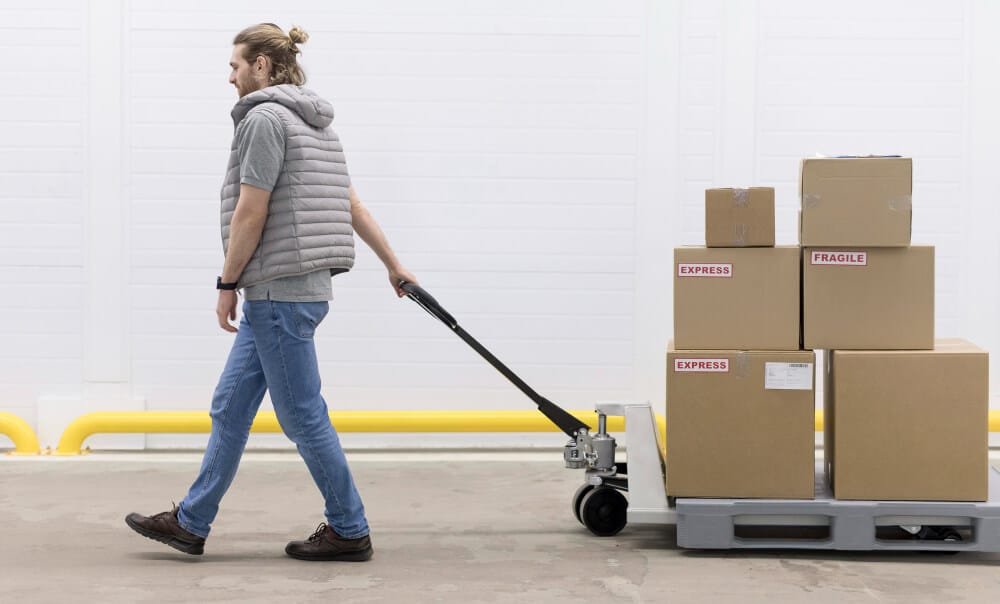
A courier route refers to the operational path a delivery vehicle follows to complete multiple stops within a given shift or service window. These routes are structured to optimize travel distance, delivery time, and cost efficiency, especially in dense urban zones or high-frequency delivery networks.
Courier routes prioritize agility over the long distances and fixed schedules that define freight transport. They are often short-range, serving dozens of stops within tight timeframes and narrow delivery windows. Common courier route models include:
- Loop-based routing, where drivers return to the origin point after completing all stops
- Zonal routing, which divides service areas into geographic segments assigned to specific teams
- On-demand routing, where stops are sequenced in real time based on live order inflow and traffic data
While the term “carrier route” typically applies to fixed postal zones defined by national mail services, courier routes are dynamic, shaped by business-specific variables like package volume, priority, customer preferences, and vehicle capacity.
Managing these routes manually becomes increasingly difficult as delivery volumes rise and order profiles diversify. High-performing logistics teams now rely on intelligent routing systems that process real-time data to build, adjust, and execute courier routes at scale with precision.
Suggested read: How to Improve Net Promoter Score for Your Courier Company
Why Optimizing Courier Routes Matters in 2025?
Every additional mile driven, idle minute spent, or route left unadjusted translates into measurable operational loss. In dense, time-critical delivery networks, inefficient routing drives up cost per order, lengthens fulfillment cycles, and reduces fleet productivity, turning minor delays into system-wide bottlenecks.
Urban courier operations often struggle with traffic unpredictability that disrupts ETAs, dense delivery clusters that increase stop frequency per mile, and strict customer time windows that leave little room for delay recovery, forcing dispatchers to constantly rebalance workloads and sequence stops with minimal margin for error.
In such environments, static routing leaves too much to chance. A fixed route created at the start of the day cannot account for dynamic inputs like weather disruptions, ad hoc orders, or evolving road conditions. As a result, delays cascade, vehicle utilization drops, and order accuracy suffers.
Optimized routing addresses these vulnerabilities by aligning delivery schedules with real-time variables. It calculates the most efficient stop sequence based on traffic patterns, service times, customer preferences, and capacity thresholds. Vehicles cover more deliveries in fewer hours, while drivers avoid unnecessary detours and bottlenecks.
For enterprise teams managing hundreds, or thousands, of daily dispatches, even marginal improvements in routing logic can unlock significant gains in resource allocation, last-mile precision, and customer satisfaction. Well-optimized courier routes reduce excess mileage, improve SLA adherence, and compress delivery cycles without expanding fleet size.
Common Challenges in Courier Route Planning
Courier route planning often breaks down under real-world complexity. Most inefficiencies trace back to disconnected systems, static logic, and the inability to respond to delivery-day variables in real time.
One key challenge lies in route sequencing based on stale or incomplete data. When planners depend on static schedules or outdated order forecasts, stops get misaligned with actual demand patterns. For instance, a driver may be routed to a low-priority warehouse first, while high-volume residential stops pile up later in the day.
Volume unpredictability, especially in sectors like online retail or pharmacy, disrupts preplanned routes within hours. Spikes in demand lead to ad hoc reassignments, often without visibility into fleet load or regional constraints. A grocery delivery service might see a significant order surge on weekends, forcing dispatchers to reassign stops without checking vehicle capacity.
Route planning systems that ignore driver experience, shift duration, or vehicle-specific constraints, such as cargo size or refrigeration, often assign incompatible tasks. An inexperienced driver might be given a route through a high-traffic CBD during rush hour, or a standard van might be routed for medical deliveries requiring cold storage.
Larger operations face coordination challenges across zones. Without a centralized view, dispatchers may assign overlapping territories, leading to over-serviced areas and underutilized capacity. Two drivers could be assigned the same neighborhood while an adjacent zone remains partially uncovered.
Each of these gaps compounds under scale, creating costly blind spots that cannot be resolved through manual adjustments alone.
Suggested read: How to address real-time courier dispatch challenges?
Core Strategies to Optimize Courier Routes
Optimizing courier routes involves more than minimizing distance. It requires a strategic framework that accounts for delivery density, vehicle capabilities, time-based constraints, and dynamic conditions throughout the day.
- Segment service areas based on demand and geographic logic
Dividing large territories into smaller zones, based on delivery patterns, traffic flow, or customer type, helps reduce cross-routing and improves clustering. Delivery teams assigned to familiar, compact regions often complete stops more efficiently. - Implement dynamic routing with intra-day recalibration
Route planning should allow for multiple optimization cycles within a shift. Networks handling unpredictable order volumes benefit from rebatching routes periodically to reflect new demand or traffic disruptions. - Align vehicle type with route profiles and cargo needs
Routing logic must consider vehicle constraints such as load capacity, access limitations, and equipment (e.g., refrigeration). Assigning the right vehicle to the right route prevents underutilization and failed deliveries. - Match drivers to routes based on shift structure and experience
Delivery accuracy improves when drivers familiar with certain territories handle those routes consistently. Complex access points, restricted entry zones, or tight windows require operators who know local nuances. - Use historical route data to refine planning inputs
Post-run analytics often reveal patterns, delays in specific zones, inefficient sequencing, or consistently overestimated buffers. Feeding these insights back into the system helps adjust future routing logic more precisely.
Each of these strategies contributes to faster, leaner delivery networks. However, results improve significantly when they operate within a system that adapts to real-time data and supports continuous optimization.
The Role of Technology in Courier Route Optimization

Courier route optimization platforms have transformed how delivery operations respond to complexity. These tools synthesize live data, enforce operational constraints, and coordinate across systems to maintain delivery speed, accuracy, and scalability.
Real-time route adjustments based on traffic conditions
Routing platforms continuously ingest location and traffic data to adjust stop sequences mid-route. When a delivery zone becomes inaccessible due to a traffic jam or event closure, the system recalibrates the remaining stops using alternate paths, without requiring dispatcher input.
Delay forecasting using behavioral and historical data
Predictive models flag high-risk delivery slots by analyzing past route performance, driver dwell times, and zone-specific trends. When a particular service area frequently causes late arrivals due to elevator delays or parking restrictions, the platform automatically adjusts expected service time or reroutes based on time-of-day behavior.
Route planning that respects operational and regulatory constraints
Enterprise-grade tools allow logistics teams to configure rules for each delivery run, including maximum load, vehicle type, permissible zones, and driver shift limits. For example, oversized items are automatically routed to vehicles with tail-lift capability, while evening deliveries are excluded from routes assigned to morning-only drivers.
Centralized dashboards for real-time delivery orchestration
Supervisors monitor progress, exceptions, and vehicle movements on a unified interface. If one route falls behind due to service delays, deliveries can be redistributed mid-shift to nearby drivers with remaining capacity, preserving SLA adherence without manual rerouting.
System-level integrations for proactive routing
Routing software connects directly with upstream order management systems and downstream fulfillment tools. When a new order is scanned at the warehouse, the platform assigns it to a route-in-progress based on current vehicle location, capacity, and stop priority.
By shifting from static tools to real-time orchestration, technology now functions as the operational backbone of courier execution. For enterprise fleets operating across multiple cities and delivery models, this orchestration is critical to balancing speed, cost, and reliability at scale.
How to Choose the Best Courier Route Planning Software
Selecting a courier route planning platform requires more than checking for optimization features. It involves evaluating whether the tool can process real-world constraints, support in-shift adjustments, and scale across delivery models.
Prioritize systems that process live delivery variables.
Platforms must respond to changing traffic conditions, shift overlaps, and real-time order inflow. A planner that locks in routes hours before dispatch leaves little room for response. In contrast, systems with continuous reoptimization capabilities rebalance routes as road conditions shift or new deliveries enter the queue.
Ensure support for multi-dimensional constraint logic.
Enterprise courier operations involve diverse requirements, time-bound deliveries, region-specific driver rules, vehicle-type restrictions, and client-specific SLAs. The route planner should allow granular configuration of these inputs, with transparent logic explaining each routing decision.
Inspect the platform’s integration capabilities across the stack.
Routing must connect seamlessly with order management systems, fulfillment software, and driver-facing apps. Without this connection, orders can be missed at handover points, or stops may be assigned to unavailable vehicles.
Confirm visibility into route execution, not just route creation.
Planners need access to live dashboards showing stop progress, delays, and route deviations. If a vehicle is falling behind, the platform should support mid-shift reassignments or dynamic ETA updates, before SLA failures occur.
Test for performance consistency across varying volumes and geographies.
High-density courier networks often operate across tiered cities, each with distinct road infrastructure, demand spikes, and service models. A viable platform must scale across this variability while maintaining route accuracy and performance benchmarks.
Locus addresses each of these operational requirements. Its routing engine is built for dynamic inputs, its planning logic is rule-based and explainable, and its orchestration layer integrates directly with execution workflows, making it purpose-fit for high-scale courier routing.
Download our whitepaper on Buying vs. Building Logistics Software: How to Choose? Here
How Locus Powers Smarter Courier Route Planning
Locus equips courier operations with the infrastructure to execute precise, scalable routing under real-world constraints. Its AI-powered platform translates business rules, order flow, and live delivery data into actionable routing and orchestration decisions.
Constraint-aware dispatch planning through DispatchIQ
DispatchIQ processes variables like driver shifts, service levels, geographic zones, and vehicle profiles to generate efficient, SLA-aligned routes. Planners define routing rules per region or use case, for example, limiting express orders to senior drivers with high first-attempt success rates.
Real-time order-to-vehicle assignment with Automated Fulfillment
The Automated Order Fulfillment engine allocates each order to the most suitable vehicle based on proximity, live load, and delivery priority. This prevents batching errors, minimizes idle time, and ensures high-priority shipments are sequenced into routes without delay.
“Locus has elevated our logistics operations to new heights of performance and productivity. Their advanced parcel sorting technology, combined with geocoding and route allocation, has transformed our order processing.”
Juster Correia
General Manager – Operations
BLUE DART DHL
Live fleet visibility and exception intervention via Track and Trace
With Track and Trace, supervisors monitor vehicle progress, stop completion, and route adherence. If a delay emerges, due to dwell time, route deviation, or unexpected traffic, managers can reassign stops or escalate interventions before SLAs are breached.
Cross-functional delivery coordination through Orchestration Tools
Delivery Orchestration Software links routing logic with upstream warehouse workflows and downstream driver execution. For example, orders are released into routes as soon as they clear picking, and reverse pickups are assigned during return legs, maximizing truck utilization.
Performance optimization through analytics and route intelligence
Logistics Analytics and Insights tracks route performance by driver, region, and time window. Teams can identify recurring inefficiencies, such as late dwell zones or underperforming microterritories, and feed those insights back into routing logic or zone assignments.
Locus enables courier operations to move beyond daily plan generation toward continuous route refinement. By embedding intelligence across dispatch, execution, and analytics, it helps logistics teams shorten delivery cycles, reduce fulfillment costs, and meet SLAs consistently, without adding vehicles or staff.
Best Practices for Courier Route Efficiency
Courier route efficiency is built on small, consistent improvements. Each of the following practices contributes to measurable gains in delivery speed, asset utilization, and operational consistency, especially at scale.
- Audit routing decisions using recent delivery performance data: Delivery logs often reveal repeat problem zones, late arrivals, prolonged dwell times, or failed first attempts. Instead of relying on static templates, planners should review route outcomes regularly and update logic to reflect real-world execution. Zones with repeated SLA breaches may require earlier time slots or staggered driver assignments.
- Incorporate structured driver feedback into route planning: Drivers frequently encounter building-specific access issues, traffic pinch points, or customer availability patterns that routing software may not account for. A formal mechanism for collecting and applying this feedback, at the end of each shift or week, ensures stop-level decisions remain grounded in operational realities.
- Calibrate routes based on both geographic scope and task complexity: Route efficiency depends not just on the number of stops but also on the difficulty of completing each one. A 15-stop route in a gated residential zone may involve more variability than a 20-stop route in a grid-like suburban layout. Planning must balance volume with zone-specific challenges.
- Automate repetitive assignments to reduce planning variance: Decision fatigue becomes a bottleneck when dispatchers manually assign drivers to routes or override optimization outputs. Business-rule engines should manage recurring constraints, such as driver certifications or zone familiarity, so planners focus on exceptions, not the routine.
- Tie operational incentives to delivery quality, not just volume: Teams perform better when metrics reflect delivery value. Tracking adherence to delivery windows, stop-level accuracy, and rate of undelivered returns provides clearer insight into driver performance and identifies zones that need retraining or reassignment.
By embedding these practices into daily operations, courier networks can increase delivery density, shorten fulfillment windows, and improve route reliability, without expanding their fleet or labor pool.
Suggested read: How to Choose Vehicle Routing Software: 8 Key Considerations
Future of Courier Routing
What once involved static route planning now requires continuous recalibration, making routing a central lever for fulfillment performance. As delivery volumes rise and service models diversify, courier networks must evolve beyond fixed-route logic and reactive dispatch.
Leading logistics teams are shifting toward adaptive routing systems that adjust in real time, align with business rules, and integrate with upstream and downstream workflows. Platforms like Locus provide the intelligence and infrastructure to support this evolution.
By consolidating routing, dispatch, and execution into a single orchestration layer, Locus helps courier operations respond faster, deliver more accurately, and scale without compromising efficiency. The future of courier routing lies in systems that don’t just plan routes, but improve them every hour.
? Schedule a demo to explore how Locus enables smarter courier operations with dynamic routing and AI-powered orchestration.
Frequently Asked Questions (FAQs)
1. What does “carrier route” mean, and how is it different from a courier route?
A carrier route refers to a predefined mail delivery path used by postal services, typically fixed and geographic. A courier route, by contrast, is dynamically planned based on order volumes, traffic, vehicle constraints, and delivery windows, often changing daily or hourly.
2. How often should courier routes be updated?
Routes should be reoptimized at least once per day, with high-volume networks benefiting from intra-day batching every 1–2 hours. Reoptimization frequency depends on order volatility, traffic conditions, and delivery SLAs.
3. Are courier route optimization tools only useful for large enterprises?
No. While enterprise courier networks see the highest returns, mid-sized fleets also benefit from better stop sequencing, driver assignment, and exception handling, especially during peak demand periods or in congested delivery zones.
4. What metrics should I track to measure courier route efficiency?
Key metrics include on-time delivery rate, cost per order, route deviation frequency, vehicle utilization, and first-attempt success rate. These help evaluate routing logic, spot inefficiencies, and guide shift planning.


General
What Is Strategic Route Planning? A 2025 Guide

Jul 28, 2025
Build a smarter delivery network in 2025 with strategic route planning. Understand its importance, routing strategies, benefits, software, and optimization tips
Read more
General
What Is Routing Efficiency? A Guide to Smarter, Leaner Logistics – Locus
Jul 28, 2025
Routing efficiency helps cut costs, save time, and improve delivery KPIs. Learn how to measure and improve it effortlessly with software and best practices.
Read moreInsights Worth Your Time




















Courier Routes: Strategies to Maximize Speed, Coverage & Profitability