


General
The Right Way to Scale Supply Chain: Why AI-Powered Order Sequencing Drives ROI


Supply chain AI is moving from experimentation to impact. Across planning and logistics, organizations are beginning to see measurable gains—from improved forecast accuracy to more efficient operations and faster decision-making. The difference between incremental progress and real transformation comes down to one factor: how AI is deployed.
The technology is ready. Advanced planning systems, optimization engines, and AI-driven decision tools are widely available and increasingly powerful. As adoption grows, so does the opportunity to unlock value across forecasting, transportation, and execution workflows.
What separates the organizations seeing consistent ROI is a clear, structured approach to implementation. Instead of treating AI as a single leap, they build capabilities in the right order—ensuring each layer strengthens the next. When sequencing is done right, AI becomes a compounding advantage across the supply chain.
The AI Maturity Gap in Supply Chain Planning
Most organizations don’t think they’re behind. Leaders generally rate the maturity of their supply chain planning capabilities as intermediate to advanced. Over 70% report having an Advanced Planning System in place.
But when you examine the capabilities that actually determine whether AI-driven forecasting succeeds or fails, the picture shifts.
- 39% of respondents of recent BCG survey rate their transformation capability at beginner or developing levels.
- Forecast inaccuracy and misalignment are the number one internal planning challenge, cited by 78% of respondents.
- Master data quality, end-to-end visibility, and digital integration gaps round out the top concerns.
Companies have modern tools running on outdated operating models. They’ve bought the engine but haven’t rebuilt the chassis.
You can’t automate your way out of broken processes and fragmented data.
The Real Issue: Organizational Infrastructure
The maturity gap is mainly about data quality, process discipline, decision rights, and the ability to manage change at the speed AI demands. Most organizations have spent recent years adding intelligence atop foundations that weren’t designed to support it.
The result is expensive underperformance that gets blamed on the technology when the real failure is in sequencing.
The Four Capability Levels: A Supply Chain AI Sequencing Framework
Across organizations making real progress with AI in planning, a clear pattern has emerged. Instead of chasing the frontier, these companies build upward through four distinct capability levels, each with increasing autonomy.
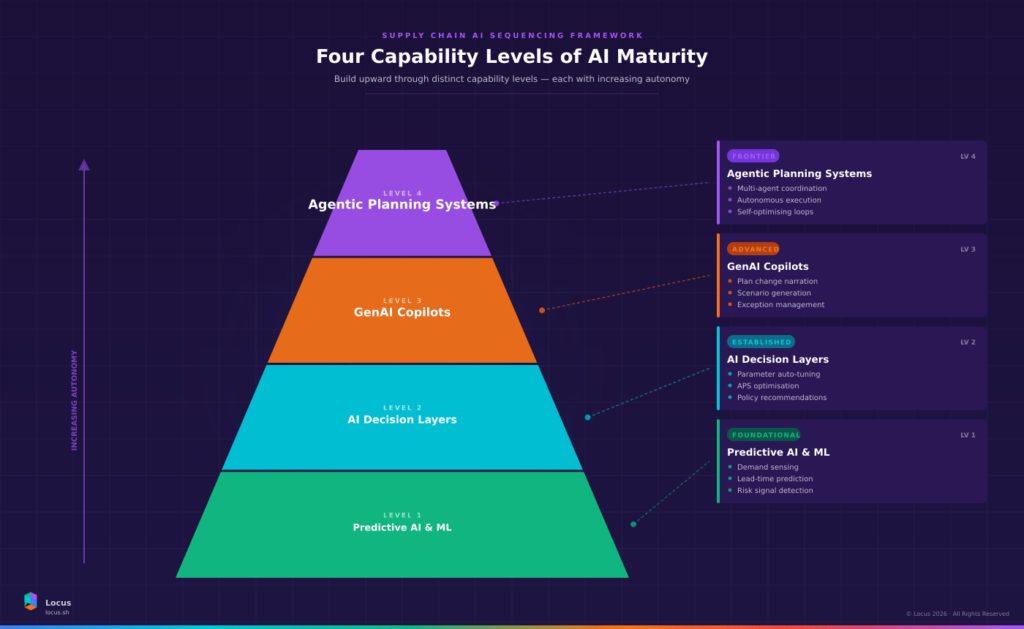
Level 1: Predictive AI and Machine Learning (Foundational)
This includes demand sensing, lead-time prediction, variability modeling, and early risk signals. These capabilities are now at scale across leading organizations. They’re proven, and they deliver measurable accuracy gains when the data underneath them is clean.
Level 2: AI Decision Layers Within Planning Systems (Established)
These applications tune parameters, enhance planning optimization, and recommend policies inside existing APS workflows. They’re available today but require a functioning planning backbone to deliver results.
Level 3: GenAI Copilots (Advanced)
Copilots explain plan changes in natural language, generate scenarios, and accelerate exception management. Early deployments are promising. But copilots depend on trusted outputs to explain. A copilot that narrates unreliable forecasts adds noise, not signal.
Level 4: Agentic Planning Systems (Frontier)
Multiple AI agents observe data, coordinate decisions, and execute actions within defined guardrails. This is where the excitement lives—and where the risk is highest. Few organizations have earned the right to operate here.
Why the Sequence Matters
Each level depends on the one before it. Predictive ML needs clean data. Decision layers need a functioning planning backbone. Copilots need trusted outputs. Agents need well-defined decision rights and proven governance.
Impatience is the most expensive mistake in supply chain AI. Organizations that try to jump to agentic planning without earning each prior level fail to get ROI and erode trust in AI across the organization, making every subsequent attempt harder.
What Successful Supply Chain AI Implementation Looks Like
Abstract frameworks are useful until you need to convince a board. What makes the sequencing argument credible is seeing it work.
As documented in BCG’s 2026 supply chain planning report, a global consumer products company deployed AI as a cognitive layer on top of its existing planning system. The AI processed routine external signals: weather patterns, social media trends, competitor pricing shifts. It adjusted forecasts within predefined guardrails. Planners stayed in place, but their role shifted from data juggling to decision orchestration.
Three design choices made this work.
1. Humans Stayed in the Loop
The AI handled signal processing and pattern recognition. People retained authority over tradeoffs and exceptions. This accelerated adoption because planners trusted the system enough to actually use it.
2. Explainability Was Non-Negotiable
Every forecast change came with attributed drivers: weather impact, promotional lift, competitor pricing moves. Planners could assess whether a plan was defensible, which matters because defensibility is what gets plans approved in cross-functional S&OP meetings. Accuracy without explanation is a black box that people route around.
3. Real-Time Feedback Loops from Day One
The system continuously compared forecasts against actual market data to detect drift and update triggers as conditions changed. The AI improved over time, and planners could see it improving, which reinforced trust in a way that static dashboards never do.
Measurable Results
The company reported forecast accuracy gains between 4 and 18 percentage points and cut planner time on routine forecasting tasks by half. Service performance and inventory efficiency both improved, all by making the existing system and its people more effective.
Explore Locus dispatch management for AI-driven delivery optimization: Locus Dispatch Management Platform
This is proper sequencing in action. Foundational automation first. Explainability built in from the start. Human oversight preserved as a feature, not a stopgap.
What This Means for Supply Chain Transformation Leaders
If you’re leading a supply chain transformation and feeling pressure to move faster on AI, three things are worth keeping in mind.
Should we skip foundational steps to accelerate AI deployment?
No. Resist the pressure to skip steps. Foundational automation has the highest ROI of any starting point and builds the organizational trust that makes everything after it possible. The companies getting the most from supply chain AI today started with predictive ML on clean data, proved value, and expanded from there. There are no shortcuts that don’t eventually cost more than the time they saved.
How important is explainability in supply chain AI?
Critical. Design for trust from day one. Explainability and guardrails make adoption stick. When planners understand why the AI is recommending something, they use it. When they don’t, they revert to spreadsheets. Every implementation that skips explainability trades short-term speed for long-term resistance.
What determines whether supply chain AI delivers value?
People and process, not technology selection. Treat AI sequencing as a change management challenge. Decision rights, data ownership, process redesign, and planner upskilling determine whether AI delivers value or sits alongside the tools people already ignore. Organizations that allocate the majority of their transformation effort to people and process change consistently outperform those that don’t.
The gap between AI winners and everyone else will keep widening. But the path to closing it starts with honest assessment, disciplined sequencing, and the patience to build each layer before reaching for the next.
The supply chain AI payoff is coming for everyone. It’ll arrive first for organizations that understand the most important thing about deploying AI is the order in which you earn the right to use it. See how Locus helps enterprises sequence AI deployment for measurable logistics ROI.


General
Why the Quietest Supply Chain AI Strategies Are Winning

Apr 10, 2026
Most supply chain AI investments stall — not because the technology fails, but because organizations skip steps. Learn the sequencing that separates AI winners from everyone else.
Read more
General
Scaling Parcel Volumes Profitably: The Role of AI Route Optimization in Modern Postal Networks
Apr 13, 2026
Discover how AI-powered route optimization helps postal and parcel networks scale efficiently, reduce costs, and improve delivery performance in a parcel-first world.
Read moreInsights Worth Your Time



















The Right Way to Scale Supply Chain: Why AI-Powered Order Sequencing Drives ROI