


Blog
Six Package Sorting Mistakes That Impact Your On-Time Delivery Rates
Key Takeaways
- Incorrect address labeling and manual sorting of non-standard packages significantly increase delivery delays and operational costs, requiring additional time and resources to correct these errors.
- Warehouses struggle with order prioritization, particularly when handling mixed inventory of perishable and non-perishable items, impacting delivery timing and product quality.
- Similar order IDs and improper quantity verification during picking lead to costly mis-shipments, with reattempted deliveries multiplying expenses up to 4 times.
- Locus’ dispatch management platform automates package sorting based on multiple constraints like service zones and order priority, while providing real-time visibility to minimize hub-level delays.
Imagine your name is Katie Wilson. One fine morning, you received the order with a different name, Katie Richardson, and address. Say the same thing happens to Katie Richardson, too.
Isn’t it frustrating?
These troubles occur as a result of sorting mistakes in the warehouse. Every sorting mistake that gets committed leads to a fall in on-time delivery rates, resulting in the company losing more dollars from its pocket. The company loses more money as the deliveries are reattempted due to sorting errors.
Let’s find out the five package sorting mistakes that impact the on-time delivery rates for businesses.
1. Incorrect Address
Mislabeled packages due to incorrect address data are simple and often repeated or overlooked mistakes in sorting. A mislabeled package from an incorrect address will reach the wrong sorting center.
For instance, a package that must have been sent to Glendale, CA, due to a mislabeled package ends up in Glendale, AZ. This small mistake in the postcode results in delivery fulfillment delays of a package. So, to ensure packages reach the right sorting centers, it is essential to check the address accuracy.
Investing in a smart parcel sorting solution is the best way to ensure address accuracy. A parcel sorting solution helps in assigning the right packages based on a variety of parameters including the addresses. It enables businesses to route the packages to the right sorting center corresponding to the customer address and minimize the delays driven by sorting.
Read Also: ETA in Shipping: Why Retailers & Delivery Partners Need to Pay Attention
2. Manual Sorting
Just imagine that a warehouse has to deal with 50,000 parcels a day, of which 10,000 packages must be decoded manually.
During every passing day, warehousing professionals find many letters and packages that machines cannot sort automatically. This can be due to address labels’ quality, handwritten addresses, or incorrect data. It’s exhausting and time-consuming to decode the packages manually and match them with information in the address database.
This situation of non-sortable parcels increases human dependency, and businesses must spend more out of their pockets to sort these packages. But how can companies counter these sorting issues and accomplish these tasks quickly and effectively? The answer lies in digitizing the entire sorting process.
Digitizing the entire sorting process means the business needs to invest in a platform for its whole hub operations. Sorting is one critical component of the hub operations, along with scanning, picking, and load formation.
When businesses don’t focus on improving sorting efficiency, it increases the time under the roof. Say that items must be sorted in an hour, which takes one hour and fifty minutes. What will happen? The delivery vehicles lined outside the warehouse need to wait an additional 50 minutes and more time to load the orders in their vehicles. This increased time under the roof reduces the on-time delivery rates and leads to businesses losing customers.
Read Also: Time Under The Roof: The Bane Of Cep Business Growth And What Can Be Done About It
3. Sorting Items With Similar ID
Say your warehouse processes more than 100,000 orders in a day. An order ID of 939-I can look like 939-L in such a quickly functioning environment. Warehouses organize and process orders using the SKUs and sequentially pick orders based on this. But this can result in mispicks when the SKUs are similar.
So, there is a need to provide the teams with barcode scanners to verify each order pick. Warehouse businesses must invest in a solution enabling automated load balancing and sorting. It allows effective sorting following the first-in and last-out loading operations, which can minimize the time vehicles spend in warehouse hubs. Another way to solve this problem is to provide distinct SKUs for each order, which can reduce the frequency of identification mistakes. Also, the business can work on visually-distinct packaging of the orders.
Read Also: Last-Mile Delivery Logistics: Problems and Solutions
4. Prioritizing Orders While Sorting
The most critical issue that warehouses face is wrongly prioritizing the products or orders while sorting. Many warehouse teams sort orders without ensuring the priority orders get filled first. This means they delay the most important orders and put them at the back of the line, which can hurt the bottom line.
Each business has a different prioritization when they sort orders, depending on what kind of products they are dealing with. When a company sorts the perishable orders, it must follow first-in-first-out prioritization. With this prioritization, they can stop the perishable products from becoming unusable or less attractive.
When a warehouse deals with long-shelf items or Consumer Packaged Goods (CPG) orders, it needs to sort the orders with the first-in-last-out to ensure the first-priority orders get picked and loaded in the vehicle containers. It makes it easier for the on-ground workforce to fulfill the orders without waiting and searching for the order in the vehicle at the customer’s destination. This saves waiting time at customer destinations and reduces vehicles’ time in hub locations.
Read Also: Five Ways to get Dispatch Management right
5. Wrong Items or Quantities Picked

Stocks can run out in a retail business setting, mainly when the business processes massive numbers of orders in a day. For instance, if the shop does not have a particular fruit or vegetable, it substitutes it with another option for delivery. It is okay if the business exchanges one set of mangoes for another. But when the grocery shop changes the type of fruit and provides an apple, it is a huge mistake.
Similarly, if a customer has ordered ten apples, five in each box, two boxes are supposed to be delivered to the customer. Now, if the business sorts only one package of five apples and sorts the other five apples into another section, it is another big mistake.
Picking up the wrong items or quantities can seem a minor issue. When a business picks, sorts, and dispatches incorrect items or wrong quantities, it leads to a refund or replacement. This means there is a higher degree of reattempted costs being incurred where it can multiply the costs 4x. When your business multiplies the number of mis-shipments with the expenses for mis-shipment, it can determine how much money is wasted by picking up the wrong quantity and items.
The best way to avoid this issue is to scan the goods as the warehouse receives them the first time. As the business uses proper barcode scanners, it creates an error message for every incorrect pick of orders. When the company repeats the scanning process one more time, the scanner alerts the sorting teams in the warehouse of their mistake at the point of dispatch and checks if the right items match each shipping label.
6. In-Compatible Delivery Vehicles Assigned
To cater to different kinds of goods like: Perishable and non- perishable, high value, low value goods, delivery trucks are specifically designed. However, due to the sheer volume of orders, assigning a perishable package to vehicles that don’t have freezer capabilities will lead to spoiled orders and bad customer experience. Not to mention additional cost of return.
However, by leveraging a smart dispatch management system with auto package sorting capabilities, orders are assigned to delivery vehicles based on multiple parameters like: address, package size, package contents and more to achieve timely and error free delivery.
Read Also: How E-commerce Warehouse Operations can be optimized with Dispatch Management Platform
Eliminate the Mistakes in Sorting With Locus’ Customer Experience and Dispatch Management Platform
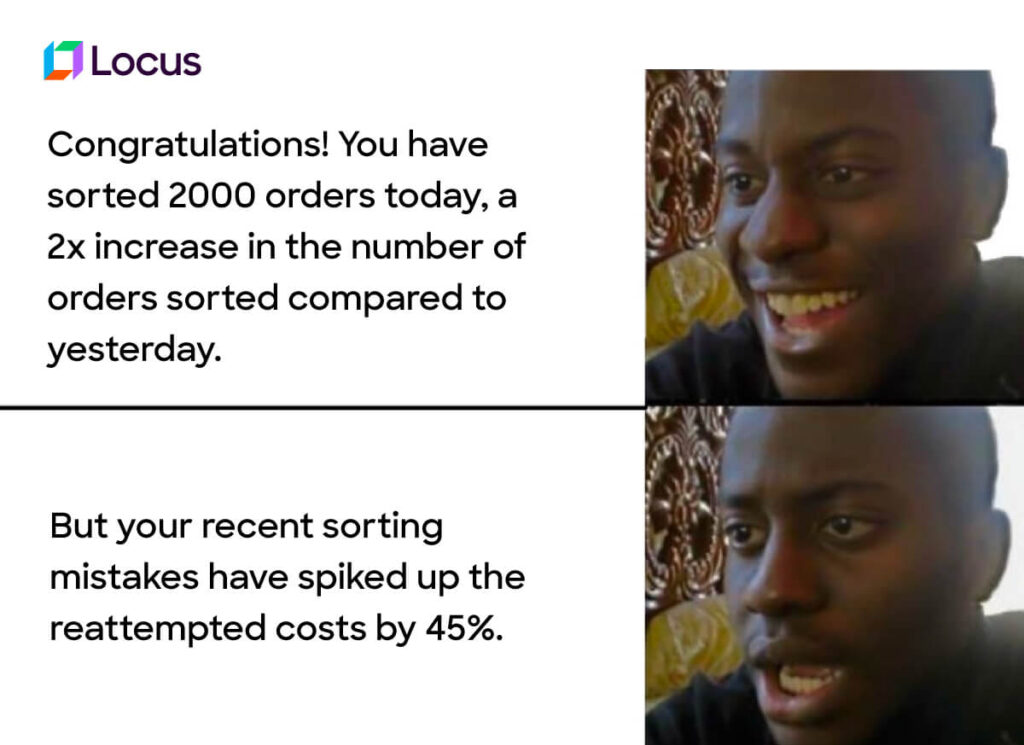
There is no doubt that companies need to focus on improving their sorting efficiency. However, the priority for businesses must be centered around minimizing or eliminating the sorting errors that can contribute to the reattempted costs. Especially if sorting mistakes results in added time under the roof for vehicles, then the reattempted costs will further increase.
How do we deal with this scenario? Businesses that face multiple errors in sorting must invest in an end-to-end platform that can optimize the entire hub operations. One of the world’s leading end-to-end multi-leg dispatch management platforms that can make the entire hub operations like picking, packing, sorting, load formation, load balancing, and delivery fulfillment efficient is Locus.
Locus is one of the world’s leading end-to-end, real-world-ready multi-leg dispatch management platforms. It auto-sorts orders based on numerous constraints like service zones, speed of delivery, nature of order, order priority, and time window. Locus’ automated load balancing, sorting, and inbound and outbound scanning capabilities minimize vehicle hub-level delays. Its granular visibility and analytical insights enable warehouse businesses to bridge operational gaps and improve their sorting processes.
Are you looking to reduce the sorting mistakes that eat up the operational costs of your business?


General
3 Lessons Tom Brady Teaches Dispatchers and Drivers

Aug 30, 2023
Three Tom Brady leadership lessons applied to logistics: smarter route planning, data-driven dispatch, and control-tower visibility for on-time delivery
Read more
Blog
How a Leading MENA-based B2B Food and Grocery Platform Saves 45% Distance Travelled With Locus Solutions

Sep 18, 2023
Discover how a leading MENA-based B2B food and grocery platform reduced travel distance by 45% with Locus' smart logistics solutions.
Read moreInsights Worth Your Time




















Six Package Sorting Mistakes That Impact Your On-Time Delivery Rates