


General
Crew Pairing & Location Intelligence: The Last-Mile Equation for Furniture Delivery
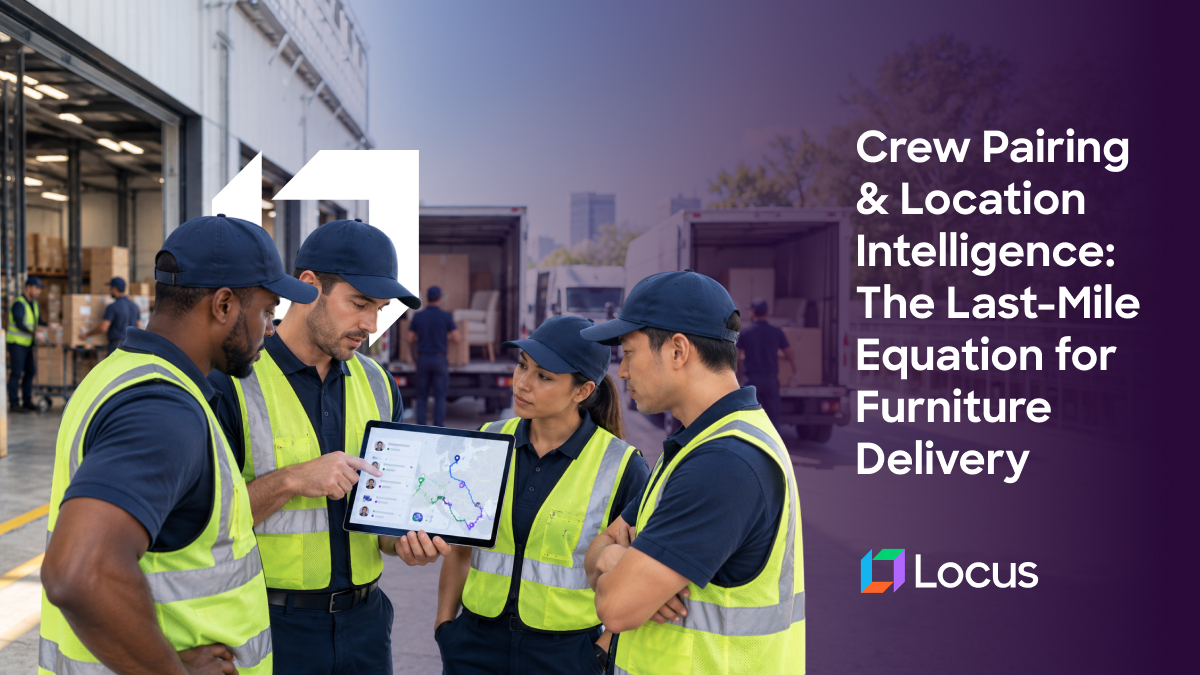
Delivering big-and-bulky furniture is fundamentally different from dropping off a parcel on a front porch. When a delivery involves a heavy marble dining table, a multi-piece sectional sofa, or a king-size bedroom set, the success of the last mile depends heavily on two critical human and spatial variables: who is executing the delivery and where the item is going.
Standard route optimization platforms treat these variables as fixed assumptions. They assume every vehicle carries a uniform crew capacity and that every street address behaves like a ground-floor single-family home.
In real-world furniture distribution, these assumptions fall apart at the doorstep:
- Assigning a single driver to deliver a heavy wardrobe results in damaged goods, driver injury, or doorstep refusal. Conversely, assigning a two-person crew to simple flat-pack drops inflates labor overhead.
- Arriving at a high-rise apartment complex with a 53-foot trailer only to discover a strict freight elevator reservation policy, narrow stairwells, or no parking zone leads to instant delivery failure.
For logistics leads and dispatch managers, protecting margins in big-and-bulky delivery requires solving Sign 3 (Dynamic Crew & Skill Pairing) and Sign 4 (Building-Level Location Intelligence) of the furniture distribution equation.
To read our complete technical framework on big-and-bulky logistics execution, download the full whitepaper: Furniture Distribution: Item, Not Stop.
Key Takeaways
- The Helper Allocation Trap: Blanket assignment of two-person crews to every route inflates labor costs by up to 30%. Helper allocation must be calculated dynamically based on SKU weight, volume, and assembly complexity.
- Beyond Geocoding: Standard GPS pin drops are insufficient for big-and-bulky logistics. Execution requires building-level intelligence, including elevator dimensions, stairwell clearances, and dock access times.
- Skill-Aware Routing: Assembly-heavy items must be dynamically matched to certified crews, preventing doorstep installation failures and customer complaints.
Sign: Dynamic Crew Pairing & Skill-Aware Dispatching
In standard parcel delivery, driver skill sets are largely uniform. In furniture and appliance distribution, crew capabilities directly dictate whether an order can be completed.
The Labor Allocation Dilemma
Carrying a two-person crew on every vehicle across an entire delivery network creates massive labor inefficiency. However, under-provisioning labor leads to failed deliveries, physical injuries, and high product damage rates.
An intelligent dispatch engine solves this by dynamically pairing drivers and helpers based on item-level parameters:
- Weight & Volume Thresholds: Orders exceeding specific weight limits (e.g., >45 kg / 100 lbs) or volumetric footprints automatically trigger a two-person helper requirement.
- White-Glove Skill Matching: SKUs requiring specialized assembly (e.g., electrical connections, intricate bed frames) are assigned exclusively to crews certified in those specific product categories.
- Route-Level Labor Optimization: Orders requiring two-person crews are consolidated onto dedicated helper routes, allowing single-driver vehicles to handle lighter, threshold-only deliveries.
Also Read: The Two-Person Crew Decision: Why US Big-and-Bulky Operations Need Helper-Aware Routing
Sign: Building-Level Location & Access Intelligence
Standard geocoding places a pin on a map based on a street address. It tells you where the building sits, but reveals nothing about how a 100 kg sofa moves from the delivery truck to an 8th-floor living room.
The “Last 100 Feet” Access Barrier
The majority of big-and-bulky delivery failures occur in the final 100 feet of the delivery journey. Incorporating location intelligence into route optimization requires evaluating four critical access parameters:
1. Vehicle Access & Parking Constraints
Evaluates alley width, overhead clearance, and loading bay restrictions before assigning heavy rigid trucks.
2. Vertical Transit Constraints
Factors in elevator availability, elevator weight/cube limits, and flight-of-stairs labor adjustments.
3. Doorway & Hallway Clearances
Validates SKU dimensions against building entrance restrictions to prevent product or property damage.
4. Customer Time-Window & Slot Agreements
Coordinates delivery arrival times with building management policies (e.g., freight elevator booking windows).
Dynamic Dwell Time Multipliers
A delivery to a single-story suburban home with a wide driveway takes 15 minutes. Delivering the exact same SKU to a 12th-floor downtown condo with a tight freight elevator schedule takes 45 minutes.
Location-intelligent routing applies dynamic dwell time multipliers based on historical address data, building type, and floor level, ensuring subsequent delivery windows remain accurate throughout the day.
Comparative Matrix: Legacy Dispatch vs. Location & Skill-Intelligent Routing
Evaluate your big-and-bulky delivery capabilities across these operational parameters:
| Execution Dimension | Legacy Stop-Based Software | Location & Skill-Intelligent Engine (Locus) |
| Labor Allocation | Fixed crew structure per truck | Dynamic helper assignment based on SKU weight & assembly tier |
| Skill Matching | None (Assumes any driver can execute any job) | Automated matching of white-glove skill ratings to SKU complexity |
| Location Data | Standard street-level lat/long geocoding | Building-level intelligence (floors, elevators, parking access) |
| Dwell Calculation | Static average minutes per stop | Dynamic calculation combining SKU volume + floor level + stair factors |
| First-Attempt Success | Frequent failures due to access/crew issues | High SLA adherence with minimized doorstep refusals |
| Customer CSAT | Low visibility during complex installations | Real-time tracking with accurate 2-hour arrival windows |
How Locus Solves the Big-and-Bulky Execution Challenge
Locus’s Decision-Intelligent platform bridges the gap between dispatch planning and real-world doorstep execution:
- Skill and Helper-Aware Dispatching: Evaluates driver certifications, helper availability, and SKU assembly requirements concurrently during route planning.
- Building Intelligence Modeling: Factors in floor levels, elevator access rules, and vehicle restrictions to calculate precise dwell times and ensure vehicle-to-site compatibility.
- 250+ Operating Constraints: Simultaneously balances dynamic time windows, 3D volumetric capacity, crew working hours, and multi-depot staging rules.
- Driver Companion App: Equips two-person crews with turn-by-turn navigation, assembly instructions, photo proof of delivery (ePOD), and instant customer sign-off.
Protect Your White-Glove Delivery Margins
Succeeding in big-and-bulky logistics requires planning for the human and physical realities of the doorstep. Pairing the right crew skills with building-level access intelligence eliminates doorstep failures, protects driver safety, and delivers an exceptional customer experience.
Download the full whitepaper: Furniture Distribution: Item, Not Stop or Schedule a Demo with Locus to see our big-and-bulky dispatching engine in action.
Frequently Asked Questions (FAQs)
1. How does skill-aware routing reduce furniture installation failures?
Skill-aware routing matches SKU handling and assembly requirements directly to certified driver and helper profiles during route generation. This ensures complex white-glove installations are never assigned to uncertified couriers.
2. Why is standard street geocoding insufficient for big-and-bulky logistics?
Standard geocoding pinpoints a building’s driveway, but ignores physical access barriers like elevator dimensions, floor levels, stairwells, and parking restrictions. Building-level location intelligence accounts for these variables to prevent doorstep delivery rejections.
3. Can dynamic helper pairing reduce last-mile labor costs?
Yes. By dynamically assigning two-person crews only to routes containing heavy, high-volume, or assembly-intensive SKUs, fleets avoid over-provisioning helpers on simple, single-driver delivery runs.
4. How does building intelligence improve delivery window accuracy?
By adding dynamic dwell time multipliers for high-rise apartments, elevator wait times, and flight-of-stairs carries, the routing engine prevents morning delays from cascading into missed afternoon delivery windows.


General
Direct Store Delivery (DSD) Optimization: From Static Beat Plans to Dynamic Dispatch

Sep 23, 2026
Discover how FMCG and CPG distributors modernize Direct Store Delivery (DSD). Learn how dynamic beat planning, real-time re-routing, and constraint-aware dispatch protect retail margins.
Read more
General
Delivery Handoffs & First-Time Assembly: The Customer Experience Gap in Furniture Logistics

Sep 23, 2026
Learn how proactive delivery communications and dynamic assembly scheduling close the two-hour handoff gap, eliminate failed drops, and protect brand reputation in big-and-bulky logistics.
Read moreInsights Worth Your Time


















Crew Pairing & Location Intelligence: The Last-Mile Equation for Furniture Delivery