


Last Mile Delivery Optimization, Supply Chain Optimization
Electric Vehicles for Last Mile Delivery: The Strategic Guide for Enterprise Logistics

Key Takeaways
- The global electric last mile delivery vehicle market was valued at USD 33.69 billion in 2025 and is projected to grow at a 19.9% CAGR through 2033, signaling accelerating enterprise adoption.
- Electric three-wheelers cost 3.3 times less to operate than conventional vehicles, with electricity running 60–70% cheaper than diesel per mile.
- EVs require at least 30% less maintenance than internal combustion vehicles due to simplified drivetrains, while modern models deliver 200–272 miles of range per charge.
- Asia Pacific holds the largest revenue share at 38.1%, with North America growing at a CAGR of 16.9% — confirming global momentum across all major markets.
- Locus’s AI-powered logistics orchestration platform — trusted by 360+ global enterprises across 30+ countries — complements EV adoption by optimizing delivery routes, reducing miles driven, and providing real-time last-mile visibility.
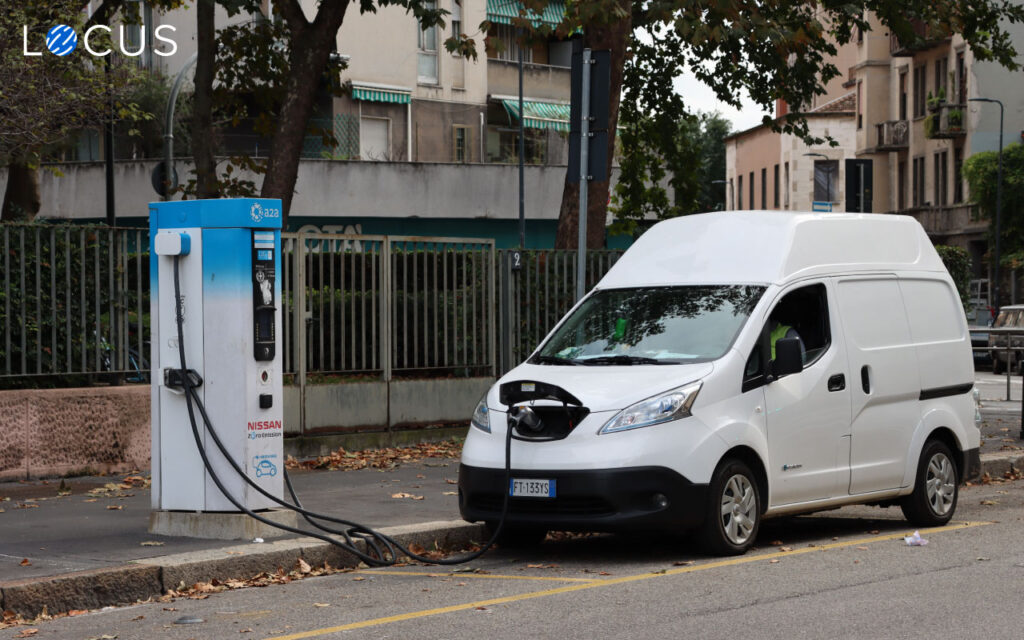
The global electric last mile delivery vehicle market is no longer an emerging trend — it is a rapidly scaling industry segment. Valued at USD 33.69 billion in 2025, the market is projected to reach USD 139.41 billion by 2033, growing at a CAGR of 19.9%. For enterprise retailers, FMCG, e-commerce, 3PL, and CPG organizations, the question has shifted from whether to adopt electric vehicles for last-mile delivery to how fast they can execute fleet electrification at scale.
The e-commerce boom — accelerated by pandemic-era shifts in consumer behavior — has permanently elevated demand for same-day and next-day home deliveries, hyperlocal delivery models, and dynamic on-demand services. This surge has driven a corresponding rise in delivery vehicles on the road, with the World Economic Forum projecting 36% more delivery vehicles in the top 100 global suburbs by 2030 — alongside a proportional increase in carbon emissions unless enterprises take decisive action.
EV last mile delivery offers enterprise supply chain leaders a proven path to reduce operational costs, meet tightening regulatory requirements, and deliver auditable ESG progress — all while maintaining or improving delivery SLAs. Combined with AI-powered route optimization and logistics orchestration, electric fleets become a true competitive advantage.
What Is EV Last Mile Delivery?
EV last mile delivery refers to the final logistics segment — from a distribution hub or micro-fulfillment center to the customer’s doorstep — executed using electric vehicles rather than internal combustion engine (ICE) vehicles. This segment is the most operationally complex and carbon-intensive portion of the supply chain, typically accounting for over 50% of total shipping costs.
Two primary categories of electric vehicles serve this function:
- All-Electric Vehicles (AEVs): Run exclusively on battery-electric power with zero tailpipe emissions. Purpose-built models like the BrightDrop 600 deliver up to 272 miles of range and 614.7 cubic feet of cargo space.
- Plug-in Hybrid Electric Vehicles (PHEVs): Combine an electric motor with a small internal combustion engine, operating primarily on electricity for short urban routes with fuel backup for extended range.
For enterprise logistics operations in urban environments — where stop-and-go driving, low-emission zone compliance, and noise restrictions are critical factors — AEVs have become the preferred choice. Their regenerative braking systems, instant torque delivery, and simplified drivetrains are purpose-engineered for the repeated acceleration and deceleration patterns of last-mile delivery.
Market Growth and Industry Momentum
The data leaves no room for ambiguity: electric last mile delivery is scaling rapidly across every major geography.
| Metric | Value | Source |
| Global EV last mile delivery market (2025) | USD 33.69 billion | Grand View Research |
| Projected market value (2033) | USD 139.41 billion | Grand View Research |
| Market CAGR (2026–2033) | 19.9% | Grand View Research |
| Total last mile delivery vehicle market (2024) | USD 164.1 billion | Global Market Insights |
| EV segment CAGR through 2034 | 8.7% | Global Market Insights |
| Asia Pacific revenue share (2024) | 38.1% | Grand View Research |
| North America CAGR | 16.9% | Grand View Research |
| 4-wheeler segment share (2024) | 57.28% | Grand View Research |
The 4-wheeler segment dominates at 57.28% market share, driven by enterprise demand for electric delivery vans with substantial cargo capacity. Meanwhile, North America’s 16.9% CAGR reflects the combined effect of federal incentives, state-level rebate programs, and corporate sustainability mandates accelerating fleet electrification decisions.
Why Electric Vehicles Make Business Sense for Last-Mile Delivery
For enterprise supply chain leaders evaluating EV last mile delivery, the business case extends well beyond environmental responsibility. The operational economics, regulatory positioning, and fleet efficiency gains create a compounding return on investment.
Dramatic Reduction in Fuel Costs
The logistics industry’s dependence on transportation translates directly into massive fuel expenditure across every link in the supply chain. The U.S. consumed nearly nine billion barrels of petroleum in 2018, with two-thirds allocated to transportation. Electricity costs 60–70% less than diesel per mile, providing enterprise logistics operators with immediate and measurable savings at scale. No petrol, CNG, or diesel is required for a fully electric vehicle, and even hybrid EVs drastically reduce fuel consumption.
For organizations managing fleets of hundreds or thousands of vehicles across multiple geographies, the fuel savings compound rapidly. Off-peak electricity contracts further stabilize energy costs, providing budget predictability that volatile diesel markets cannot match.
Cost-Efficient Total Cost of Ownership
The operational cost of a conventional three-wheeler is 3.3 times higher than an electric three-wheeler. Over the asset’s lifecycle, this translates to substantial cost savings that directly improve last-mile delivery margins. Federal tax credits (up to $7,500 per vehicle), state-level rebates, and accelerated depreciation programs collectively compress payback periods to 3–5 years for most enterprise deployments.
Combined with AI-powered delivery logistics software that improves fleet utilization, the TCO advantage of electric fleets becomes decisive.
Simplified Maintenance and Higher Uptime
Electric vehicles eliminate the engine, radiator, pistons, spark plugs, fuel pumps, cooling systems, exhaust systems, and timing belts found in ICE vehicles. This simplified drivetrain means EVs require only periodic battery health checks and brake pad replacements — with regenerative braking further extending brake life. Research by automotive data experts KeeResources confirmed that an electric vehicle is at least 30% cheaper to service and maintain than an internal combustion-engined vehicle.
For enterprise fleets, this translates to higher vehicle uptime, fewer service bay rotations, and more predictable maintenance scheduling — critical factors when delivery SLAs must be met consistently across high-volume operations.
EV vs. Diesel: Total Cost of Ownership Comparison
Enterprise logistics leaders require clear, data-backed comparisons to justify fleet electrification investments. The following table summarizes the TCO differential across key operational dimensions:
| Cost Category | Diesel/ICE Vehicle | Electric Vehicle | Advantage |
| Fuel/Energy per mile | $0.15–$0.25 (diesel) | $0.04–$0.08 (electricity) | 60–70% savings (EV) |
| Annual maintenance | $1,200–$1,800 | $600–$1,000 | 30–40% savings (EV) |
| Federal incentives | None | Up to $7,500 tax credit | EV only |
| Low-emission zone access | Restricted/fees apply | Unrestricted | EV only |
| Drivetrain complexity | 2,000+ moving parts | ~20 moving parts | Significantly simpler (EV) |
| Noise emissions | 70–80 dB | <40 dB | Extended delivery hours (EV) |
| Scope 1 emissions | Direct CO? output | Zero tailpipe | EV only |
| Payback period (with incentives) | N/A | 3–5 years | — |
The economics become even more favorable when smart routing software eliminates unnecessary miles, further reducing both energy consumption and vehicle wear.
Overcoming EV Last Mile Delivery Adoption Barriers
Range Anxiety Is a Solved Problem
The most common objection to EV fleet adoption — range limitations — no longer holds. Modern purpose-built electric delivery vehicles achieve 200–272 miles of range per charge. Given that typical last-mile delivery routes cover 50–100 miles per day, most electric delivery vehicles complete full shift operations with 50% or more battery reserve remaining.
The resolution follows a clear logic chain:
- Modern EV range: 200–272 miles per charge (e.g., BrightDrop 600: 272 miles)
- Average last-mile route: 50–100 miles per day
- Fast-charging capability: 180 miles of range per hour of charging
- Smart routing integration: AI software plans routes with real-time range prediction and built-in charging stops aligned to delivery schedules
- Result: Daily operations completed with substantial battery buffer, eliminating range as a deployment constraint
Charging Infrastructure Strategy
Enterprise EV fleet operators have multiple infrastructure options depending on fleet size, depot configuration, and operational patterns:
- Depot-based overnight charging: The most cost-effective approach, leveraging off-peak electricity rates to fully charge vehicles during non-operational hours.
- Fast-charging stations: For mid-shift top-ups during extended delivery windows, providing 180 miles of range per hour.
- Wireless inductive charging: Emerging technology (e.g., Electreon) that enables automated charging when vehicles park over embedded charging pads, eliminating manual plug-in requirements and reducing idle time.
Choosing the right route planning software that integrates real-time charger mapping, traffic conditions, and vehicle range data ensures drivers receive optimized routes with charging stops that align naturally with delivery schedules rather than disrupting them.
Payload and Cargo Capacity
Purpose-built electric delivery vehicles now match or exceed ICE equivalents in cargo volume. The BrightDrop 600 offers 614.7 cubic feet of cargo space compared to the Ford Transit’s 445 cubic feet — a 38% improvement that directly increases per-route delivery density and reduces the total number of vehicles required.
Enterprise Leaders Driving EV Last Mile Adoption
The world’s largest logistics operators have moved beyond pilot programs into binding, large-scale EV deployment commitments:
- Amazon partnered with Rivian Automotive Inc. to deploy 100,000 battery-electric delivery vans for its Prime deliveries, with a broader commitment to 100% renewable energy operations by 2030.
- Walmart is deploying BrightDrop 400 vans for its InHome delivery service and aims to operate an all-electric vehicle fleet powered by 100% renewable energy, targeting zero emissions by 2040.
- DHL has committed to 60% electric fleet composition by 2030, representing one of the most aggressive electrification timelines in global logistics.
- Flipkart (Walmart-owned) pledged 100% EV adoption by 2030 through The Climate Group’s EV100 initiative.
- IKEA targeted 25% of its last-mile deliveries via electric vehicles by 2025 as part of its sustainability roadmap.
- BigBasket, India’s leading online grocery retailer, has deployed electric bikes and three-wheelers for last-mile delivery with plans to expand its fleet from 800 to 4,000–5,000 EVs.
The collective market share of top players — BYD, Ford, General Motors, Mercedes-Benz, and Stellantis — reached 36% in 2024, with Stellantis alone holding 11% market share. This concentration among major OEMs signals maturity in vehicle availability, parts supply chains, and service networks — all critical factors for enterprise-scale deployment.
Across Europe, stricter low-emission zones are accelerating adoption, while in Southeast Asia, rapid e-commerce growth and dense urban environments are making electric two- and three-wheelers the default choice for on-demand food logistics and hyperlocal delivery operations.
Key Benefits of EV Last Mile Delivery for Enterprise Logistics
1. Regulatory Compliance as Competitive Advantage
Low-emission zones, Scope 1 emissions tracking mandates, and ESG disclosure rules are no longer optional for enterprises operating in major urban markets. EV last mile fleets convert compliance from a cost center into auditable proof of sustainable operations, strengthening stakeholder confidence while unlocking incentive programs and shielding operations from rising congestion fees.
2. Auditable ESG Progress
Each electric delivery vehicle eliminates Scope 1 emissions from the moment it leaves the depot. Real-time shipment-level carbon tracking provides the granular data required for ESG reports, investor disclosures, and customer-facing sustainability commitments. This level of measurement precision is not achievable with conventional fleets.
3. Extended Urban Operating Hours
Electric vehicles produce less than 40 dB of noise compared to 70–80 dB for diesel vehicles. In noise-sensitive urban zones, this enables extended delivery windows — including early morning and late evening operations — increasing asset utilization and improving delivery density without regulatory friction.
4. Predictable Operating Budgets
Diesel price volatility introduces significant uncertainty into logistics cost planning. Electricity rates — particularly under off-peak commercial contracts — provide stable, predictable energy costs. Combined with the 30–40% reduction in maintenance expenses, enterprise CFOs gain the cost visibility required for accurate multi-year budget forecasting.
5. Improved Driver Experience and Retention
Electric vehicles offer smoother acceleration, reduced cabin noise, zero exhaust fumes, and simplified controls. In an industry facing persistent driver shortages, these improvements in working conditions contribute to higher driver satisfaction and retention — directly reducing recruitment and training costs.
For organizations implementing green logistics strategies, EV fleet deployment serves as the most visible and measurable initiative available.
Key Features to Evaluate in EV Last Mile Delivery Vehicles
Enterprise fleet procurement teams should evaluate electric delivery vehicles against these critical specifications:
- Range per charge: Minimum 150 miles for urban routes; 250+ miles for mixed urban/suburban operations. Confirm range under loaded conditions, not manufacturer-stated unloaded range.
- Cargo volume and payload capacity: Purpose-built models (e.g., 614.7 cu ft for BrightDrop 600) significantly outperform converted ICE platforms. Match cargo specs to average parcel volume and delivery density.
- Charging speed and compatibility: Fast-charging capability (180 miles/hour) for mid-shift top-ups; standard depot charging for overnight recovery. Verify compatibility with existing infrastructure.
- Telematics and fleet management integration: Native support for real-time battery monitoring, GPS tracking, and route optimization software integration. Critical for orchestrating mixed fleets (EV + ICE) during transition periods.
- Regenerative braking efficiency: Directly impacts effective range in stop-and-go urban delivery patterns. Higher regenerative braking recovery extends battery life and reduces brake maintenance.
- Weight class and licensing requirements: Most electric delivery vans fall within Class 1–3 classifications. Verify driver licensing requirements match existing workforce credentials.
- Warranty and battery lifecycle: Battery degradation rates, warranty terms (typically 8 years/100,000 miles for batteries), and replacement costs directly affect long-term TCO calculations.
Pairing the right vehicle specifications with intelligent route optimization software ensures that range capabilities align precisely with daily operational demands — maximizing asset utilization while maintaining delivery SLAs.
How Locus Empowers Enterprise EV Logistics
For enterprise retailers, FMCG, e-commerce, 3PL, and CPG organizations, Locus’s AI-powered logistics orchestration platform transforms EV adoption from an isolated sustainability initiative into a fully integrated strategic advantage.
Why enterprise leaders choose Locus:
- Trusted by 360+ global enterprises across 30+ countries
- 1.5B+ deliveries optimized with AI-powered routing and dispatch
- End-to-end logistics orchestration — from route planning and dispatch management to real-time tracking and analytics
- EV-aware route optimization — algorithms account for vehicle range, charging station locations, payload weight, and traffic conditions to generate routes that maximize delivery density while ensuring vehicles return to depot with adequate battery reserve
- Mixed fleet orchestration — seamlessly manage EV and ICE vehicles during fleet transition periods, automatically assigning the optimal vehicle type to each route based on distance, load, and charging availability
- Real-time visibility and analytics — live dashboards provide dispatchers with battery status, route progress, and predictive alerts for range shortfalls, enabling proactive intervention before delivery SLAs are compromised
Based on Locus’s experience optimizing over 1.5 billion deliveries, enterprises that combine EV fleet deployment with AI-powered route optimization achieve significantly greater cost savings than either initiative delivers independently. The reduction in unnecessary miles — typically 10–15% with optimized routing — directly extends effective EV range and reduces the total fleet size required.
Explore how Locus helps organizations take the EV route for last-mile logistics with data-driven precision.
Schedule A Demo to see how Locus can optimize your enterprise EV logistics operations.
The Future of EV Last Mile Delivery
The trajectory is clear. With the electric last mile delivery vehicle market growing at 19.9% CAGR through 2033 and major logistics operators executing binding fleet electrification commitments, EV last mile delivery is the operational standard enterprise supply chain leaders must plan for in 2026 and beyond.
Five critical insights define the path forward:
- Market momentum is accelerating. From USD 33.69 billion in 2025 to a projected USD 139.41 billion by 2033, the investment trajectory is steep and backed by commitments from Walmart, DHL, Amazon, and every major OEM.
- Range anxiety is a solved problem. Modern purpose-built EVs (272-mile range) combined with smart routing software and fast-charging infrastructure (180 miles/hour) eliminate the primary adoption barrier. Typical last-mile routes operate with 50%+ battery reserve.
- TCO economics decisively favor electrification. Electricity costs 60–70% less than diesel per mile. Simplified drivetrains reduce maintenance by 30–40%. Federal and state incentives compress payback to 3–5 years for most enterprise deployments.
- Regulatory compliance becomes competitive advantage. Low-emission zones, Scope 1 tracking, and ESG disclosure mandates are tightening globally. EV fleets convert compliance requirements into auditable proof, unlocking incentives while shielding operations from congestion fees.
- Technology integration multiplies returns. Wireless inductive charging, real-time telematics, charger mapping, and traffic-aware routing software transform EV fleets from sustainability checkboxes into efficiency engines. Dispatchers gain live dashboards; drivers receive optimized routes with built-in charging stops; customers receive dependable, zero-emission deliveries.
For enterprise logistics leaders, the competitive window to establish EV fleet capabilities is narrowing. Organizations that act decisively — pairing vehicle procurement with AI-powered logistics orchestration — will capture structural cost advantages that late movers cannot easily replicate.
Locus offers best-in-class AI-enabled logistics solutions to optimize your last-mile delivery operations. Schedule A Demo to see how we can help your enterprise scale.
Frequently Asked Questions
What is the typical range of electric last mile delivery vehicles?
Modern purpose-built EV delivery vehicles achieve 200–272 miles of range per charge. The BrightDrop 600 offers 272 miles, while Alkè vehicles deliver approximately 200 km (124 miles) with fast-charging capabilities. Most last-mile delivery routes cover 50–100 miles per day, meaning these vehicles complete full shift operations with 50% or more battery reserve remaining. Smart routing systems further optimize range by integrating charging stops during natural break times and accounting for real-time traffic and payload conditions.
How much does an electric last mile delivery vehicle cost after incentives?
Purpose-built electric delivery vans range from approximately $25,000 (after $7,500 federal rebate for eligible models) to $40,000–$60,000 for larger vehicles like the BrightDrop 600. Federal tax credits, state-level rebates, and accelerated depreciation programs collectively reduce net acquisition costs. When factoring in 60–70% lower electricity costs versus diesel and 30–40% maintenance savings, total cost of ownership payback periods typically fall within 3–5 years for enterprise deployments.
What are the main advantages of EV last mile delivery over diesel vehicles?
Electric delivery vehicles provide four primary advantages: (1) Operational efficiency — regenerative braking and instant torque are purpose-engineered for stop-and-go urban delivery patterns. (2) Regulatory compliance — zero-emission access to low-emission zones and Scope 1 emissions reductions for ESG targets. (3) Cost savings — simplified drivetrains eliminate oil changes and exhaust system maintenance, reducing service costs by approximately 30–40%. (4) Urban operating flexibility — noise levels below 40 dB enable extended delivery hours in noise-sensitive areas, increasing daily asset utilization.
What charging infrastructure is needed for EV last mile fleets?
Most enterprise EV fleets rely on depot-based overnight charging using off-peak electricity rates — the most cost-effective approach. Fast-charging stations (providing 180 miles of range per hour) support mid-shift top-ups during extended delivery windows. Emerging wireless inductive charging technology (e.g., Electreon) enables automated charging when vehicles park over embedded charging pads, eliminating manual intervention. Intelligent route planning software integrates real-time charger mapping and traffic conditions, ensuring drivers receive routes with built-in charging stops that align with delivery schedules.
Which companies are leading EV last mile adoption?
Major logistics operators include Amazon (100,000 Rivian electric delivery vans), Walmart (BrightDrop 400 vans for InHome delivery, zero emissions target by 2040), and DHL (targeting 60% electric fleet by 2030). On the vehicle manufacturing side, GM (BrightDrop), BYD, Ford, Mercedes-Benz, and Stellantis collectively held 36% of the last mile delivery vehicle market in 2024. Purpose-built designs maximize cargo space — the BrightDrop 600 offers 614.7 cubic feet versus the Ford Transit’s 445 cubic feet.
How do electric delivery vehicles support ESG targets?
Each EV last mile vehicle eliminates Scope 1 emissions from the point of depot departure, converting corporate sustainability pledges into auditable, quantifiable results for stakeholder reporting and regulatory disclosure compliance. Real-time shipment-level carbon tracking provides granular impact measurement. The electric vehicle segment in last mile delivery is expected to grow at a CAGR of 8.7% through 2034, driven by both regulatory mandates and enterprise commitments to measurable emissions reductions.
How does route optimization software improve EV last mile delivery?
AI-powered route optimization software — such as Locus’s logistics orchestration platform — maximizes EV fleet performance by accounting for vehicle range, real-time battery status, charging station locations, payload weight, traffic patterns, and delivery time windows simultaneously. This typically reduces unnecessary miles by 10–15%, directly extending effective EV range, lowering energy consumption, and enabling more deliveries per charge cycle. For enterprises managing mixed EV/ICE fleets during transition periods, intelligent dispatch automatically assigns the optimal vehicle type to each route based on distance, load characteristics, and charging availability.


Delivery Experience
Same-Day Delivery: What It Takes to Make It Work for You

Jul 1, 2025
Key Takeaways With a massive demand for daily life essentials, the world is staring at another tough time. Whether it is top retailer brands, or small retailers, both are facing the heat to allocate their resources for standard delivery, next-day delivery and same day delivery. As the in-store traffic has reduced, things are not going […]
Read more
Dispatch Management
What is Dispatch Management? 5 Ways to Get It Right in 2026
Jul 1, 2025
Get the last-mile dispatch management process right in five steps for proper planning and to improve productivity and efficiency of dispatch management plans.
Read moreInsights Worth Your Time




















Electric Vehicles for Last Mile Delivery: The Strategic Guide for Enterprise Logistics