


General
Best Dynamic Route Planning Software: The Good, the Shortfalls, and Who It’s For

Key Takeaways
- Dynamic route planning keeps routes current by adjusting to live traffic, order changes, driver location, and vehicle capacity during the day
- Enterprise evaluations should focus on execution depth by checking constraint handling, re-optimization logic, hybrid routing support, and routing-to-dispatch connectivity
- Platform categories should be compared by operating model because execution platforms, fleet tools, and SMB routing systems solve different routing problems
- Data readiness should be checked before rollout because delayed feeds and weak integrations can reduce dynamic routing to faster but still flawed planning
- Locus should be considered for execution-heavy operations because it supports 250+ variables, event-triggered re-optimization, and a connected flow from routing to dispatch and settlement
Modern delivery networks rarely follow the plan created at dispatch. Real-world conditions, like traffic disruptions and new orders, force dispatch teams to adjust routes repeatedly during the execution window
Static route planning tools struggle in these conditions because they treat routing as a one-time decision rather than a continuous operational process. Dynamic route planning software addresses this gap by recalculating routes as conditions change, using live inputs such as traffic data, driver location, order updates, and vehicle capacity to keep routes aligned with real execution conditions.
For enterprise logistics teams, evaluating these platforms goes beyond checking feature lists. The real differences appear in how quickly it re-optimizes routes during the execution window.
This guide is logistics and supply chain management leaders to compare eight dynamic route planning platforms used in modern logistics operations. It examines the features that determine execution depth, the operational shortfalls teams should plan for during rollout, and how the leading tools differ across three categories, including execution platforms, fleet optimization tools, and SMB routing systems.
What Is Dynamic Route Planning Software?
Dynamic route planning software updates delivery routes as conditions change during the day. Instead of locking a plan at dispatch and hoping it still works hours later, the system keeps adjusting based on live inputs such as traffic, driver location, order changes, and available vehicle capacity.
It matters because real delivery operations rarely stay predictable for long. A road closure at 10 a.m., a few return pickups added mid-route, or a driver delayed at one stop can affect the rest of the schedule very quickly. Dynamic routing helps teams respond to those shifts quickly rather than working around them manually.
Currently, some operations use a hybrid model. This means recurring routes or fixed service zones stay in place for the stable parts of the network, while dynamic optimization updates stop order, timing, and new order allocation during execution.
For example, a pharmaceutical distributor may keep scheduled pharmacy routes fixed while handling urgent hospital deliveries dynamically on the same fleet. Locus supports both within the same routing environment.
Features to Look for in Dynamic Route Planning Software
Route planning tools have varying levels of operational complexity. Some platforms can create clean plans at the start of the day. Enterprise teams usually need more than that, such as:
Instant re-optimization
This is one of the clearest signs of whether a platform is truly dynamic. Some systems refresh routes on a schedule. Stronger ones respond the moment conditions change.
A driver falling behind, a failed delivery attempt, or an urgent order added after dispatch can all affect the rest of the route. The platform should recalculate quickly and show whether updated instructions go straight to drivers or through dispatcher review.
When evaluating vendors, ask what actually triggers re-optimization, how long recalculation takes at your delivery volume, and how route changes are communicated in the field.
Constraint-based routing
Route plans hold up better when the engine accounts for real operating conditions from the start. It includes weight limits, delivery windows, vehicle restrictions, driver hours, zone access rules, and handling requirements tied to specific customers or shipment types.
If those details sit outside the platform in spreadsheets or manual notes, dispatch teams still end up fixing routes after the plan is built. For enterprise operations, it leaves too much room for error.
Constraint depth matters here. It is worth checking how many variables the system can actually process and how those constraints interact in live planning.
Hybrid routing model support
Many delivery networks do not run on a single routing model. Some parts of the operation follow recurring routes or fixed service zones, while other parts change throughout the day.
A platform should be able to handle both within the same planning environment. This makes it easier to manage stable route structures without losing the flexibility to respond to shifting demand, urgent deliveries, or stop-level changes during execution.
For teams balancing repeatability with day-of agility, native hybrid routing support makes a noticeable difference.
Real-time cost and ETA tradeoff simulation
Route changes affect more than distance. They can change delivery timing, route economics, and service performance across the rest of the schedule.
A useful platform helps dispatchers see those tradeoffs before a change is confirmed. If one route adjustment adds cost or pushes the next few stops closer to an SLA breach, the system should surface it clearly.
Such visibility helps teams make better decisions in the moment, especially in operations where routing changes carry financial or contractual implications.
Integration and data connectivity
Dynamic routing depends on the quality and speed of the data flowing into it. Order feeds, GPS signals, traffic inputs, and delivery status updates all influence how accurately the system can respond.
If those inputs arrive late or update too slowly, the routing engine may still produce faster plans, but it can be unresponsive to real-time operations.
Before choosing a platform, it helps to look at the full data chain. Delays between order creation and system ingestion, GPS activity and platform visibility, or traffic events and routing updates can all reduce the value of dynamic planning.
Benefits of Dynamic Route Planning Software

Dynamic route planning changes how delivery operations perform during the day, going beyond just how routes look at dispatch. Its impact usually shows up in four areas: fleet usage, service reliability, operating cost, and customer communication.
Let’s go over the key benefits of the tool:
Fleet utilization and stop density
Fleet capacity opens and closes throughout the day. One driver may finish early while another falls behind, and dynamic routing helps teams rebalance work across the fleet instead of letting that spare capacity go unused.
It often leads to more stops completed per vehicle without adding fleet. Locus customers, for example, have reported a 45% increase in deliveries per vehicle using the same fleet. The gain comes from tighter route clustering, stronger load matching, and mid-shift reassignment when capacity becomes available.
On-time delivery and SLA compliance
Delivery plans can lose accuracy quickly once the day begins. Traffic builds, unloading takes longer than expected, and early delays can push the rest of the route off schedule.
Dynamic routing helps teams respond while the route is still recoverable. For operations with strict SLA commitments, this directly impacts revenue and service quality.
Locus reports 99.5% on-time delivery in high-complexity environments, driven by continuous route adjustment during execution.
Cost reduction across pillars
More efficient routes usually mean fewer unnecessary miles, less overtime, and lower vehicle wear over time. Those savings build across every planning cycle.
Locus customers have documented 15–30% reductions in total delivery costs within the first year of implementation. Much of that improvement comes from reducing empty miles, consolidating vehicles more effectively, and avoiding inefficient route paths.
Customer-facing ETA accuracy
Customer updates work better when they reflect what is happening on the road right now. As routes adjust to live traffic, stop delays, and order changes, ETA updates stay closer to actual delivery conditions.
It helps reduce inbound status calls, improves first-attempt delivery rates, and gives customers a more reliable view of when to expect an order.
Shortfalls of Dynamic Routing
Dynamic routing can improve day-to-day execution, but it also asks more from the operation around it. Real-time re-optimization works best when the data is reliable, the planning logic reflects how the business runs, and dispatch teams are comfortable using the system in live conditions.
This is why rollout decisions should go beyond feature depth. Teams also need to look at data readiness, process fit, and how much day-to-day variability the network actually has.
Data quality sets the ceiling
Dynamic routing depends on fast, accurate inputs. Route changes are only as useful as the order feeds, GPS signals, and traffic updates behind them.
If those inputs arrive late, the platform may still generate plans quickly, but the decisions will reflect an outdated picture of the network. Before evaluating vendors, it helps to trace how data moves across the full chain, from order creation to platform ingestion and from driver movement to system visibility.
When those gaps are large, fixing the data flow often creates more value than switching routing platforms.
Dispatcher adoption takes work
Experienced dispatchers build strong judgment over time. They know where delays tend to happen, which drivers move fastest in certain zones, and how specific customers affect route timing.
Adoption tends to go better when teams understand why the recommendation changed and how to use the system as part of their daily workflow.
Training and process alignment matter here just as much as technical setup. Without them, teams may fall back on familiar planning habits even when the software can produce a stronger route.
Some networks may not need it
Dynamic routing brings the most value in operations in which delivery conditions change often, and service commitments carry more weight. For fleets running stable, recurring routes to fixed locations, the extra configuration and maintenance may not deliver the same return.
In those environments, static or zone-based routing can be easier to manage and more cost-effective. The key question is whether the network changes enough during the day to justify the added implementation depth.
What Happens When Dynamic Routing Comes Too Early
At enterprise scale, rollout issues spread quickly. A gap that seems manageable in one region can affect hundreds of routes across multiple hubs once volumes increase. Readiness matters as much as platform capability.
Integration gaps
Enterprise logistics teams rely on connected systems, from WMS and OMS to ERP, carrier feeds, and fleet telematics. Dynamic routing works best when those systems are feeding the platform accurately and continuously.
When the connection is incomplete, route decisions can drift away from what is actually happening in the network. Orders canceled may still appear in route plans. Vehicles may be assigned work that does not match their live capacity.
For high-volume fulfillment teams, those gaps affect execution quickly and make dispatchers less confident in system recommendations.
Override culture at scale
In smaller teams, route planning habits are easier to align. Enterprise operations are different. Multiple hubs, larger dispatcher teams, and varied working styles make consistency harder to maintain.
Such a scenario makes governance important. Teams need a clear view of when overrides are appropriate, how often they happen, and whether certain hubs or dispatchers rely on them more than others.
Without the structure, the software may produce stronger routes on paper, while much of that value gets lost during day-to-day execution.
Point solution routing without alignment
A better route plan helps, but enterprise operations gain more when routing connects cleanly with dispatch, proof of delivery, settlement, and fleet execution.
If those layers stay separate, teams may still be working across multiple tools to communicate updates, capture delivery outcomes, and reconcile performance later. This fragmentation reduces the operational value of dynamic routing, even when the optimization itself is strong.
The right time to adopt dynamic routing at enterprise scale is when data connectivity, process governance, and execution workflows are ready to support it end-to-end.
Best Dynamic Route Planning Software in 2026
Eight platforms, three categories:
- Execution platforms handle routing and dispatch as an integrated layer, with the depth needed for multi-fleet, high-variability enterprise operations.
- Fleet optimization tools are stronger on vehicle routing and telematics but thinner on downstream execution integration.
- SMB routing tools consolidate routing within a broader operations stack suited to smaller, less complex operations.
Dynamic route planning software: Comparing the top 8 tools
| Tool | Category | Core Identity | Dynamic Re-optimization | Constraint Depth | Hybrid Routing | Execution Layer | Best For |
|---|---|---|---|---|---|---|---|
| Locus | Execution Platform | Full-stack dispatch execution for high-volume, high-variability networks. | Event-triggered. Failed deliveries, driver delays, urgent orders fire instant recalculation. Updates push to drivers via the LOTR app. | 250+ variables. Zone access by time of day, driver HOS, vehicle-road compatibility, weight/volume, handling requirements. | Native. Fixed zones + dynamic optimization in same environment. | Full chain. Routing to dispatch to driver workflow to ePOD to plan-vs-actual to settlement. Includes ShipFlex (3PL orchestration), NodeIQ (network design), Control Tower. | Enterprise logistics: retail, FMCG, e-commerce, 3PL, CPG with mixed fleets and strict SLAs. 30+ countries. |
| FarEye | Execution Platform | Carrier visibility and delivery experience platform for multi-carrier B2C retail. | Limited. Route planning exists but is not the core architecture. | Limited. Less developed constraint handling vs. execution-focused tools. | No | Strong (carrier layer). Multi-carrier connectivity, branded tracking, SLA dashboards, delivery scheduling, ePOD. | Retail/e-commerce with heavy 3PL reliance needing unified carrier visibility and customer comms. |
| LogiNext | Execution Platform | Structured, high-frequency distribution routing for CPG and field service. | Limited. Handles sequencing and time windows well but not built for material mid-day plan rebuilding. | Moderate. Time window + vehicle capacity + territory/beat planning. ERP/TMS integration. | No | Partial. Driver tracking, field force visibility, exception management. No full dispatch-to-settlement chain. | CPG distribution and field service with predictable, high-frequency, beat-based routes and moderate variability. |
| Wise Systems | Fleet Optimization | AI learning-based routing that improves over time from historical delivery and driver behavior data. | Moderate. Real-time traffic and stop-time adjustment available. | Distribution-calibrated. Time windows, vehicle capacity. Not designed for complex mixed-fleet constraints. | No | Partial. Driver performance modeling, route analytics. No full execution chain. | Beverage, food service, and CPG distribution with high-frequency recurring customer sets. |
| Route4Me | Fleet Optimization | Accessible SaaS route optimization with a marketplace integration model. | Minimal. Standard stop-sequence optimization. No continuous dynamic re-optimization at scale. | Basic. Time windows, vehicle capacity, drag-and-drop editing. Deep constraints require marketplace add-ons. | No | Basic. GPS tracking, mobile driver app. Advanced capabilities via the third-party marketplace. | SMB and mid-market field service/delivery with standard routing needs and moderate complexity. |
| Verizon Connect | Fleet Optimization | Fleet telematics and compliance platform. Routing is a module inside a compliance suite. | Minimal. Route planning with traffic/scheduling inputs. Not a dynamic re-optimization engine. | Minimal. Routing constraints secondary to ELD/HOS compliance focus. | No | Strong (compliance). ELD, HOS, FMCSA, driver behavior, fleet maintenance, asset lifecycle. Hardware ecosystem. | Compliance-heavy fleets where ELD, HOS, and asset tracking are primary. Routing is secondary. |
| Grasshopper Labs | SMB Routing | Consolidated TMS + WMS + routing platform eliminating tool fragmentation for smaller ops. | Limited. AI-powered with real-time traffic/driver inputs. Not continuous enterprise-grade re-optimization. | SMB-calibrated. Standard routing constraints. Not enterprise-scale variability. | No | Broad (SMB scope). WMS, order fulfillment, demand forecasting, customer comms, 100+ pre-built integrations. | SMB retailers and 3PLs wanting to consolidate TMS, WMS, and routing into one platform. |
| DispatchTrack | SMB Routing | Home delivery scheduling and CX platform for furniture, appliances, specialty retail. | Limited. Time window and capacity management. Not continuous re-optimization. | Home-delivery calibrated. Scheduling precision, time windows, capacity. Exhausted quickly at enterprise scale. | No |
The category matters as much as any individual feature comparison.
Category A: execution platforms
1. Locus
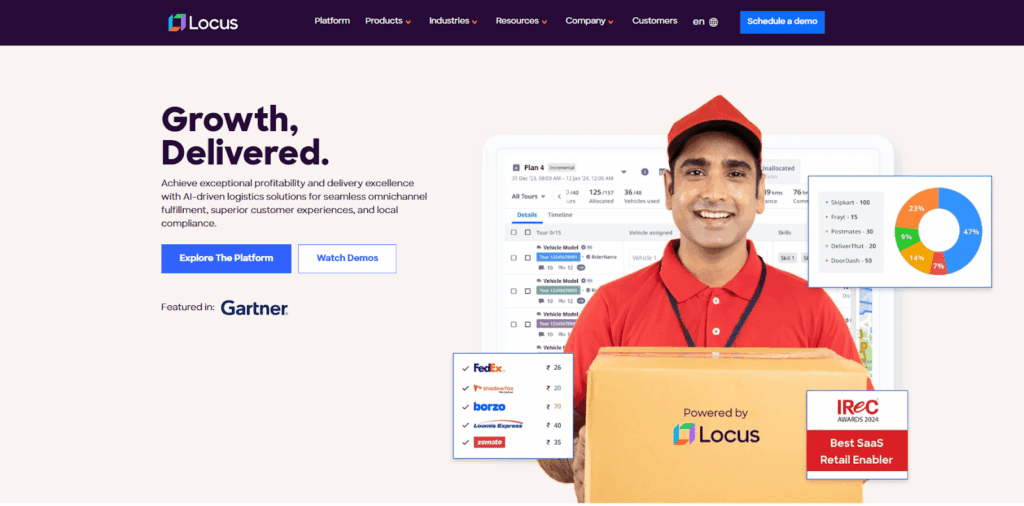
The problem Locus was built to solve is not route optimization in the generic sense. It is the operational complexity of high-volume, high-variability delivery networks where the morning plan degrades by mid-morning and manual intervention is already failing to keep up.
DispatchIQ, the proprietary optimization engine, processes over 250 variables simultaneously. These include time-of-day zone access restrictions, driver break preferences feeding into stop sequencing, and vehicle-specific road-type compatibility. These specific variables are exactly where manual exception handling accumulates.
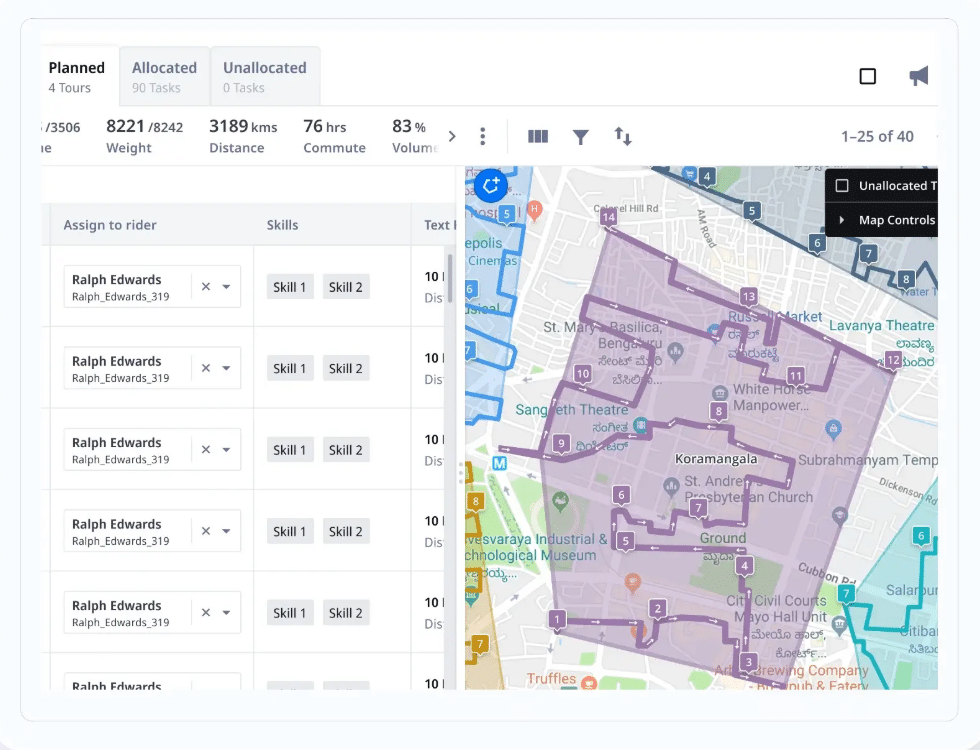
Also, re-optimization in Locus is event-triggered. A first-attempt delivery failure fires a recalculation. A driver falling 20 minutes behind triggers updated assignments across the remaining fleet.
Additionally, new urgent orders arriving after dispatch are absorbed into live routes without requiring the dispatcher to manually rebuild anything. Updated instructions push directly to drivers through the LOTR mobile app.
Where Locus differentiates most sharply from the other platforms in this list is the scope of the execution layer. Routing does not operate as a standalone module. It connects to dispatch assignment, driver workflow, proof of delivery capture, plan-vs-actual analysis, and settlement.
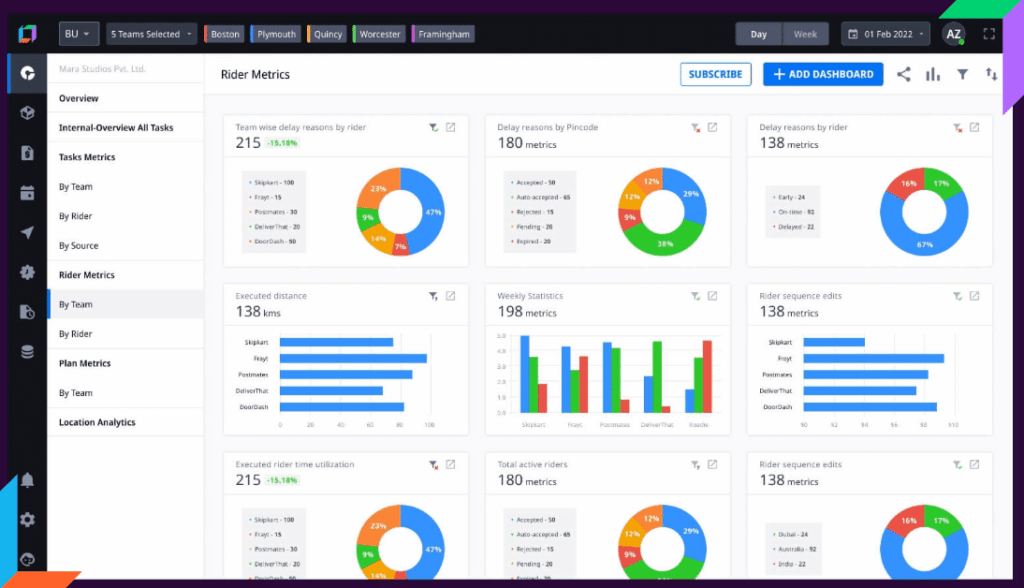
The route optimization produces a better plan. The execution layer ensures that the plan is actually what happens, or surfaces how it diverged and why.
Locus’ Key Features
- DispatchIQ for deep constraint-based optimization: Processes 250+ operational variables at the same time, including delivery windows, vehicle capacity limits, road restrictions, driver hours, zone access rules, and live traffic inputs
- Event-triggered mid-route re-optimization: Recalculates routes when delays, failed deliveries, urgent orders, or traffic disruptions occur to keep execution aligned with live conditions
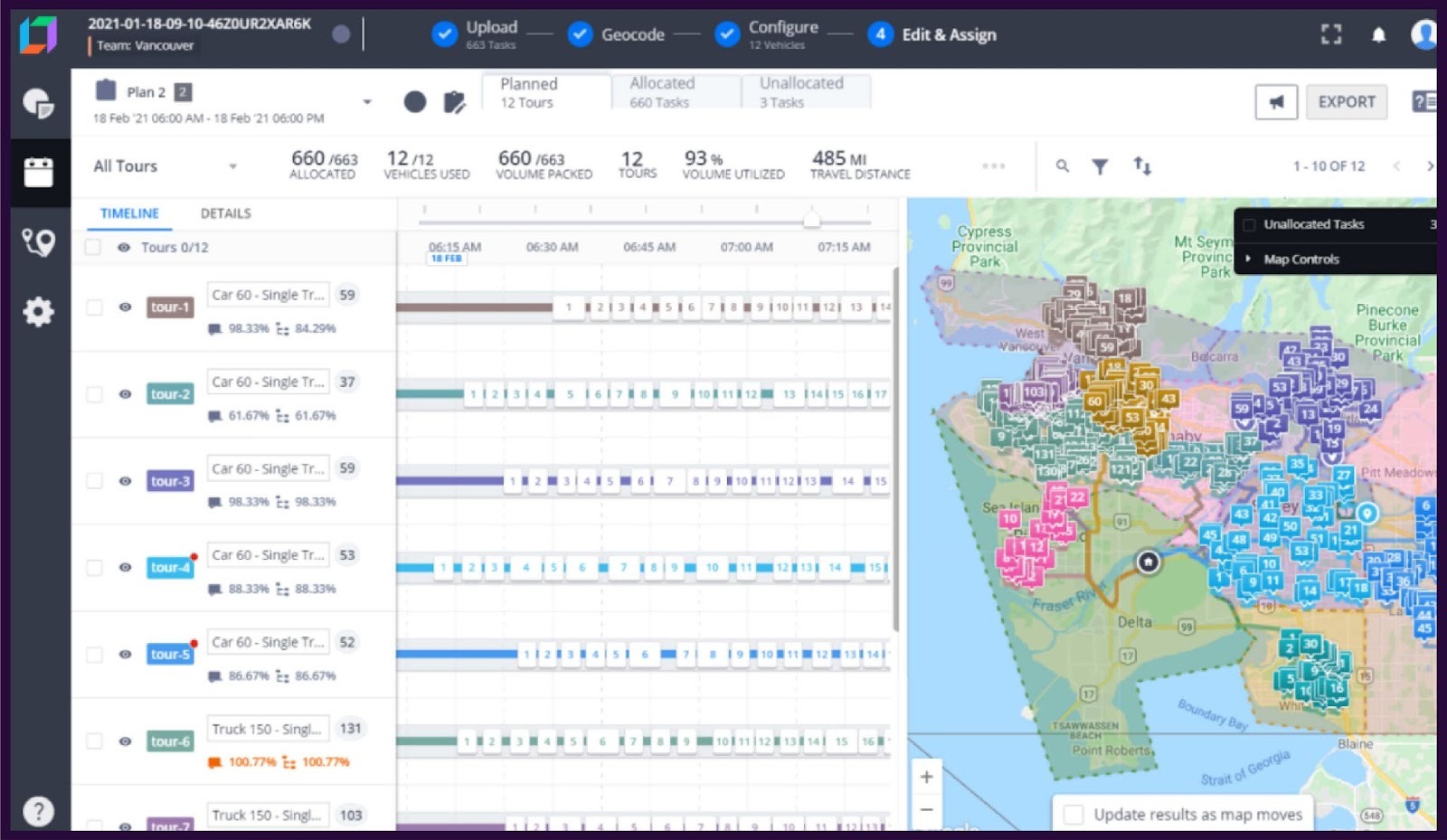
- Hybrid routing model support: Combines fixed route structures with dynamic optimization to support recurring deliveries and variable demand within the same fleet
- Real-time cost and ETA tradeoff simulation: Shows the cost and delivery-time impact of each routing change to help dispatchers review tradeoffs before applying updates
- LOTR driver app with live route updates: Sends turn-by-turn navigation, task updates, proof of delivery, and route changes directly to drivers during active execution
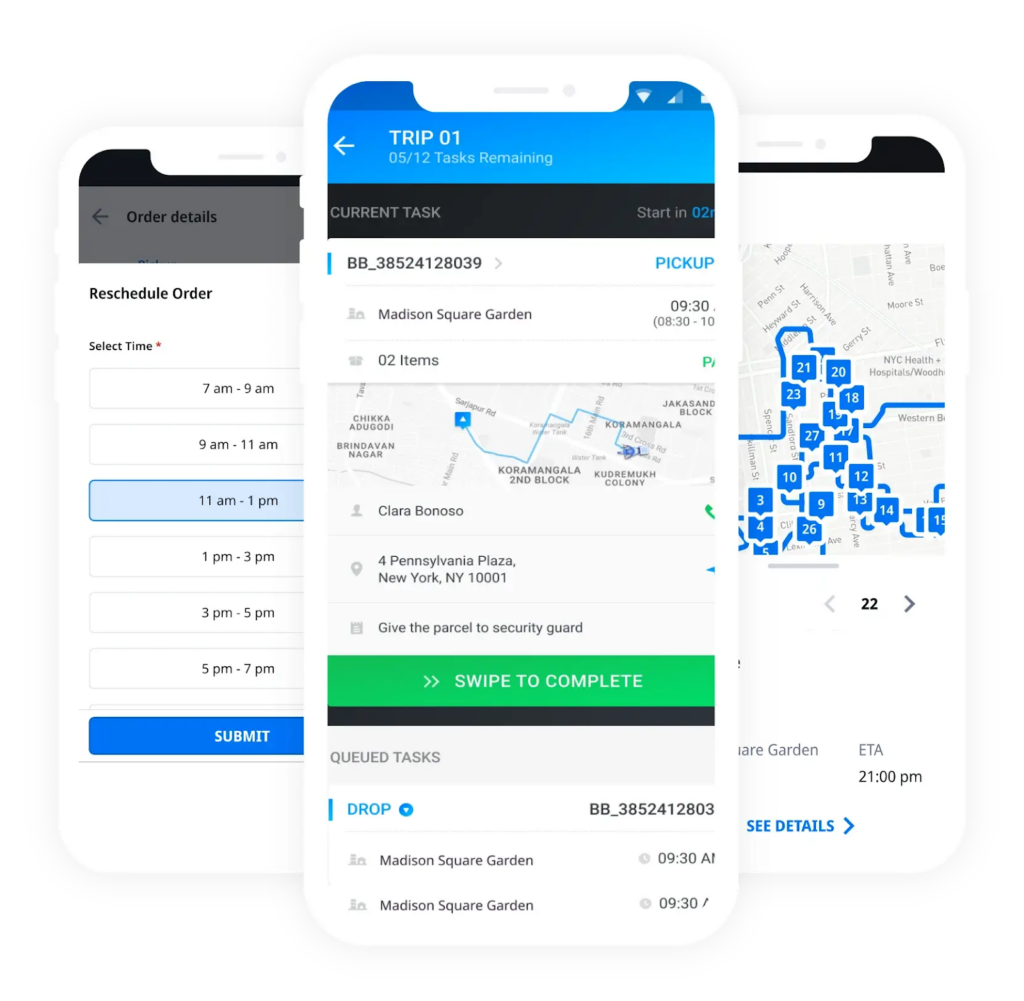
- Control Tower for live fleet visibility: Displays vehicle location, delivery progress, flagged exceptions, and ETA drift to help operations teams act while routes are still in motion
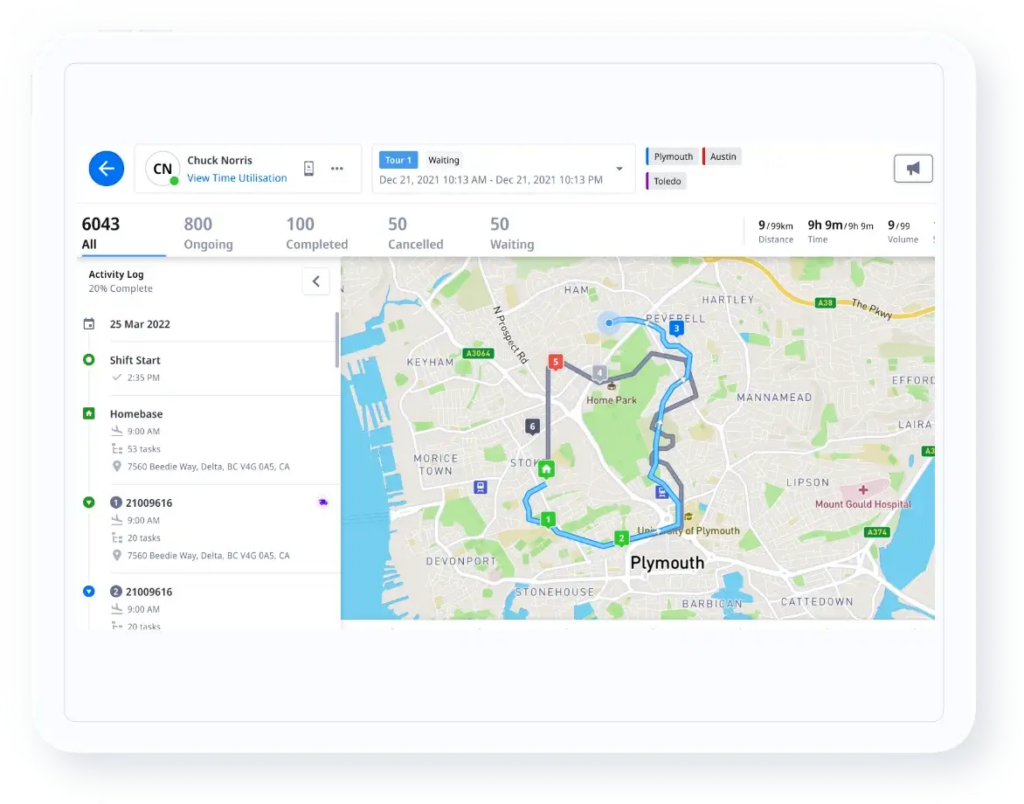
- ShipFlex for third-party carrier orchestration: Extends routing decisions to third-party carriers by handling carrier selection, rate comparison, and assignment in the same workflows
- Proprietary geocoding engine: Converts incomplete or unclear addresses into accurate coordinates to improve route quality before optimization begins
Locus Is Best For
Enterprise logistics operations running high daily order volumes with variable demand, mixed fleet types, and SLA commitments in retail, FMCG, e-commerce, 3PL, or CPG distribution. Ideal for teams that need routing to connect directly to dispatch execution, fleet management, and settlement
Locus’ Pros
- Handles real-world routing complexity without forcing teams to manage exceptions through manual workarounds
- Responds to live operational events through mid-route re-optimization rather than fixed batch-based updates
- Connects routing to the full execution chain so dispatch, delivery, and settlement stay aligned in one workflow
- Supports mixed routing models in one system so recurring routes and ad-hoc demand can run on the same fleet
- Supports deployment across global markets with geocoding built for non-standard address formats in 30+ countries
Locus’ Cons
- Delivers the strongest value when used across the full execution layer so teams adopting only the routing module may not see the outcomes the platform is designed to produce
- Requires dedicated implementation effort during setup because data preparation and constraint configuration are a meaningful part of enterprise deployment
- Fits complex delivery environments better than simple ones because small fleets and predictable route structures may not justify the configuration overhead
Locus’ Pricing
Locus uses custom enterprise pricing based on order volume, fleet size, module selection, and geographic deployment scope. No self-serve tiers exist. Teams evaluate fit through a workflow demo using their actual constraints and fleet structure. Contact Locus here.
2. FarEye
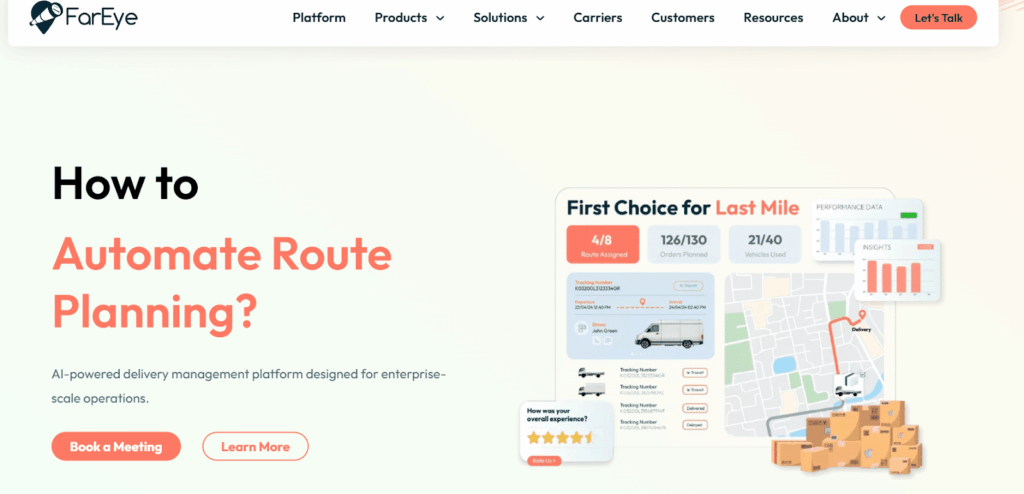
FarEye was built for a different logistics problem. Its strength lies in giving retailers and e-commerce teams a consistent visibility layer across multiple third-party carriers, especially when tracking, updates, and customer communication are spread across disconnected systems.
Post-purchase tracking, branded notifications, delivery scheduling, and carrier performance visibility are all well-suited to operations that rely heavily on external carrier networks.
For B2C retail teams, it can be valuable. If the main challenge is fragmented tracking data and an uneven customer experience across carriers, FarEye is worth considering.
Routing is part of the platform, but it is better understood as a carrier visibility and delivery experience platform than a dispatch-first execution system.
FarEye’s Key Features
- Multi-carrier connectivity to bring last-mile visibility into one layer across carrier networks
- Post-purchase tracking, which supports branded customer communication after dispatch
- Delivery scheduling that gives customers self-service appointment and rescheduling options
- Carrier SLA monitoring to give operations teams a clearer view of partner performance
- Route planning that supports owned-fleet last-mile delivery workflows
FarEye Is Best For
Retail and e-commerce operations with high reliance on third-party carriers who need unified visibility, customer communication, and carrier performance management across a multi-carrier network. Teams whose primary problem is owned-fleet dispatch optimization at enterprise scale will find the execution depth insufficient for that use case.
FarEye’s Pros
- Strong multi-carrier connectivity across a broad carrier ecosystem
- Well-developed delivery experience features for B2C retail operations
- Centralized SLA tracking and carrier performance visibility in one dashboard
FarEye’s Cons
- Lighter route optimization depth than dispatch-first execution platforms
- Less suited to operations where owned-fleet dispatch is the primary requirement
- Narrower configuration depth for complex, high-volume fleet environments
FarEye’s Pricing
FarEye uses custom enterprise pricing. Costs are driven by shipment volume, carrier integrations, and module selection. No public pricing is available.
3. LogiNext Mile
LogiNext Mile earns its place on the list for one specific operational type: structured, high-frequency distribution.
For CPG teams, replenishment follows fixed weekly beats. Field service teams run appointment-based routes across consistent territories. In these operations, the plan remains similar from day to day. The primary optimization work happens in sequencing and managing specific time windows.
Within that environment, LogiNext handles constraints well and integrates reliably with ERP and TMS systems.
LogiNext’s Key Features
- Route optimization for scheduled and recurring delivery operations
- Territory and beat planning for distribution networks
- Time window and vehicle capacity constraint management
- Real-time driver tracking and field force visibility
- ERP and TMS integration
- Delivery exception management and escalation workflows
LogiNext Is Best For
CPG distribution and field service operations with predictable, high-frequency routes and moderate daily variability. Not the right fit for operations that require the morning plan to be rebuilt multiple times during the execution window.
LogiNext’s Pros
- Strong fit for structured, beat-based distribution routing
- Useful field force management capabilities for B2B and service operations
- Reliable support for recurring route optimization in stable operating environments
LogiNext’s Cons
- Less dynamic re-optimization depth in high-variability enterprise operations
- Weaker fit for large mixed-fleet dispatch environments with changing daily constraints
- Longer configuration cycles outside structured distribution use cases
LogiNext’s Pricing
LogiNext offers subscription pricing typically structured per vehicle per month, with enterprise configurations quoted separately. Pricing varies by fleet size and module selection.
Category B: fleet optimization tools
4. Wise Systems
Wise Systems takes a slightly different approach to route planning. Instead of relying only on what is happening right now, it also looks at what the operation has learned over time. The platform uses historical delivery patterns, stop-level service times, driver behavior, and recurring delay trends to make route decisions that become more informed as the system sees more of the network.
This approach works well in distribution environments where routes repeat often, and customer locations stay fairly consistent. Beverage, food service, and consumer goods operations tend to fit that pattern.
Wise Systems’ Key Features
- AI-driven dynamic routing improves route decisions using historical delivery data and recurring operating patterns
- Driver behavior modeling factors real driver performance into route assignment and sequencing decisions
- Real-time traffic adjustment updates route timing based on changing road conditions and stop-level delays
- Distribution-focused constraint handling supports delivery windows and vehicle capacity requirements in recurring route environments
- Route performance analytics help teams review efficiency trends across routes, stops, and drivers
Wise Systems Is Best For
Ideal for beverage, food service, and CPG distribution operations running high-frequency routes to recurring customers. Less suited to large enterprise fleets with high daily variability and deep constraint complexity
Wise Systems’ Pros
- Builds stronger route quality over time through a learning model shaped by historical delivery performance
- Produces more realistic route plans by factoring driver-level behavior into planning decisions
- Fits recurring distribution networks well, where service patterns stay relatively consistent
Wise Systems’ Cons
- Offers a lighter fit for enterprise-scale multi-fleet dispatch with variable order volumes
- Handles distribution constraints well but is less tuned for mixed-fleet enterprise complexity
- Gains less advantage in fast-changing environments where stable operating patterns are harder to build
Wise Systems’ Pricing
Wise Systems uses custom pricing based on fleet size and operational scope. No public pricing is available.
5. Route4Me
Route4Me is built for teams that want route optimization in place quickly. It covers the basic features likemulti-stop planning, driver tracking, mobile execution, and a broad integration marketplace. For smaller delivery teams or mid-market operators, that ease of setup is a big part of the appeal.
The platform works best when routing needs are fairly standard, and constraint complexity stays manageable. Teams can launch fast, make manual edits easily, and expand functionality through add-ons as requirements grow.
Route4Me starts to feel stretched in large enterprise environments. Continuous re-optimization, deeper constraint logic, and multi-hub execution usually call for more than its native setup.
Those gaps can be filled, but doing so often adds integration work and extra cost.
Route4Me’s Key Features
- Multi-stop route optimization for delivery and field service teams
- Manual route editing when planners need tighter control over stop order
- Live GPS tracking for in-day driver visibility
- Marketplace integrations across telematics, CRM, and delivery tools
- Support for time windows and vehicle capacity rules
- Mobile execution tools for navigation, tasks, and proof of completion
Route4Me Is Best For
SMB and mid-market field service and delivery operations with standard stop-sequence optimization needs and moderate constraint complexity. Operations requiring enterprise-grade constraint handling, multi-hub execution, and continuous dynamic re-optimization should evaluate execution platform alternatives before shortlisting.
Route4Me Pros
- Accessible self-serve onboarding for smaller operations
- Flexibility for standard use cases through a broad marketplace of integrations
- Competitive pricing for teams with straightforward routing requirements
Route4Me Cons
- Native optimization depth feels lighter in enterprise-scale fleet environments
- Advanced use cases often depend on extra integrations, which add cost and setup work
- Complex dynamic routing across large networks
Route4Me’s Pricing
Route4Me offers tiered subscription pricing. Team plans start at approximately $200 per month. Enterprise plans are custom-quoted based on fleet size and module selection.
6. Verizon Connect
Verizon Connect serves well mainly as a telematics and fleet compliance platform. Route planning is part of the product, but it sits inside a broader system focused on GPS tracking, ELD compliance, HOS management, driver safety, and asset visibility.
It makes the platform a strong fit for fleets where compliance and fleet oversight carry more weight than route optimization depth. If the main goal is to manage regulated vehicles, monitor driver behavior, and keep fleet operations visible in one system, Verizon Connect can do that well.
The gap shows up when routing becomes the primary buying criterion. Teams looking for deeper dynamic re-optimization and more advanced constraint handling will usually need a platform designed around dispatch execution rather than telematics.
Verizon Connect’s Key Features
- ELD compliance and HOS controls for regulated fleet operations
- Real-time GPS tracking and asset visibility across vehicles and equipment
- Route planning informed by traffic conditions and schedule inputs
- Driver behavior monitoring and safety analytics for field performance oversight
- Fleet maintenance tracking and lifecycle management for vehicle operations
- Native connectivity with Verizon’s telematics hardware ecosystem
Verizon Connect Is Best For
Compliance-heavy fleets that need ELD, HOS management, driver oversight, and asset tracking. It is less suited to operations evaluating platforms mainly on re-optimization depth and constraint-based dispatching.
Verizon Connect’s Pros
- Strong ELD compliance and HOS management for regulated fleets
- Robust integration between software, telematics, and Verizon hardware
- Simpler vendor setup for teams prioritizing compliance and fleet visibility
Verizon Connect’s Cons
- Lighter route optimization depth than dispatch-focused platforms
- Higher switching friction over time within the Verizon hardware ecosystem
- Narrower fit for high-volume, multi-hub operations with daily routing variability
Verizon Connect’s Pricing
Verizon Connect uses custom pricing driven by vehicle count, hardware selection, and module configuration. No public self-serve pricing is available.
Category C: SMB routing tools
7. Grasshopper Labs
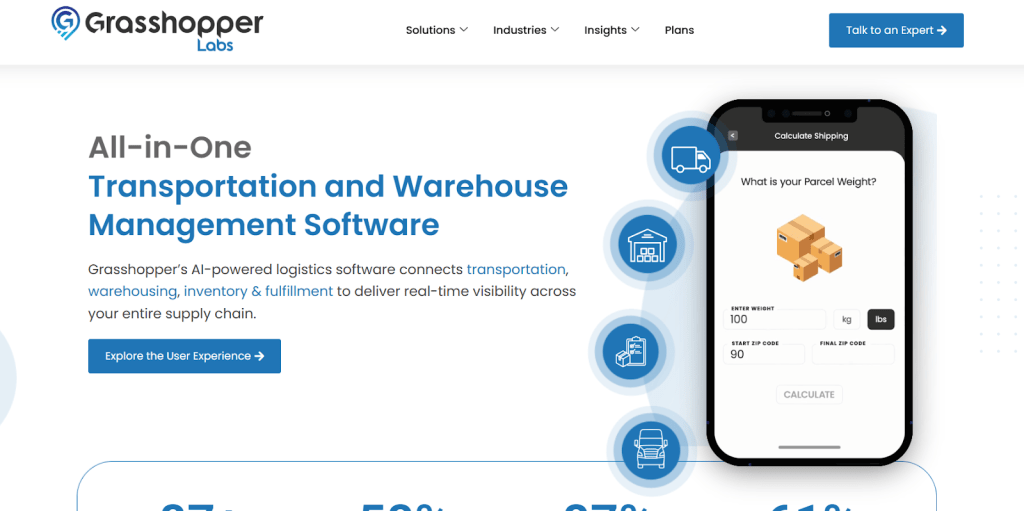
Grasshopper Labs is meant for operators who are tired of stitching together separate systems. When routing lives in one tool, inventory in another, and order flow in a third, small gaps in data turn into planning delays, manual fixes, and missed updates.
Grasshopper excels at keeping routing, dispatch, warehouse workflows, and order fulfillment in one place, so handoffs happen within the platform rather than across disconnected tools.
In more complex delivery environments, it may feel lighter when constraint-heavy optimization and frequent in-day changes matter more than having everything under one roof.
Grasshoppers Labs’ Key Features
- AI-driven route optimization using live traffic and driver availability
- Automated dispatch and scheduling for daily delivery coordination
- Warehouse management with inventory tracking and cycle counts
- Order fulfillment tools with customer self-scheduling and demand forecasting
- Branded delivery communication across status updates and notifications
- Pre-built integrations across ERP, accounting, and e-commerce systems
Grasshopper Labs Is Best For
SMB retailers and 3PLs looking for a consolidated TMS, WMS, and routing solution that eliminates manual data handoffs between separate systems
Grasshoppers Labs’ Pros
- Less tool fragmentation for smaller operations running multiple workflows
- Fewer manual handoffs between routing, dispatch, warehouse, and order data
- Stronger customer communication built directly into the delivery flow
Grasshopper Labs’ Cons
- Lighter constraint depth in large, high-variability fleet environments
- Lower re-optimization and orchestration depth in complex multi-fleet operations
- Narrower fit for enterprise teams that need deeper execution capability
Grasshopper Labs’ Pricing
Grasshopper Labs uses custom pricing. Public pricing tiers are not listed, and most teams evaluate fit through a demo.
8. DispatchTrack
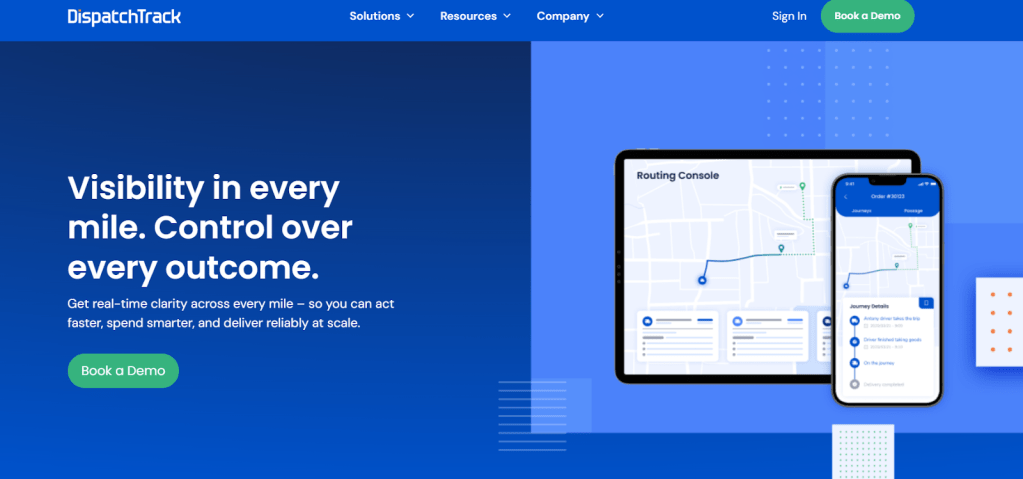
DispatchTrack makes the most sense when the delivery appointment matters almost as much as the delivery itself. That is why it has long been a fit for furniture, appliance, and specialty retail operations, where customers expect clear scheduling, timely updates, and a smooth handoff at the door.
Self-service booking, milestone notifications, proof of delivery, and post-delivery feedback are all well-developed for home delivery workflows. Route optimization is part of the package, but it is built to support the delivery model rather than to handle the full depth of enterprise dispatch complexity.
For teams running standard home delivery volumes, that can be enough. For larger operations managing mixed fleets, heavy variability, and constant in-day route changes, the optimization layer will feel more limited.
DispatchTrack’s Key Features
- Customer scheduling with self-service appointment booking
- Route optimization with time window and capacity controls
- Proof of delivery capture for completed handoffs and confirmations
- Automated customer notifications across key delivery milestones
- Real-time driver tracking during active deliveries
- Post-delivery feedback collection through ratings and surveys
DispatchTrack Is Best For
The tool is ideal for home delivery operations in furniture, appliance, and specialty retail, areas that need scheduling precision, customer communication, and proof-of-delivery workflows are the primary operational differentiators. It is not designed for enterprise operations with multi-fleet, high-volume dynamic routing requirements.
DispatchTrack’s Pros
- Strong customer-facing delivery experience for appointment-based models
- Well-developed booking and scheduling flows for home delivery operations
- Tighter proof-of-delivery and communication workflows within one system
DispatchTrack’s Cons
- Lighter optimization depth in constraint-heavy enterprise environments
- Lower dynamic re-optimization capability than dispatch-focused platforms
- More pricing friction for scaling teams using multiple modules
DispatchTrack’s Pricing
DispatchTrack uses custom enterprise pricing. Costs vary by delivery volume, module selection, and configuration scope.
Upgrade Your Delivery Operations with Locus
Teams handling high-order volumes, mixed fleets, and strict SLA commitments need more than basic route planning. They need deep constraint handling, mid-route re-optimization, and a clear link between planning and execution.
It rules out a large share of the market.
Execution platforms, fleet optimization tools, and SMB routing products are built for different levels of complexity. The more useful question is not which platform has the longest feature list. It is which category fits the problem your operation is trying to solve?
Locus is built for high-complexity logistics environments. It processes 250+ variables at once, supports event-triggered re-optimization, and handles hybrid routing for networks which combine recurring routes with variable demand.
Routing also connects directly to dispatch, driver workflows, fleet execution, and settlement. Route improvements carry through to delivery performance, rather than stopping at the planning screen.
If you are evaluating dynamic route planning software for enterprise operations and need to see how Locus performs against your specific constraints and fleet structure, schedule a demo.
Frequently Asked Questions (FAQs)
1. What is dynamic route planning software?
Dynamic route planning software recalculates delivery routes continuously using live data: traffic conditions, order changes, driver locations, and vehicle capacity. Unlike static planning, which sets routes at the start of each cycle and holds them, dynamic routing treats the route as a live decision, responding to conditions as they develop throughout the execution window.
2. Is dynamic routing suitable for all types of fleets?
No. Dynamic routing is most valuable for operations with variable daily order volumes, time-sensitive SLA commitments, and high stop counts where real-time conditions materially affect route performance. Fleets running predictable, recurring routes to fixed locations may find static or zone-based routing sufficient and operationally simpler. The route optimization decision depends on how much daily variability your operation actually faces.
3. Can dynamic route planning software help reduce operational costs?
It can, when implemented with appropriate data infrastructure and process alignment. Cost reduction comes primarily from fewer miles driven, better fleet utilization, and reduced driver overtime. Locus customers have documented 15 to 30% reductions in total delivery costs within the first year of implementation. The size of that reduction depends on how much waste exists in current routes and how fully the platform connects to dispatch execution.
4. How can I measure the effectiveness of a dynamic routing system?
Track on-time delivery rates before and after rollout, along with plan-versus-actual miles, stops per vehicle per day, driver overtime, and dispatcher override rates. Frequent overrides usually point to one of three issues: weak configuration, unreliable data, or low user confidence in the system.
5. What technologies or data are required for effective dynamic route planning?
At minimum: a real-time traffic API, a live order data feed with low latency, GPS or telematics data from vehicles updated throughout the day, and driver availability and capacity inputs. Operations that also feed in historical delivery performance data, customer time window commitments, and vehicle-level constraint profiles will see substantially better optimization quality.
6. How does dynamic route planning software improve ETAs?
By generating route plans that reflect current conditions rather than assumed ones, and by updating ETAs throughout the day as the actual delivery sequence evolves. A route plan generated at 7 AM and never updated is not accurate by 11 AM. When the route adapts to traffic, failed attempts, and order changes continuously, the ETA the customer receives reflects what is actually happening.


General
Top Logistics Automation Software Platforms in 2026 for Smarter Operations

Mar 12, 2026
Compare the top logistics automation software platforms of 2026. Find the right execution-led dispatch tool, TMS suite, or specialized freight system based on your operational model.
Read more
General
Dispatch Scheduling Software: Enterprise Logistics Guide by Locus
Mar 13, 2026
Dispatch scheduling software enables automated driver assignment, optimized routing, and real-time fleet visibility, helping enterprises scale delivery operations efficiently.
Read moreInsights Worth Your Time




















Best Dynamic Route Planning Software: The Good, the Shortfalls, and Who It’s For