


General
Why Enterprise Logistics Teams Are Rethinking Dispatch Routing Software

Key Takeaways
- Dispatch routing at enterprise scale involves coordinating multiple decisions across planning and execution. When routing and dispatch are handled as separate processes, teams often take on additional manual coordination to keep operations aligned.
- Static dispatch planning can reduce efficiency over the course of the day. Systems that adjust plans using live operational inputs help maintain consistency during execution.
- Reverse logistics, 3PL workflows, and sustainability tracking are part of standard enterprise operations. Platforms need to support these within core workflows to ensure smooth execution.
- The value of dispatch routing software is reflected across operational performance, including fleet utilization, planning timelines, service reliability, and resource efficiency.
- For enterprises managing complex delivery networks, Locus provides the depth required to support coordinated execution and maintain operational stability as systems scale.
Enterprise logistics operations lose delivery capacity every day to dispatch decisions made without visibility into the full picture. Decisions around how orders should be grouped into a single run, which carrier aligns with cost and service commitments, or how plans should adapt when hub conditions shift during execution have a direct impact on delivery outcomes, often more than route sequencing itself.
For enterprises running thousands of daily deliveries across multiple depots and carrier networks, that gap has a measurable cost. It shows up in fleet utilization numbers, in SLA breach patterns that trace back to assignment decisions nobody flagged in time, and in dispatcher teams absorbing coordination work that the platform was supposed to handle automatically.
This article covers what modern dispatch routing software must actually deliver at enterprise scale, how AI is changing the underlying decision-making, which capabilities most platforms consistently overlook, and what to evaluate before committing to a platform that must hold up in complex logistics environments.
What Dispatch Routing Software Does at Enterprise Scale
By the time a dispatch plan reaches the first driver, conditions would have already shifted. This may be because:
- A carrier that confirmed capacity the previous night may no longer be available.
- A priority order may enter the system after routes are created.
- Delivery windows can change while warehouse loading is still in progress.
Even when some of these changes are addressed, others continue into execution and affect service outcomes. This is an example of the operating environment that enterprise dispatch software must support.
At the scale of thousands of daily deliveries spanning multiple depots, owned fleets, and third-party carrier networks, the dispatch decision carries a level of complexity that mid-market tools were never designed to absorb. These platforms handle order lists and route generation well. What they do not account for is the layer of interdependent decisions that sits underneath: which carrier fits the cost and SLA profile of a given shipment, how capacity constraints at one hub affect dispatch across the rest of the network, and how the plan needs to respond when any of those variables shift between plan generation and execution.
Enterprise-grade dispatch routing software evaluates vehicle routing decisions against operational factors such as cost-to-serve, capacity constraints, compliance requirements, and delivery commitments within a unified process. This ensures that plans reflect current operating conditions rather than a static view of the network.
In parallel, the platform must maintain operator control at every step of execution. Teams need the ability to review, adjust, and track automated decisions so that outcomes remain aligned with dispatch decisions. This is the design principle that makes automation reliable at scale.
The Shift from Static Route Planning to Dynamic Dispatch Orchestration
The cost of static dispatch planning often appears gradually, through small inefficiencies that accumulate over time. For example:
- A delivery zone runs consistently fifteen minutes behind schedule due to a recurring traffic pattern that the system does not account for.
- A driver remains underutilized because zone allocation was set up eighteen months ago and has not been reconfigured since.
- A 3PL partner confirms capacity at plan generation and then partially withdraws it two hours into execution, without any automatic adjustment to assigned orders.
These situations highlight how static planning fails to adapt to changing conditions, leading to inefficiencies that affect delivery performance and resource utilization.
Automated route planning built on dynamic orchestration works differently because it treats live signals as inputs to an ongoing plan. Real-time traffic conditions, warehouse loading status, carrier capacity changes, and mid-route exceptions all feed into the system continuously, and the ML layer underneath builds on historical delivery performance across zones and time-of-day patterns to make each subsequent plan more accurate than the one before it.
For enterprises coordinating ship-from-store fulfillment, 3PL networks, and both forward and reverse logistics within the same operating window, dispatch decisions need to stay aligned with how the network is operating in real time.
When dispatch is connected to warehouse readiness, inventory availability, and supply chain network design as they evolve, plans remain consistent with actual execution capacity at that moment.
How AI and Machine Learning Redefine Dispatch Decision-Making
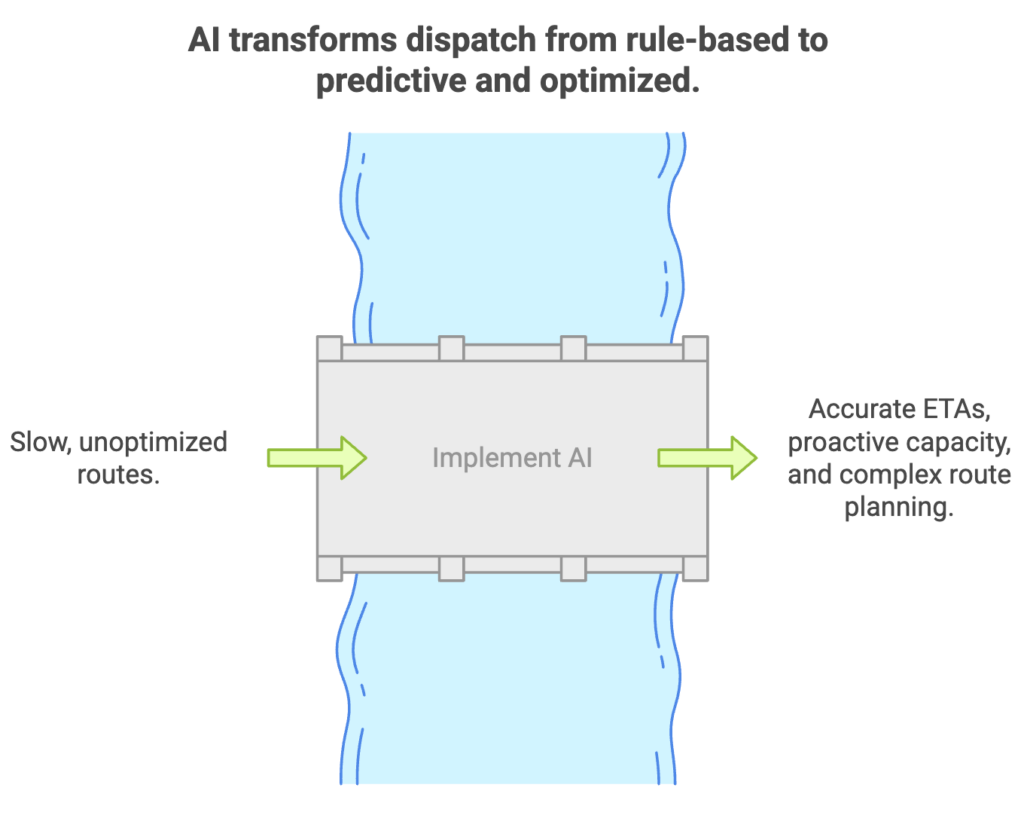
There is a version of AI in dispatch routing software that amounts to faster rule execution. The system applies a predefined set of constraints to an order list and produces a route plan more quickly than a human planner could. This accelerates the work without any change in the quality of decisions being made.
The version that actually moves the needle for enterprise logistics operations works at a different level:
- Predictive ETAs built on historical delivery data account for driver-specific performance patterns, recurring delays in specific zones, and time-of-day traffic behavior, producing arrival estimates that get more accurate with every completed delivery.
- Demand-aware batching anticipates order volume spikes based on historical patterns, preparing capacity allocations before the spike hits rather than responding to it after the fact.
- AI route optimization that processes constraints across fleet type, vehicle capacity, delivery priority, and geographic density simultaneously produces dispatch plans that reflect the full complexity of your network rather than a simplified version of it.
Locus’s optimization engine takes this further by planning against 250+ real-world constraints simultaneously, including driver shift hours, hub throughput, road restrictions, and live traffic conditions alongside the standard routing variables. Where this becomes particularly consequential is in dispatch driver assignment.
Apart from matching drivers to orders through static zone allocation, Locus evaluates current driver location, skill set, vehicle compatibility, and order-specific handling requirements dynamically for every assignment decision. Across an enterprise fleet running thousands of daily deliveries, the cumulative impact of those individual decisions surfaces directly in cost-per-delivery and fleet utilization rates, which is where the challenge between AI-assisted dispatch and genuine decision intelligence becomes measurable.
Enterprise-Critical Capabilities Most Dispatch Software Overlooks
Dispatch routing platforms are often evaluated based on the features they highlight. What receives less attention are the capabilities that are not included, even though the same limitations appear across many platforms used in enterprise logistics.
When these capabilities are missing, the impact becomes visible during daily operations. The sections below focus on the areas where this becomes most evident and how it affects execution at scale.
Reverse Logistics Dispatch
Returns, reattempts, cancellations, and failed delivery attempts occur alongside forward deliveries within the same operating window. When a dispatch system handles them as a separate workflow, teams often rely on dedicated return vehicles, which increases empty miles and reduces overall fleet utilization, while also creating a growing backlog in reverse logistics over the course of the day.
Enterprises that manage reverse logistics pickup within the same dispatch cycle as forward deliveries do not just reduce that overhead but also recover the capacity that was previously written off as the unavoidable cost of returns, and that recovery shows up directly in cost-per-delivery figures across the full operation.
3PL-Specific Workflows
For third-party logistics providers, every client contract carries its own SLA commitments and carrier preferences. A dispatch platform that cannot manage them simultaneously across multiple clients within a single workflow merely becomes a scheduling tool that your team has to work around.
Carrier margin optimization, multi-client order management, SLA-specific dispatching, and reverse logis are the baseline of what the dispatch system needs to handle reliably every day, across every client, without manual intervention to bridge the gaps between contracts.
Sustainability and Carbon Footprint Tracking
ESG reporting has moved from a voluntary disclosure to a board-level requirement for most large enterprises, and the emissions data that satisfies that requirement needs to come from somewhere. A dispatch platform that optimizes for cost and delivery speed without surfacing the emissions implications of those decisions leaves your sustainability team reconstructing carbon data from fuel receipts rather than pulling it from the system that made the routing decisions in the first place.
Locus customers have reduced GHG emissions by 17 million kg through constraint-based route optimization, with carbon-aware dispatching built into the standard workflow. Lower-emission vehicles and green delivery slots are dispatch variables, not sustainability add-ons reported separately after the fact.
Scalability Under Peak-Season Pressure
Performance degradation under load is one of the most underweighted risks in dispatch software evaluation, because it only surfaces at the moment your operation can least afford it.
Enterprise-grade dispatch routing software is built to process 10,000+ daily orders at the same constraint depth during a peak week as it does on a standard operating day. If the platform has not been tested and proven at that scale, the first time you find out about its limits will be during your highest-stakes trading period of the year.
Measuring the ROI of Dispatch Routing Software
The key question in any dispatch software evaluation is, “What improvements meaningfully impact performance when reviewed at the budget level?”
Routing efficiency improvements translate into measurable outcomes across the metrics that matter most at enterprise scale. Here is what Locus delivers across those metrics:
| Metric | Baseline | With Locus |
|---|---|---|
| Logistics Cost Reduction | Varies by operation | 20% average across 350+ enterprise customers |
| Fleet Utilization | 55% on legacy dispatch systems | 90% with constraint-based planning |
| Planning Cycle Time | Hours of dispatcher effort | 66% faster planning cycles |
| On-Time Delivery Rate | Varies by operation | 99.5% SLA adherence |
| GHG Emissions | Varies by fleet size | 17 million kg reduction across customer base |
A 20% reduction in logistics costs reflects improved fleet utilization and fewer empty miles, supported by faster planning cycles operating within a unified system.
The analytics and performance reporting layer that surfaces these metrics functions as a feedback mechanism, identifying where the next improvement opportunity exists. This enables continuous optimization, extending returns beyond the initial deployment period.
You are right. Here is the full section with Locus cited naturally in each H3:
What to Evaluate Before Choosing a Dispatch Routing Platform
The following questions help assess whether the platform continues to perform over time, as the operation grows and new operational conditions become part of day-to-day execution.
Let’s look at them individually.
Integration Depth
A dispatch platform needs to connect cleanly with existing WMS, OMS, ERP, TMS, and carrier management systems to support reliable operations. During evaluation, the focus should be on how well the platform integrates with the specific systems in use, and the level of effort required to achieve the data accuracy needed for dispatch decisions.
Locus is built on an API-first architecture, with pre-built connectors for SAP and Oracle, along with connectivity across more than 1,000 carriers.
Multi-Channel Fulfillment Configurability
Enterprises managing ship-from-store fulfillment alongside distribution center dispatch, 3PL coordination, reverse logistics, and hybrid fulfillment models need a platform that can support all of these within a single dispatch workflow.
When separate configurations are required for each fulfillment model, teams are forced to manage parallel workflows and keep them aligned manually.
Locus supports forward and backward scheduling within the same planning and dispatch workflow, while also accommodating 3PL coordination without requiring separate system configurations for each model.
Constraint Configurability
Platforms described as customizable often require additional effort to implement or update workflows. In enterprise logistics operations, teams need the ability to adjust business rules directly, without relying on engineering support for every change.
Requirements such as delivery prioritization, vehicle restrictions, SLA definitions, and client-specific conditions are part of daily operations, and the platform should support these updates as they evolve.
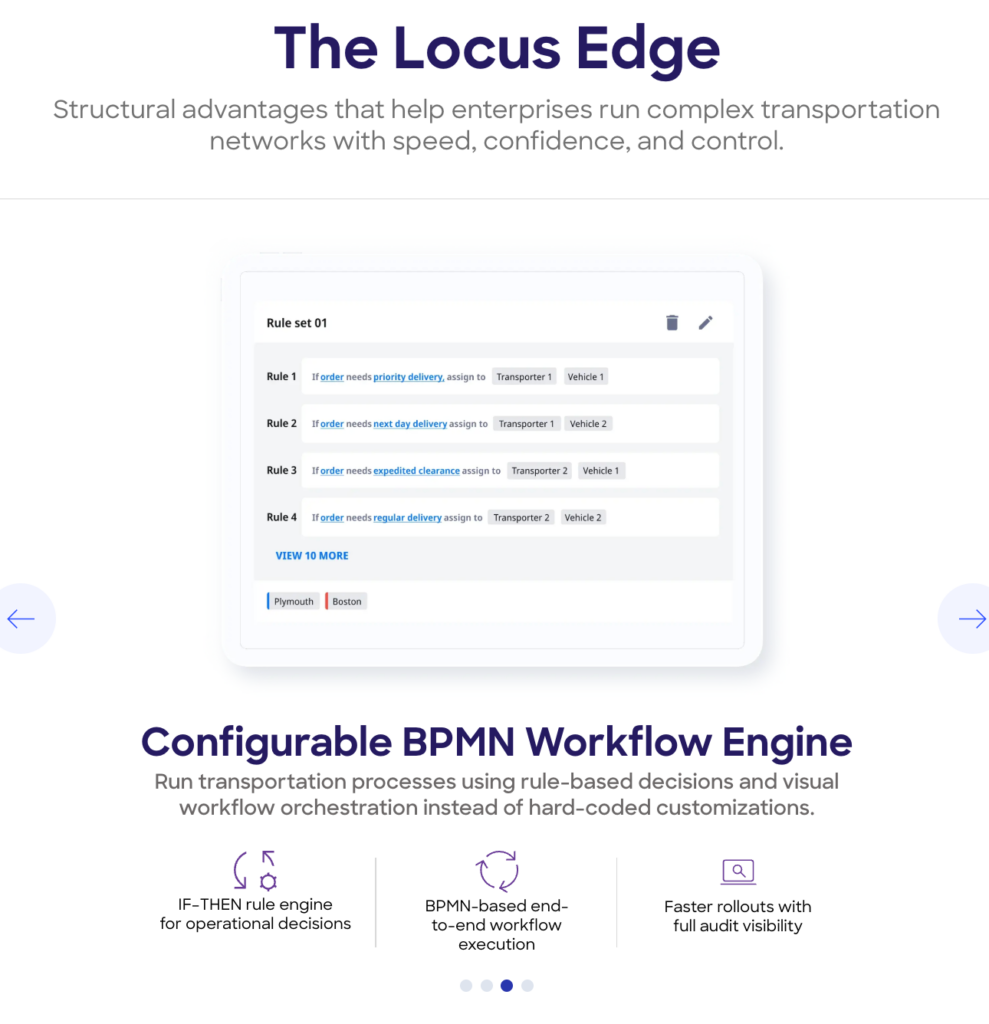
Locus includes a configurable BPMN workflow engine that allows operators to define and modify routing rules and workflows directly within the platform. This enables business rules to remain current without delays caused by development dependencies.
Vertical Track Record
When evaluating a platform, relevance of past deployments matters. Case studies should reflect similar operating conditions, including industry, scale, and fulfillment model.
A platform used in smaller delivery environments may not represent how it performs for a large FMCG distributor or a multi-client 3PL managing complex operations. The focus should be on whether existing deployments match your context and demonstrate measurable outcomes that can be used as a benchmark.
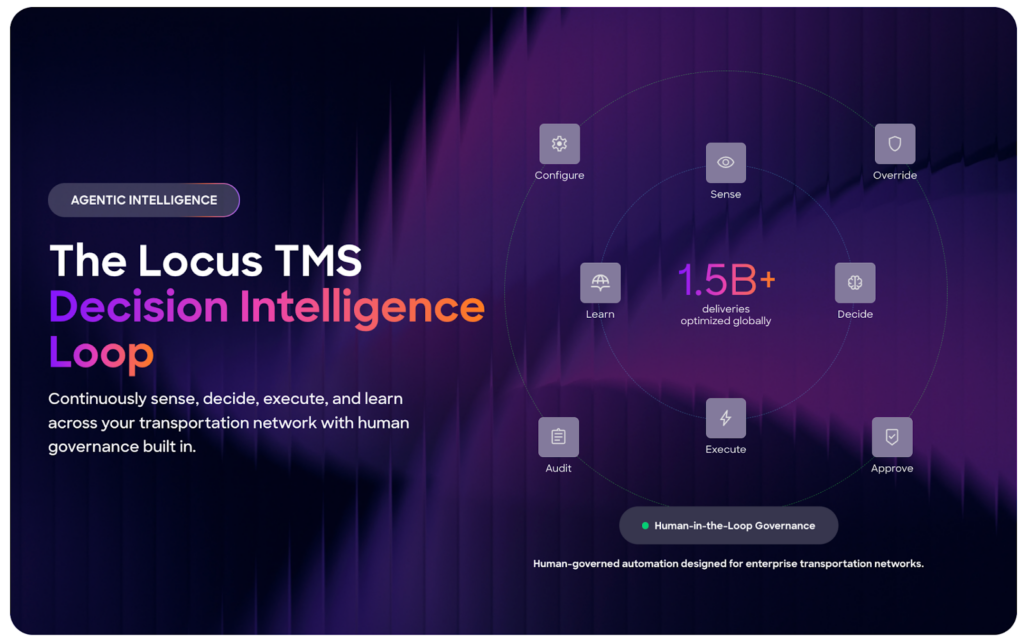
Enterprise logistics platforms are evolving toward systems where dispatch operates as part of an end-to-end orchestration layer. The Sense – Decide – Execute – Learn loop defines how these systems operate, requiring dispatch, visibility, analytics, and governance to function within a connected workflow.
Locus follows this model as an agentic TMS, where dispatch is integrated into a unified orchestration platform, providing a clear standard for evaluating how well a system supports complex logistics operations.
From Dispatch Decisions to Full Logistics Control
Backed by Ingka Group and recognized by Gartner for six consecutive years, Locus brings long-term platform stability to enterprise dispatch operations alongside the execution depth that complex, high-volume logistics networks require. Its modular, API-first architecture allows organizations to evolve workflows across fulfillment, dispatch, carrier management, and analytics without rebuilding core systems each time the network grows or the operating model changes.
With 360+ enterprise customers across 30+ countries, $320M+ in documented logistics cost savings, and 17 million kg of GHG emissions reduced across its customer base, Locus combines operational maturity with the reliability that enterprise logistics teams need when dispatch is a board-level capability rather than a back-office function.
For organizations treating dispatch as a strategic investment rather than a cost center, that combination of execution depth and platform stability is what makes the difference between a tool that handles today’s operation and a platform that scales with the operation you are building toward.
Schedule a demo with Locus to see how enterprise dispatch orchestration supports delivery operations built for scale.
Frequently Asked Questions (FAQs)
1. How does dispatch routing software handle multi-country operations with different regulatory requirements?
Enterprise-grade platforms support localized road restrictions, regional compliance requirements, and address formats natively. Platforms with strong emerging market coverage also manage non-standardized addressing across geographies, which is a common operational challenge for logistics networks expanding across borders.
2. Can dispatch routing software support same-day and on-demand delivery models?
Yes, provided the platform is built for dynamic order ingestion rather than batch planning. Locus’s dispatch management layer handles same-day order allocation by continuously evaluating available capacity, driver proximity, and delivery commitments in real time rather than waiting for a fixed planning window.
3. How does dispatch routing software manage driver performance and accountability?
Platforms with integrated driver applications capture delivery outcomes, proof of delivery, and time-on-task data at the individual driver level. Over time, this data feeds back into dispatch assignment logic, so driver-specific performance patterns inform future routing and assignment decisions automatically.
4. What happens to the dispatch plan when a vehicle breaks down mid-route?
A platform with real-time exception management detects the disruption, evaluates the impact on affected deliveries, and generates reassignment options for the remaining stops without requiring the dispatcher to rebuild the plan manually. Resolution speed depends on available capacity in the network at that moment.
5. Is dispatch routing software suitable for pharmaceutical and temperature-controlled logistics?
Yes. Platforms built for regulated industries manage cold-chain continuity, temperature-sensitive vehicle assignments, and compliance documentation within the standard dispatch workflow, ensuring chain of custody requirements are met without a separate tracking system running alongside the main operation.


General
Top 10 Fleet Routing Software for Enterprise Logistics Teams in 2026

Mar 27, 2026
Most fleet routing software lists were written for small couriers. This one was not. Top 10 platforms evaluated on what actually matters at enterprise scale.
Read more
General
How Route Mapping Software Transforms Enterprise Logistics Operations
Mar 27, 2026
Struggling with multi-depot dispatch at scale? See how enterprise route mapping software cuts fuel costs by 25% and compresses planning time to under 15 minutes.
Read moreInsights Worth Your Time




















Why Enterprise Logistics Teams Are Rethinking Dispatch Routing Software