


General
What Enterprise Logistics Teams Actually Need from Courier Management Software

Key Takeaways
- Based on patterns across enterprise logistics operations, four signals commonly indicate your courier software has reached its limits: manual dispatch overrides above 20%, exception escalation latency beyond 30 minutes, multi-3PL coordination consuming more than two FTEs, and beat-plan divergence exceeding 15%
- The Enterprise Courier Software Maturity Diagnostic introduced in this article scores platforms across five dimensions, helping buying committees distinguish SMB-grade tools from enterprise-ready systems using a repeatable framework
- Locus combines ML-driven dispatch planning, dynamic route optimization, multicarrier allocation through ShipFlex, and end-to-end visibility via its Control Tower in a single closed-loop platform, a combination most courier software vendors require multiple point products to approximate
Enterprise demand is driving the growth of courier management software, but most tools being built still target small fleet operators running 50 to 200 deliveries a day.
This gap creates measurable problems. When a retail or FMCG enterprise managing 10,000-plus daily dispatches across multiple carriers adopts courier software designed for single-depot operations, the consequences compound: SLA breach rates climb, delivery costs per order increase, and visibility fragments into disconnected data silos.
This article covers what enterprise-grade courier management software requires, where commonly adopted platforms fall short, and how to evaluate them using a structured maturity diagnostic.
Why the Courier Management Software Category Has Outgrown Its Own Name
The term “courier management software” entered common use to describe a simple capability set: assign a driver, plan a route, track a delivery. For a 50-van local courier service, that feature set still works. For enterprises orchestrating multi-carrier, multi-hub logistics across geographies, it does not.
Enterprise buyers searching for courier software today are often evaluating platforms that span dispatch planning, carrier allocation, real-time visibility, exception handling, settlement, and analytics. These capabilities bear little resemblance to the basic dispatch-and-track tools that defined the category a decade ago.
A courier management system built for small fleets will typically lack the multi-3PL orchestration, predictive dispatch intelligence, and API-first architecture that an enterprise operation requires.
Recognizing this gap is the first step toward a more productive evaluation, one that matches the scope of your logistics network to the depth of the platform you are vetting.
The Operational Reality Driving Enterprise Demand for Courier Software
The pressure on enterprise courier operations shows up in three recurring patterns that cut across industries:
The FMCG distributor managing store repeplenishment at scale
Consider a CPG distributor restocking 3,000 retail outlets daily across 15 distribution hubs. Each hub relies on a mix of captive fleet vehicles and contracted carriers. Route plans are generated the night before, but morning cancellations, traffic disruptions, and partial order changes force dispatchers to rebuild routes manually.
The courier dispatch software in place handles basic GPS tracking. It cannot re-optimize routes mid-execution or dynamically reallocate orders to alternate vehicles. Beat-plan divergence runs at 12 to 18%, with fuel costs rising alongside it.
The 3PL provider coordinating across multiple clients
A regional 3PL managing fulfillment for eight e-commerce clients faces a different constraint. Each client has different SLA windows, carrier preferences, and parcel delivery software requirements. The current system was designed for a single-client operation.
Coordinating across clients means switching between disconnected dispatch and tracking dashboards, manually reconciling invoices from each carrier, and losing hours each day to exception escalation.
The e-commerce brand scaling hyperlocal same-day delivery
A 9% failed first-attempt delivery rate is what forced one online grocery brand to re-examine its courier routing stack entirely. The brand was dispatching 5,000-plus orders daily within two-hour windows across three metro areas, but its routing tool generated static routes in batch and could not factor in real-time order inflow, traffic conditions, and driver availability simultaneously.
That 9% rate translated to 450 daily reattempts, eroding margin and customer trust at a pace no amount of post-delivery survey optimization could offset. These represent the operational patterns that make courier delivery software a strategic investment.
Core Capabilities That Separate Enterprise-Grade Courier Management Systems from SMB Tools
The difference between SMB courier software and an enterprise courier management system is about how each capability handles operational complexity at scale.
| Capability | SMB-Grade Tools | Enterprise-Grade Platforms |
|---|---|---|
| Route Planning | Static, batch-generated routes based on distance and time | Dynamic route optimization across 250+ constraints including capacity, SLAs, and fuel efficiency |
| Dispatch | Manual or rules-based assignment to a single fleet | ML-driven dispatch across captive, contracted, and outsourced fleets with auto-reassignment |
| Visibility | GPS tracking on the last-mile leg only | End-to-end shipment tracking from origin to destination with predictive ETAs |
| Exception Handling | Manual escalation via phone or email | Automated exception workflows with predictive SLA risk scoring |
| Carrier Management | Single carrier integration | Multi-carrier orchestration with rate comparison across hundreds of carriers |
| Analytics | Basic delivery count reports | Plan-versus-actual analysis with optimization recommendations |
ML-driven dispatch and dynamic route optimization
Static route planning breaks down when you manage thousands of daily dispatches with real-time variability. Enterprise-grade automated route planning considers vehicle capacity, time windows, driver skill sets, service level requirements, and live traffic conditions simultaneously, generating routes that are probabilistically optimal rather than merely rule-compliant.
The math matters. At an average cost of $8 per delivery, a 5% route efficiency gain across 10,000 daily dispatches translates to roughly $4,000 per day in direct cost reduction. Rules-based routing cannot capture this because it treats constraints as fixed when they are, in practice, probabilistic.
ML-driven dispatch also enables predictive ETAs that account for a driver’s historical speed on specific road segments, time-of-day traffic patterns, and stop-sequence dependencies. This goes well beyond the static distance-divided-by-speed calculations that basic delivery dispatch software provides.
Dynamic re-routing adjusts plans mid-execution when cancellations, new orders, or traffic disruptions change the optimal sequence, keeping fleet utilization high and delivery costs per order low.
One honest caveat: ML-driven dispatch requires sufficient historical delivery data to train effectively. Operations launching in entirely new geographies will need a ramp-up period, typically four to eight weeks, during which the system learns local patterns before optimization reaches full potential. Ask vendors specifically about cold-start performance and the data volume needed for meaningful model accuracy.
Real-time visibility and automated exception management
Courier tracking software that only offers GPS pings on the last-mile leg leaves enterprises blind to upstream delays, hub bottlenecks, and carrier handoff failures. Enterprise platforms provide origin-to-destination visibility with dynamic ETA calculations and automated exception workflows that flag at-risk shipments before they breach SLA windows.
The importance of real-time communication across the delivery chain becomes clear when you consider that every delayed status update cascades into downstream planning errors.
API-first architecture and integration depth
Enterprise logistics operations run on interconnected systems: ERP, WMS, OMS, carrier APIs, and telematics platforms. A courier management system that cannot connect natively to this stack through robust APIs becomes another data silo.
Platforms that rely on CSV imports or middleware to connect to your ERP will typically stall at mid-market maturity regardless of how strong their dispatch engine is.
4 Signals Your Courier Software Has Reached Its Ceiling
If your dispatch team is overriding the system more than 20% of the time, you have a platform problem.
Based on patterns we have observed across enterprise logistics operations, four signals commonly indicate that a courier software platform has hit its ceiling. Each one is measurable and maps to a specific business impact.
Signal 1: Manual dispatch override frequency exceeds 20%
Dispatchers routinely bypass automated assignments because the system cannot account for real-world constraints like vehicle capacity, driver certifications, or multi-stop sequencing. Every manual workaround degrades operational efficiency and increases labor costs.
Signal 2: Exception escalation latency exceeds 30 minutes
Failed deliveries, missed pickups, and SLA-risk shipments take too long to surface and reassign. Every delayed escalation increases the probability of a missed delivery window, and platforms that cannot flag risks predictively will always leave you managing failures after the fact.
Signal 3: Multi-3PL coordination consumes more than two FTEs
Coordinating across multiple carriers and 3PL providers through manual rate comparison, dashboard toggling, and invoice reconciliation means the platform is not performing the orchestration work it was purchased to handle.
Capgemini’s Research Institute finds last-mile costs account for 41% of total logistics supply chain spend, making delivery failure one of the highest-leverage inefficiency points in the entire network.
Signal 4: Beat-plan vs. actual divergence exceeds 15%
A persistent gap between planned routes and actual execution indicates the routing engine cannot adapt to real-world variability, directly impacting delivery costs, fleet utilization, and customer satisfaction.
Each of these signals often correlates with a deeper structural issue: the platform was designed for last-mile management in a single-carrier, single-depot context and cannot stretch to handle multi-carrier, multi-hub complexity.
The absence of upstream supply chain context leaves enterprises reacting to problems rather than preventing them. Effective delivery exception management depends on visibility and automation that most SMB-grade courier tools were not built to provide.
Consider the FMCG distributor from the earlier scenario, running at 12 to 18% beat-plan divergence across 15 hubs. That operation is a textbook Signal 4 case: the routing engine generates plans the night before, but by 9 AM, more than 15% of those plans no longer reflect reality.
An enterprise-grade platform with continuous re-optimization would close that gap by adjusting routes dynamically as conditions change rather than requiring dispatchers to manually rebuild the day’s plan.
The Enterprise Courier Software Maturity Diagnostic
Identifying the right courier management software requires moving beyond feature checklists. Feature lists tell you what a platform does. They do not tell you whether it will hold up under the operational pressure your network generates daily.
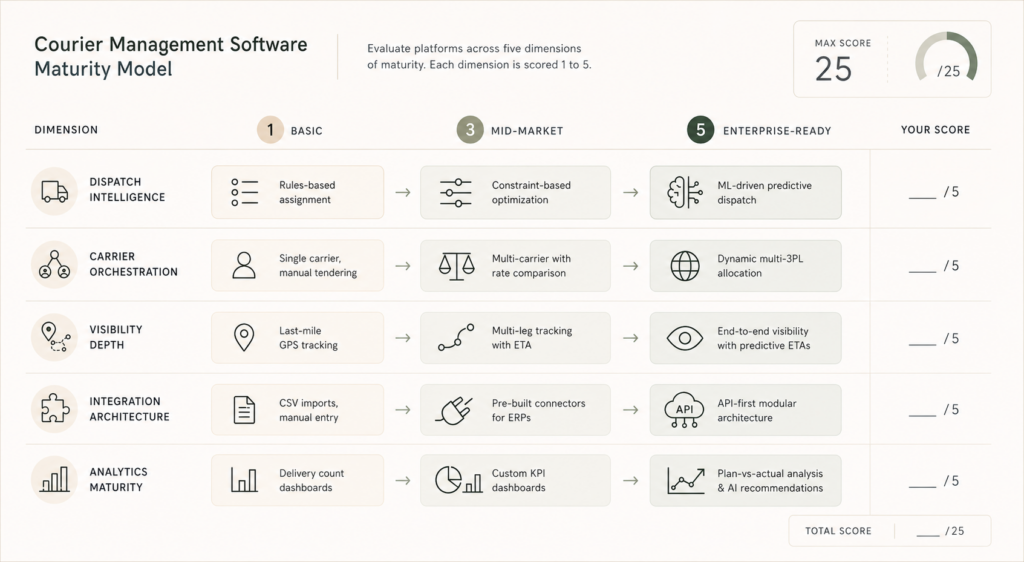
The Enterprise Courier Software Maturity Diagnostic scores platforms across five dimensions. Each dimension is rated 1 to 5, with a maximum possible score of 25.
| Dimension | Score 1 (Basic) | Score 3 (Mid-Market) | Score 5 (Enterprise-Ready) |
|---|---|---|---|
| Dispatch Intelligence | Rules-based static assignment | Constraint-based optimization with manual overrides | ML-driven predictive dispatch with continuous re-optimization |
| Carrier Orchestration | Single carrier, manual tendering | Multi-carrier with basic rate comparison | Dynamic multi-3PL allocation with automated tendering across 1,000+ carriers |
| Visibility Depth | Last-mile GPS tracking only | Multi-leg tracking with basic ETA | End-to-end origin-to-destination visibility with predictive ETAs and exception alerts |
| Integration Architecture | CSV imports, manual data entry | Pre-built connectors for major ERPs | API-first modular architecture with native ERP, WMS, OMS, and carrier connectivity |
| Analytics Maturity | Delivery count dashboards | Custom KPI dashboards with historical reporting | Plan-vs-actual analysis with AI-driven network optimization recommendations |
Scoring thresholds:
- 5-12: SMB-grade. Your operation has likely outgrown this platform
- 13-19: Mid-market capable. Adequate for moderate complexity but may strain under multi-3PL or multi-geography scaling
- 20-25: Enterprise-ready. Built for the dispatch volume, carrier diversity, and analytical depth that enterprise operations demand
Apply this framework internally by scoring your current platform and each candidate against the same rubric. Two dimensions tend to separate enterprise-ready platforms from the rest: carrier orchestration depth and integration architecture.
The role of thoughtful supply chain network design also factors in, because a platform that scores a 5 on dispatch intelligence but a 1 on integration architecture will create more problems than it solves.
Enterprise-grade platforms require longer implementation cycles than SMB tools. Budget for 8 to 16 weeks of integration and configuration, depending on the complexity of your existing technology stack and the number of carrier connections involved.
Locus’s architecture addresses these dimensions through its modular, API-first platform, recognized as a G2 #1 Leader in Route Optimization.
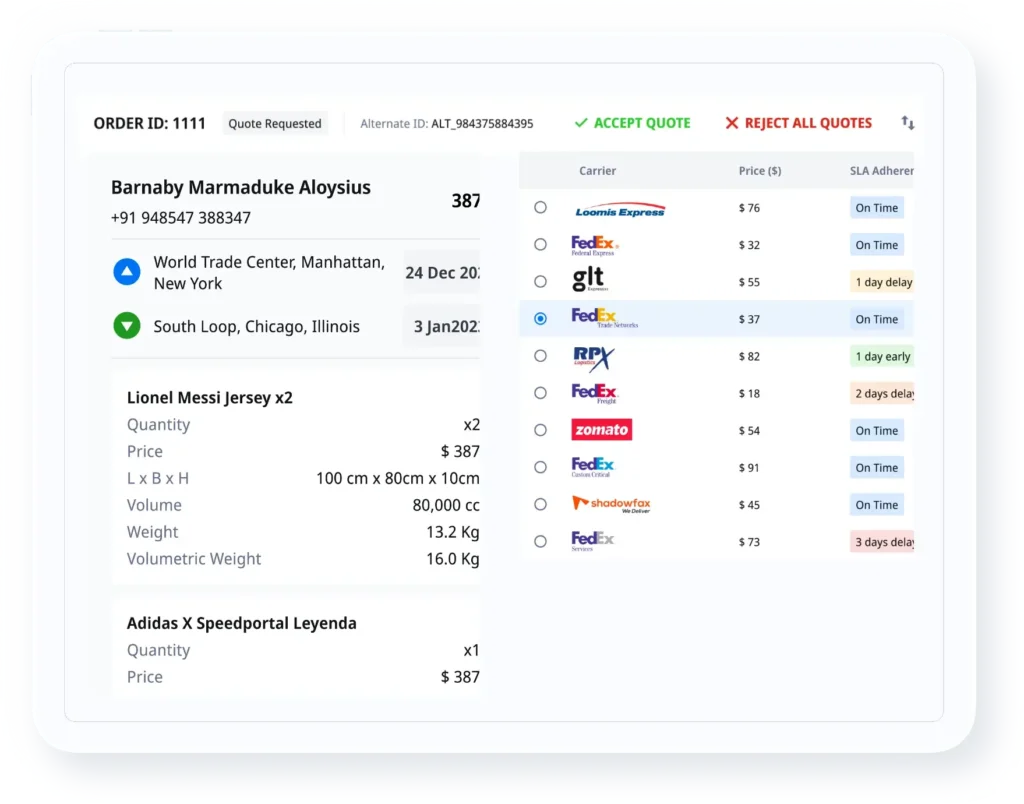
ShipFlex provides dynamic multicarrier allocation across 160+ carriers from a broad network of 1,000+, while the Control Tower delivers end-to-end visibility with predictive ETAs from a single pane.
Meanwhile, DispatchIQ uses ML-driven optimization across all fleet types, continuously learning from delivery outcomes to improve accuracy over time.
Mycroft, Locus’s AI agent layer, sits across these modules to surface recommendations and automate decision workflows, a capability set that Ingka Group valued when it acquired Locus to power its global logistics operations.????????????????
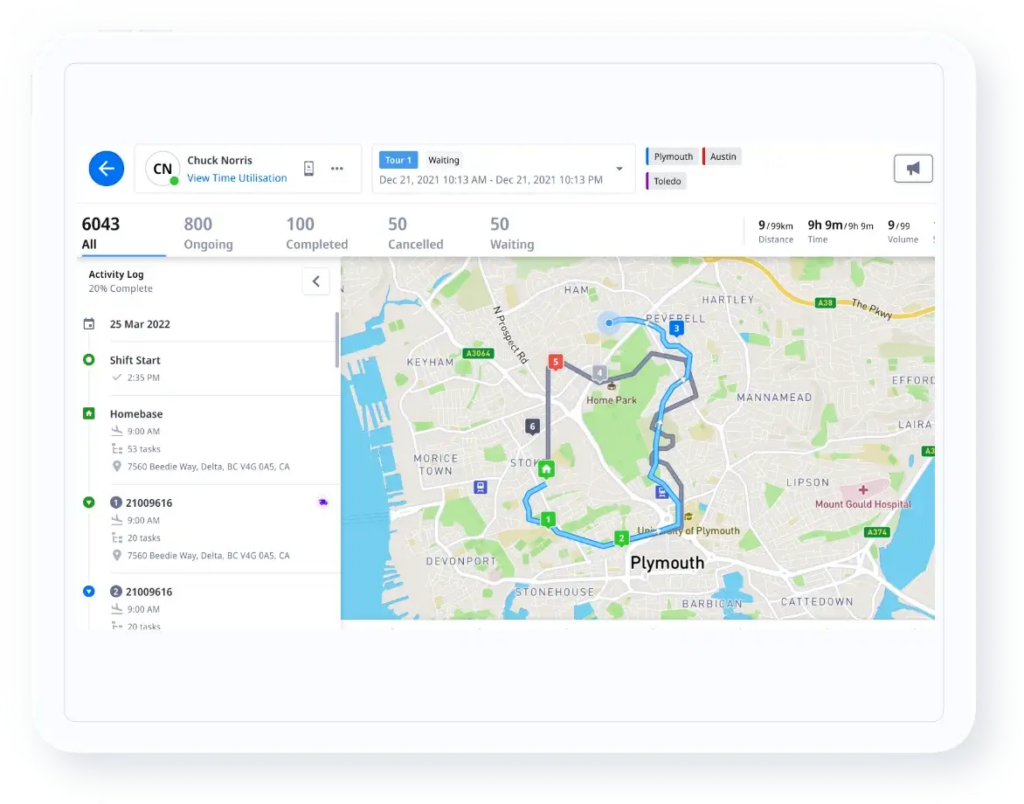
See How Locus Handles Enterprise-Scale Dispatch Complexity
What the Next 18 Months Look Like for Enterprise Courier Management
Several trends are reshaping enterprise courier management requirements through 2026. Platform decisions made now should account for where the category is heading, not just where it stands today.
| Trend | Implication for Platform Evaluation | Timeline |
|---|---|---|
| Convergence of courier management with broader supply chain orchestration | Platforms must handle first-mile, mid-mile, and last-mile in a closed loop | Accelerating in 2026 |
| Sustainability-driven routing and carbon-aware dispatch | Route optimization engines need to factor CO2 emissions alongside cost and time | Regulatory pressure building through 2026 |
| EV and mixed-energy fleet integration | Platforms must accommodate varying range constraints and charging requirements | Early adoption 2025, scaling 2026 |
| Shift from reactive exception management to predictive intervention | Exception handling must move from post-failure escalation to pre-failure prevention | Already differentiating leaders from laggards |
The convergence of courier management with broader supply chain orchestration is the most consequential shift. Enterprises that adopt a platform covering only the last-mile leg will face compounding integration overhead as they try to stitch together mid-mile visibility, carrier settlement, and upstream planning later.
Locus’s positioning as an agentic enterprise TMS, covering planning, execution, tracking, and settlement across all-mile logistics, reflects this trajectory. The platform has powered over 1.5 billion deliveries across 30+ countries, with $320 million in documented transit cost savings and 99.5% SLA adherence.
For logistics leaders focused on achieving last-mile excellence while preparing for all-mile complexity, this closed-loop architecture offers a path forward without layering additional point products.
The gap between enterprises running AI-native courier management platforms and those still operating fragmented or SMB-grade systems will widen as delivery volumes scale. Organizations that lock in continuous optimization now build a data and efficiency moat that compounds with every delivery executed through the system.
Talk to the Locus Team about your logistics network. Schedule a demo today.
Frequently Asked Questions (FAQs)
What is courier management software and how does it differ from a logistics orchestration platform?
Courier management software handles dispatch, routing, and delivery tracking for courier fleets. A logistics orchestration platform extends this to cover multicarrier allocation, end-to-end visibility across all transportation legs, settlement, and analytics. Enterprise operations typically require orchestration-level capabilities that basic courier software does not provide.
How long does it take to implement enterprise courier management software?
Implementation timelines for enterprise-grade platforms typically range from 8-16 weeks, depending on the number of carrier integrations, ERP and OMS connections, and the complexity of existing dispatch workflows. Organizations with standardized APIs and clean master data tend toward the shorter end of that range. Those migrating from manual or spreadsheet-based dispatch processes should plan for the longer end, including parallel-run testing across distribution hubs.
How should enterprises handle the cold-start problem with AI-powered courier dispatch?
ML-driven dispatch engines need historical delivery data to optimize effectively. In new geographies or for new service types, plan for a 4-8 week ramp-up during which the system learns local traffic patterns, driver performance baselines, and stop-time distributions. During this period, rule-based fallback logic should run in parallel. Ask vendors how much historical data their models require and what accuracy benchmarks the system reaches at 30, 60, and 90 days post-launch.
What are the hidden costs of running multiple point products instead of a single courier management platform?
Fragmented logistics stacks generate costs that rarely appear in procurement budgets: middleware maintenance, manual data reconciliation between dispatch and tracking systems, duplicate license fees, and the FTE overhead of managing separate vendor relationships. Organizations running three or more point products for dispatch, carrier management, and visibility often find they spend 15 to 25% more on integration maintenance than those using a consolidated platform, with the gap widening as carrier networks and delivery volumes grow.
How does Locus’s platform differ from traditional courier management software?
Locus operates as an all-mile logistics orchestration platform rather than a last-mile dispatch tool. Its dispatch engine (DispatchIQ) uses ML-driven optimization across captive, contracted, and outsourced fleets. ShipFlex automates multicarrier allocation, and the Control Tower provides end-to-end visibility with predictive ETAs and exception management. This closed-loop architecture eliminates the integration overhead that enterprises face when stitching together separate point products for each logistics function.


General
5 European Logistics Innovations Reshaping 2026: From Agentic TMS to GenAI Customer Service

May 7, 2026
Five technology categories reshaping European logistics in 2026 — Agentic TMS, Autonomous Control Tower, Governed IT, AI Orchestration, GenAI CX.
Read more
General
SEA Unified Visibility Evaluation: Fragmented Carrier Networks

May 8, 2026
Southeast Asian logistics visibility is structurally harder than US or European. A framework for SEA logistics leaders evaluating unified tracking in 2026.
Read moreInsights Worth Your Time



















What Enterprise Logistics Teams Actually Need from Courier Management Software