


General
Carrier Management: Onboarding, Performance Tracking, Contracts, and Compliance
Key Takeaways
- Carrier management decides which carriers move freight, under what terms, and what accountability exists when things go wrong.
- The onboarding shortcuts taken under peak-season pressure rarely create problems at go-live. They often show up weeks later.
- Scorecards only matter if they change next week’s volume allocation. When performance data doesn’t feed routing guide updates on a defined cadence, you’re left to run a reporting exercise.
- Compliance tracked on spreadsheets and reminder calendars creates liability exposure that surfaces during audits. Carriers with lapsed insurance certificates keep moving freight until someone manually catches it.
- A carrier management system closes that gap. Selection, onboarding, performance, contracts, and compliance run under one framework with enforceable rules and audit trails.
The following scenario might strike a chord with many dealing with carrier management daily.
A regional grocery distributor added three carriers for peak season, completed onboarding in two weeks, and started shipping.
A regional grocery distributor brought on three carriers two weeks before peak season. Onboarding moved fast, the loads went out, and nothing looked wrong until week four. That’s when customer service started getting escalations that no one could resolve.
Temperature logs hadn’t been captured. POD timestamps didn’t exist. There was nothing to reference in a dispute because the process was never built to produce it.
The carriers weren’t the problem. The onboarding was.
This is what happens when carrier management runs on speed rather than structure. When selection, onboarding, contracts, compliance, and performance tracking operate on rules you can audit, exceptions stop cascading into disputes.
We’ve created a complete 2026 guide to cover what carrier management is, where it breaks at scale, and how to build each of its core disciplines into a repeatable operating framework.
What Is Carrier Management?

Simply put, carrier management is selecting carriers, onboarding them, enforcing contract terms, tracking performance, and keeping compliance current so freight moves predictably and at a known cost.
In transportation and logistics management, carrier management sits between procurement and execution. Procurement negotiates rates and sets contract terms.
But someone still decides which carrier gets which load today, how re-tenders go out when a carrier rejects, what counts as a billable accessorial, and how a missed appointment window gets resolved. That is carrier management.
A carrier in supply chain management is any third party that physically moves goods: truckload operators, LTL providers, regional parcel networks, last-mile couriers, and specialized operators like refrigerated carriers or two-person crew providers.
Note: Managing a mixed carrier base means managing different rates, capabilities, compliance requirements, and failure modes under one operating framework.
What Does a Carrier Manager Do?
A carrier manager owns the operational relationship between the shipping organization and its carrier base. In enterprise logistics, the role touches every freight decision made at scale.
The responsibilities span the full carrier lifecycle:
- Routing guide maintenance: Keeping lane coverage current, encoding constraint-fit rules, and updating carrier priority as performance data comes in. A routing guide six months out of date is a liability
- Contract negotiation and enforcement: Negotiating rate terms and accessorial definitions, then ensuring those terms are applied consistently at every tender and invoice. This is not a one-time task. Contracts require active management when carriers miss SLAs and when market conditions shift
- Performance monitoring and QBR preparation: Pulling scorecard data, classifying exception root causes by carrier versus facility, and building the factual basis for quarterly business reviews
- Compliance oversight: Tracking insurance renewals, authority certificates, and safety documentation across the full carrier base
Titles vary: Director of Carrier Management, Transportation Operations Manager, Carrier Relations Manager. The accountability is the same: keep the carrier base performing, compliant, and aligned to the network’s SLA requirements.
In retail logistics and FMCG environments, the role owns the financial exposure tied to chargeback agreements and delivery SLAs.
What Is a Carrier Management System?
A carrier management system (CMS) is software that standardizes carrier selection, onboarding, performance tracking, contract management, and compliance in one workflow.
The difference between a CMS and a rate library is enforceability.
| A rate library stores terms. | A CMS applies them at every tender, tracks performance against them, and surfaces exceptions before they become disputes. |
For carrier management TMS teams, the key question is whether your TMS runs these workflows day to day or stops at rate storage and tender messaging. Many enterprise teams close that gap with transporter management software that connects carrier allocation to dispatch execution.
Key Features of an Effective Carrier Management System
These are the features that separate execution-grade platforms from rate libraries with a tracking add-on:
- Constraint-fit carrier assignment: Routes loads based on weight limits, equipment type, lift-gate availability, two-person crew requirements, and appointment window compatibility. Without it, dispatchers make those decisions manually for every load that falls outside a standard profile.
- Re-tender automation: When a carrier rejects, the system re-tenders to the next qualified carrier automatically, with a full audit trail. Manual re-tendering is where exceptions become incidents.
- Contract enforcement at the transaction level: Accessorial logic applied at tender time and at invoice time, not reconciled monthly. Invoice mismatches get flagged before payment runs.
- Compliance monitoring with expiration alerts: Certificate expirations tracked automatically, with carriers removed from active allocation when documents lapse.
- Performance-linked allocation rules: Scorecard data feeds routing guide updates on a defined cadence. If the performance module and the allocation module are not connected, they are two separate tools that share a login screen.
- Integration with OMS, TMS, and WMS: A CMS that cannot reconcile promised appointment windows with carrier behavior will still generate manual exceptions. Order management handoffs need to flow through the same layer where carrier decisions happen.
Why Carrier Management Breaks at Scale
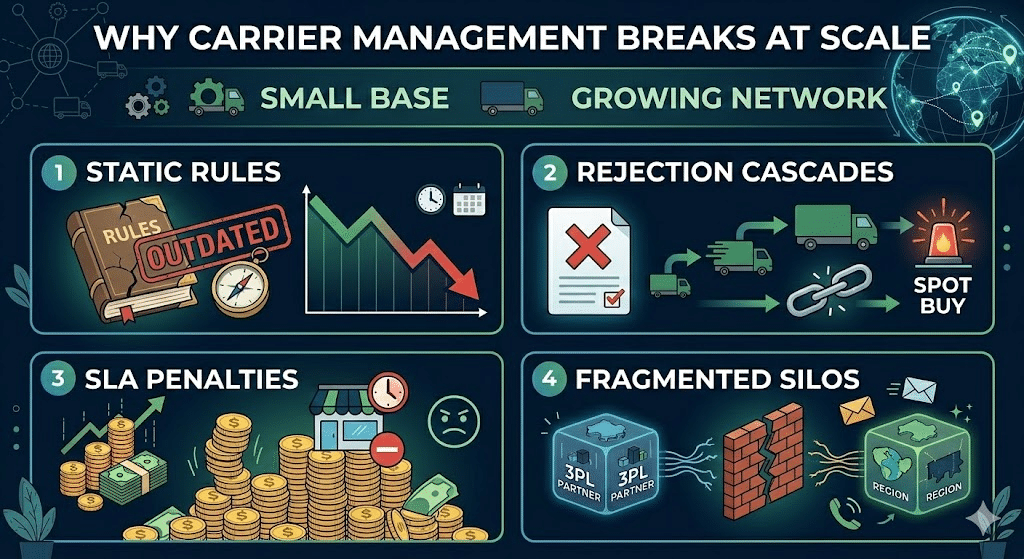
A small carrier base with stable lanes and predictable volumes is manageable without systems. Once volume, carrier count, and regional complexity grow, four failure modes appear.
Static routing guides and changing carrier behavior
Routing guides get built at onboarding and rarely get updated.
A carrier hitting 94% on-time delivery in Q1 may be at 71% by Q3 due to driver turnover or seasonal capacity constraints. The guide still sends them priority volume because no one updated the rule.
Tender rejection cascades in multi-region networks
One rejection forces a re-tender, which may exhaust the backup carrier, which forces a spot buy. In a network running 80 tender decisions daily across four regions, a 15% rejection rate generates 12 manual re-tenders before 9:00 a.m. That means 12 different phone calls, 12 appointment rebookings, and 12 cost variances.
Invisible SLA penalty exposure
A retailer paying $150 per missed delivery window across 40 stores accumulates $6,000 in daily chargeback exposure before anyone has pulled a report. Carrier management requires connecting carrier performance to financial exposure in real time.
Fragmented coordination across 3PLs and regions
When fulfillment runs across multiple 3PL partners, each with their own carrier relationships and compliance standards, every exception requires manual reconciliation across organizational boundaries.
Why Your Business Needs Carrier Management for Enterprise Logistics
Carrier management is a daily control requirement once your network crosses specific thresholds.
Multi-region networks with SLA commitments
Different regional carriers operate under different contract terms, appointment windows, and accessorial rules. Without a centralized framework, regional teams build local workarounds.
Exception handling becomes inconsistent across regions, and chargebacks accumulate before anyone identifies the source carrier.
High SLA penalty exposure
Retailers and FMCG manufacturers operating under chargeback agreements face direct financial consequences for missed delivery windows.
Last-mile delivery failures that go untracked at the carrier level translate into invoice deductions and lost replenishment slots that compound week over week.
Multi-3PL coordination
Managing carrier relationships across multiple 3PL partners requires a governance layer that enforces consistent contract terms, performance standards, and compliance requirements regardless of which 3PL is executing on a given lane.
Without it, each 3PL defaults to its own standards, and performance becomes impossible to compare.
Rapid network expansion
Adding carriers under peak-season pressure is where onboarding shortcuts get taken. Incomplete document submissions, untested integrations, and missing escalation contacts do not create problems at go-live. They create problems six weeks later when the first exception cannot be resolved.
Reverse logistics complexity
Return flows add carrier decision points that outbound logistics does not require: pickup eligibility by return category, different cost allocation rules, and appointment scheduling that does not match outbound patterns.
Carrier management that does not cover reverse flows leaves order fulfillment gaps that show up in the financials before they show up in the routing guide.
Understanding when carrier management becomes necessary is only the first step. Now, let us go over the four disciplines that make it work starting with how carriers enter your network in the first place.
Carrier Onboarding: An Overview
Carrier onboarding is the fastest way to add capacity. It is also where the most operationally costly decisions get made under time pressure.
The common failure pattern: a carrier gets added days before a peak window. Documents are submitted but not verified. The EDI connection is tested but not end-to-end validated. No escalation contact is named for after-hours failures. The first three loads move without incident. On the fourth, a temperature log is missing, a POD does not capture a signature, and customer service has no timestamp to reference in a dispute. None of this is the carrier’s fault.
A repeatable onboarding framework covers three layers.
- Documents: Insurance certificates, operating authority, safety filings, and lane-specific certifications must be collected and verified before the first load moves. For specialized lanes, this includes temperature chain documentation, hazmat handling certifications, and oversized load permits.
- System integrations: EDI or API connections for tender messages, status milestones, invoice data, and POD transmission need to be tested end-to-end. A carrier that sends tenders but cannot return status events is not operationally integrated. That gap shows up as “carrier delivered, no proof” at the moment you most need it.
- Operational setup: Cutoff times, appointment scheduling processes, driver escalation contacts, and the documented exception path when a load cannot be serviced. When a load fails at 2:00 a.m. with no named escalation contact, the failure propagates until morning.
For teams managing delivery management software with automated dispatch, onboarding completeness determines which carriers are available for constraint-fit allocation.
Carrier Performance Tracking: 12 KPIs You Must Know
Performance tracking matters when and only when it changes volume allocation. Scorecards that generate monthly reports but do not feed routing guide updates are documentation. They are not management.
The pattern in retail networks makes this concrete. One carrier runs at 97% on-time delivery but rejects tenders at a 20% rate during peak weeks. Another accepts every tender but misses dock windows often enough to generate chargeback exposure.
The routing guide built during calmer periods rewards the high on-time carrier with premium volume. Both failure modes stay invisible until someone connects scorecard data to financial impact.
The 12 KPIs that should drive allocation decisions include:
- Tender acceptance rate: Reveals which carriers hold capacity under volume pressure. A carrier dropping from 95% to 72% acceptance during peak periods is a capacity risk
- Tender response time: Carriers that hold tenders to the cutoff compress the re-tender window and create downstream dock scheduling failures
- On-time pickup rate: A 10-minute late pickup at a cross-dock can cascade into a two-hour missed delivery appointment
- On-time delivery rate: The metric that determines chargeback exposure and last-mile delivery SLA compliance
- First-attempt delivery success rate: The clearest proxy for total delivery cost. A 15% re-delivery rate adds cost; no rate negotiation recovers
- Claims rate by product type: Identifies carrier-and-product pairings that generate damage patterns before they accumulate into claims history
- POD completeness: Signatures, timestamps, photos, and exception notes must exist for every delivery before performance records can be defended
- Tracking event accuracy: False “delivered” statuses are the primary driver of WISMO calls and erode buyer confidence
- Detention frequency: High detention at a specific dock is often a scheduling problem, not a carrier problem. Lane-level drill-down separates the two
- Invoice exception rate: An 8% exception rate on 200 weekly invoices is 16 disputes per week, each requiring documentation and resolution time
- SLA penalty exposure by carrier: Quantifies the financial risk attached to each carrier’s performance pattern, not just their delivery rate
- Lane-level cost-to-serve: A carrier with a lower lane rate and a 15% first-attempt failure rate costs more than one with a higher rate and a 3% failure rate. This KPI makes that math visible
To note, Locus customers running carrier allocation as a governed execution workflow have reported a 72% increase in carrier allocation efficiency and a 38% reduction in WISMO calls. Those outcomes require performance tracking to be connected to allocation rules, not maintained in a separate reporting tool.
What is Carrier Contract Management?
Contract management in a CMS means the platform applies contract terms consistently at every tender and every invoice. The test is not whether terms are stored. It is whether they are enforced.
Rate logic is table stakes. The gap between a rate library and governed contract management is whether the system triggers proof requirements for detention claims and applies dispute windows automatically.
Plus, it’s also whether it prevents mismatched invoices before they require manual resolution, and enforces accessorial definitions that cannot be interpreted differently by the carrier and the shipper.
A shipper running 200 carrier invoices per week without automated contract enforcement will spend hours every week resolving discrepancies that should not have been generated. According to data, transportation invoice errors cost shippers between two and five percent of their freight spend annually.
At $10 million in annual freight spend, that is $200,000 to $500,000 in recoverable leakage.
Contract governance at scale requires four things:
- Accessorial definitions enforced at the transaction level, not negotiated per invoice
- Detention proof requirements applied automatically when detention is billed
- Rate logic that pulls the correct contract for the correct lane without manual lookup
- Dispute window tracking that escalates automatically rather than depending on follow-up
Transportation and logistics management platforms that surface contract mismatches before payment cycles eliminate the back-and-forth that consumes dispatch and finance team bandwidth at volume.
For instance, Locus’s ShipFlex module digitizes transporter contracts, extracts key parameters automatically, and handles invoice reconciliation against those parameters, recovering $288 million in revenue leakage across customers.
Carrier Compliance: At a Glance
Carrier compliance covers operating authority, insurance certificates, safety filings, and lane-specific regulatory requirements.
An expired insurance certificate on an active carrier is more than a documentation problem. It is an uninsured liability exposure on every load that the carrier moves until the gap is caught.
Compliance failures surface at the worst moments: audits, claims, and incidents. The problem is not that organizations forget about compliance. It is that tracking expiration dates across a carrier base of 50 or more carriers, each with multiple certificate types renewing on different schedules, exceeds what a spreadsheet and a reminder calendar can reliably handle.
The operational requirement is a system that:
- Tracks certificate expiration dates and triggers renewal requests before lapse
- Holds carriers from receiving tenders when compliance documents have expired or are missing
- Maintains lane-specific certification records separately from general compliance documents
- Produces audit-ready compliance history without manual compilation
Beyond documentation, compliance management in logistics and supply chain management includes staying current on regional regulatory changes: Hours of Service rules, emissions compliance requirements, and road restrictions that change carrier eligibility on specific lanes.
The cost of a compliance gap is asymmetric. It is inexpensive to prevent and expensive to remediate. Organizations that treat compliance as a monthly task rather than a continuous process discover that asymmetry during claims resolution.
CMS vs. Traditional Freight Management: Which Wins?
Traditional freight management works through spreadsheet routing guides, tender calls placed by phone or email, and exception handling through whoever picks up first. It breaks when volume grows, and carrier performance varies by lane, season, and week.
Here’s how they stack against each other:
| Scenario | Traditional approach | CMS approach |
|---|---|---|
| Carrier rejects a tender | Manual phone call, no audit trail | Automated re-tender to the next qualified carrier, logged |
| The insurance certificate expires | Missed until an incident | Auto-flagged, carrier blocked from allocation |
| Invoice billed above the contract rate | Caught during monthly reconciliation, if at all | Flagged before the payment run |
| Carrier performance drops mid-quarter | Noticed at QBR | The allocation rule is adjusted based on the live scorecard |
| New carrier added under time pressure | Informal checklist, variable completeness | Structured checklist, blocked until complete |
The investment case is not primarily about software cost versus headcount. It is about the cost of the exceptions the current process cannot handle fast enough: re-delivery costs, spot rate premiums, chargeback exposure, and the labor hours spent resolving disputes that automated contract enforcement would have prevented.
How to Choose the Right Carrier Management System
A CMS is a justified investment when operational complexity exceeds what manual processes can handle reliably. That threshold arrives earlier than most teams expect.
Must-have capabilities to validate:
- Carrier onboarding with document management and integration testing before go-live
- Performance tracking that connects directly to routing guide updates, not a separate reporting module
- Contract management with accessorial enforcement at transaction time, not monthly reconciliation
- Compliance tracking with expiration alerts and automatic allocation blocks
- Integration with existing TMS, OMS, and WMS that goes beyond data export
Ideally, you must also look into these aspects:
- Fit for your volume and complexity: A CMS that handles 50 carriers and 300 daily tenders operates differently from one handling 500 carriers and 5,000 daily tenders. Validate that the system has been deployed at your complexity level, not just that it claims to support it.
- Actual usage, not configuration: The most common CMS failure mode is a system that gets configured, used for six months, and then abandoned because routing guide updates require a support ticket. Ask vendors to demonstrate how a routing guide change happens in practice.
- Support that matches your operational hours: A carrier rejection at 3:00 a.m. during peak week cannot wait for a business-hours support response. Understand what your support access looks like at failure moments, not in normal operations.
What to Validate in Carrier Management Software Demos
Carrier management software wins or loses on edge cases. Ask questions that force the platform to show the mechanism, not screenshots.
- Constraint-fit allocation: Ask the vendor to demonstrate that weight limits, lift-gate requirements, two-person crew pairing, and appointment windows change carrier assignment in real time. If the platform cannot show that constraint rules affect selection, it is running rate lookup, not carrier management.
- Re-tender workflow under pressure: Trigger a carrier rejection and ask to see the reallocation rules, escalation path, and audit trail. Count the manual steps between rejection and re-confirmation. More than two is a signal.
- Contract enforcement at invoice time: Request the vendor to show accessorial logic applied at tender time and at invoice time, including what happens when detention is billed without the required proof. If that check happens in a separate process, the integration is shallow.
- Exception handling from failure to resolution: Ask to see a missed pickup, a rebooked appointment, and the resulting customer communication workflow in sequence.
- Performance data connected to allocation rules. Let vendors also show, specifically, how a carrier scorecard update changes routing guide priority. If the two modules are not directly connected, they are separate tools that share a login.
- Integration with order management: A CMS that cannot reconcile promised appointment windows with carrier behavior will still generate manual exceptions at the order level.
Locus: Streamline Your Logistics with Carrier Management
Carrier management is the operating framework that determines which carrier receives the freight, what the terms are, how exceptions are resolved, and whether the network holds under pressure.
The four disciplines that make it work are carrier onboarding built for completeness, performance tracking connected to allocation rules, contract management that enforces terms at the transaction level, and compliance tracking that runs continuously rather than periodically.
Locus is purpose-built for the day-of execution layer where these decisions happen. Processing 650M+ orders across 400+ cities with a 99.5% on-time delivery rate, it connects dispatch, routing, carrier allocation, and exception handling in one operational workflow.
Schedule a Locus demo to see how carrier allocation, dispatch decisions, and exception handling run inside one operational workflow.
Frequently Asked Questions (FAQs)
1. What is the difference between a carrier management system and a TMS?
A TMS handles planning, tendering, and settlement. A carrier management system focuses on the carrier lifecycle: onboarding, compliance, contract enforcement, scorecards, and allocation rules. The practical gap shows up when you need enforceable accessorial logic, compliance tracking, and performance data that changes routing guide priority week to week.
2. How long should carrier onboarding take?
The right target is completeness, not speed. A carrier that is operationally ready with verified documents, tested integrations, confirmed POD capture, and a named escalation contact takes longer to onboard than one that is simply added to a routing guide. That difference shows up in the first month of live operations.
3. What KPIs belong on a carrier scorecard?
The 12 that drive allocation decisions: tender acceptance rate, tender response time, on-time pickup, on-time delivery, first-attempt delivery success, claims rate by product type, POD completeness, tracking event accuracy, detention frequency, invoice exception rate, SLA penalty exposure, and lane-level cost-to-serve. Always maintain lane-level drill-down to separate carrier behavior from facility-level issues.
4. How does carrier contract management differ from storing rates in a TMS?
A rate store holds terms. Governed contract management enforces them: accessorial definitions applied at the transaction level, detention proof triggered automatically at billing, dispute windows tracked without manual follow-up, and invoice mismatches surfaced before payment runs. The test is whether the platform prevents disputes or only documents them after the fact.
5. When is the right time to invest in a carrier management system?
When manual processes cannot handle the exception volume your network generates reliably. That threshold arrives earlier than most teams expect, typically when rejection rates require daily re-tendering, when invoice exceptions require dedicated staff, or when compliance tracking spans more carriers than a spreadsheet can reliably monitor.


General
7 Best Large Bulky Item Courier Delivery Software of 2026

Mar 5, 2026
Compare bulky delivery software for furniture, appliances, and B2B freight. See features, best-fit use cases, and pricing models
Read more
General
SLA Economics: The Real Cost of Your Delivery Promises

Mar 9, 2026
Same-day promises aren’t free. Learn how to model SLA cost, performance, and revenue to protect margins and design profitable delivery tiers.
Read moreInsights Worth Your Time




















Carrier Management: Onboarding, Performance Tracking, Contracts, and Compliance