


General
10 Best Route Tracking Software for Enterprise Logistics Teams in 2026
Key Takeaways
- Enterprise logistics operations running 1,000+ daily orders need AI-driven dispatch and real-time re-optimization, not basic multi-stop route planners built for small fleets.
- Locus leads for enterprises managing high-volume, multi-zone fulfillment with SLA commitments, powered by the DispatchIQ engine that optimizes 180+ variables per route.
- DispatchTrack, LogiNext, and Shipsy each carry enterprise-grade strengths within narrower functional zones, with clear gaps in full-stack orchestration.
- Routific, Onfleet, and OptimoRoute serve mid-market delivery well but reach their operational limits quickly as order volumes and geographic scale grow.
- Badger Maps and RouteXL serve field sales and basic mapping needs. They belong in a different product category from logistics fleet management software.
A missed SLA in enterprise logistics costs more than the delivery itself. Fuel wasted on suboptimal routes compounds daily across a fleet of hundreds. When a dispatcher manually reconciles 800 orders across three zones every morning, downstream errors accumulate before the first truck leaves the dock.
Route tracking software now spans a wide range: consumer-grade driving planners, mid-market delivery tools, and enterprise dispatch engines capable of AI-driven optimization across thousands of concurrent routes. Choosing the wrong one creates an operational ceiling compounding every quarter.
The guide evaluates 10 options through the lens of what matters to high-volume logistics teams, including AI optimization depth, dispatcher control, real-time visibility, and integration readiness.
For context on what separates enterprise execution from basic planning, see what is route mapping.
Quick Comparison: 10 Route Tracking Software Options
Evaluation at enterprise scale produces different requirements than evaluation at five-van scale. The table captures the most consequential decision dimensions.
| Software | Best For | Key Feature | AI/Dynamic Routing | Dispatch Management | Real-Time Tracking | Starting Price | Rating | Enterprise Readiness |
|---|---|---|---|---|---|---|---|---|
| Locus | Enterprise high-volume, multi-zone fulfillment | DispatchIQ: 180+ variable AI optimization engine | Yes | Yes (full command center) | Yes | Contact vendor | Gartner: 4.2/5 (53 reviews) | High |
| OptimoRoute | Mid-market delivery and field service | Multi-day routing with workload balancing | Limited | Basic | Yes | $39/driver/month | Capterra: 4.6 | Medium |
| Route4Me | SMB and growing delivery ops | Modular add-on marketplace | Limited | Basic | Yes | $200+/month | Capterra: 4.5 (388 reviews) | Low |
| DispatchTrack | Enterprise last-mile delivery | AI scheduling, 98% ETA accuracy | Yes | Yes | Yes | Contact vendor | Capterra: 4.2 (72 reviews) | High |
| LogiNext | FMCG and 3PL route planning | Capacity planning, live fleet tracking | Yes | Yes | Yes | Contact vendor | Gartner: 4.2 (52 reviews) | High |
| Shipsy | Cross-border and carrier-heavy logistics | Carrier allocation, intelligent routing | Yes | Partial | Yes | Contact vendor | Gartner: 4.6 | Medium-High |
| FarEye | CX-focused last-mile delivery | Low-code delivery workflow builder | Yes | Yes | Yes | Contact vendor | Enterprise; contact vendor | High |
| Routific | Small-to-mid delivery teams | Clean UX with drag-and-drop route editing | No | Minimal | Yes | Free (100 orders/month); $150/month (1,000 orders) | Capterra: 4.9; G2: 4.6 | Low |
| Onfleet | Courier and last-mile delivery teams | Auto-dispatch, strong mobile driver app | Partial | Partial | Yes | $599+/month | G2: ~4.6 | Medium |
| Badger Maps | Field sales route planning | CRM integration, territory management | No | No | Limited | $58/user/month | G2: 4.4 | Low |
The clearest dividing line in this table runs between platforms developed around dispatch execution (Locus, DispatchTrack, LogiNext) and those built around route planning or field sales visualization (Routific, Route4Me, Badger Maps).
If your operation runs above 500 daily deliveries across multiple zones, the AI/Dynamic Routing and Dispatch Management columns are where the evaluation actually happens.
10 Best Route Tracking Software for Enterprise Logistics Teams
The range below spans full-stack enterprise orchestration, mid-market delivery management, and tools designed for entirely different buyer categories. Each entry covers what the option genuinely does well, where it runs into limitations at enterprise scale, and which verticals or operational profiles it realistically serves.
1. Locus
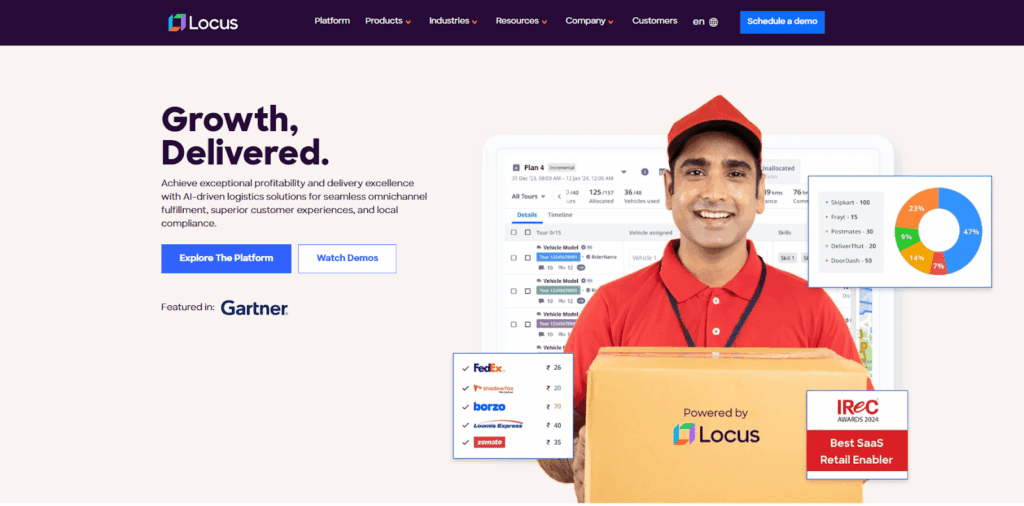
Locus is purpose-built for logistics operations where manual dispatching has become a throughput bottleneck. The DispatchIQ engine processes more than 180 variables simultaneously to generate delivery plans, covering time windows, driver skill levels, vehicle capacity, real-time traffic, fuel profiles, and regulatory hours-of-service limits.
At 5,000 deliveries per day, the gap between 30-variable and 180-variable optimization shows up in execution outcomes like under-constrained routes produce on-road failures requiring dispatcher intervention throughout the day.
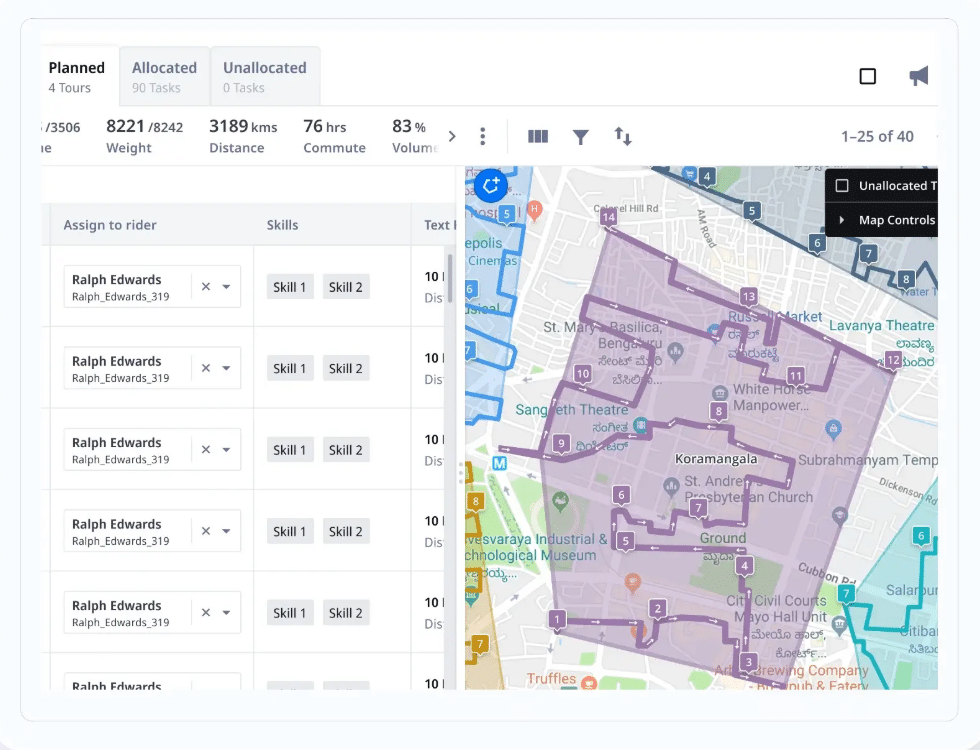
The AI route optimization engine handles scheduled, dynamic, and recurring fulfillment in a single pass. A driver calling out at 6 AM triggers automatic resequencing across all affected routes. The patent-protected geocoding engine converts ambiguous addresses into precise coordinates, directly determining first-attempt delivery rates for enterprises in APAC or MEA markets where standardized addressing is uncommon.
Real-time communication for delivery fulfillment runs through a manager dashboard, the LOTR driver app with offline mode, and a customer-facing tracking layer with predictive ETAs and self-service rescheduling.
Gartner reviewers note a UI learning curve. The configuration depth behind it handles multi-zone fulfillment with vehicle-type constraints and recurring schedules at enterprise scale.
Locus’s Key Features
- DispatchIQ optimization engine handling 180+ variables, capable of planning 15,000+ orders in under 30 minutes
- Patent-protected geocoding engine converting non-standard addresses to precise coordinates, designed for APAC and MEA market conditions
- Control Tower with predictive SLA breach alerts (15-30 minute advance warning), auto-escalation, and exception workflow management
- LOTR driver app (Android and iOS) with offline mode, turn-by-turn navigation, proof of delivery, and two-way dispatcher communication
- SLA-compliant scheduling across scheduled, dynamic, and recurring fulfillment models in a single optimization pass
- API-first integration with ERP, WMS, and OMS systems via RESTful APIs, with no rip-and-replace requirement
Locus Is Best For
Locus is best suited for enterprise retail, FMCG, e-commerce, 3PL, or CPG operations managing 1,000 or more daily deliveries across multiple zones with strict SLA commitments. Specifically, operations where daily variability is high, such as mixed owned and contracted fleets, non-standard address environments, and recurring fulfillment schedules interleaving with on-demand order flows.
Businesses expanding geographically into APAC, MEA, or multi-country coverage benefit particularly from the geocoding depth and regional team support across 30+ countries.
Locus’s Pricing
Locus uses custom enterprise pricing based on delivery volume, geographic scope, and the modules selected. Every engagement includes dedicated customer success and integration support. There is no self-serve or published SMB pricing tier. Contact the vendor for a quote or schedule a demo.
Locus’s Ratings
Gartner Peer Insights: 4.2/5 (53 reviews). Reviewers cite fast exception identification, reliable Control Tower performance at peak volumes, and strong support responsiveness as consistent strengths. UI complexity is the most frequently noted limitation, particularly during initial setup and dispatcher onboarding.
2. OptimoRoute
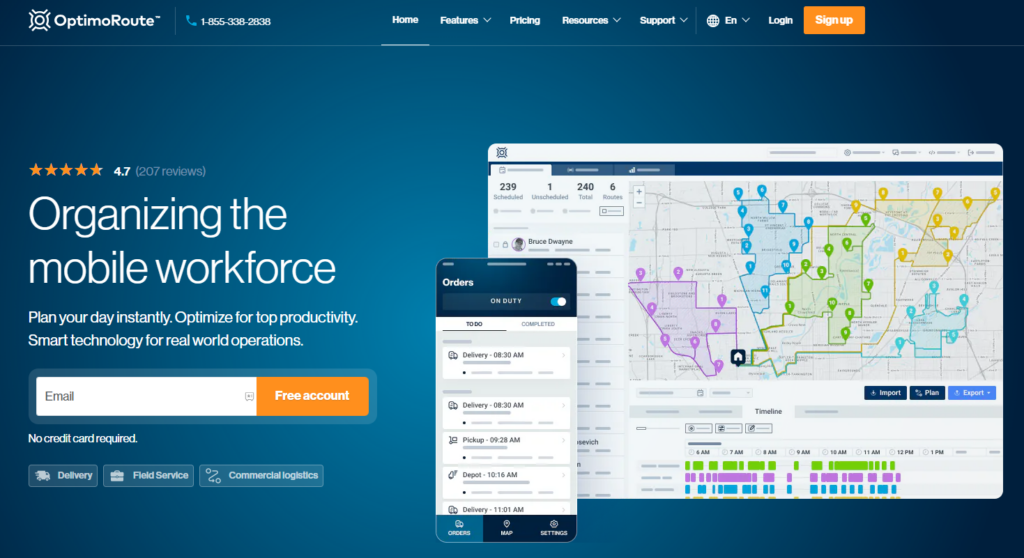
OptimoRoute has earned a solid mid-market position through its multi-day routing engine, workload balancing, and driver scheduling flexibility. Proof-of-delivery capture and per-driver pricing make it accessible for fleets growing from 10 to 50 vehicles.
Dynamic re-routing based on live traffic conditions requires manual dispatcher intervention. OptimoRoute carries no AI layer for autonomous route adjustment. Integration depth for OMS and WMS connections falls short of what multi-warehouse or multi-carrier operations require.
Field service companies with stable routes get good value. Logistics operations running 500+ daily deliveries across dynamic environments will encounter the ceiling quickly.
OptimoRoute’s Key Features
- Multi-day routing and workload balancing for driver scheduling across extended periods
- Proof-of-delivery capture with photo, signature, and barcode options via mobile app
- Real-time order tracking with customer notifications and delivery status updates
- Return-to-depot routing for operations using bikes, cargo bikes, or small vans
- Analytics and driver performance reporting with route history comparison
OptimoRoute’s Pricing
Lite plan: $39/driver/month. Pro plan: $49/driver/month. Both are billed monthly with no long-term contract requirement. Custom plans available for larger fleets.
OptimoRoute’s Ratings
Capterra: 4.6 (246 reviews). High marks on ease of use and value for money. Enterprise reviewers consistently flag the absence of live traffic-based re-routing and limited API administrative endpoints as the primary gaps.
3. Route4Me
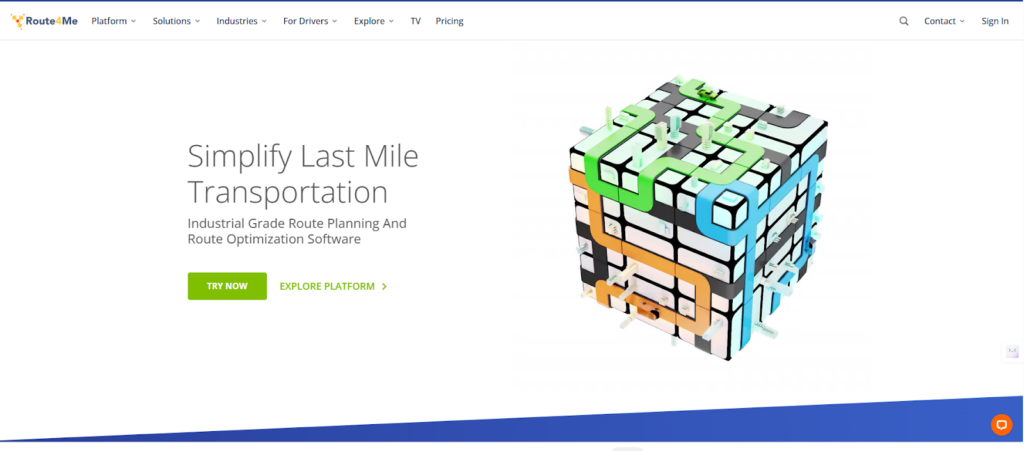
Route4Me’s primary selling point is modularity. The add-on marketplace covers telematics integrations, RFID support, curbside delivery tools, and customizable customer feedback surveys.
For SMBs building a routing stack incrementally, the flexibility has real value. The mobile app handles basic driver navigation and proof-of-delivery without requiring integration setup.
Route optimization quality is inconsistent in high-density multi-driver environments. Reviewers on both G2 and Capterra report overlapping routes and unnecessary backtracking at scale.
Pricing compounds the problem, for example, the base tier at $200+/month covers minimal optimization, and add-ons accumulate quickly as fleets grow past 100 vehicles.
Route4Me’s Key Features
- Modular add-on marketplace with telematics, RFID, and curbside delivery modules
- Mobile driver app with turn-by-turn navigation and proof-of-delivery capture
- Real-time order tracking and customer notifications via the customer portal
- Driver rating and customizable customer feedback surveys
- Territory management with geographic zone visualization
Route4Me’s Pricing
Pricing starts at approximately $200/month (minimum five users at $40/user/month). Route optimization features require higher-tier plans above the base tier. Contact the vendor for enterprise pricing on larger fleet configurations.
Route4Me’s Ratings
Capterra: 4.5 (388 reviews). SMB and field service reviewers report solid value for basic routing needs. Enterprise-scale reviewers cite optimization inconsistency at high stop counts and pricing escalation as the two most common concerns.
4. DispatchTrack
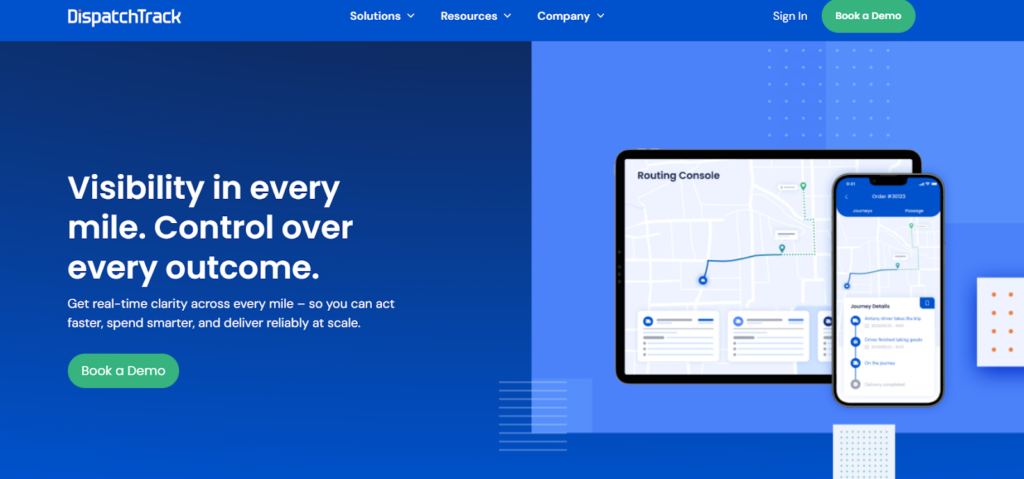
DispatchTrack holds a strong position in enterprise last-mile delivery with documented performance metrics like 98% ETA accuracy, 10%+ reduction in total miles driven, and 50-70% reduction in routing time.
For businesses managing high-volume last-mile delivery in furniture, appliances, building supplies, and retail distribution, those figures reflect real operational outcomes. The AI scheduling engine and customer communication tools address the customer experience layer of last-mile tracking directly.
The differentiation from Locus is architectural. DispatchTrack optimizes within a defined last-mile scope. Locus covers first-mile, mid-mile, and last-mile in a single optimization pass, with carrier orchestration, third-party fleet integration, and supply chain visibility extending beyond DispatchTrack’s defined last-mile scope.
Enterprises managing captive fleets, contracted carrier networks, and 3PL providers simultaneously will reach DispatchTrack’s boundary before Locus’s.
DispatchTrack’s Key Features
- AI-powered scheduling with 98% ETA accuracy across 2,500+ customers in 30 countries
- Customer communication tools, including proactive delivery notifications and tracking links
- 10%+ reduction in total miles driven through route sequencing and clustering
- Proof-of-delivery with photo capture, signature, and exception logging
- Integration with existing ERP and order management systems
DispatchTrack’s Pricing
Custom enterprise pricing. DispatchTrack publishes no self-serve tiers or public rate cards. Contact the vendor directly.
DispatchTrack’s Ratings
Capterra: 4.2 (72 reviews). Reviewers rate ETA accuracy and customer communication tools highly. Some reviews note performance variability under large data volumes and complexity around multi-tenant configurations.
5. LogiNext

LogiNext Mile targets the same enterprise buyer as Locus, with AI-powered route optimization, real-time fleet tracking, and capacity planning. Carrier allocation and analytics dashboards are recognized strengths, particularly for businesses managing large carrier ecosystems.
The Gartner Peer Insights presence at 4.2/5 (52 reviews) reflects a genuine enterprise install base across FMCG and 3PL verticals.
The differentiation runs at the algorithm layer. LogiNext’s optimization engine handles standard routing competently but operates with significantly fewer simultaneous constraints than Locus’s DispatchIQ. The geocoding engine lacks the patent-backed precision Locus provides for APAC and MEA address environments.
Enterprises operating across India, Southeast Asia, or the Middle East with high first-attempt delivery requirements will find that geocoding accuracy determines outcomes more than routing sequence.
LogiNext’s Key Features
- AI-powered route optimization with real-time fleet tracking and live driver position visibility
- Capacity planning and carrier allocation across owned and third-party fleets
- Analytics dashboards with delivery performance reporting and exception tracking
- Integration with ERP, WMS, and OMS systems
- Mobile driver app with proof of delivery and route guidance
LogiNext’s Pricing
Custom enterprise pricing. Contact the vendor for a quote.
LogiNext’s Ratings
Gartner Peer Insights: 4.2/5 (52 reviews). Reviewers frequently cite analytics depth and carrier management as the leading strengths. Geocoding accuracy in non-standardized address markets and optimization granularity for high-constraint scenarios are the most noted limitations.
6. Shipsy
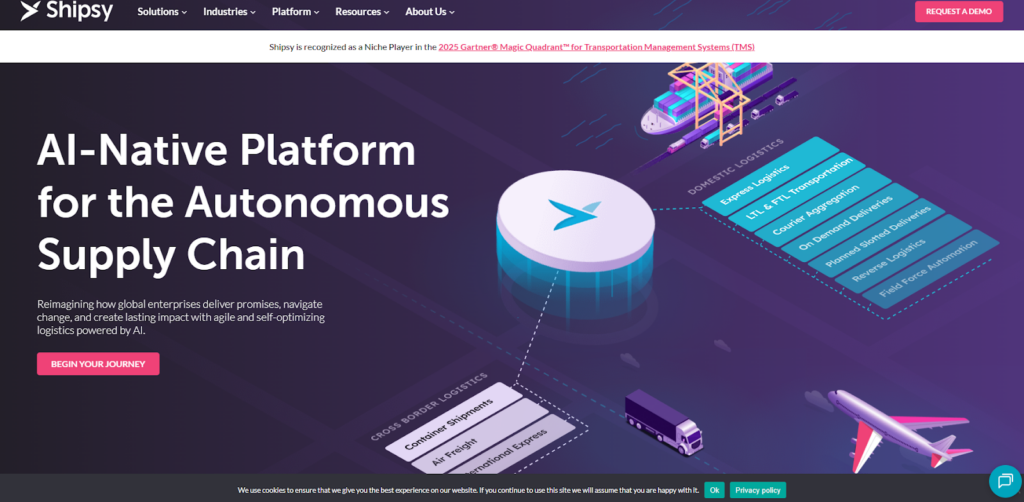
Shipsy has created a recognized position in cross-border logistics and carrier management, with a 4.6 Gartner rating and documented 18% routing time savings. For businesses managing international freight corridors in addition to domestic last-mile, the carrier allocation intelligence and freight invoicing automation address operational problems that pure last-mile platforms leave unaddressed.
The design center leans toward carrier management and freight visibility rather than per-route dispatch execution. Enterprises running high-density recurring delivery networks where the dispatcher command-center layer determines daily cost and compliance outcomes will find Locus’s AI dispatch depth and track-and-trace infrastructure better suited.
Shipsy fits best where cross-border logistics depth and carrier invoice reconciliation are the primary pain points.
Shipsy’s Key Features
- Intelligent delivery planning with routing optimization and real-time tracking
- Carrier allocation and management across domestic and international providers
- Cross-border compliance tooling and freight invoicing automation
- Data-driven routing insights with performance analytics
- Customer-facing delivery tracking and communication tools
Shipsy’s Pricing
Custom pricing. Contact the vendor.
Shipsy’s Ratings
Gartner Peer Insights: 4.6. Reviews highlight data-driven routing insights and carrier management as the primary value drivers. Integration friction and UI navigation have been noted as concerns in some enterprise deployments.
7. FarEye
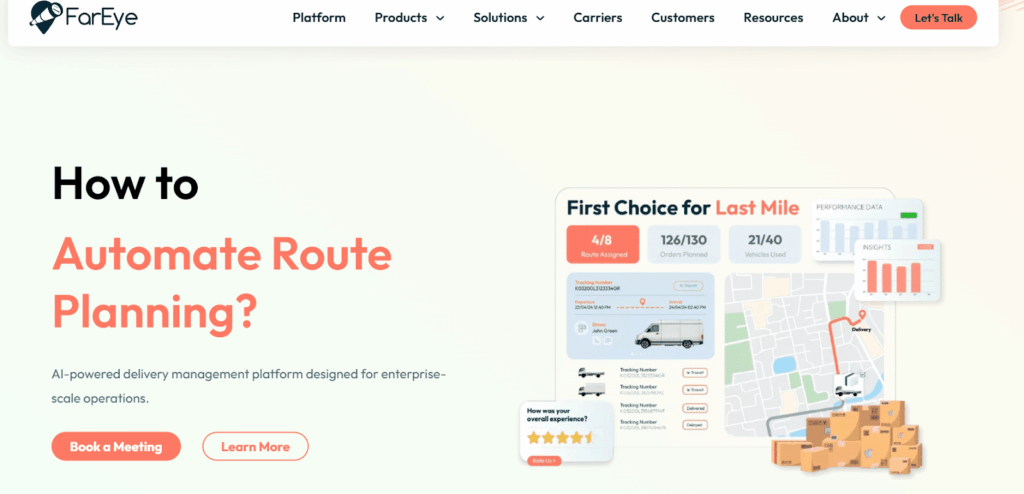
FarEye’s design philosophy is workflow-first. The low-code builder lets operations teams configure delivery processes and exception workflows without engineering resources, which has practical value for enterprises managing diverse delivery types.
Customer experience orchestration, including proactive breach notifications and customer-facing tracking, is a consistently recognized strength across enterprise reviews.
Locus provides tighter control at the dispatch and route-execution layer, where SLA compliance, dynamic re-routing, and dispatcher override determine whether fleet costs stay within plan.
Operations needing deeper execution control tend to evaluate Locus after FarEye. The two platforms serve different stages of the same logistics challenge.
FarEye’s Key Features
- Low-code delivery workflow builder for process configuration without engineering resources
- Customer-facing tracking and proactive delivery breach notifications
- Real-time visibility and operational dashboards with exception tracking
- Integration ecosystem for connecting with existing OMS and carrier systems
- Enterprise client base across retail, FMCG, and courier verticals
FarEye’s Pricing
Custom enterprise pricing. FarEye publishes no self-serve tiers. Contact the vendor for a quote.
FarEye’s Ratings
Ratings available on Gartner Peer Insights, G2, and Capterra. Enterprise reviewers highlight delivery visibility and workflow coverage as consistent strengths. Implementation complexity and customization timelines are the most frequently cited considerations in longer deployments.
8. Routific
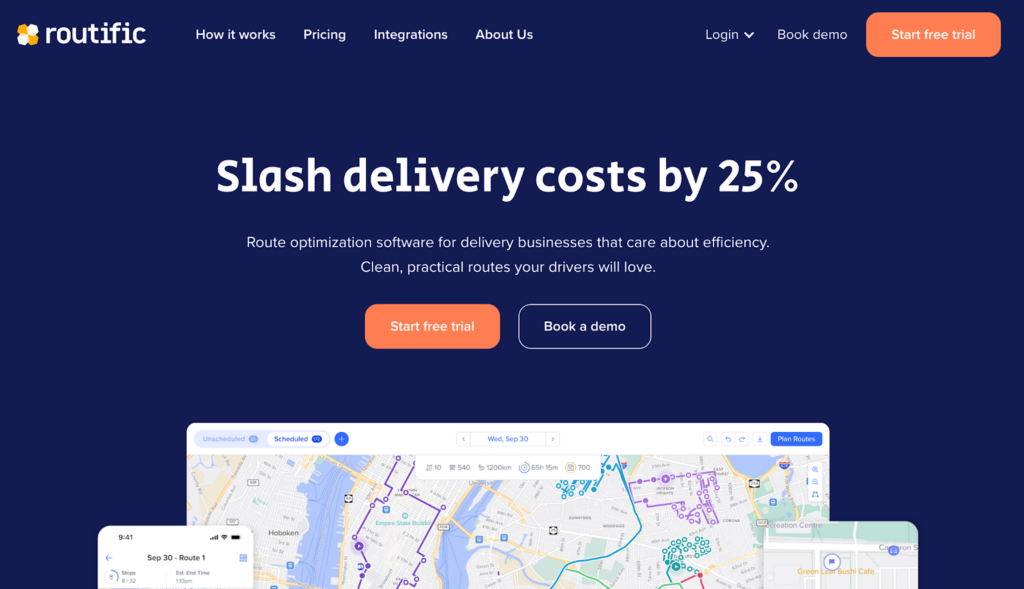
Routific’s 4.9 Capterra rating reflects genuine product quality for a specific buyer, such as small delivery teams who need optimized routes without an IT implementation. The drag-and-drop editor and clean interface have made it the default choice for florists, meal kit services, and small courier operations.
The free tier (100 orders/month) and $150/month plan for 1,000 orders suit businesses with limited routing budgets.
Above 500 daily deliveries, the gaps become operational constraints. Dynamic re-routing requires manual dispatcher action. Enterprise integrations with OMS or ERP are limited. The optimization algorithm produces overlapping routes in high-density multi-driver environments.
Routific executes its design intent well. Its design intent covers teams managing under 50 vehicles with stable, repeating routes.
Routific’s Key Features
- Drag-and-drop route editing with instant route impact preview
- Clean dispatcher interface with driver tracking and delivery status visibility
- Proof of delivery with photo capture and customer notification features
- Barcode scanning for delivery confirmation (added December 2026)
- CSV import for address lists with support for Shopify and other integrations
Routific’s Pricing
Free tier: 100 orders per month, available ongoing. $150/month for up to 1,000 orders. Per-order pricing at $0.15/order from 1,001 to 2,000 orders monthly, scaling down to $0.03/order above 20,000 orders.
Routific’s Ratings
Capterra: 4.9 (134 reviews). G2: 4.6. Consistently high marks for ease of use, route accuracy, and customer service. Enterprise scalability falls outside Routific’s documented use cases and feature development roadmap.
9. Onfleet
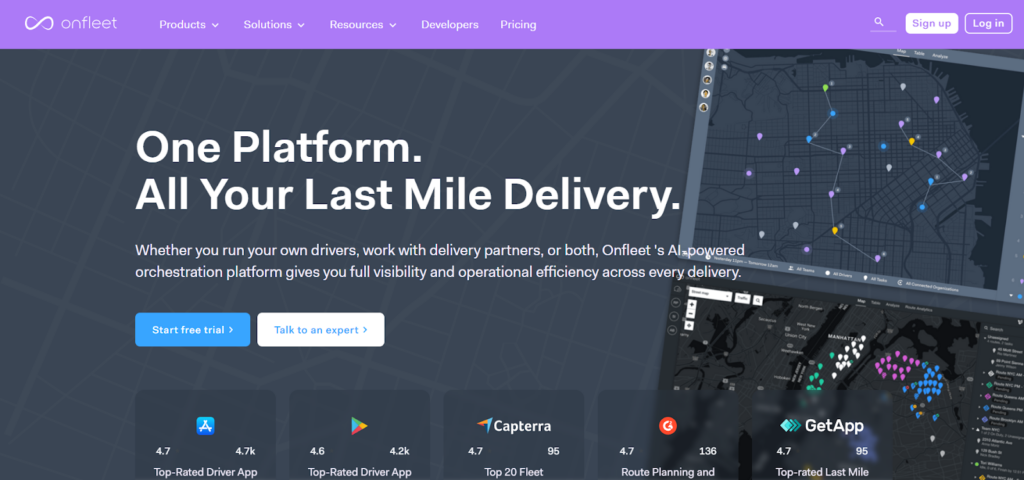
Onfleet’s mobile driver app is well-built, auto-dispatch reduces manual task assignment, and predictive ETA performs reliably for urban delivery operations. For growing delivery businesses and courier services needing solid operational tooling, it is a credible choice.
Three gaps emerge at enterprise scale. The analytics suite covers basic delivery performance but falls short of what logistics directors at $150M+ enterprises use for fleet-wide management. Multi-modal support for operations running owned fleets in combination with contracted carriers requires supplemental tools.
Pricing scales steeply at volume; for instance, operations running 2,000+ daily deliveries pay rates outpacing the optimization depth available at volume.
Onfleet’s Key Features
- Auto-dispatch with task assignment based on proximity and capacity
- Mobile driver app with turn-by-turn navigation, proof of delivery, and customer communication
- Predictive ETA with real-time tracking links for customer-facing delivery status
- Route optimization with time window and priority support
- Analytics dashboard with delivery performance metrics and completion rate tracking
Onfleet’s Pricing
Starts at approximately $599/month (Launch plan). Volume-based pricing scales with delivery task count. Contact the vendor for enterprise-tier pricing above standard plans.
Onfleet’s Ratings
G2: approximately 4.6. Capterra: 4.6. Driver experience and real-time tracking earn the strongest reviewer sentiment. Analytics limitations and steep per-task pricing at high delivery volumes are the primary enterprise-tier concerns.
10. Badger Maps
Badger Maps is a field sales routing tool. Including it addresses a real search behavior. Buyers researching “map my route” or “driving trip planner” frequently encounter the tool, and need a clear signal on whether it fits logistics fleet management.
For enterprise logistics fleet management, Badger Maps belongs in a different product category. The platform integrates with Salesforce, HubSpot, and other CRMs to help sales reps sequence account visits, manage territory coverage, and surface leads on a map.
Fleet dispatch, delivery optimization for high-order volumes, SLA enforcement, and supply chain visibility fall entirely outside its design scope. For field sales teams routing 10-30 account visits daily, it is a purpose-built tool. For an FMCG distributor or 3PL, it is the wrong category.
Badger Maps’ Key Features
- CRM integration with Salesforce, HubSpot, and other major sales platforms
- Territory visualization with lead clustering and account filtering on a map
- Sales-optimized route sequencing to reduce drive time between account visits
- Lasso tool for selecting account clusters and generating visit-order suggestions
- Check-in and activity logging for field sales reps synced back to CRM
Badger Maps’ Pricing
Business plan: $58/user/month. Enterprise plan: $95/user/month. Annual billing available at reduced rates.
Badger Maps’ Ratings
G2: 4.4. Capterra: 4.3. Reviewer sentiment reflects field sales use cases. Logistics and delivery fleet management fall outside both the product’s documented capabilities and its review population.
How to Evaluate Route Tracking Software for Enterprise Logistics
Consumer-grade tools like RouteXL and basic browser-based planners optimize sequences for up to 20 stops with no concept of fleet constraints, time-window enforcement, driver skill matching, or SLA compliance. Automated route planning at enterprise scale requires all four. An enterprise logistics director who arrives at one of these tools has found a solution designed for a fundamentally different buyer.
The five criteria below determine whether a tool serves as an execution layer or a routing calculator.
AI-led dynamic optimization
Route plans rarely survive the real day unchanged. Drivers call out, traffic incidents close corridors, and customers reschedule. Static planning requires dispatcher intervention for each exception.
AI-driven optimization handles those scenarios automatically, updating affected routes within seconds. The operational line between a planning tool and an execution engine runs directly through this capability.
Dispatcher control and override
Automation handles the standard case. Dispatchers handle the exceptions. A tool without exception, dashboarding forces dispatchers to monitor individual orders rather than fleet performance. What matters is specific: the ability to identify SLA breach risk 15-30 minutes in advance, intervene on specific routes, and resequence without disrupting the full fleet plan.
Real-time track-and-trace
Operations-facing visibility means live driver positions, departure timestamps, and automatic exception escalation. Customer-facing visibility means predictive ETAs with proactive breach notifications and self-service rescheduling. Visibility covering only one layer creates support queue overload on the other.
SLA and compliance enforcement
Route tracking software that enforces time windows, hours-of-service limits, and customer-specific delivery constraints at the planning layer functions as an execution engine. Tools that skip this enforcement operate as routing calculators.
The enforcement belongs in route generation from the start, built into the planning constraints rather than added as an exception layer.
Integration with OMS, WMS, and ERP systems
Orders flow from OMS systems, inventory positions from WMS, and financial performance into ERP systems. A platform requiring manual file uploads or batch synchronization introduces latency and error rates compounding at high volumes.
API-first integration with the existing stack is the baseline requirement for enterprise-grade evaluation. It is table stakes across premium platforms in this category.
The cost of inaction
Logistics fuel waste from suboptimal routing runs at 10-15% of transportation costs for enterprises relying on static planning. Missed SLA windows correlate directly with customer churn in FMCG and e-commerce.
The financial case for AI-driven route tracking software is created on monthly recurring operational savings against a one-time implementation investment.
Start Reducing Route Costs With the Right Platform
Route tracking software selection driven by feature count alone produces the wrong outcome. The decision frame under scrutiny is operational. Can the platform run your operation when conditions degrade? At 2,000 deliveries, across four zones, in the morning, three drivers call in, and two routes collapse.
For enterprises in retail, FMCG, e-commerce, and 3PL managing high-volume, multi-zone fulfillment with SLA commitments, Locus’s DispatchIQ engine, Control Tower exception management, and patent-backed geocoding combine into an execution layer that planning-only or visibility-only platforms cannot replicate.
To achieve last-mile excellence at scale, start with a platform-level conversation.
Schedule a demo with Locus to see how AI-driven dispatch performs against your routing complexity and delivery volumes.
Frequently Asked Questions
1. What is the difference between route tracking software and a basic route planner?
A basic route planner calculates a stop sequence for one driver or a small team. Route tracking software covers the full dispatch cycle: order ingestion, fleet-aware optimization, driver assignment, real-time monitoring, exception management, and customer communication. Enterprise platforms add AI-driven dynamic re-optimization and deep OMS/WMS/ERP integration basic planners have no architectural capacity to support.
2. How does AI-powered route optimization reduce delivery costs at enterprise scale?
At high volumes, AI optimization cuts fuel consumption by 10-15% through better stop clustering and sequencing. Predictive SLA breach detection reduces missed-window rates and attached re-delivery costs. Driver productivity improves when routes account for vehicle capacity, shift windows, and skill levels from the start. Operations running Locus at 1,000+ daily deliveries report double-digit reductions in per-delivery cost after deployment.
3. Can route tracking software integrate with existing OMS, WMS, or ERP systems?
Enterprise route tracking platforms connect with OMS, WMS, and ERP systems via RESTful API. An API-first architecture allows the routing layer to operate composably within an existing stack rather than requiring full replacement. Integration typically spans order ingestion, inventory signals, proof-of-delivery sync, and financial reporting exports.
4. What route tracking capabilities matter most for 3PL and FMCG logistics operations?
For 3PLs managing multiple client networks, multi-client fleet isolation, carrier orchestration, and per-client SLA enforcement are the critical requirements. FMCG logistics adds recurring fulfillment scheduling, geocoding precision for non-standard distribution addresses, and the ability to handle mixed scheduled-and-dynamic order flows in a single optimization pass. The two segments share a requirement for AI optimization depth and command-center visibility.
5. How does real-time dispatch management improve SLA compliance rates?
SLA failures trace to three sources: unrealistic route plans, late exception detection, and slow dispatcher response. Real-time dispatch management addresses all three. AI-generated plans build compliant schedules from the start. Predictive breach alerts fire 15-30 minutes before a window closes. Automated rerouting resolves the majority of exceptions without requiring dispatcher action at all.


General
Top 12 Route Planning Software for Enterprise Teams (2026)

Mar 31, 2026
A side-by-side breakdown of 12 route planning platforms across constraint depth, dispatch support, and scalability for enterprise delivery operations.
Read more
General
Fragmented Logistics Technology Is Cost: A Guide to Strategic Fixes
Apr 1, 2026
Fragmented logistics tech stacks drain $5-15M annually from enterprise margins. Learn why orchestration beats adding more point solutions.
Read moreInsights Worth Your Time




















10 Best Route Tracking Software for Enterprise Logistics Teams in 2026