


General
Best AI Dispatch and Allocation Platforms for Logistics Carriers in 2026
Key Takeaways
- For logistics carriers, the best AI dispatch and allocation platform is the one that makes load assignment, driver allocation, and routing decisions intelligently, not just tracks them.
- The platform landscape splits into categories: agentic TMS platforms, carrier-specific point tools, freight and trucking TMS, and telematics-based platforms with dispatch add-ons.
- What to look for: agentic (autonomous) decisioning, intelligent load and driver allocation, deep route optimization, real-time exception handling, and multi-carrier and multi-fleet orchestration.
- Locus is an agentic TMS: it assigns loads and drivers, optimizes routes across 250+ real-world constraints, re-optimizes in real time, and orchestrates across carriers and fleets.
- Locus is strongest for carrier delivery, last-mile, and CEP operations and multi-carrier orchestration; pure FTL line-haul brokerage is a freight-TMS category.
- Match the platform to your operation, and verify any competitor’s specifics directly, since carrier-focused tools vary widely.
Direct Answer: Best AI Dispatch and Allocation Platforms for Logistics Carriers
The best AI dispatch and allocation platform for a logistics carrier depends on the carrier’s operating model. Based on the categories covered in this article, Locus is the agentic TMS option for delivery, last-mile, CEP, and multi-carrier networks; Loadstop represents freight and trucking TMS for FTL/LTL line-haul and brokerage; Samsara and Geotab represent telematics-led platforms; and Numeo.ai represents narrower carrier-specific dispatch automation.
| Carrier need | Best-fit category | Named examples in this article | Why it fits | Limitation to verify |
| Autonomous delivery dispatch, driver allocation, routing, and multi-carrier orchestration | Agentic TMS | Locus | Built to assign loads and drivers, optimize routes, re-optimize in real time, and orchestrate across carriers and fleets | Not a line-haul freight load board, brokerage system, ELD, telematics, or safety-scoring platform |
| Narrow carrier dispatch automation | Carrier-specific point tool | Numeo.ai | Focuses on a narrower slice of carrier dispatch automation | Scope and depth vary and should be checked against the carrier’s requirements |
| FTL/LTL line-haul, load management, and freight brokerage workflows | Freight and trucking TMS | Loadstop | Built for line-haul trucking and freight workflows | Usually a better fit for pure freight brokerage than for autonomous last-mile dispatch |
| Vehicle tracking, safety, compliance, and basic dispatch | Telematics-based platform | Samsara, Geotab | Strong for the vehicle and safety layer | Dispatch is typically an add-on rather than the core autonomous decision engine |
Use the table as a category shortlist, not as a verified feature-by-feature competitor ranking. The article’s position is that carriers should first match the platform category to the operation, then verify product specifics directly.
What AI Dispatch and Allocation Means for Logistics Carriers
For a logistics carrier, dispatch and allocation is the core operating decision: which load or order goes to which driver or vehicle, in what sequence, on which route, and what happens when something changes en route. AI dispatch and allocation replaces the manual and rules-based versions of those decisions with software that evaluates capacity, constraints, and efficiency together and adapts in real time. For a carrier, whose margin lives and dies on how efficiently it moves volume, the quality of that decision, made continuously across the operation, is what a dispatch platform is really being bought for.
The catch is that “AI dispatch platform” now describes several different kinds of product, built for different carrier segments and making decisions in very different ways. Choosing well means knowing which category fits your operation and what separates a platform that genuinely decides from one that mostly tracks. This roundup lays out the categories, the criteria that matter for carriers, and where Locus fits.
What to Look for in an AI Dispatch and Allocation Platform
Five criteria separate a strong carrier dispatch platform from a weak one.
- Agentic, autonomous decisioning. Does the platform actually make the dispatch and allocation decision on its own, or does it surface suggestions for a dispatcher to approve? At carrier volume, autonomous decisioning within guardrails is what removes the manual bottleneck.
- Intelligent load and order assignment. Can it assign loads and orders to the best-suited driver or vehicle based on capacity, service level, and route fit, rather than by proximity or manual rules?
- Route optimization and constraint depth. How many real-world constraints does its routing model, and does it re-optimize as conditions change during the day?
- Real-time exception handling. When a delivery fails, a driver runs late, or capacity shifts, does the platform detect and act on it, or just alert someone?
- Multi-carrier and multi-fleet orchestration. Can it coordinate across owned, contracted, and gig capacity, and across multiple carriers, as one operation?
Gartner predicts that by 2030, 50% of SCM solutions will use intelligent agents to autonomously execute decisions, and that 15% of day-to-day decisions will be made autonomously by 2028 (from 0% in 2024).
A platform strong on all five is running the operation. One strong only on tracking and basic assignment is helping a dispatcher run it manually.
Also Read: Real Cost of Manual Dispatch for North American 3PLs
Carrier Evaluation Checklist for AI Dispatch and Allocation Software
A logistics carrier should evaluate AI dispatch software by whether the platform makes allocation decisions, not just whether it tracks vehicles or suggests routes. The strongest platform should autonomously assign loads or orders, allocate drivers or vehicles, optimize routes against real-world constraints, handle exceptions, and coordinate owned, contracted, gig, and carrier capacity.
| Evaluation criterion | What a strong platform should show | Weak signal to watch for |
| Autonomous dispatch decisioning | The system can make dispatch and allocation decisions within guardrails | The system only recommends actions for a dispatcher to approve |
| Load and order assignment | Orders or loads are matched to the best-suited driver or vehicle using capacity, service level, and route fit | Assignment depends mainly on manual rules or proximity |
| Route optimization depth | Routes account for real-world constraints and can be re-optimized as conditions change | Routing is static once the plan is created |
| Exception handling | The platform detects changes such as failed deliveries, late drivers, or capacity shifts and acts on them | The platform only alerts a dispatcher to investigate |
| Multi-carrier and multi-fleet orchestration | Owned, contracted, gig, and carrier capacity can be coordinated as one operation | Each fleet or carrier is managed separately |
For carrier operations at volume, the practical test is simple: if the software mostly helps a dispatcher run the plan manually, it is dispatch support. If the software assigns, sequences, re-optimizes, and resolves exceptions across the operation, it is closer to an AI dispatch and allocation platform.
Carrier Evaluation Checklist for AI Dispatch and Allocation Software
A logistics carrier should evaluate AI dispatch software by whether the platform makes allocation decisions, not just whether it tracks vehicles or suggests routes. The strongest platform should autonomously assign loads or orders, allocate drivers or vehicles, optimize routes against real-world constraints, handle exceptions, and coordinate owned, contracted, gig, and carrier capacity.
| Evaluation criterion | What a strong platform should show | Weak signal to watch for |
| Autonomous dispatch decisioning | The system can make dispatch and allocation decisions within guardrails | The system only recommends actions for a dispatcher to approve |
| Load and order assignment | Orders or loads are matched to the best-suited driver or vehicle using capacity, service level, and route fit | Assignment depends mainly on manual rules or proximity |
| Route optimization depth | Routes account for real-world constraints and can be re-optimized as conditions change | Routing is static once the plan is created |
| Exception handling | The platform detects changes such as failed deliveries, late drivers, or capacity shifts and acts on them | The platform only alerts a dispatcher to investigate |
| Multi-carrier and multi-fleet orchestration | Owned, contracted, gig, and carrier capacity can be coordinated as one operation | Each fleet or carrier is managed separately |
For carrier operations at volume, the practical test is simple: if the software mostly helps a dispatcher run the plan manually, it is dispatch support. If the software assigns, sequences, re-optimizes, and resolves exceptions across the operation, it is closer to an AI dispatch and allocation platform.
The Platform Landscape for Carriers
The market sorts into four categories, and matching the category to your operation matters more than any single feature.
Agentic TMS platforms make dispatch and allocation decisions autonomously through multiple coordinating agents, with deep route optimization and multi-carrier orchestration. Locus is the example here, and this category fits carriers running delivery, last-mile, and courier-express-parcel (CEP) operations and multi-carrier networks.
Carrier-specific point tools, such as Numeo.ai, focus on a narrower slice of carrier dispatch automation. They can be a fast start for a single-purpose need, though scope and depth vary and should be verified against your requirements.
Organizations using autonomous planning report improved decision speed (78%) and decision quality (75%) while reducing manual intervention.
Freight and trucking TMS platforms, such as Loadstop, are built for FTL and LTL line-haul and freight workflows, including load management and the brokerage side of trucking. For pure line-haul freight brokerage, this category, rather than an agentic delivery TMS, is usually the right fit.
Telematics-based platforms, such as Samsara and Geotab, lead on vehicle tracking, safety, and compliance and offer dispatch as an add-on. They are strong for the vehicle and safety layer but are not primarily dispatch-and-allocation decision engines.
Comparison Table: Categories of Carrier Dispatch Platform
| Category | Built for | Dispatch decisioning | Best fit |
|---|---|---|---|
| Agentic TMS (e.g., Locus) | Dispatch, allocation, routing, multi-carrier orchestration | Autonomous, multi-agent, 250+ constraints | Carrier delivery, last-mile, and CEP operations, multi-carrier networks |
| Carrier-specific point tools (e.g., Numeo.ai) | A narrower slice of carrier dispatch | AI-assisted, narrower scope | Single-purpose carrier dispatch needs |
| Freight and trucking TMS (e.g., Loadstop) | FTL/LTL line-haul, load management, brokerage | Rules and workflow, some AI | Line-haul trucking and freight brokerage |
| Telematics-based platforms (e.g., Samsara, Geotab) | Vehicle tracking, safety, compliance | Telematics-led, dispatch as add-on | Vehicle safety and compliance with basic dispatch |
Which AI Dispatch Platform Category Should a Carrier Choose?
A carrier should choose the platform category that matches its freight or delivery model before comparing individual vendors. Delivery, last-mile, CEP, and multi-carrier networks need a different system than pure FTL/LTL line-haul brokerage or vehicle safety and compliance operations.
- Choose an agentic TMS when dispatch and allocation are the core operating problem. This is the fit for carriers that need autonomous load assignment, driver allocation, route optimization, real-time re-optimization, exception handling, and multi-carrier orchestration. In this article, Locus is the example of this category.
- Choose a carrier-specific point tool when the need is narrow. A point tool can be a faster fit when the carrier is solving one slice of dispatch automation rather than replacing broader dispatch, routing, and orchestration workflows. The article names Numeo.ai as an example and recommends verifying scope and depth.
- Choose a freight and trucking TMS for line-haul and brokerage workflows. If the operation is mainly FTL/LTL line-haul, load management, or freight brokerage, a freight TMS such as Loadstop is the category fit.
- Choose telematics for vehicle tracking, safety, and compliance. Telematics platforms such as Samsara and Geotab are strong for the vehicle and safety layer. They may run alongside a dispatch platform, but the article does not position them as primary autonomous dispatch-and-allocation engines.
This category-first approach prevents a carrier from comparing tools that solve different problems under the same “AI dispatch” label.
Which AI Dispatch Platform Category Should a Carrier Choose?
A carrier should choose the platform category that matches its freight or delivery model before comparing individual vendors. Delivery, last-mile, CEP, and multi-carrier networks need a different system than pure FTL/LTL line-haul brokerage or vehicle safety and compliance operations.
- Choose an agentic TMS when dispatch and allocation are the core operating problem. This is the fit for carriers that need autonomous load assignment, driver allocation, route optimization, real-time re-optimization, exception handling, and multi-carrier orchestration. In this article, Locus is the example of this category.
- Choose a carrier-specific point tool when the need is narrow. A point tool can be a faster fit when the carrier is solving one slice of dispatch automation rather than replacing broader dispatch, routing, and orchestration workflows. The article names Numeo.ai as an example and recommends verifying scope and depth.
- Choose a freight and trucking TMS for line-haul and brokerage workflows. If the operation is mainly FTL/LTL line-haul, load management, or freight brokerage, a freight TMS such as Loadstop is the category fit.
- Choose telematics for vehicle tracking, safety, and compliance. Telematics platforms such as Samsara and Geotab are strong for the vehicle and safety layer. They may run alongside a dispatch platform, but the article does not position them as primary autonomous dispatch-and-allocation engines.
This category-first approach prevents a carrier from comparing tools that solve different problems under the same “AI dispatch” label.
Why Locus is Among the Best for Carrier Dispatch and Allocation
Locus is the world’s first agentic TMS, and for carrier dispatch and allocation that architecture is the differentiator. Its Dispatch agent assigns and sequences loads and orders to the best-suited driver or vehicle automatically; its Carrier agent selects and orchestrates carriers across a multi-carrier network; its routing optimizes against 250+ real-world constraints and re-optimizes in real time; and its Orchestrator agent detects and resolves exceptions as conditions change, rather than escalating each one to a dispatcher. The agents coordinate as one system, so a carrier runs the operation autonomously at volume instead of manually patching a plan.
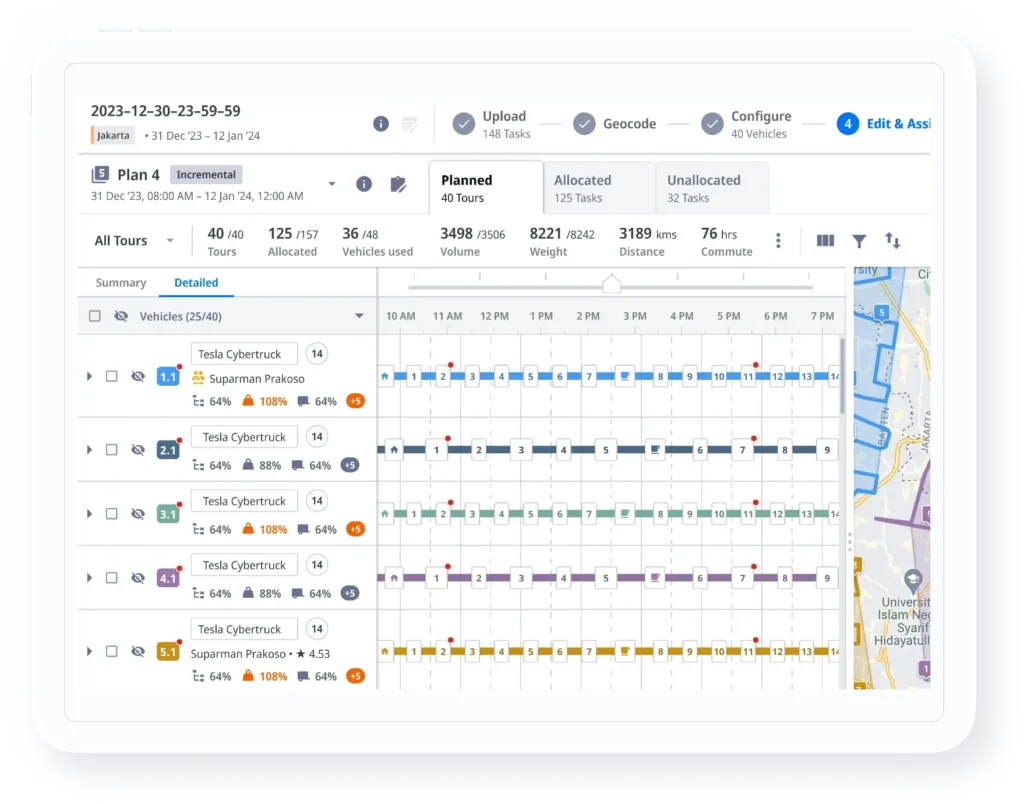
McKinsey finds AI-driven, multi-constraint routing delivers 10–25% cost reductions versus a static plan.
Where Locus is strongest is carrier delivery, last-mile, and CEP operations and multi-carrier orchestration, which is the segment this decision most often concerns. It is not a line-haul freight load board or brokerage system, and it does not provide vehicle telematics, ELD, or safety scoring; for pure FTL brokerage a freight TMS is the right category, and for vehicle safety and compliance a telematics platform is. Within its lane, Locus’s route intelligence holds G2’s #1 position for Route Planning, and it is recognized in the 2026 Gartner Hype Cycle and the QKS SPARK Matrix for TMS. In one anonymized deployment, an operation running 4,500+ drivers raised its delivery execution rate from 75% to 92% on Locus, worth $14M+ in annualized opportunity, the kind of gain autonomous dispatch and allocation produces at carrier scale.
Also Read: The End of the “Captive Fleet Only” Era: Orchestrating Hybrid Last-Mile Capacity in 2026
How to Choose
Start from your operation, not the vendor list. If you run delivery, last-mile, or CEP volume and want autonomous dispatch, allocation, and multi-carrier orchestration, an agentic TMS like Locus is the category to shortlist. If your need is narrow carrier dispatch automation, a point tool may suffice, though verify its depth. If you are a line-haul trucking or freight brokerage operation, a freight TMS fits better. And if your priority is vehicle safety and compliance, a telematics platform is the tool, often run alongside a dispatch platform rather than instead of one.
The best AI dispatch and allocation platform for a logistics carrier, then, is not a single winner for everyone; it is the one whose category matches your operation and that genuinely decides rather than merely tracks. For carrier delivery operations that want autonomous decisioning at scale, that is what Locus is built to be.
Request a Locus demo at locus.sh to see agentic dispatch and allocation on your carrier operation.
Frequently Asked Questions (FAQs)
What is the best AI dispatch and allocation platform for logistics carriers?
There is no single winner for every carrier, because the market splits into categories: agentic TMS platforms, carrier-specific point tools, freight and trucking TMS, and telematics-based platforms. For carriers running delivery, last-mile, or CEP operations that want autonomous load assignment, driver allocation, and multi-carrier orchestration, an agentic TMS such as Locus is the strongest category. Match the category to your operation.
What should a carrier look for in an AI dispatch platform?
Five criteria: agentic, autonomous decisioning rather than dispatcher-approved suggestions; intelligent load and order assignment by capacity and route fit; deep route optimization with real-time re-optimization; real-time exception handling that acts rather than just alerts; and multi-carrier and multi-fleet orchestration. A platform strong on all five runs the operation; one strong only on tracking helps run it manually.
How is an agentic TMS different from a freight TMS for carriers?
An agentic TMS such as Locus makes dispatch, allocation, and routing decisions autonomously for delivery, last-mile, and CEP operations and orchestrates across carriers. A freight TMS such as Loadstop is built for FTL and LTL line-haul, load management, and freight brokerage workflows. For pure line-haul brokerage, a freight TMS fits; for autonomous delivery dispatch and allocation, an agentic TMS does.
Do telematics platforms handle AI dispatch and allocation?
Telematics platforms such as Samsara and Geotab lead on vehicle tracking, safety, and compliance and typically offer dispatch as an add-on rather than as an autonomous decision engine. They are complementary to a dispatch platform: a carrier often runs telematics for the vehicle and safety layer and a dispatch-and-allocation platform for the operating decisions.
How does Locus handle load assignment and driver allocation?
Locus’s Dispatch agent assigns and sequences loads and orders to the best-suited driver or vehicle by capacity, service level, and route fit; its Carrier agent orchestrates across a multi-carrier network; its routing optimizes over 250+ constraints and re-optimizes in real time; and its Orchestrator agent resolves exceptions autonomously. The agents coordinate as one system, so allocation happens at scale without manual dispatch.
Is Locus suitable for FTL and LTL freight carriers?
Locus is strongest for carrier delivery, last-mile, and CEP operations and multi-carrier orchestration, and it supports multi-mode movements. It is not a line-haul freight load board or brokerage system, so a freight or trucking TMS is the better fit for pure FTL and LTL brokerage. Carriers with delivery and last-mile operations are where Locus’s agentic dispatch and allocation delivers most.


General
The Complete Guide to Rider and Driver Management for Last-Mile Logistics Operations

Aug 24, 2026
How to manage a delivery workforce spanning owned drivers, gig riders, and carrier fleets: onboarding at scale, demand-matched scheduling, exception-based performance management, and retention.
Read more
General
11 Best Routing Software for Enterprise Logistics in 2026

Aug 24, 2026
Compare the 11 best routing software platforms for enterprise logistics in 2026. Covers AI routing, dispatch orchestration, and real-time tracking.
Read moreInsights Worth Your Time




















Best AI Dispatch and Allocation Platforms for Logistics Carriers in 2026