


General
AI Agents in Transportation are not a Replacement for Strategy, They are a Test of Yours

Overview
AI agents in transportation are systems that make and execute operational decisions inside a transportation management system, as distinct from assistants that summarize information or answer questions in natural language. The distinction matters commercially, because an agent inherits whatever process it is placed inside. Where decision logic, data quality and ownership are already clear, an agent compounds that clarity. Where they are not, it moves work faster without moving the business closer to an outcome, and it makes the underlying problem harder to see because activity looks like progress. The following is a first-person account from Kevin, Director of Product Marketing at Locus, after a webinar hosted with QKS Group on the questions transportation leaders should ask before evaluating another AI agent pitch for a TMS.
Why an AI agent needs more than tasks
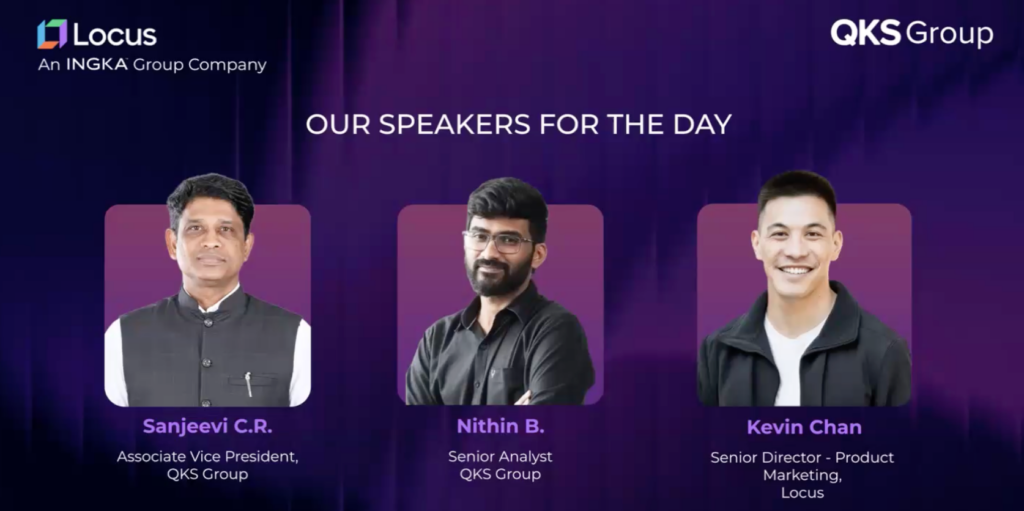
Last week, I joined QKS Group, Sanjeevi, and Nithin for my first webinar at Locus. We talked about the questions transportation leaders should ask before buying into another AI pitch for a TMS.
It was a useful conversation because “AI agent” can now mean almost anything: a workflow assistant, a chatbot (I think the fancy word for this now is “natural language processing agents”), or a system that can make and execute decisions.
Gartner has a name for the confusion this creates. It calls the rebranding of assistants, RPA and chatbots without substantial agentic capability “agent washing”, and estimates that only about 130 of the thousands of agentic AI vendors are real.
Those distinctions matter. But as we talked, I kept coming back to a more basic point:
AI agents are not a replacement for strategy. They are a test of yours.
An agent can move faster than a person. It can process more information, follow rules consistently, and handle work that would otherwise consume a team’s time.
But the goal should not be to give an agent more actions to take.
The goal is to put an agent inside a system that can consistently drive the right outcome.
That requires clarity on a few things:
- The business outcome the team is trying to improve
- The inputs an agent can trust
- The tradeoffs the business is willing to make
- The decisions an agent can own
- The moments when it needs to escalate to a person
These are not new questions. They are strategy and process questions that existed before AI.
AI just makes it much harder to avoid them.
McKinsey’s 2025 global AI survey points the same way. Among organizations seeing measurable financial impact from AI, it is redesigning workflows that has the biggest effect on EBIT, not the volume of AI deployed. The same survey found 23% of organizations scaling AI agents in at least one function while 39% were still experimenting.
In transportation, action is not the same as outcome
Transportation is full of decisions that look straightforward until conditions change.
A customer requirement conflicts with the lowest-cost option. A planner has to make a judgment call because the available data does not tell the full story.
These are not rare events. American Transport Research Institute (ATRI) finds detention of six or more hours at 39% of stops, which describes a daily operating condition rather than an exception queue that occasionally fills up.
An agent can support those decisions. In some cases, it can make them.
But it can only do that well when the business has made the underlying logic clear.
A transportation management process is more than a sequence of screens, rules, and workflows. It is how a business manages the tradeoffs between cost, service, capacity, customer commitments, and the exceptions that show up every day.
If the process is inconsistent, the data is unreliable, or ownership is vague, AI does not solve the problem. It can make the problem harder to see because the work appears to be moving.
A strong process connects individual actions to an intended business outcome. Without that connection, an agent may be able to execute the next step without helping the business get where it needs to go.
Product marketing has a version of the same problem
I see a smaller version of the same challenge in product marketing.
AI makes it much easier for a PMM team to produce work: more variations, more use cases, more content.
The harder question is whether any of it gets to a real point of view or a larger shared context: the customer problem the business is trying to solve, the role our solution should play, and the outcome that matters.
For me, that is the more useful question to bring into AI conversations. The work cannot begin and end with, “What can this tool do?”
It has to start with, “What are we trying to make better, and what system needs to exist for that to happen?”
Start with one decision, not an AI roadmap
Rather than beginning with a broad AI-agent strategy, start with one operational decision that matters.
Choose a point in the transportation workflow where the team regularly has to weigh cost, service, capacity, or customer commitments. Then make the decision logic visible.
What outcome are we optimizing for? What information is needed? What tradeoffs are acceptable? When should the decision be escalated?
That work will tell you more about whether an agent can help than a long list of potential AI use cases.
It also creates a better foundation for implementation. The process becomes clearer for the people doing the work today, whether or not an agent is involved tomorrow.
A better readiness test before the next TMS pitch
Before evaluating the next AI-agent pitch for a TMS, transportation leaders should spend as much time evaluating the work beneath it.
- Can the team explain the process clearly?
- Do they know where judgment is required?
- Are the inputs reliable?
- Are decision rights clear?
- Is the desired outcome shared across the business?
These are not new questions. They are strategy and process questions that existed before AI.
AI just makes it much harder to avoid them.
Frequently Asked Questions (FAQs)
What are AI agents in transportation?
AI agents in transportation are software systems that make and execute operational decisions within a transportation management system, such as allocating a load, resequencing a route or escalating an exception. They differ from assistants and chatbots, which retrieve information or summarize it for a person who then decides. The practical test is whether the system changes the state of the operation or only reports on it.
What is the difference between an AI agent and a chatbot in a TMS?
A chatbot, sometimes described as a natural language processing agent, interprets a question and returns an answer. An AI agent takes an action inside the workflow and is accountable for the outcome of that action. Both can be useful, but only the second changes how decisions get made, and only the second requires decision rights to be defined before deployment.
How do we know whether we are ready for AI agents in transportation?
Five questions answer it faster than a vendor evaluation: can the team explain the process clearly, do they know where human judgment is required, are the inputs reliable, are decision rights clear, and is the desired outcome shared across the business. Where the answers are vague, an agent will execute quickly against an unclear objective rather than fix it.
Should we begin with an AI roadmap or a single decision?
Begin with one operational decision that genuinely matters, typically a point in the transportation workflow where cost, service, capacity and customer commitments have to be traded off against each other. Making that decision logic explicit reveals more about whether an agent can help than a long list of candidate use cases, and it improves the process for the people doing the work today regardless of what gets automated later.
Can an AI agent fix a broken transportation process?
No, and it can make a broken process harder to diagnose. When decision logic is inconsistent, data is unreliable or ownership is unclear, an agent will still produce activity, and that activity can read as progress while the business moves no closer to the outcome it wanted. The process work has to come first, which is why an AI agent is better understood as a test of the operating model than a substitute for one.


General
TMS for European Operations in 2026: Why Four Constraints Checked in Sequence Leave You With No Plan

Sep 15, 2026
European planning carries four independent legality filters. Applied in sequence to a plan built without them, they leave 24% of candidates standing, and most of the solver's work was never legal.
Read moreInsights Worth Your Time



















AI Agents in Transportation are not a Replacement for Strategy, They are a Test of Yours