


General
The CXO’s Guide to Implementing Agentic AI for Autonomous Route Optimization


Introduction
Transportation costs represent 50–60% of total logistics spend, according to the CSCMP State of Logistics Report (2024). Yet most routing decisions still run on rule-based engines designed for a simpler era — systems that process 10–20 static constraints against networks now generating hundreds of real-time variables per hour.
The gap between what these engines can handle and what modern operations demand is widening with every new fulfillment channel, carrier relationship, and customer SLA.
The market confirms the urgency. The global AI in transportation market is valued at USD 4.61 billion (Intel Market Research, 2026), and companies deploying AI across supply chain operations report 10–15% reductions in fuel costs, 15–20% faster average delivery times, and approximately 30% fewer late shipments (McKinsey, 2025). For enterprises with complex, high-volume logistics operations across retail, FMCG, e-commerce, 3PL, and CPG, autonomous route optimization is no longer aspirational — it is the operational baseline competitors are building on.
This guide maps the technical evolution from rule-based routing through ML-optimized models to the current frontier: agentic AI systems that autonomously orchestrate routing across every mile, carrier, and constraint. It is written for supply chain heads, VPs, and transformation leaders evaluating this transition — covering how the technology works, where the business impact lands, how to govern autonomous decisions, and a step-by-step implementation roadmap.
Understanding the fundamentals of vehicle routing is essential context before examining how agentic AI transforms the entire paradigm.

Optimize Your Routes with AI
Discover how Locus’s AI-driven solutions can enhance your logistics operations across every mile, carrier, and channel.
Key Takeaways
- The constraint gap is measurable. Traditional engines handle 10–20 constraints; today’s operations generate 180–250+ real-time variables per computation. The gap shows up in cost, SLA failures, and fleet waste.
- Agentic AI acts — not just suggests. Unlike ML models that recommend routes, agentic systems autonomously decide, dispatch, and adapt across every mile, carrier, and constraint in real time.
- Governance is non-negotiable. Six mechanisms — explainability, traceability, evaluation, autonomy levels, execution sandbox, and human-in-the-loop — make agentic decisions auditable and reversible.
- Multi-lever ROI exceeds 25%. Route optimization (10–15%), carrier allocation optimization (5–10%), and fleet utilization recovery (5–8%) combine for 25–30%+ total logistics cost reduction at enterprise scale.
- Deploy in weeks, not years. Start with recommendations, measure against baseline, expand autonomous execution incrementally. Deploy alongside your existing ERP/TMS in weeks — not as a 12–24 month replacement project.
- Fresh data validates the shift. AI-powered route optimization improves on-time delivery from 82–88% to 94–97% and boosts vehicle utilization from 65–72% to 80–90% (Industry benchmarks, 2026).
Editorial Methodology
This guide synthesizes primary research from McKinsey, BCG, Gartner, the World Economic Forum, the American Transportation Research Institute, and the CSCMP State of Logistics Report. Technical benchmarks are drawn from enterprise-scale implementations processing 180–250+ constraints per computation. All cost and performance claims are attributed to named sources with publication dates. Where Locus-specific capabilities are referenced, they are presented alongside independent industry data to ensure objectivity. The implementation roadmap reflects deployment patterns validated across retail, FMCG, e-commerce, 3PL, and CPG enterprises operating in NA, EU, SEA, India, and MEA.
The Three Generations of Route Optimization
Understanding where your organization sits today is the first step toward planning the transition. Route optimization technology has evolved through three distinct generations, each defined by how it handles constraints and whether it can act on its own decisions.
Generation 1: Rule-Based Routing
Rule-based engines follow static if/then logic — predefined time windows, vehicle assignments, zone constraints — processed in overnight batch runs or at fixed intervals. These systems cannot learn from outcomes or adapt to real-time disruptions. MIT Center for Transportation & Logistics research indicates they typically handle 10–20 simultaneous constraints, and performance degrades 15–25% during disruptions because the system cannot recompute dynamically. Deloitte’s “The Future of Freight” (2024) report notes that manual route replanning takes 4–8 hours for what advanced AI computes in minutes.
The business impact is quantifiable: 20–35% of fleet capacity goes underutilized daily under manual planning (BCG logistics research), last-mile costs consume 41–53% of total supply chain spend (Capgemini Research Institute), and each failed delivery costs $12–17 in re-delivery expenses (Loqate/GBG, 2023). Rule-based routing remains deeply embedded in ERP-native TMS modules, where 12–24 month deployment cycles lock organizations into architectures built before omnichannel fulfillment existed.
For enterprises still relying on manual processes, understanding strategic route planning fundamentals reveals exactly where these static systems fall short.
Generation 2: ML-Optimized Routing
Machine learning models trained on historical delivery data represent the second generation. They consider more variables — traffic patterns, delivery time distributions, driver behavior — and improve as data accumulates. They handle 30–80 constraints depending on implementation and can re-optimize routes dynamically during the day, not just overnight. McKinsey’s “Automation in logistics” report (2023) documents 10–30% delivery cost reductions versus rule-based or manual routing.
The limitation is structural: ML models optimize but do not act. They suggest routes; a human or another system must execute. Most operate as point solutions optimizing a single leg — usually last-mile — rather than orchestrating across the full delivery journey. They cannot autonomously allocate carriers, adjust SLAs, or rebalance capacity when conditions shift.
The role of AI in supply chain decision making accelerated significantly with ML-optimized routing — but it also exposed the ceiling of suggest-only systems.
Generation 3: Agentic AI Routing
Agentic AI systems don’t just optimize routes — they orchestrate entire delivery operations. Autonomous agents decide which fulfillment node to source from, which carrier to assign, which route to execute, and how to adapt when conditions change mid-execution. Each agent specializes — route optimization, carrier allocation, SLA enforcement, cost optimization, capacity management, sustainability — and collaborates with others to produce a governed, multi-objective solution.
Also Read: The End of Static Logistics: How Real-Time Decisioning Is Redefining Supply Chains
The technical differentiator is constraint depth. Advanced agentic engines process 180–250+ real-world constraints simultaneously per computation — vehicle types, load capacities, time windows, regulatory routes, driver certifications, carrier performance scores, cost thresholds, SLA requirements, and sustainability targets evaluated in a single pass. This is a combinatorial optimization problem that scales exponentially, which is why constraint depth — not simply “using AI” — is the meaningful benchmark.
The scope is all-mile (first, mid, and last), all-channel (e-commerce, store, wholesale, returns), and all-mode (owned fleet, contracted carriers, spot market, gig economy). The American Transportation Research Institute reports 10–15% fleet fuel savings from optimized routing, while the World Economic Forum (2024) documents 10–20% carbon emissions reduction. When combined with autonomous carrier allocation and load optimization, enterprise implementations report 25–30%+ total logistics cost reductions.
Generation Comparison: Rule-Based vs. ML-Optimized vs. Agentic AI
| Feature | Rule-Based Routing | ML-Optimized Routing | Agentic AI Routing |
| Constraint Depth | 10–20 | 30–80 | 180–250+ |
| Adaptability | Static; batch processing | Dynamic suggestions | Autonomous real-time execution |
| Execution | Manual dispatch | Human-approved | Governed autonomous dispatch |
| Scope | Single leg (usually last-mile) | Single leg with re-optimization | All-mile, all-channel, all-mode |
| Deployment Timeline | 12–24 months | 6–12 months | Weeks (API-first) |
| Cost Impact | Baseline | 10–30% reduction | 25–30%+ composite reduction |
| On-Time Delivery | 82–88% | 88–93% | 94–97% |
| Vehicle Utilization | 65–72% | 72–80% | 80–90% |
What is the difference between rule-based, ML-optimized, and agentic AI routing?
Rule-based routing follows static if/then logic with 10–20 constraints and cannot adapt in real time. ML-optimized routing uses trained models handling 30–80 constraints to suggest better routes, but still requires human execution. Agentic AI routing deploys autonomous agents that process 180–250+ constraints simultaneously, making and executing decisions across carriers, routes, and SLAs in real time within governed parameters.
Revolutionize Your Vehicle Routing
Explore how advanced vehicle routing solutions streamline logistics from first mile to last — across every carrier and channel.
The Governance Imperative: Why Autonomy Without Guardrails Fails
Gartner predicts 33% of enterprise software will include agentic AI by 2028, up from less than 1% in 2024. But autonomy without governance is a non-starter for enterprise logistics. Supply chain leaders will not hand routing decisions to a system they cannot audit, explain, or override — nor should they. As CSRD Scope 3 mandates and the EU AI Act reshape compliance requirements heading into 2026 and beyond, governance is not optional infrastructure — it is a regulatory prerequisite.
Six governance mechanisms define enterprise-grade agentic routing:
- Explainability ensures every routing decision traces to the constraints and data that produced it.
- Traceability provides a complete audit trail from decision to execution — critical for EU AI Act compliance and operational post-mortems.
- Evaluation continuously measures agent decisions against business KPIs, proving the system outperforms alternatives quantifiably.
- Autonomy levels graduate control from human-approved recommendations to fully autonomous execution — the mechanism that builds organizational trust.
- Execution sandbox tests new routing strategies in controlled environments before live deployment.
- Human-in-the-loop escalation ensures the system routes edge cases and high-stakes decisions to human operators.
Organizations that build governance in from day one achieve sustainable autonomy that scales. Those that skip it deploy faster but fail faster.
How do you govern agentic AI in logistics?
Enterprise-grade agentic AI governance requires six mechanisms: explainability (why each decision was made), traceability (audit trail from decision to execution), evaluation (continuous KPI measurement), autonomy levels (graduated control from recommendations to full autonomy), execution sandbox (testing before live deployment), and human-in-the-loop escalation for edge cases.
Business Impact: Mapping Autonomous Route Optimization to P&L Outcomes
Delivery cost reduction. AI-driven route optimization delivers 10–30% cost reductions depending on network complexity (McKinsey, 2023). When combined with autonomous carrier allocation and dynamic load optimization across all miles, composite savings at enterprise scale consistently exceed 20%.
DHL internal benchmarks (2026) confirm a 12% reduction in total transportation spend from AI-powered route optimization alone — before factoring in carrier allocation and load consolidation gains. And Gartner’s 2025 supply chain technology survey reports that companies using AI-powered dynamic routing achieve an average 10–15% reduction in fuel costs, a figure that compounds across enterprise-scale fleets.
Fleet utilization recovery. Reclaiming even a portion of the 20–35% daily underutilized fleet capacity (BCG) through real-time re-optimization translates directly to margin. For 3PLs operating on 3–8% net margins (Armstrong & Associates), each utilization point recovered is material. Automated route planning is the operational mechanism that converts idle capacity into revenue.
Also Read: Why Execution, Not Planning, Is Becoming the New Competitive Advantage in Logistics
SLA resilience under stress. Instead of the typical 15–25% SLA degradation during peak surges or disruptions, governed agentic systems maintain performance by continuously adapting — rerouting shipments, reallocating carriers, and adjusting time windows within SLA boundaries in real time.
Measurable sustainability impact. Route optimization reduces fleet carbon emissions by 10–20% (World Economic Forum, 2024). Agentic systems optimize for sustainability as a constraint alongside cost and SLA — not as a separate reporting initiative. This matters as CSRD Scope 3 mandates take effect and enterprises face increasing pressure to document emissions reductions across their logistics networks heading into 2026.
Market acceleration. The autonomous last-mile delivery market is estimated at USD 1.3 billion (Global Market Insights, 2025) and projected to reach USD 49.23 billion (Research and Markets, 2026) as enterprises accelerate adoption. For organizations managing multi-country engagements, autonomous route optimization scales the same governed logic across geographies without replicating planning teams.
What is the ROI of agentic AI in route optimization?
Agentic AI route optimization delivers multi-lever ROI: 10–30% delivery cost reduction (McKinsey, 2023), recovery of 20–35% underutilized fleet capacity (BCG), maintained SLA adherence during peak surges, 10–20% carbon emissions reduction (WEF, 2024), and deployment in weeks via API-first architecture alongside existing ERP/TMS systems.
Implementation Roadmap: A Step-by-Step Guide
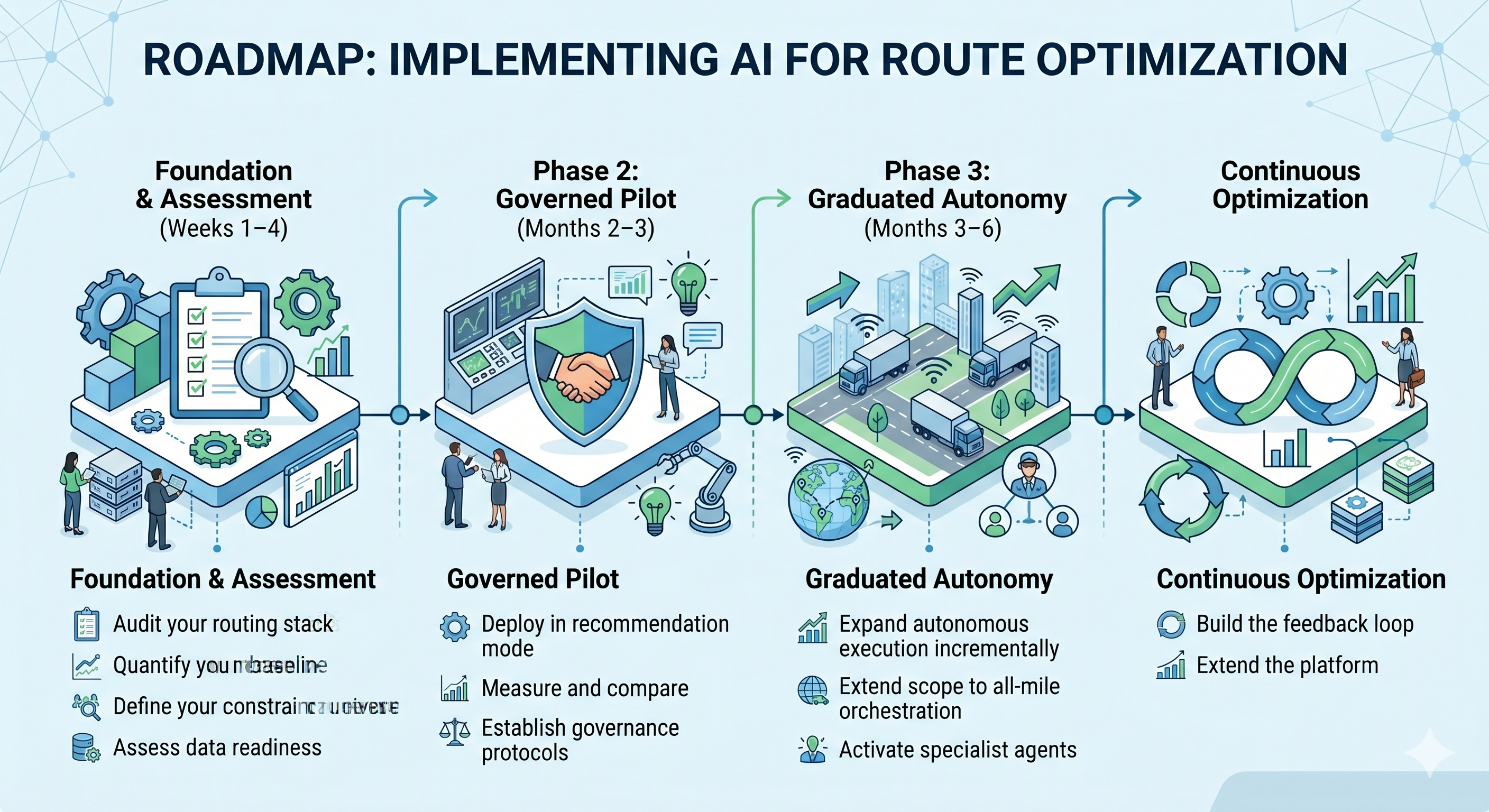
The following four-phase approach mirrors the graduated autonomy philosophy that separates successful agentic AI deployments from failed ones. The principle: start narrow, prove value, expand scope.
Phase 1: Foundation & Assessment (Weeks 1–4)
Audit your routing stack. Map every system touching route planning, dispatch, carrier management, and delivery execution. Identify where rule-based logic lives and where manual intervention fills the gaps.
Quantify your baseline. Measure current cost-per-delivery, fleet utilization rate, SLA adherence, and carrier allocation efficiency across lanes and regions. Without a baseline, you cannot prove ROI.
Define your constraint universe. Document every operational constraint your routing must respect — vehicle types, time windows, load limits, driver certifications, regulatory restrictions, carrier preferences, customer SLAs. Most organizations discover 80–150+ active constraints; their rule engine is processing 10–20 of them.
Assess data readiness. Agentic systems need real-time data feeds — carrier APIs, GPS/telematics, traffic, weather, order management systems. Map integration requirements and identify gaps.
Phase 2: Governed Pilot (Months 2–3)
Deploy in recommendation mode. Start the agentic system alongside your existing routing — it suggests optimized routes and carrier allocations, but humans approve and execute. This is the trust-building phase.
Measure and compare. Run A/B comparisons between existing routing and AI-recommended routing on matched lanes. Quantify the delta on cost, SLA adherence, utilization, and planning time.
Establish governance protocols. Implement explainability dashboards, decision audit trails, and escalation workflows before expanding autonomy. Define which decision types require human approval and which qualify for autonomous execution.
Phase 3: Graduated Autonomy (Months 3–6)
Expand autonomous execution incrementally. Move from recommendation mode to autonomous execution on proven lanes, carrier relationships, and decision types. Maintain human-in-the-loop for edge cases and new scenarios.
Extend scope to all-mile orchestration. Expand from last-mile to first-mile and mid-mile. Integrate additional carrier networks. Each expansion follows the same pilot ? measure ? graduate pattern. Achieving last mile excellence is often the proving ground before extending autonomous capabilities upstream.
Activate specialist agents. As the platform matures, deploy specialized agents for distinct optimization objectives — route optimization, carrier allocation, SLA enforcement, cost optimization, sustainability, compliance. These agents collaborate to produce multi-objective solutions governed by your business rules.
Phase 4: Continuous Optimization (Ongoing)
Build the feedback loop. Every delivery generates training data. Agentic systems improve continuously as they process more operational context. Establish KPI dashboards tracking agent performance, decision quality, and business outcomes over time.
Extend the platform. The system should function as a software factory — extensible via custom workflows, third-party integrations, and business-rule configurations that evolve with your operations. Your data becomes context. Your context becomes capability. As organizations scale into 2026 and beyond, supply chain network design becomes the strategic layer that autonomous route optimization continuously refines.
How do you implement agentic AI for route optimization?
Implementation follows four phases: (1) Foundation — audit your routing stack, quantify baselines, and map your constraint universe (weeks 1–4). (2) Governed Pilot — deploy in recommendation mode alongside existing systems and measure performance deltas (months 2–3). (3) Graduated Autonomy — expand autonomous execution incrementally on proven lanes, then extend to all-mile scope (months 3–6). (4) Continuous Optimization — build feedback loops and extend the platform as a configurable software factory.
Benefits of Autonomous Route Optimization
The business case for autonomous route optimization extends beyond cost reduction. Enterprises with complex, high-volume logistics operations across retail, FMCG, e-commerce, 3PL, and CPG realize compounding advantages across six dimensions:
1. Compounding Cost Reduction Individual levers — route efficiency, carrier allocation, load consolidation — each contribute 5–15% savings. When orchestrated by agentic AI operating across all miles and channels simultaneously, these compound to 25–30%+ total logistics cost reductions. DHL benchmarks confirm 12% transportation spend reduction from routing alone.
2. Operational Resilience Static systems degrade 15–25% during disruptions. Autonomous systems reroute, reallocate, and re-optimize in real time. The result: SLA performance that holds under peak surges, weather disruptions, and carrier failures without manual intervention.
3. Capacity Monetization Recovering underutilized fleet capacity (20–35% daily waste under manual planning per BCG) converts fixed costs into revenue. For 3PLs operating on 3–8% net margins, each utilization point recovered is a material margin event.
4. Speed-to-Decision What takes manual planning teams 4–8 hours, agentic AI computes in minutes. This is not just efficiency — it is the ability to respond to same-day order changes, carrier failures, and demand spikes at the speed operations require.
5. Sustainability as an Operational Constraint Route optimization reduces fleet carbon emissions 10–20% (WEF, 2024). Autonomous systems treat sustainability as a first-class optimization variable alongside cost and SLA — embedding emissions reduction into every dispatch decision, not relegating it to a quarterly report.
6. Scalability Without Linear Headcount Growth Autonomous route optimization scales across new geographies, channels, and carrier networks without proportionally scaling planning headcount. The same governed AI that optimizes 1,000 deliveries per day operates at 100,000 with configuration — not re-architecture.
Key Features of Enterprise-Grade Autonomous Route Optimization
Not all AI routing platforms qualify as enterprise-grade. The following capabilities separate agentic orchestration from point-solution optimization:
Multi-Constraint Processing (180–250+ Variables) The system must evaluate vehicle types, load capacities, time windows, regulatory routes, driver certifications, carrier performance scores, cost thresholds, SLA requirements, and sustainability targets in a single computation pass. Constraint depth — not marketing claims about “AI” — is the technical benchmark.
All-Mile, All-Channel, All-Mode Orchestration Autonomous route optimization must span first-mile pickup, mid-mile linehaul, and last-mile delivery across e-commerce, store, wholesale, and returns channels — coordinating owned fleets, contracted carriers, spot market, and gig economy simultaneously.
Governed Autonomy Framework Six mechanisms are non-negotiable: explainability, traceability, evaluation, graduated autonomy levels, execution sandbox, and human-in-the-loop escalation. Without this framework, autonomous execution is a liability.
API-First Integration Architecture The platform deploys above existing ERP/TMS systems (SAP, Oracle, and others) via APIs — not as a 12–24 month rip-and-replace project. Data flows bidirectionally: ingesting operational data, optimizing in real time, and pushing decisions back into existing workflows.
Specialist Agent Collaboration Distinct agents for route optimization, carrier allocation, SLA enforcement, cost optimization, sustainability, and compliance operate independently but collaborate to produce multi-objective solutions. This architecture mirrors how real logistics decisions involve competing priorities resolved through trade-off logic.
Dynamic Rerouting and Real-Time Adaptation The system must adapt mid-execution — rerouting shipments around traffic, carrier failures, and demand spikes without human intervention. AI-powered route optimization improves on-time delivery from 82–88% to 94–97% (Industry benchmarks, 2026) specifically because of this real-time adaptability.
Continuous Learning from Operational Data Every delivery generates training data. The system must improve its constraint models, carrier performance predictions, and route efficiency calculations continuously — not through periodic retraining cycles.
Why Locus for Autonomous Route Optimization
Locus is the AI-powered logistics orchestration platform trusted by 360+ enterprises in retail, FMCG, e-commerce, 3PL, and CPG globally — operating across NA, EU, SEA, India, and MEA.
Purpose-built constraint engine. Locus processes 180–250+ real-world constraints per computation, spanning vehicle specifications, carrier SLAs, regulatory requirements, sustainability targets, and customer preferences in a single optimization pass.
Agentic AI architecture. Specialist agents for route optimization, carrier allocation, SLA enforcement, and cost optimization collaborate within a governed framework — delivering autonomous execution with full explainability, traceability, and human-in-the-loop escalation.
Weeks to deploy, not years. API-first architecture integrates above existing SAP, Oracle, and other ERP/TMS environments. Enterprises deploy in recommendation mode within weeks and graduate to autonomous execution incrementally — preserving technology investments while unlocking autonomous capabilities.
All-mile orchestration at enterprise scale. From first-mile pickup through mid-mile linehaul to last-mile delivery, Locus orchestrates across owned fleets, contracted carriers, spot markets, and gig economy networks — unified under a single decision engine.
Proven P&L impact. Enterprise implementations consistently deliver 25–30%+ total logistics cost reductions through composite savings across route efficiency, carrier allocation, fleet utilization, and failed-delivery elimination. See case studies ?
Governance built in from day one. Explainability dashboards, decision audit trails, autonomy level controls, execution sandboxes, and escalation workflows meet EU AI Act and CSRD Scope 3 compliance requirements without bolt-on additions.
The Transition Is Underway
The shift from rule-based routing to agentic AI is not a technology upgrade — it is an operational model change. Rule engines plan but cannot act. ML models suggest but cannot orchestrate. Agentic systems decide, dispatch, and deliver within governed constraints, across every mile, carrier, and channel.
The organizations that move first will compound advantages in cost, SLA performance, carrier relationships, and sustainability metrics that late movers cannot replicate quickly. With the global AI in transportation market at USD 4.61 billion and accelerating into 2026, the implementation path is clear: assess your constraint universe, deploy with governance from day one, graduate autonomy incrementally, and choose a platform built for orchestration at enterprise scale.
The question for supply chain leadership is no longer whether agentic AI will transform autonomous route optimization. It is whether your organization will be operating it — or competing against those who are.
Achieve Last Mile Excellence
See how enterprises with complex, high-volume logistics operations use Locus to orchestrate autonomous route optimization across retail, FMCG, e-commerce, 3PL, and CPG — globally.
Frequently Asked Questions (FAQs)
What is agentic AI in logistics and how does it differ from traditional AI?
For enterprises with complex, high-volume logistics operations, agentic AI refers to autonomous AI agents that perceive real-time operational conditions, reason against business constraints, make decisions, and execute actions — without waiting for human instruction. Unlike traditional ML models that analyze data and suggest optimal routes for human approval, agentic systems autonomously dispatch, reroute, and reallocate carriers within governed parameters. The distinction is agency: the system acts within defined boundaries, processing 180–250+ constraints simultaneously, rather than producing recommendations that require manual execution. This is especially valuable in sectors like retail, FMCG, e-commerce, 3PL, and CPG operating globally.
What is autonomous route optimization?
Autonomous route optimization uses AI, machine learning, and real-time data to compute optimal delivery paths while autonomously executing dispatch, carrier allocation, and mid-route adjustments. It integrates optimization models like the Vehicle Routing Problem (VRP) with advanced heuristics and metaheuristics — including Ant Colony Optimization (ACO) and Particle Swarm Optimization (PSO) — to solve multi-constraint logistics problems at enterprise scale. Unlike static or suggest-only systems, autonomous route optimization acts on its own decisions within governed parameters, processing live traffic, vehicle status, carrier performance, and customer SLAs simultaneously.
How much can agentic AI reduce delivery and logistics costs?
Enterprise-scale agentic route optimization delivers multi-lever cost reductions. McKinsey’s “Automation in logistics” (2023) documents 10–30% delivery cost reductions from AI-driven routing. When combined with autonomous carrier allocation and fleet utilization recovery, total logistics cost reductions of 25–30% are achievable. Additional savings include 10–15% fleet fuel reduction (American Transportation Research Institute), 12% total transportation spend reduction (DHL internal benchmarks, 2026), and elimination of the $12–17 per-delivery cost of failed deliveries (Loqate/GBG, 2023).
What are autonomy levels in agentic AI logistics systems?
Autonomy levels define the graduated spectrum of control between full human oversight and full autonomous execution. In a logistics context, this starts with recommendation mode (the AI suggests routes and carrier allocations, humans approve), progresses to supervised autonomy (the AI executes routine decisions, humans review exceptions), and advances to full autonomy (the AI operates independently within governed constraints with human-in-the-loop escalation for edge cases). This graduated approach builds organizational trust and reduces deployment risk.
How does dynamic route adjustment work in autonomous vehicles and fleet operations?
Dynamic route adjustment uses real-time data — traffic conditions, road closures, carrier failures, weather events — combined with machine learning to reroute shipments mid-execution. Cloud-based platforms analyze historical patterns, vehicle capacities, and live operational signals to re-optimize routes without manual intervention. This capability is why AI-powered route optimization improves on-time delivery from 82–88% to 94–97% (Industry benchmarks, 2026), consistently outperforming static planning — especially during peak surges and disruptions.
Can agentic AI routing platforms integrate with existing ERP systems like SAP and Oracle?
Yes. Modern agentic routing platforms are built with API-first architecture specifically to deploy above existing ERP and TMS systems. Rather than requiring a 12–24 month rip-and-replace implementation, these platforms function as an agile execution layer — ingesting data from your existing SAP or Oracle environment, optimizing routing and carrier allocation in real time, and pushing decisions back into your operational workflow. Leading implementations deploy in weeks to months while preserving existing technology investments.
How do you ensure governance and compliance with autonomous AI routing decisions?
Enterprise-grade agentic routing requires six governance mechanisms: explainability (tracing every decision to its inputs and constraints), traceability (complete audit trails from decision to delivery), evaluation (continuous performance measurement against KPIs), autonomy levels (graduated control spectrum), execution sandbox (testing strategies before live deployment), and human-in-the-loop escalation (routing edge cases to human operators). These mechanisms are increasingly a regulatory requirement — the EU AI Act mandates transparency and auditability for AI systems in operational decision-making.
How long does it take to implement agentic AI for route optimization?
Implementation follows a four-phase approach spanning approximately six months to full autonomous operation. Phase 1 (weeks 1–4) covers foundation and assessment — auditing your routing stack, establishing baselines, and mapping your constraint universe. Phase 2 (months 2–3) deploys a governed pilot in recommendation mode alongside existing systems. Phase 3 (months 3–6) graduates to autonomous execution incrementally across proven lanes and expands to all-mile scope. Phase 4 is ongoing continuous optimization as the system processes more operational data. API-first platforms enable this timeline by deploying above your existing ERP/TMS rather than replacing it.
What is the future of autonomous route optimization in 2026?
By 2026, AI-driven autonomous route optimization is prioritizing sustainability (EV-optimized routing, emissions-as-constraint), predictive analytics for demand forecasting, and global fleet unification through V2X communication and advanced sensor fusion. The global AI in transportation market has reached USD 4.61 billion (Intel Market Research, 2026), and innovations like NVIDIA cuOpt enable near-real-time fleet-scale adaptation. Enterprises adopting governed agentic systems now are compounding data advantages — operational context, carrier performance models, and constraint refinements — that late movers will take years to replicate.
What algorithms power autonomous route optimization?
Enterprise-grade autonomous route optimization combines multiple algorithmic approaches: exact methods (Dijkstra’s, A*) for shortest-path calculations; metaheuristics (Ant Colony Optimization, Particle Swarm Optimization) for complex multi-constraint VRP problems; and deep learning for predictive components like demand forecasting and ETA estimation. Agentic AI platforms layer these with constraint satisfaction engines, multi-objective optimization solvers, and reinforcement learning for continuous improvement. The critical differentiator is not any single algorithm but the orchestration layer that coordinates specialist agents — each using appropriate methods — to produce governed, multi-objective solutions in real time.


General
AI Capacity Planning: How Predictive Intelligence Is Reshaping Peak Season Logistics

Apr 17, 2026
Learn how ML-powered demand forecasting and dynamic carrier orchestration help logistics operators cut peak season costs, protect SLAs, and optimize fleet utilization through constraint-governed optimization.
Read more
General
The Hidden Cost of Failed ETA Promises: How AI Routing Breaks the 95% Accuracy Barrier

Apr 17, 2026
Inaccurate delivery ETAs cost enterprises millions annually through customer churn, re-delivery costs, and support overhead. Learn how ML-powered routing achieves 95%+ ETA accuracy.
Read moreInsights Worth Your Time


















The CXO’s Guide to Implementing Agentic AI for Autonomous Route Optimization